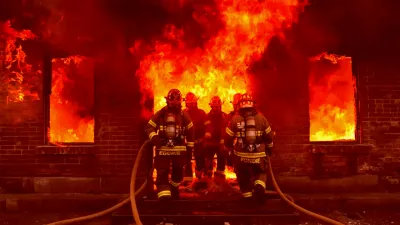

In a harrowing reminder of nature's unpredictability, the Wolf Fire rapidly spread across more than 1,000 acres near Banning, California, igniting a sense of urgency among local residents and emergency responders alike. With flames licking at the edges of dry brush and rugged terrain, the fire's ferocity has prompted immediate evacuations and a massive response from firefighting teams. As the sun set on a seemingly ordinary day, the smoke billowed into the sky, painting a stark picture of the challenges that lay ahead for both firefighters and community members.
The Wolf Fire ignited late in the afternoon, fueled by strong winds and dry conditions that have plagued the region. Firefighters were deployed almost immediately, with aerial support quickly mobilized to combat the flames from above. Despite their early intervention, the fire’s rapid growth overwhelmed initial containment efforts, forcing officials to issue evacuation orders for nearby neighborhoods. "We’re not just fighting fire; we’re fighting for the safety of our community," remarked a local fire chief, encapsulating the emotional toll this incident has taken on those on the front lines.
Evacuations and Community Response
As the fire surged, residents in the vicinity were urged to evacuate as a precautionary measure. Local authorities organized evacuation centers, providing shelter and support for those displaced by the flames. Community members rallied together, offering assistance to their neighbors by sharing resources and information. The spirit of solidarity was palpable, as families came together in the face of adversity, reinforcing the idea that in times of crisis, unity can shine through the darkness.
The evacuation orders were not made lightly; officials emphasized the need for safety above all else. Many residents expressed their concerns about leaving their homes behind, torn between the desire to protect their property and the imperative to heed the warnings of authorities. “It’s heartbreaking to leave everything behind, but I know it’s for the best,” said one evacuee, her voice trembling with emotion as she packed her belongings. “I just hope we have a home to return to.”
Firefighting Efforts and Challenges
As the Wolf Fire raged on, the firefighting teams faced numerous challenges that made containment efforts particularly difficult. The rugged terrain of the San Jacinto Mountains, coupled with the high winds, created a volatile environment for the brave men and women battling the blaze. Firefighters utilized both ground and aerial tactics to combat the flames, employing helicopters and air tankers to drop water and retardant on the most active areas of the fire.
Despite their best efforts, the fire's rapid spread forced containment lines to be adjusted multiple times throughout the day. Fire officials reported that the blaze was fueled by a combination of dry vegetation, steep slopes, and shifting winds, which complicated their strategies. “Every time we think we have a handle on it, the fire surprises us,” said an incident commander, highlighting the unpredictable nature of wildfire behavior. “We’re doing everything we can to protect lives and property, but nature has its own plans.”
As the evening progressed, the intensity of the fire showed no signs of waning. Firefighters continued to work tirelessly, often under the cover of darkness, utilizing the night to gain ground against the encroaching flames. The community watched anxiously as the fire illuminated the night sky, a stark reminder of the power of nature and the fragility of human life and property. Each flare of light brought with it a wave of fear, yet also a collective hope that the resolve of the firefighting crews would prevail.
In addition to the immediate concerns of life and property, the Wolf Fire also raised questions about the long-term impact on the environment. The scorched earth, once teeming with life, now stands as a stark reminder of the fierce battle waged against the flames. Ecologists and environmentalists are already voicing concerns about the potential repercussions on local wildlife and the ecosystem. “Every fire has its own story, and the aftermath can be just as devastating as the flames themselves,” remarked a local environmental scientist. “We need to be prepared for the long-term effects of this fire, not just on our homes but on our natural habitats.”
Community Resilience and Recovery
As dawn broke over the charred landscape, the community began to assess the damage and plan for recovery. Many evacuees returned to their neighborhoods, facing the sobering reality of loss and destruction. The local government, in conjunction with emergency services, launched recovery efforts aimed at helping residents rebuild their lives. “We will stand together as a community to help each other through this,” said the mayor of Banning, addressing the gathered crowd of concerned citizens. “We will not let this fire define us.”
Support also poured in from neighboring cities and organizations, with volunteers stepping up to provide aid and comfort to those affected. Donations of food, clothing, and essential supplies flooded into donation centers, showcasing the resilience of the human spirit in the face of disaster. “It’s incredible to see everyone come together like this,” said a local resident who volunteered at a donation center. “We may have lost a lot, but we haven’t lost our compassion for one another.”
The Wolf Fire is far from over, with containment efforts continuing as crews work to secure the perimeter and prevent any reignition. Fire officials remain vigilant, prepared to adapt their strategies as needed in the face of changing conditions. The community remains hopeful, united in their determination to rise from the ashes and rebuild stronger than before. As the smoke slowly clears, the true extent of the battle fought against the Wolf Fire will emerge, revealing not only the scars left behind but also the strength and resolve of a community that refuses to back down in the face of adversity.
In the end, the Wolf Fire serves as a poignant reminder of the delicate balance between humanity and nature, a call to action for preparedness in the face of such unpredictable events. The fire may have consumed the land, but it has also ignited a flame of resilience within the hearts of those affected, a testament to the enduring spirit of a community that will rise again.