Why Wildland Fire Investigation Is a Specialized Discipline
Wildland fire investigation occupies a distinct branch of U.S. fire science, separate from structural fire investigation in methodology, environment, and physical evidence. Fires burning across brush, forest, and grassland do not leave the same artifact-rich evidence base as structure fires — there are no walls, no melted appliances, and no circuit panels to examine. Instead, investigators read the landscape itself: the angles of burned grass stems, the height of char on tree bark, the depth of ash in a fuel bed, and the survival patterns of unburned islands within a larger burn.
Federal agencies including the U.S. Forest Service (USFS) and Bureau of Land Management (BLM) have developed formalized investigation protocols based on the NWCG Fire Investigations Guide (PMS 412), the primary methodological standard for wildland fire origin and cause determination in the United States. State agencies, tribal fire programs, and cooperating local jurisdictions increasingly align their procedures with PMS 412 to ensure consistent, legally defensible investigation outcomes.
The Legal and Operational Stakes
Wildland fire investigation outcomes have direct consequences in several areas. In cases involving intentional ignition — arson — criminal prosecution depends on a documented chain of evidence that identifies both origin and cause to a legally admissible standard. Civil litigation involving power line contacts, railroad sparks, or equipment-caused fires involves significant liability for utilities, contractors, and landowners. Prevention and mitigation planning — determining which human activities and infrastructure failures are responsible for ignitions in specific geographic areas — requires accurate, long-term cause data.
As wildfire frequency and severity increase across the western United States, the demand for qualified wildland fire investigators continues to grow. The NWCG defines investigator qualification levels through its training curriculum, including the INVF (Fire Investigator) position and the more advanced INVT (Fire Investigation Team Leader) qualification, both of which require documented training, field experience, and periodic re-qualification.
Step 1: Initial Scene Assessment and Safety
Before any investigative work begins, the scene must be safe for entry. Active fire, falling snags, unstable terrain, and residual smoke all create hazards that must be managed. Investigators typically cannot access a scene until Incident Command confirms the area is controlled or a safe access corridor is established.
The initial scene assessment establishes a working hypothesis for the area of origin — the geographic zone within which the ignition most likely occurred. This hypothesis is informed by:
- Fire perimeter maps and aerial photography from suppression operations
- Witness accounts from the public, first responders, or aerial observers who reported the fire
- Dispatch records and initial attack reports noting the fire's reported location and initial spread direction
- Satellite and remote sensing data, including MODIS and VIIRS thermal anomaly detections, which can place fire location and ignition timing within a narrow window
This working hypothesis is treated as provisional — physical evidence encountered during the investigation may shift the area of origin determination significantly.
Step 2: Reading Burn Indicators
Burn indicators are the foundational evidence of wildland fire investigation. They are physical signs within the burn area that record fire travel direction, intensity, and timing. Investigators are trained to read these indicators systematically, moving from the fire's exterior perimeter inward toward the area of origin.
Grass and Fine Fuel Indicators
Grass stem lean is one of the most reliable directional indicators in grass and brush fires. As fire moves through standing grass, radiant heat and flame contact cause stems to lean in the direction of fire travel. Investigators read stem lean angles across a transect to map fire movement vectors. Where stems radiate outward in multiple directions — the classic starburst pattern — this signals the point of origin.
Cupping refers to the curling of grass stems or leaves around the point of maximum heat exposure. Stems tend to curl toward the fire's direction of approach. Ash fall patterns can also indicate wind direction during burning, providing a cross-reference against weather records.
Timber and Woody Fuel Indicators
Char height on tree trunks correlates with fire intensity and travel direction — char is typically higher on the side of the tree facing the direction from which the fire came, particularly in uphill or wind-driven runs. Branch and needle scorch patterns reflect radiant and convective heat vectors.
Catfacing — localized, deep char on the base of a tree — often indicates a sustained heat source at ground level at that location, which can be significant when investigating possible ignition points near structures, roads, or equipment use areas.
Soil and Mineral Indicators
Soil color changes reflect heat exposure: reddish or pinkish discoloration of mineral soil indicates high-temperature burning. Spalling — the flaking or fracturing of rocks — occurs where moisture trapped in rock is rapidly vaporized by heat, and its pattern can suggest fire direction.
Protection patterns — unburned areas sheltered on the lee side of rocks, logs, or other objects — confirm fire travel direction. The object acts as a heat shield; the unburned zone is on the side away from the fire's approach.
Step 3: Locating the Point of Origin
Using burn indicators, investigators work systematically from the fire perimeter inward, mapping direction arrows on a field diagram as they go. The area of convergence — where the directional arrows point toward — defines the narrowed area of origin. Within this area, investigators perform a careful surface examination to identify the point of origin: the specific location where ignition occurred.
Physical characteristics of the point of origin in wildland fires often include:
- Shallower ash depth compared to adjacent areas (the fire burned outward, consuming fuel away from the origin rather than toward it)
- Unburned or partially burned fuel directly at the ignition point in some scenarios (particularly in low-wind, low-slope ignitions where fire spread slowly outward)
- Grass stems angling outward from a central point
- Presence of ignition-related physical evidence — cigarettes, matches, hot metal fragments, arc sites on conductors, or campfire ring remnants
Locating the point of origin does not automatically identify the cause. It identifies the location where the investigative search for causal evidence is concentrated.
Step 4: Common Ignition Sources
Wildland fire investigators classify ignition sources into several major categories. Determining which category applies — and then identifying the specific source within that category — is the central task after origin is established.
Lightning
Lightning strikes are the leading natural ignition source for wildland fires. Investigation involves cross-referencing the identified point of origin with lightning strike data from services such as the National Lightning Detection Network (NLDN). A confirmed strike at or near the point of origin, with no other plausible ignition source present, typically supports a lightning cause determination. Fire managers note that lightning fires can smolder for hours or days before becoming active, particularly in heavy woody fuels and duff.
Powerline Contact and Equipment
Powerline-caused fires involve arc sites on conductors, damaged insulators, vegetation contact, or equipment failure that causes electrical discharge to ground-level fuel. Evidence includes melted conductor bead sites beneath the line, damaged or burned crossarms, trip records from utility SCADA systems, and vegetation encroachment patterns. These investigations frequently involve coordination with utility companies and may result in civil litigation.
Equipment-caused fires — from mowing, grinding, welding, chainsaw use, or vehicle operation — often leave metal spark or slag fragments near the origin point. Investigators examine equipment used in the area prior to ignition and may submit metal fragments for metallurgical analysis to confirm a match.
Human Activity — Campfires, Smoking, and Debris Burning
Improperly extinguished campfires, carelessly discarded cigarettes, and debris burning that escapes containment are among the most common human-caused ignition sources. Evidence includes fire ring remnants, cigarette butts (submitted to a lab for tobacco DNA analysis in serious cases), and burn pile remnants. Witness interviews are particularly important in this category, as direct observation of the activity is often the strongest evidence available.
Arson
Intentionally set wildland fires may involve accelerants, mechanical igniters, delay devices, or simple open flame. Physical evidence of incendiary devices — wire, batteries, matches in unusual configurations, accelerant residue detected by canine or laboratory GC-MS analysis — supports an arson determination. Multiple points of origin within a single fire perimeter, or a pattern of fires within a geographic area, are significant arson indicators. These investigations are conducted in coordination with law enforcement.
Step 5: Weather Data and Fire Behavior Analysis
Weather conditions at and before ignition are a critical investigative component. Investigators obtain certified weather records from the nearest Remote Automated Weather Station (RAWS), the National Weather Service, and utility weather systems where available. Key parameters include:
- Wind speed and direction — both at ignition and during the fire's growth phase
- Relative humidity — low humidity desiccates fuels and reduces ignition threshold
- Temperature — high temperatures increase fine fuel moisture loss
- Drought indices — the Keetch-Byram Drought Index (KBDI) and Energy Release Component (ERC) quantify cumulative drying of fuels
- Precipitation history — antecedent rainfall determines dead fuel moisture levels
Weather data is used to confirm fire behavior plausibility. A proposed ignition source must be consistent with the fire's actual behavior: a single dropped cigarette in conditions of 8% relative humidity, 25-mph wind, and an ERC of 80 is far more plausible than the same source in 45% humidity with calm winds. Fire behavior modeling tools such as BehavePlus or FARSITE can be used to reconstruct probable fire spread from the proposed ignition point and compare it to the actual burn perimeter.
Step 6: Evidence Collection in Wildland Environments
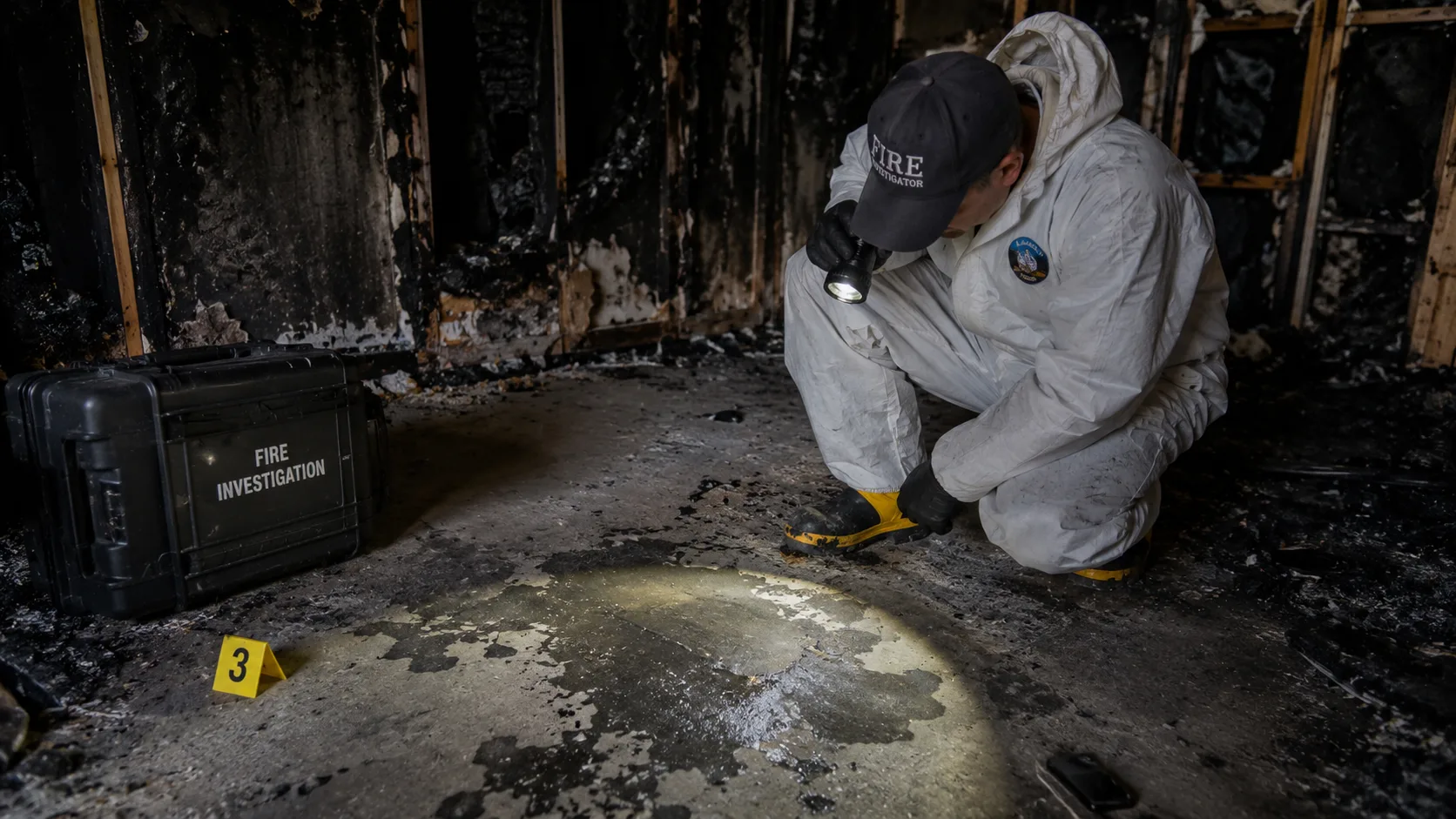
Physical evidence collection at wildland fire scenes follows the same chain-of-custody principles as structural fire investigation, but with additional challenges imposed by the environment.
Soil and fuel samples from the point of origin are collected in clean, sealed containers — glass jars for samples that may contain accelerant residue, paper bags for other combustible debris. Investigators photograph the point of origin in detail before disturbing any physical evidence and establish fixed reference points for scaled mapping.
Metal fragments, electrical components, or other physical objects found at the point of origin are photographed in place, measured to reference points, and collected with non-contaminating tools. In cases involving suspected arson or powerline contact, samples may be submitted to certified fire investigation laboratories for accelerant screening, metallurgical analysis, or trace evidence examination.
Witness and first responder interviews should be conducted early, before memories fade. Open-ended questions about what was seen, where the fire was first observed, and what activities were occurring in the area prior to the fire provide critical contextual data. Digital evidence — social media posts, GPS tracks from nearby hikers, dashcam footage from roads adjacent to the fire — is increasingly valuable and time-sensitive.
Challenges Unique to Wildland Investigation
Wildland fire scenes present preservation challenges that have no structural equivalent. Active suppression operations — including bulldozer lines, retardant drops, and hand line construction — may run directly through the area of origin before investigators arrive. Wind disperses ash and fine debris. Rain events between ignition and investigation access can erase grass stem indicators entirely. Animal activity disturbs soil samples.
This requires investigators to work rapidly and to document the state of the evidence at the time of collection, noting any known disturbances. When a bulldozer line has been cut through the suspected origin area, investigators work the dozer spoil piles — excavated material pushed aside — as well as the intact terrain on either side of the line. Evidence of origin can often be reconstructed from these secondary locations.
For Fire Science Students and New Investigators
Wildland fire investigation competency requires both classroom training and supervised field experience. Priority foundational skills include:
- Reading and mapping burn indicators across varying fuel types — grass, brush, timber, and mixed fuels
- Understanding fire weather and fuel moisture fundamentals, including the fire environment triangle
- Familiarity with the PMS 412 documentation requirements: origin diagrams, photo logs, cause classification worksheets
- Evidence collection chain-of-custody procedures as applied to field environments
- Coordination protocols with law enforcement for arson investigations and civil cases
Field exercises at controlled burn sites, tabletop origin-and-cause scenarios, and mentored investigation of real fires under qualified supervision are the most effective pathways to building reliable investigator judgment.


Comments 0
No comments yet. Be the first to share your thoughts!
Leave a Comment