
Fire Hose Friction Loss Explained – Quick Method, Worked Examples & Pump Ops Cheat Sheet
Last updated:
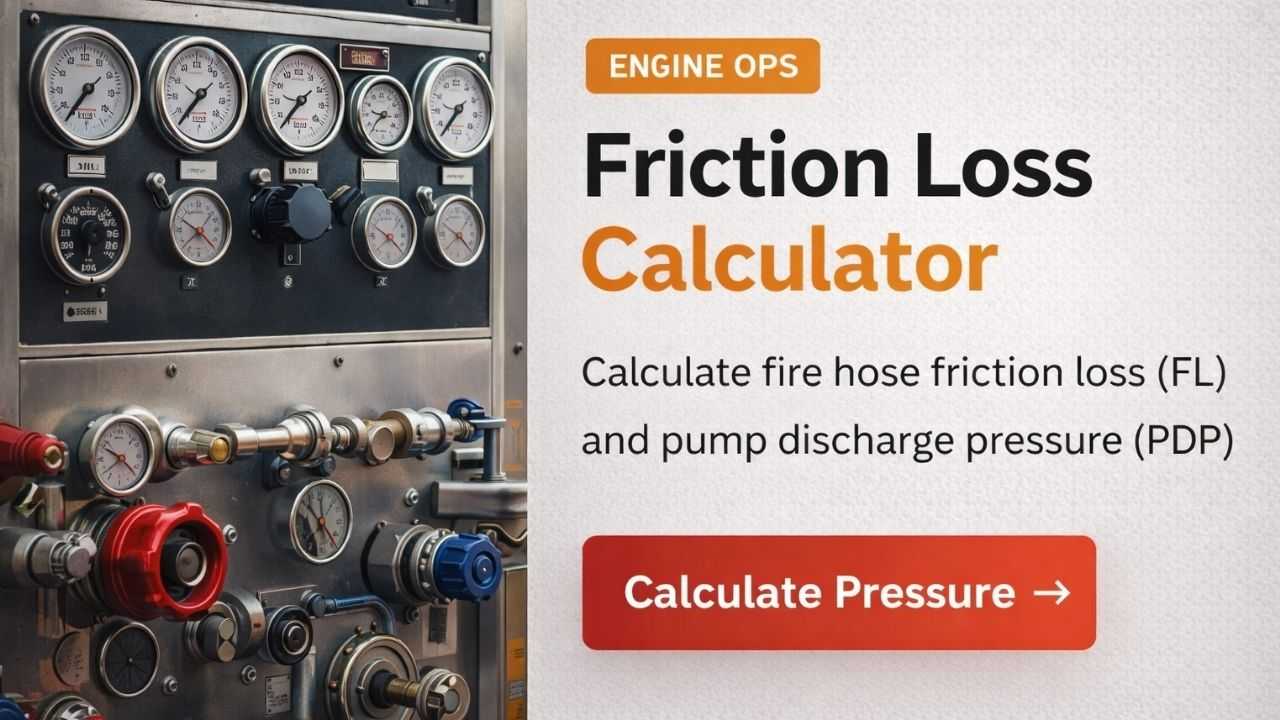
Friction loss is one of the most practical pump-ops skills you can build: it connects your hose layout, flow decision, and nozzle performance to a single question—what pressure do we need at the pump? This guide explains friction loss in plain terms, gives fast math you can use on the apron, and shows worked examples for common handlines and supply situations. When you want a quick confirmation during training, use the Friction Loss Calculator.
Jump to:Friction loss basics · Quick formula · Common coefficients · Worked examples · From FL to PDP · Common mistakes · Cheat sheet · FAQ
Open the Friction Loss CalculatorFire Flow Calculator
What Friction Loss Really Means (and Why It Matters)
Friction loss (FL) is pressure lost as water moves through hose and appliances. The faster you push water (more flow), the more pressure you lose. The longer your lay, the more pressure you lose. The smaller your hose diameter, the more pressure you lose for the same flow. In pump operations, friction loss matters because it determines whether you can deliver the desired flow at the nozzle without wasting pressure—or starving the line.
| Driver | What increases friction loss | Operational implication |
|---|---|---|
| Flow (GPM) | Higher GPM = higher turbulence and energy loss | Big flows demand more pump pressure, especially on small hose |
| Length | More feet = more loss over distance | Long lays need FL planning or relay/alternate supply |
| Diameter | Smaller hose = higher loss at same flow | Line choice matters as much as pump pressure |
| Appliances | Wyes, manifolds, standpipes, master stream devices | Appliance loss can be the hidden “missing pressure” |
The Quick Formula (Field-Friendly)
Many departments teach a variation of the same relationship. A common “quick math” approach is:
- C = hose coefficient (depends on diameter and hose type)
- Q = flow in hundreds of GPM (e.g., 150 GPM → Q = 1.5)
- L = hose length in hundreds of feet (e.g., 200 ft → L = 2)
This gives you friction loss in PSI for the hose segment. You can then add nozzle pressure and any appliance/elevation factors to reach a workable pump discharge pressure (PDP). If you want a fast cross-check, use the Friction Loss Calculator and compare it to your hand math.
Common Hose Coefficients (Use Your Department Numbers)
Coefficients vary by hose construction and what your department standardizes. The goal here is not to force one value—it’s to remind you to standardize. Use your local C values on your pump chart and in training.
| Hose Size | Typical Use | Coefficient (C) | Notes |
|---|---|---|---|
| 1.75" (handline) | Most interior attack lines | Department-specific | High FL at higher flows; line selection is critical |
| 2.5" (handline) | High-flow attack / exterior / standpipe feeds | Department-specific | Lower FL per GPM vs 1.75" for the same flow |
| 3" / LDH / supply | Supply to engine, relay, long lays | Department-specific | Use supply hose when distance/flow rises |
Tip: If you want your content to match your tool settings, publish the coefficient set you use in your calculator UI and in your pump chart documentation.
Worked Examples (Attack & Supply Scenarios)
Below are realistic training-style examples. They show the process, not “the one true number.” Use your department’s nozzle pressure (NP), appliance loss (AL), and coefficients.
Example 1: 200 ft of 1.75" at 150 GPM (typical interior attack)
- Flow: 150 GPM → Q = 1.5
- Length: 200 ft → L = 2
- Friction loss: FL = C × (1.5)² × 2 = C × 4.5
Once you compute FL using your C value, add nozzle pressure and any appliance/elevation factors to estimate PDP.
Example 2: 200 ft of 2.5" at 250 GPM (high-flow handline / exterior)
- Flow: 250 GPM → Q = 2.5
- Length: 200 ft → L = 2
- Friction loss: FL = C × (2.5)² × 2 = C × 12.5
This example highlights why you must match hose choice to expected flow. A higher-flow mission may demand a bigger line, not just more pump pressure.
Example 3: 600 ft supply lay to the attack engine (keep it stable)
Long supply lines are where friction loss planning pays off. If your attack engine is being supplied by a long lay, the supply line must support changing demand (multiple lines, master stream, standpipe operations). Supply planning is about stability—not just hitting a single number.
- Choose a supply hose size appropriate for the expected flows and length.
- Anticipate demand changes and maintain a buffer for surges.
- If the lay is extreme, consider relay/pump-to-pump strategy.
From Friction Loss to PDP (What the Pump Operator Actually Sets)
Most engine companies ultimately care about PDP (Pump Discharge Pressure). A practical way to think about it:
- NP = nozzle pressure required by your nozzle package
- FL = friction loss in hose (sum segments if needed)
- AL = appliance loss (wyes, manifolds, standpipes, master stream devices)
- Elevation = adjust for significant grade/vertical rise (department method)
For training, you can pair friction loss decisions with demand planning using the Fire Flow Calculator. That combination helps crews connect expected flow (tactical objective) to hose/nozzle choice and pump settings (execution).
Common Friction Loss Mistakes (That Cost Time)
- Forgetting the units: Q is “hundreds of GPM” and L is “hundreds of feet.” Mixing raw GPM/feet breaks the math.
- Overpumping instead of resizing: If the mission requires higher flow, consider moving to a larger line instead of chasing pressure.
- Ignoring appliance loss: Wyes, manifolds, standpipes, and master stream appliances can be the missing pressure.
- Assuming a single RMV-style ‘constant’ for everything: Fire conditions change; flows change; friction loss changes. Plan for margin.
- Not validating with a pump chart: Departments that win at pump ops standardize their numbers and drill them repeatedly.
Pump Ops Cheat Sheet (Save for Drills)
Q = flow/100, L = length/100.
Confirm NP/AL by department SOP.
Open the Friction Loss Calculator
FAQ – Fire Hose Friction Loss
What is friction loss in fire hose?
Friction loss is pressure lost due to water moving through hose and appliances. It increases with flow, length, and smaller hose diameter.
Why does friction loss matter to the pump operator?
Because the pump operator must supply enough pressure to overcome friction loss and still deliver the correct nozzle pressure and flow at the point of use.
What’s the fastest way to calculate friction loss?
Use a department-approved quick formula (like FL = C × Q² × L) and standardize your coefficients. For fast validation, use the Friction Loss Calculator.
Should I just increase pressure if the line feels weak?
Not automatically. Confirm the objective (needed flow), check for kinks, confirm nozzle selection, and consider whether hose size is appropriate for the mission. Overpumping can create safety and handling issues.




Comments 0
No comments yet. Be the first to share your thoughts!
Leave a Comment