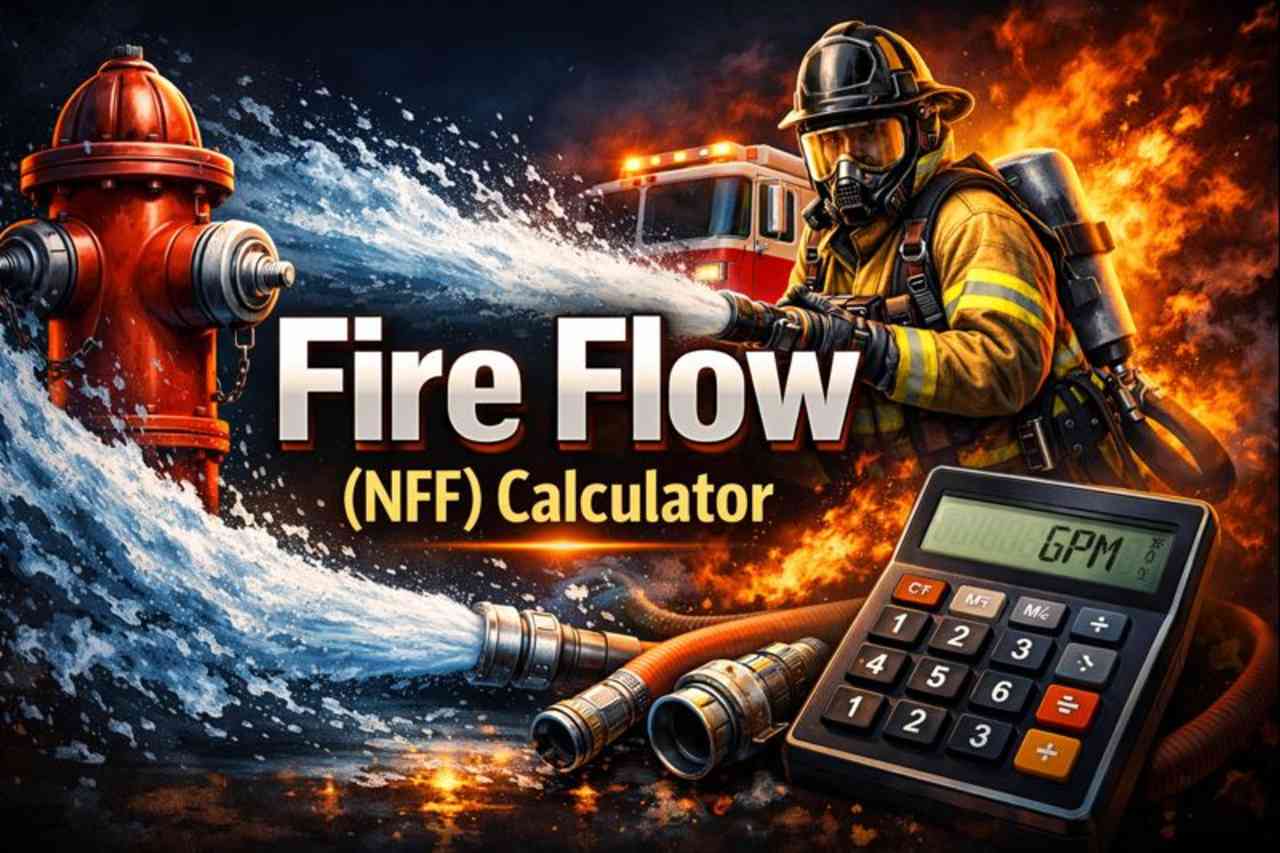

Fire Flow Calculation – What It Means, Quick Estimation Methods, and Training Scenarios
Last updated:
“Fire flow” is not a magic number—it’s a planning estimate that helps you match the attack package and water supply plan to the incident. Used correctly, it improves decision speed: you’re less likely to under-resource a growing fire or overbuild a supply plan when it isn’t needed. This guide explains what fire flow means, how to estimate quickly, and how to turn the estimate into practical engine company decisions. For a fast check during drills, use the Fire Flow Calculator.
Jump to:What fire flow means · Quick estimation methods · Turning flow into tactics · Water supply reality check · Training scenarios · Common mistakes · FAQ
Open the Fire Flow CalculatorFriction Loss CalculatorHydrant Flow Calculator
What “Fire Flow” Means (In Plain Terms)
Fire flow is a way to estimate how much water (GPM) is needed to control and extinguish a fire under a given set of assumptions. It’s not a promise that you can deliver that water—especially in low-pressure systems or rural areas. It’s a guide that helps you:
- Choose an attack package that matches expected demand (handlines, master stream, transitional options).
- Decide whether your first engine’s tank is enough for initial actions or only a short bridge.
- Build a water supply plan that won’t collapse when you add lines or conditions worsen.
Quick Estimation Methods (Why “Fast Math” Exists)
Departments use different methods to estimate fire flow based on occupancy, construction, and fire area. The purpose of a quick method isn’t perfect precision—it’s getting into the right tactical neighborhood fast.
| Method style | Best for | Limitations |
|---|---|---|
| Area-based estimates | Residential/light commercial where fire area is approximable | Depends heavily on how accurately you estimate involvement |
| Occupancy-driven planning ranges | Preplans and “first alarm expectations” by building type | Can be too generic unless updated to local response reality |
| Scenario tables / SOP playbooks | Fast decisions with consistent staffing and equipment packages | Must be trained and revised; fails if staffing/equipment changes |
Use the Fire Flow Calculator as a consistent training reference and to document your assumptions when comparing scenarios.
Turning a Flow Estimate into Tactics (What to Do With the Number)
The quickest way to make fire flow practical is to translate it into deliverable packages and time:
- Package selection: one handline, multiple handlines, or a master stream decision based on expected demand and exposure risk.
- Time budget: how long your tank can support the initial attack while supply is established.
- Pressure planning: if the package requires higher flow, you must confirm hose selection and friction loss using the Friction Loss Calculator.
Water Supply Reality Check (Can You Actually Deliver It?)
Before you commit to a high-flow plan, validate supply. In hydranted areas, confirm options and constraints; in limited systems, plan redundancy.
- Hydrant availability: locate primary and secondary hydrants with Hydrant Finder.
- Hydrant performance assumptions: use the Hydrant Flow Calculator for training-style estimates and discussion.
- Long lays/relay risk: high flow + long distances demands friction-loss planning and often supply strategy changes (relay, additional engine, alternate connection).
Training Scenarios (Use These for Company Drills)
These scenarios are designed for training discussion, not rigid prescriptions. Run each scenario through the Fire Flow Calculator, then test feasibility using friction loss and supply constraints.
Common Fire Flow Mistakes
- Confusing estimate with capability: a fire flow number doesn’t mean your supply system can deliver it.
- Not translating to packages: if you can’t describe the hose/nozzle package and staffing to deliver the flow, the number is theoretical.
- Ignoring friction loss: high flow through small hose over distance creates unstable operations and overpumping risk.
- One-source planning: always identify primary/secondary hydrants or fallback supply options.
- Not revising assumptions: as involvement increases or you discover access constraints, update the demand and adjust tactics.
Open the Fire Flow CalculatorFriction Loss Calculator
FAQ – Fire Flow Calculation
What is “needed fire flow”?
It’s an estimated GPM demand to control and extinguish a fire given assumptions about building, occupancy, and involvement. It’s primarily a planning tool.
Is fire flow the same as what my nozzle flows?
No. Fire flow is an overall demand estimate; your attack package may include one or multiple lines and possibly a master stream depending on the strategy.
How do I know if I can actually deliver the flow?
Validate water supply (hydrants, relay, drafting, tanker shuttle) and confirm hose selection and PDP feasibility using friction loss planning.
What’s the fastest way to estimate fire flow during training?
Use a department-approved quick method or your SOP playbook. For consistent scenario comparison, use the Fire Flow Calculator.

Comments 0
No comments yet. Be the first to share your thoughts!
Leave a Comment