
Last updated:
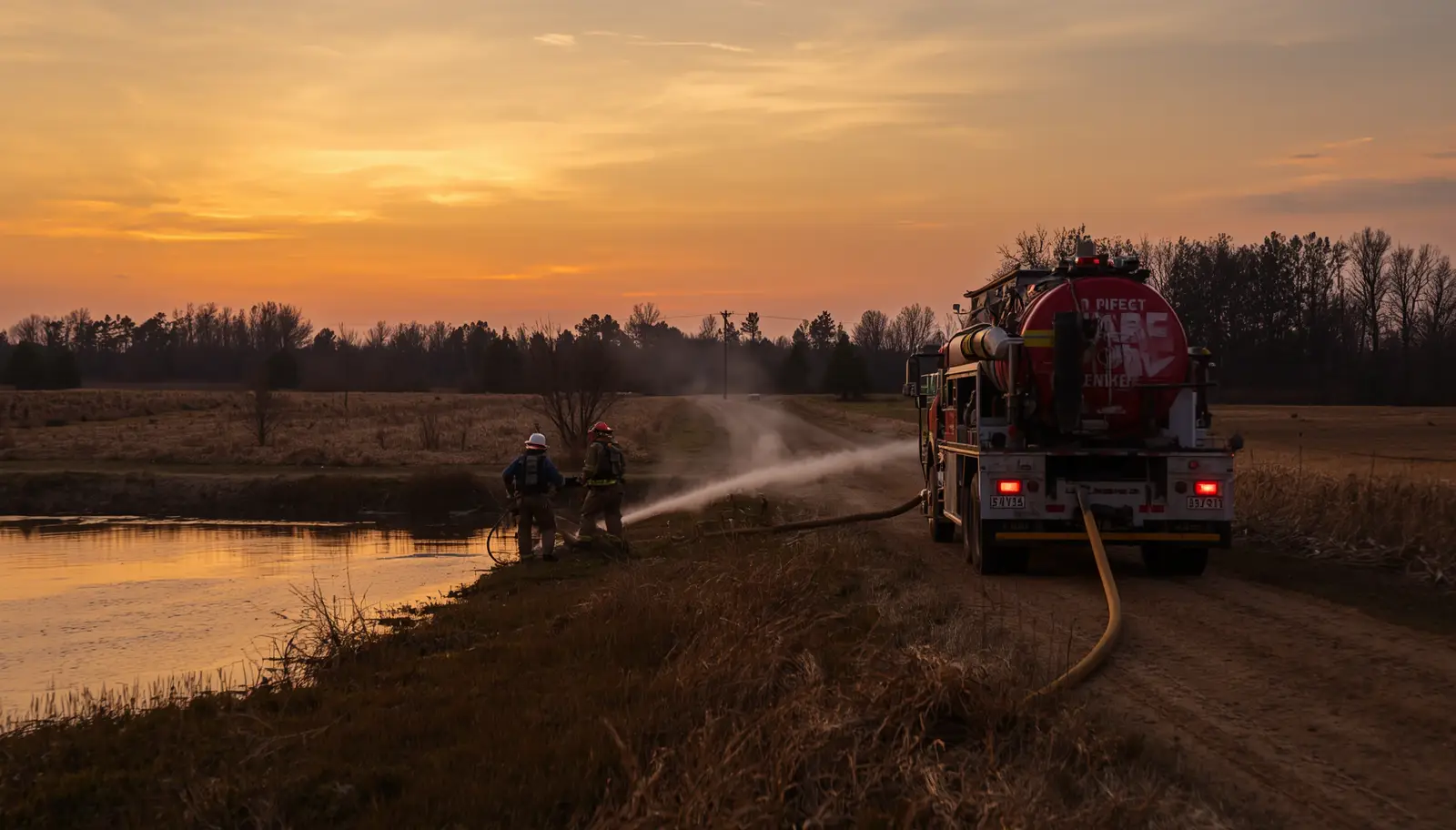
A tanker shuttle is not just "send more tankers." It is a moving water system. If the fill site is slow, the dump site is tight, the route is long, the staging area is confused, or tankers arrive without a loop, the operation can look busy while the attack engine still waits for water.
The Tanker Shuttle Calculator helps put numbers around that problem. It estimates sustained water delivery from tanker capacity and cycle time, then lets you compare the result against expected demand. The calculator does not run the incident. It gives command and training officers a better way to ask: can this shuttle actually support the fire flow we are planning to use?
Open Tanker Shuttle CalculatorFire Flow CalculatorHydrant Finder
Operational note: use this for preplans, drills, and command estimates. Real tanker operations require SOP/SOG, traffic control, water supply supervision, fill and dump site management, and local apparatus knowledge. NFPA 1142 is a useful standards reference for rural and suburban water supply planning.
When To Trigger Tanker Shuttle Thinking
The worst time to start building a tanker shuttle is after the first tank is gone and the fire is still growing. Rural water supply needs time. Tankers have to be requested, assigned, routed, filled, dumped, staged, and kept moving. If the first realistic question is "where is our next water coming from?" the shuttle conversation should already be happening.
Common triggers include no hydrant district, weak hydrants, long access roads, dead-end roads, limited municipal supply, large setbacks, commercial or agricultural buildings, defensive operations, and any fire where expected demand is likely to outrun the first alarm water. A small residential fire may not need a full shuttle, but command should still know when the operation crosses that line.
The Inputs That Matter
A tanker shuttle estimate is only as honest as the inputs. Capacity is easy to see on the side of the apparatus. Cycle time is where the truth hides. A tanker that carries more water can still deliver less sustained flow if it takes too long to fill, turn, travel, dump, and re-enter the route.
| Input | What to include | Common mistake |
|---|---|---|
| Tanker capacity | Usable delivered water, not just tank label. | Assuming every gallon in the tank becomes usable fireground water. |
| Fill time | Hydrant, draft, nurse, or fill appliance performance. | Using best-case fill speed from a drill site that is not the incident site. |
| Travel time | Distance, road type, grade, traffic, weather, and speed limits. | Estimating with normal car speed instead of heavy apparatus movement. |
| Dump time | Dump valve, portable tank setup, access, and congestion. | Ignoring the delay caused by a tight dump site or poor approach angle. |
Fill Site And Dump Site Discipline
The fill site should be boring. That is a compliment. It needs room to enter, stop, fill, and leave without backing chaos or traffic surprises. If drafting is used, the access point needs to be reliable in the conditions you actually face: winter, mud, darkness, low water, or blocked approaches.
The dump site needs the same discipline. Portable tanks, hard suction, dump valves, jet siphons, and attack engine placement all need space. A good dump site has an approach, a dump position, an exit, and someone keeping the route clean. When the dump site becomes a parking lot, sustained GPM collapses even if enough tankers were dispatched.
Staging And Route Flow
Tankers need a loop, not a crowd. The cleanest shuttle routes separate incoming and outgoing traffic when possible. Staging should keep reserve apparatus close enough to feed the operation but far enough away that the fill and dump sites keep moving. If traffic control is an afterthought, the shuttle will eventually stop being a water operation and become a road problem.
In preplans, mark route direction, turnarounds, bridge or weight concerns, narrow lanes, school or event traffic, and winter trouble spots. If the best route includes a narrow bridge or steep driveway, write that down before the incident. Do not make the water supply officer discover it behind the wheel of a full tanker.
How To Use The Calculator
- Estimate the needed flow with the Fire Flow Calculator or your department method.
- List the tankers that are realistic for the response, including mutual aid timing.
- Enter usable tanker capacity, fill time, travel time, dump time, and turnaround assumptions.
- Compare sustained shuttle GPM against attack flow, exposure needs, and reserve margin.
- Run a second scenario for the backup fill site or a longer route.
- Use the result to decide whether you need more tankers, a closer fill site, a relay, a nurse tanker, or a different tactical flow plan.
The most useful result is not a perfect number. It is the gap between what the fire needs and what the shuttle can honestly deliver. If the gap is large, the answer is not optimism. The answer is changing the plan early.
What To Put In The Preplan
- Primary and secondary fill sites with access notes.
- Primary and secondary dump sites with portable tank placement notes.
- Expected route direction and traffic-control points.
- Bridge limits, narrow roads, steep drives, low wires, and seasonal hazards.
- Mutual aid tanker list and likely arrival sequence.
- Estimated sustained GPM for best-case and realistic-case scenarios.
- Who manages water supply, staging, fill site, and dump site under the local incident command structure.
Common Tanker Shuttle Mistakes
- Late activation: tankers are requested only after the first engine is already committed and low on water.
- Best-case math: route times ignore traffic, weather, apparatus speed, fill delay, and dump congestion.
- No site boss: fill and dump sites run themselves until they do not.
- No backup source: the plan depends on one hydrant, pond, or draft site staying available.
- Over-application: attack flow is chosen without respect for what the shuttle can sustain.
A tanker shuttle works when the water keeps moving in a predictable rhythm. The calculator helps build that rhythm on paper. Training, preplanning, and disciplined site management make it real.
Frequently Asked Questions
When should a tanker shuttle be requested?
Request it early when hydrants are absent, unreliable, distant, or unable to support the expected fire flow. Shuttles take time to build, so late activation is a common failure point.
What is the most important tanker shuttle input?
Cycle time is usually the input that changes the result most. Travel time, fill time, dump time, traffic, and turnaround space all affect sustained GPM.
Does a larger tanker always improve sustained flow?
Not always. A larger tanker helps only if fill and dump sites can handle it efficiently and the route does not slow the cycle enough to erase the capacity gain.
What should be documented in a rural water preplan?
Document fill sites, dump sites, drafting access, turning radius, bridge or road limits, winter issues, staging location, route direction, and backup water sources.
Can the calculator replace a water supply officer?
No. It supports planning and training. Real incidents still need command, staging discipline, traffic control, site management, and local SOP/SOG.




Comments 0
No comments yet. Be the first to share your thoughts!
Leave a Comment