I have been on working structure fires at temperatures well below zero. Not drills — actual fires, in January, in the kind of cold where the water turns to steam before it hits the ground and your facepiece fogs the second you exit the building. Cold weather changes almost everything about a fire: how water behaves, how your SCBA performs, how long your crew can stay on the line, and especially how fast your equipment fails in ways it never fails in September. What follows is a breakdown of the real problems — the ones that do not always make it into the cold-weather SOG because they happen fast and get fixed quietly on scene by whoever figures them out first.
What we cover:
- Frozen hydrants — the real problem and how to open one
- Hose lines icing up mid-operation
- SCBA in extreme cold: what freezes and when
- Turnout gear limitations nobody talks about
- Water supply planning changes in winter
- Rehab in cold: hypothermia sneaks up
- How fire buildings behave differently in winter
- Pre-season checklist before the cold hits
Frozen Hydrants: The Real Problem
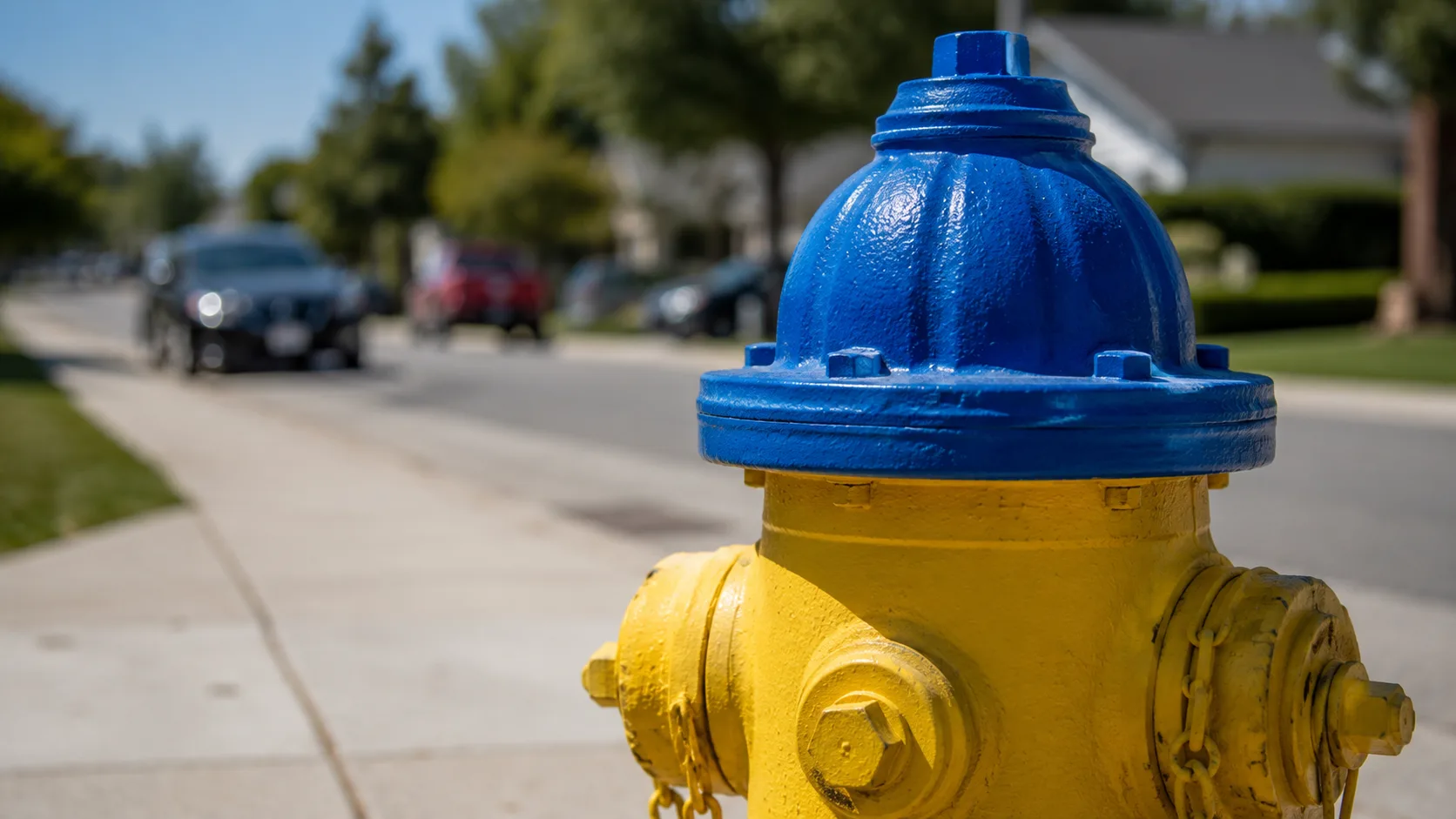
Here is what a lot of firefighters do not know about frozen hydrants: the hydrant barrel itself is almost never the problem. The water in a dry-barrel hydrant drains into the ground after each use through a drain valve at the base. If the hydrant was properly operated and maintained, there is no standing water in the barrel to freeze. What you actually get is ice in three specific places — and each one has a different fix.
Where hydrants actually freeze
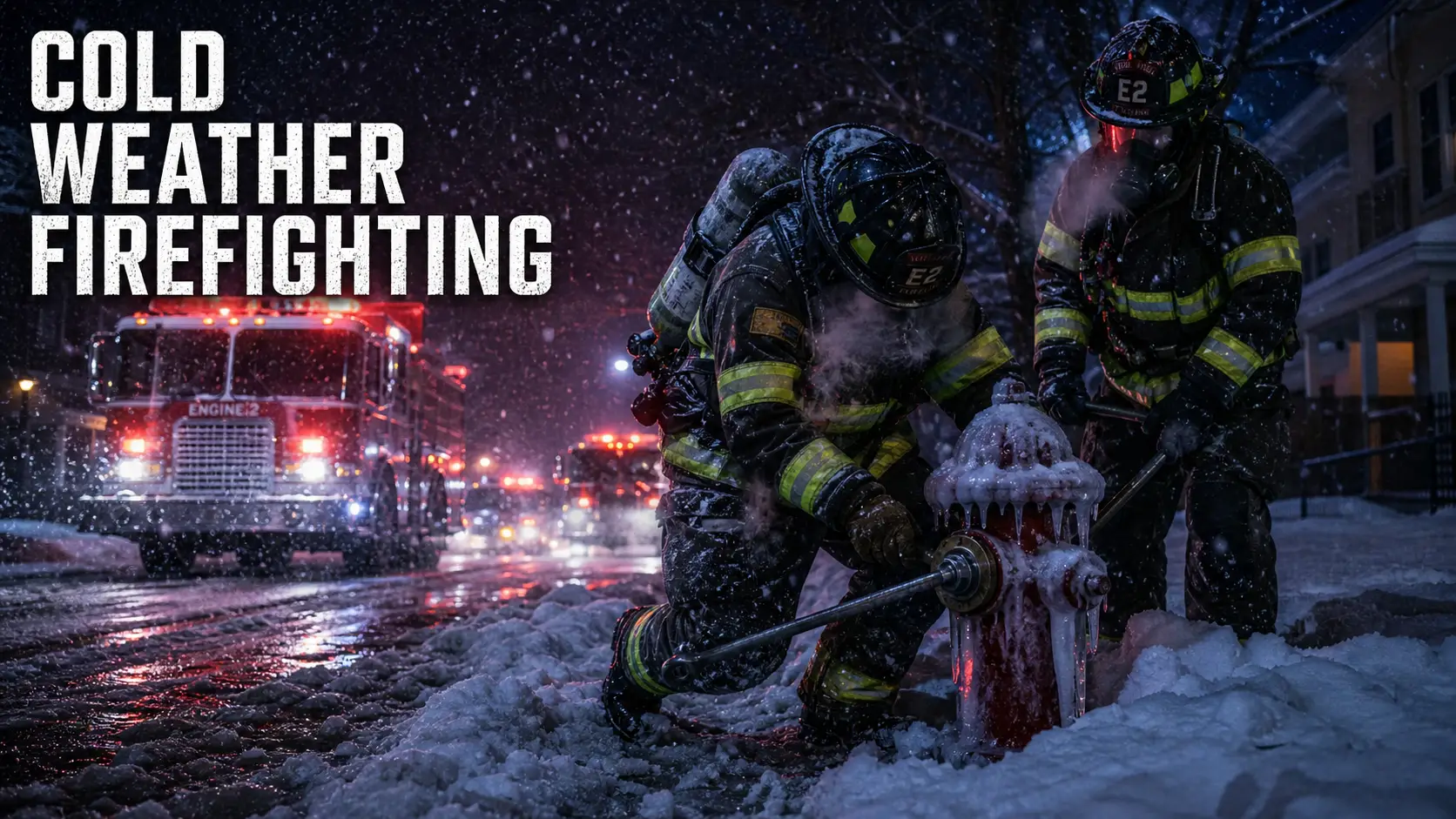
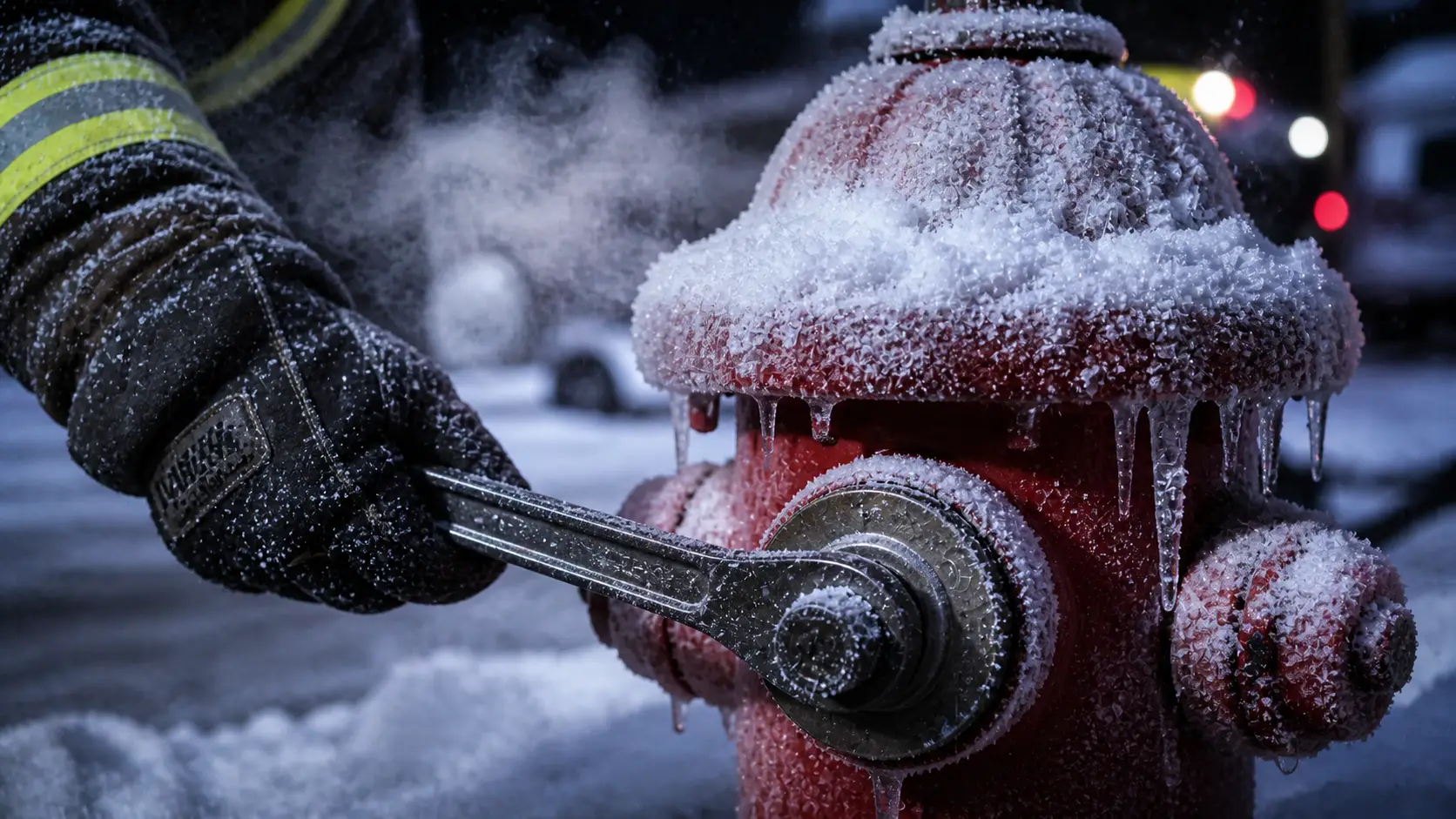
The outlet ports. Water left in the outlet cap threads and the cap gasket freezes solid. The cap looks fine but will not budge. This is by far the most common cold-weather hydrant problem. Fix: carry a hydrant wrench with a breaker bar extension, not just the standard wrench. Apply force to the cap, not the hydrant body. If it still will not move, pour a small amount of warm water (not boiling — thermal shock can crack old cast iron) into the port. Most departments with cold climates carry a thermos of warm water on the engine for exactly this.
The operating nut. Ice can form around the operating stem at the top of the hydrant. The nut turns but the stem does not move. You open the hydrant, nothing happens. This is what gets people — you think you have water, you pull the line, you have nothing. Fix: a sharp strike with the wrench handle on the top of the operating nut will usually break the ice seal around the stem. If not, warm water on the operating nut area.
The barrel — but only if it was not properly maintained. A hydrant that was not fully opened during its last use, or that was operated incorrectly so the drain valve did not seat, will have standing water in the barrel that freezes. When you open a barrel-frozen hydrant you get nothing — not a slow flow, nothing. This is the version that kills you on a working fire. You cannot fix a barrel-frozen hydrant quickly on scene. Flag it, move to the next one, and get your department to address it during inspection season.
Know your hydrant inventory before winter. Every department in a cold-weather climate should be doing hydrant inspections in October — not January. Flag problem hydrants, identify your backup water points, and pre-plan alternate water supply routes. The Hydrant Finder can help map your coverage area; use it in conjunction with your own department hydrant records to spot gaps.
The slow-to-open hydrant
Cold also makes old hydrant operating stems stiffer. A hydrant that opens smoothly in July might take 20 full turns instead of 15 in January. That is not necessarily a problem unless your guy on the hydrant is stopping early because it feels open. A partially open hydrant at a working fire with a 2½-inch supply line pulled is a friction loss disaster waiting to happen. Train your hydrant operators to count full turns and verify flow before charging the supply line.
Hose Lines Icing Mid-Operation
Once you have water flowing, cold weather creates a second problem that is slower to develop but harder to deal with: everything the water touches freezes. Charged hose at sub-freezing temperatures in wet conditions can become a rigid pipe in under ten minutes if flow is interrupted even briefly. This is not a training scenario. I have seen a 200-foot 2½-inch line go from a charged working line to an ice sculpture that could not be rolled, coiled, or moved without cracking the jacket.
Hose jacket behavior in cold
Natural rubber-lined hose handles cold reasonably well as long as water is flowing. The water inside keeps the temperature above freezing at the liner. The exterior jacket gets wet, starts to ice, but the hose remains functional. The danger is any interruption in flow — a closed nozzle, a kink, a pressure drop from a hydrant problem. Within minutes of water stopping in sub-freezing temps, the liner begins to set. The longer you leave it, the harder it gets to restart flow.
Synthetic rubber (EPDM) liners are slightly better in cold than natural rubber but not dramatically so. Thermoplastic-lined hose is more vulnerable to cold-temperature stiffening even with water flowing. Know what you are carrying.
Keeping lines mobile
- Keep water flowing whenever possible. A slowly flowing line stays a hose. A static line becomes a pipe.
- If you need to shut down a line temporarily, do it at the nozzle, not at the pump panel. Water in the line between the nozzle and the pump stays warmer longer than the section nearest the pump discharge.
- Lay lines on the exposed ground surface, not on snow. Snow conducts cold to the hose faster than pavement does. On pavement, the residual heat from under the surface slows icing.
- After the fire, do not try to roll frozen hose on scene. Get it on the apparatus and into a heated bay before rolling and rinsing. Trying to roll a frozen-jacketed hose splits jackets and cracks couplings.
Coupling freeze-up
The coupling is where most cold-weather hose failures actually occur. Water gets into the swivel gasket area and freezes. The coupling looks fine but the swivel will not turn — which means you cannot disconnect it on scene. Carry a rubber mallet. A few sharp strikes to the swivel ring while someone holds the male coupling usually breaks the ice enough to turn. Do not hammer the coupling body or the ears. The swivel ring is the target.
After a cold-weather fire: Every coupling that was deployed gets individually inspected before the hose goes back in service. Ice that formed inside a swivel gasket and then thawed can leave the gasket cracked or displaced. A displaced gasket at a working fire is a pressure leak at the worst possible moment.
SCBA in Extreme Cold: What Freezes and When
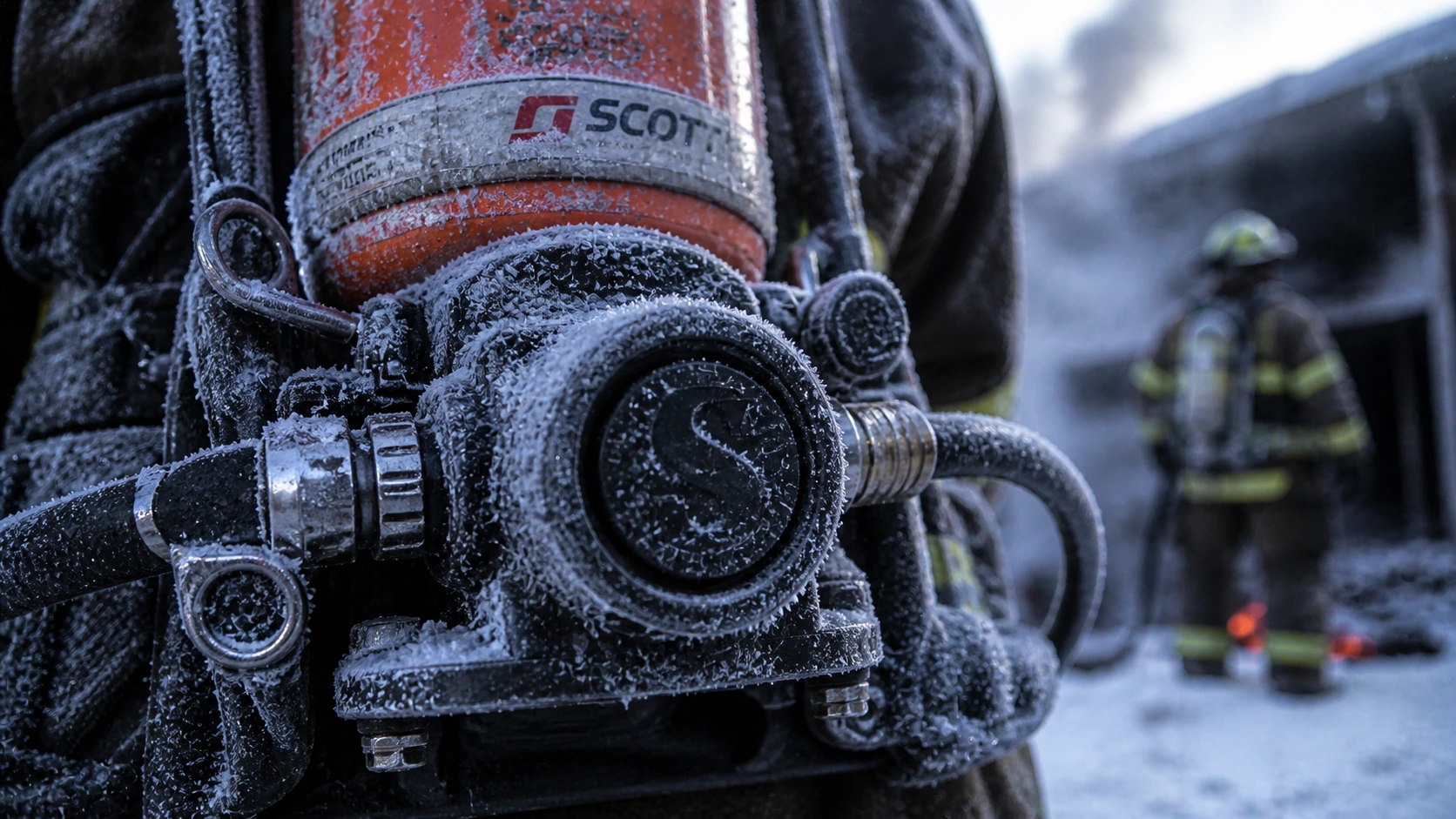
SCBA in cold weather is a topic that does not get enough honest discussion. Most departments know cold affects SCBA performance in a general way. Fewer know the specific failure modes and the temperatures at which they become likely. Here is what actually happens.
Cylinder pressure gauge accuracy
At very low temperatures, compressed air cylinder pressure gauges read low. The Bourdon tube inside the gauge becomes stiffer in cold and does not respond as accurately. You might put on a cylinder that reads 4,000 PSI at room temperature. At -20°F (-29°C), that same cylinder sitting in the cold apparatus bay might read 3,500 PSI before you even breathe a breath. This is not air loss — it is gauge behavior. The air is there; the gauge is lying to you. Do not short-change your crew on bottles because a cold gauge reads low. Warm the cylinder to room temperature (bring it inside, not heat gun it) and recheck before condemning it.
First-stage regulator freeze
The first-stage regulator drops cylinder pressure (around 4,500 PSI full) down to intermediate pressure (around 90 PSI) before it reaches the second stage. This pressure drop involves the Joule-Thomson effect — expanding gas cools dramatically. At ambient temperatures below -4°F (-20°C), moisture in the air supply can freeze in the first stage. The symptom: air flows freely at first, then you feel resistance, then flow drops off sharply. If the pressure relief opens because of frozen internal components, you get continuous bleed-off and your bottle empties fast.
The fix before the incident: make sure your cylinders are filled with dry air. Moisture in the fill station is the root cause of first-stage freeze. A properly maintained fill station with an adequate desiccant dryer eliminates most first-stage freeze problems even in extreme cold. Check your fill station maintenance records, not just the hose and nozzles.
Facepiece lens fogging and freezing
Exiting a warm building into extreme cold causes the facepiece lens to fog and sometimes ice from the outside. This is not just uncomfortable — it is a vision-loss event at a fire scene. Some SCBA masks have a defrost port that directs a small air stream across the inner lens surface. Use it. If your masks do not have this feature, know that staying in the positive-pressure environment of the building interior is the only time your lens will be reliably clear. Coming out into -15°F for a mask swap or a quick task and going back in is how you lose your ability to see for 30-60 seconds in the cold transition.
Bypass valve behavior
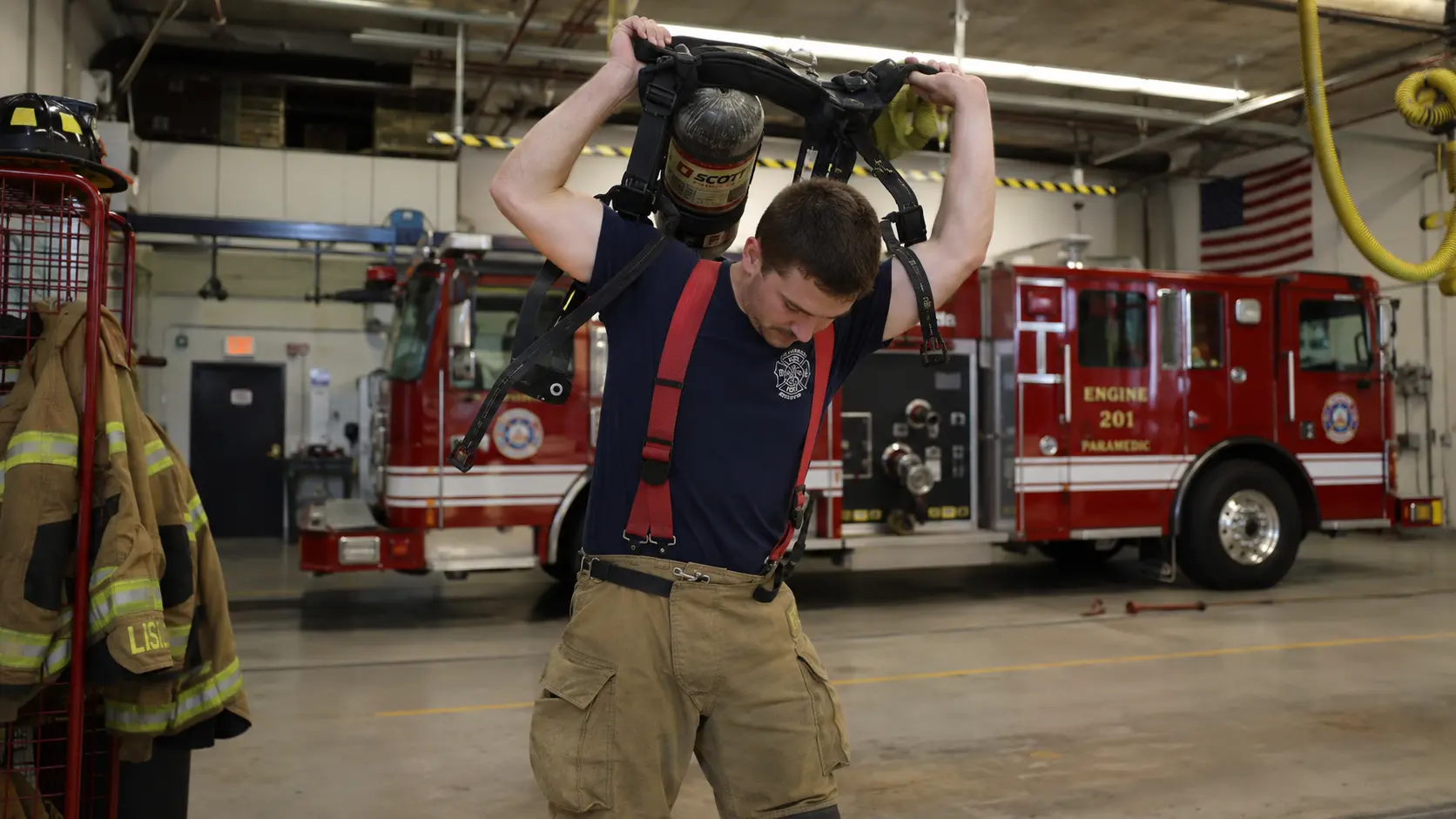
The bypass valve (the wheel or lever that bypasses the demand valve to deliver continuous air flow) can become stiff or difficult to operate with heavily gloved hands in cold. Test every bypass valve in your SCBA fleet before cold weather season, not during a MAYDAY. If a valve requires more than one-hand operation with winter gloves, it needs maintenance. The bypass valve has to work when you need it most.
For air time calculations at cold-weather fires, keep in mind that cold increases your RMV (respiratory minute volume) — you breathe harder because your body is working harder to stay warm. Use the SCBA Air Time Calculator with a higher-than-normal RMV setting for cold-weather planning. A crew used to getting 18 minutes at moderate exertion may get 13-14 minutes in hard cold.
Turnout Gear Limitations Nobody Talks About
Turnout gear is a thermal protection system designed around the heat threat of a structural fire. In cold weather, it faces a threat it was not primarily designed for. This creates some problems that get quietly managed on scene but rarely discussed in training.
Moisture vapor transmission — backwards
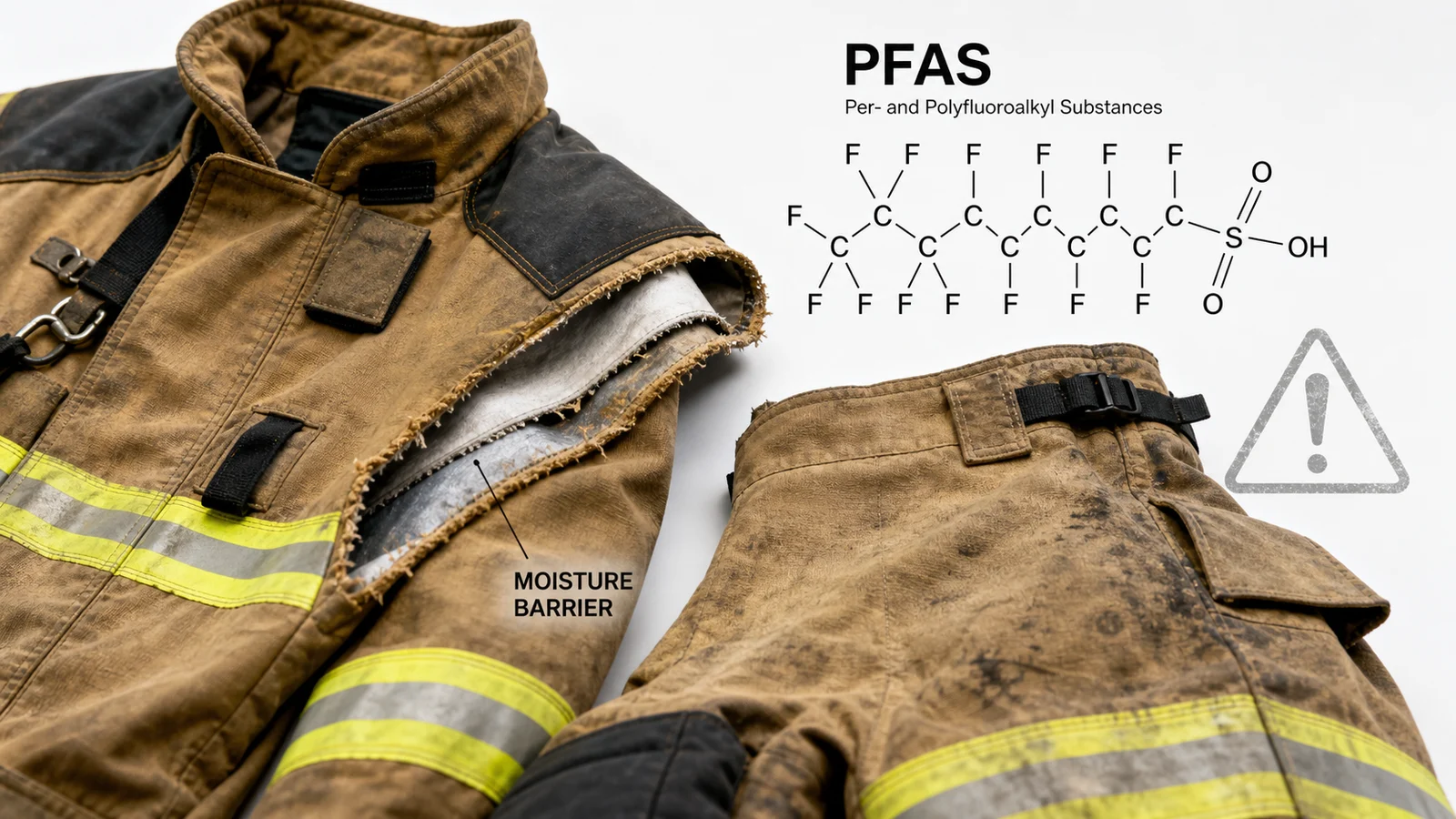
Modern turnout gear uses a moisture barrier (typically Gore-Tex or similar) that allows body heat vapor to escape outward while blocking liquid water from getting in. In extreme cold, this system can work backwards: the extreme temperature differential causes vapor to condense on the inner surface of the moisture barrier. You feel wet on the inside even though no exterior water has penetrated. This is not a gear failure — it is physics. But it makes you feel cold, it reduces the insulating value of the thermal liner, and it contributes to hypothermia risk in extended cold-weather operations.
Thermal liner compression
The thermal liner is where most of the insulation comes from. That insulation depends on loft — air trapped in the fiber structure. When the liner gets compressed (sitting in an apparatus seat for a long response, kneeling on ice and debris), it loses loft and loses insulation value. In cold weather, you lose body heat faster than you would in moderate temps even with the gear on. At a long cold-weather operation, check your crew for cold signs even though they are in full gear.
Glove management
This is where most firefighters get hurt in cold weather, not in the fire. The moment you go hands-on with water, metal, or wet hose, your gloves start absorbing moisture. Structural gloves are not waterproof in any operational sense. Wet gloves in cold air cause local cold injury (frostnip and frostbite) to fingers and hands much faster than most firefighters expect — as little as 15 minutes in hard cold at -10°F (-23°C). Carry spare gloves on every cold-weather incident. Dry gloves are not a comfort item in January — they are a medical necessity.
Boots and ground contact
Structural firefighting boots provide radiant heat protection from above but almost none from below. Standing on ice and cold concrete for extended periods conducts heat out through the soles regardless of how good your boots are. Get your crew off the cold ground when they are not actively working. Wooden pallets, rolled hose, anything that breaks ground contact. This sounds trivial until someone comes off scene unable to feel their toes.
Water Supply Changes in Winter
Everything about water supply gets harder in cold. Your default hydrant may be frozen. Your mutual aid tanker is working through 8 inches of snow on a county road. Your supply line has to travel over ice instead of dry pavement. Pre-planning these scenarios in October is not optional for cold-climate departments — it is the difference between a manageable rural fire and a burn-down.
Tanker operations in snow
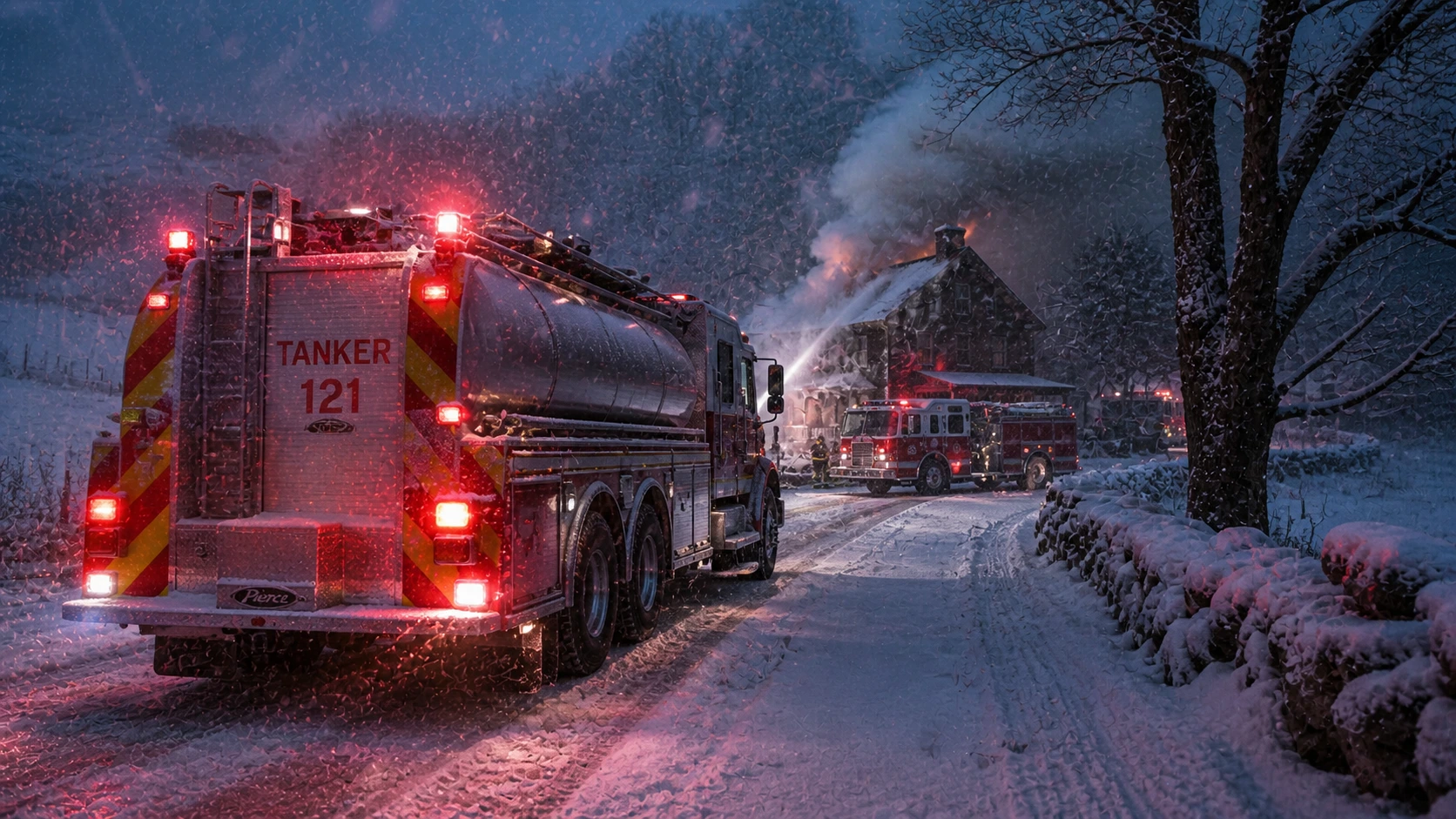
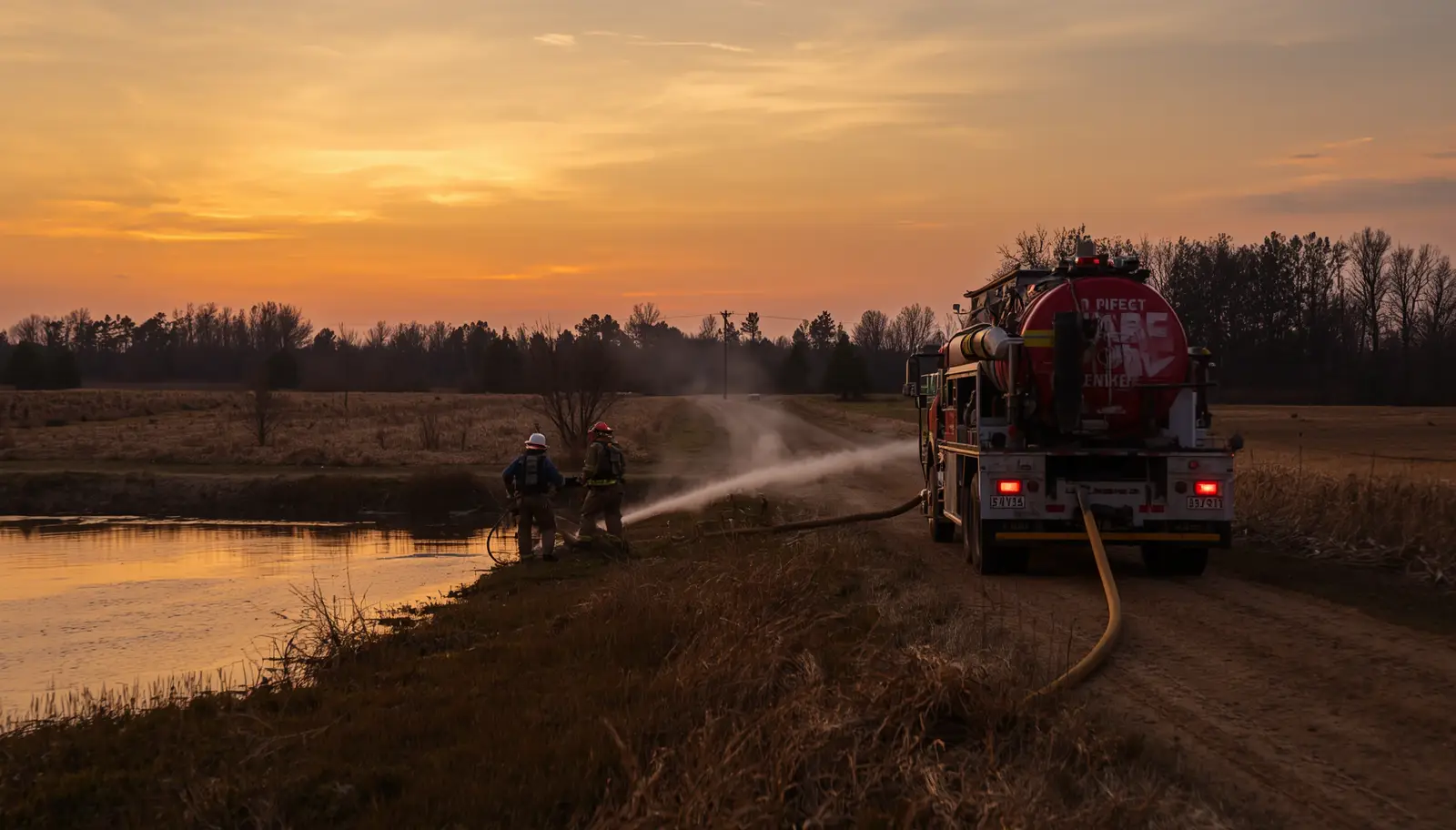
A loaded tanker on a rural snow-covered road is a different vehicle than a loaded tanker in July. Stopping distance triples on packed snow. Turning a 4,000-gallon tanker around on a narrow farm road that has been plowed into a single lane is an exercise that has rolled tankers. Establish your dump site and turnaround point before you commit your tankers to a remote road. Use the Tanker Shuttle Calculator to model your cycle times — and add 30-50% to your estimated travel times in snow conditions.
Portable tank freeze-up
A portable water tank (nurse tank, fold-a-tank) in sub-freezing temperatures will begin to freeze from the edges inward during a sustained operation. In very hard cold (below 0°F/-18°C), the surface can ice over fast enough to restrict flow from the tank to the hard suction. Keep a firefighter at the portable tank throughout the operation. Their job is to break ice off the strainer and keep the hard suction clear. It is not glamorous, but it keeps your pump from running dry.
Pump panel operation
The pump itself can freeze if water sits in the pump casing after a draft operation or after the pump is shut down. Discharge gates partially left open, drain valves closed, and residual water in the casing will freeze and crack pump housings. Drain your pump completely after every cold-weather operation. Open all drains. Verify they are flowing. If you are staging on scene for a re-ignition watch, keep the pump circulating at low RPM rather than shutting down if the temperature is at or below 28°F (-2°C).
Rehab in Cold: Hypothermia Sneaks Up
Cold-weather rehab is not just warm beverages and a place to sit. Hypothermia is a medical emergency that develops slowly and quietly in fireground conditions, and it is easy to miss because the signs — impaired judgment, slurred speech, confusion — look a lot like exhaustion after a hard fire. Except exhaustion does not kill people the way hypothermia does.
Why firefighters are especially at risk
A firefighter coming off a working fire in cold weather has several simultaneous risk factors: they are wet (sweat from interior operations, water from hose operations), they are fatigued (which impairs thermoregulation), and they are coming from a very hot environment into a very cold one. Core temperature can drop faster in a wet, fatigued person than in a dry, rested one. The transition from interior to exterior is when the risk spikes.
What to look for in your crew
- Shivering is good — it means the body is still fighting to maintain temperature. If shivering stops in someone who was shivering, that is a worsening sign.
- Impaired manual dexterity — cannot undo their own coat buckles, fumbling with equipment. More than just cold hands.
- Confusion or poor decision-making in someone who was sharp 20 minutes ago.
- Paradoxical undressing — in severe hypothermia, victims feel hot and try to remove clothing. On a fireground, this will look bizarre.
Running rehab right in the cold
Get people out of wet gear and into dry clothing or blankets as fast as possible. Heated apparatus cabs are the best immediate option — put crew members in the cab, not standing outside near the engine. Hot fluids work: water, broth, hot chocolate. No alcohol. Alcohol causes peripheral vasodilation which dumps core heat to the extremities and makes hypothermia worse. Have EMS assess any crew member who shows confusion, stops shivering after extended cold exposure, or reports numbness that does not resolve with rewarming after 10-15 minutes.
How Fire Buildings Behave Differently in Winter
Cold weather does not just change your equipment — it changes the building. Several behavioral differences are worth knowing before you do size-up on a winter structure fire.
Thermal inversion in the structure
In warm weather, a heated fire compartment has hot gases at the ceiling and cooler air near the floor in a relatively stable thermal layer. In cold weather, with very cold exterior air and a heated fire compartment, the temperature differential at openings (windows, doors, gaps) is extreme. This drives stronger bi-directional airflow at every opening — hot gases out at the top, cold air in at the bottom. The fire gets more air and burns hotter in cold weather all else being equal. It also means ventilation decisions have more immediate consequences — opening a window in January at 0°F creates a bigger pressure differential than the same opening in July.
Faster steam production
Applying water to a very hot structure in extreme cold produces enormous amounts of steam — more than you would see in summer for the same amount of water and the same fire temperature. This is not a sign you are making progress faster. It is a visibility and burn hazard. Steam burns are serious burns. Keep your crew's face away from steam plumes even with facepieces on. Steam at 212°F will transfer heat through your gear much faster than dry heat at the same temperature because of the latent heat of condensation.
Ice accumulation on the structure
Water running down the exterior of a burning structure in cold weather freezes into ice on walls, stairs, porches, and ladder positions. By the middle of a working fire in hard cold, the exterior of the building can be coated in ice that is not there when the first unit arrives. Ladder placement that was solid on arrival may be on ice 20 minutes in. Reassign someone specifically to monitoring ladder butt positions and the condition of the exterior approach paths throughout the operation. Ladders have slipped and crews have fallen in these conditions.
Pre-Season Checklist: Before the Cold Hits
The best time to do cold-weather prep is before the first freeze. Here is what actually matters:
- ✓Hydrant inspection — operate every hydrant in your first-due. Flag problem hydrants. Test drain valve function (hydrant should drain in 60 seconds after closing).
- ✓Fill station desiccant — inspect and replace desiccant dryer in your SCBA fill station. Dry air prevents first-stage freeze.
- ✓SCBA regulator function test — test all units including bypass valve operation with winter gloves on. Not bare hands — gloves.
- ✓Pump drain valves — verify all pump drain valves open fully and flow freely. Replace any that are sticky or leak.
- ✓Hose coupling swivels — lubricate all coupling swivels. Dry or corroded swivels freeze more readily than lubricated ones.
- ✓Spare gloves on every rig — two pairs per seat minimum. Wet gloves in cold are a medical problem.
- ✓Thermos / warm water supply — stage on apparatus specifically for frozen hydrant cap work.
- ✓Portable tank cold-weather protocol — assign a tank monitor to every cold-weather tanker operation.
- ✓Tanker routes in snow — identify which roads your tankers can and cannot safely navigate when snow-covered. Do it in advance, not at 3am during a farmhouse fire.
- ✓Rehab kit — blankets, dry clothing options, hot fluids, and a heated space identified in the pre-plan. A rehab position in a cold parking lot is not a rehab position.
- ✓Ladder safety in ice — carry roof jacks or rubber ladder feet. Ice-covered roofs are not roofs you send crews onto without anchor points.
- ✓Shift calendar — use the Shift Calendar Builder to schedule cold-weather drills before the season hits, not after the first bad incident teaches your crew what you missed.
The Temperature Threshold Table
| Temperature | Primary Concerns | Operational Adjustments |
|---|---|---|
| 28–32°F (-2–0°C) | Wet surfaces ice rapidly; hose jacket stiffens after flow stops; hydrant cap threads freeze | Stage warm water; monitor hose lines; keep pump running if staging |
| 15–28°F (-9–-2°C) | Active icing on structure and ground; coupling freeze risk; glove wet-out dangerous; cylinder gauge reads low | Assign ladder monitor; mandatory spare gloves; pre-warm cylinders; shorter crew rotations |
| 0–15°F (-18–-9°C) | SCBA first-stage freeze risk starts; portable tank icing begins; hypothermia risk in 15-20 min for wet crew | Verify dry fill; assign tank monitor; heated rehab mandatory; RIT/MAYDAY protocols reviewed |
| Below 0°F (below -18°C) | SCBA freeze risk is real; steam burns more likely; barrel-freeze possible on neglected hydrants; frostbite in minutes for exposed skin | 30-min max crew rotation; no bare-face exposure; pre-position second engine at alternate hydrant; continuous pump circulation |
Cold weather fires are not more complicated than warm weather fires — they are the same fire with more things trying to fail at the same time. The departments that do these well are the ones that dealt with each failure mode before it happened on a working fire, figured out the fix, and built it into their normal pre-winter routine. The ones that struggle are the ones who find out what frozen hydrant caps feel like at 2am in January when they have a fully involved residential and no water.

Comments 0
No comments yet. Be the first to share your thoughts!
Leave a Comment