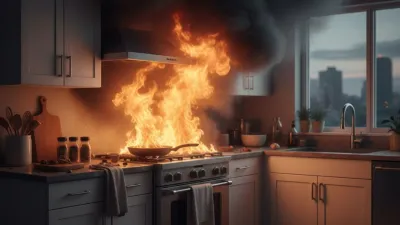
Cooking fires are the number one cause of home fires in the United States. And the most common cooking fire call we respond to is a grease fire on the stove — almost always because someone panicked and did exactly the wrong thing. I have been on these calls. The kitchen goes from a pan fire that could have been smothered with a lid in five seconds to a fully involved kitchen because someone's instinct was to grab water. This piece explains what actually happens inside a grease fire, what you should do in the first ten seconds, and what will make it dramatically worse.
Quick navigation:
Why You Must NEVER Put Water on a Grease Fire
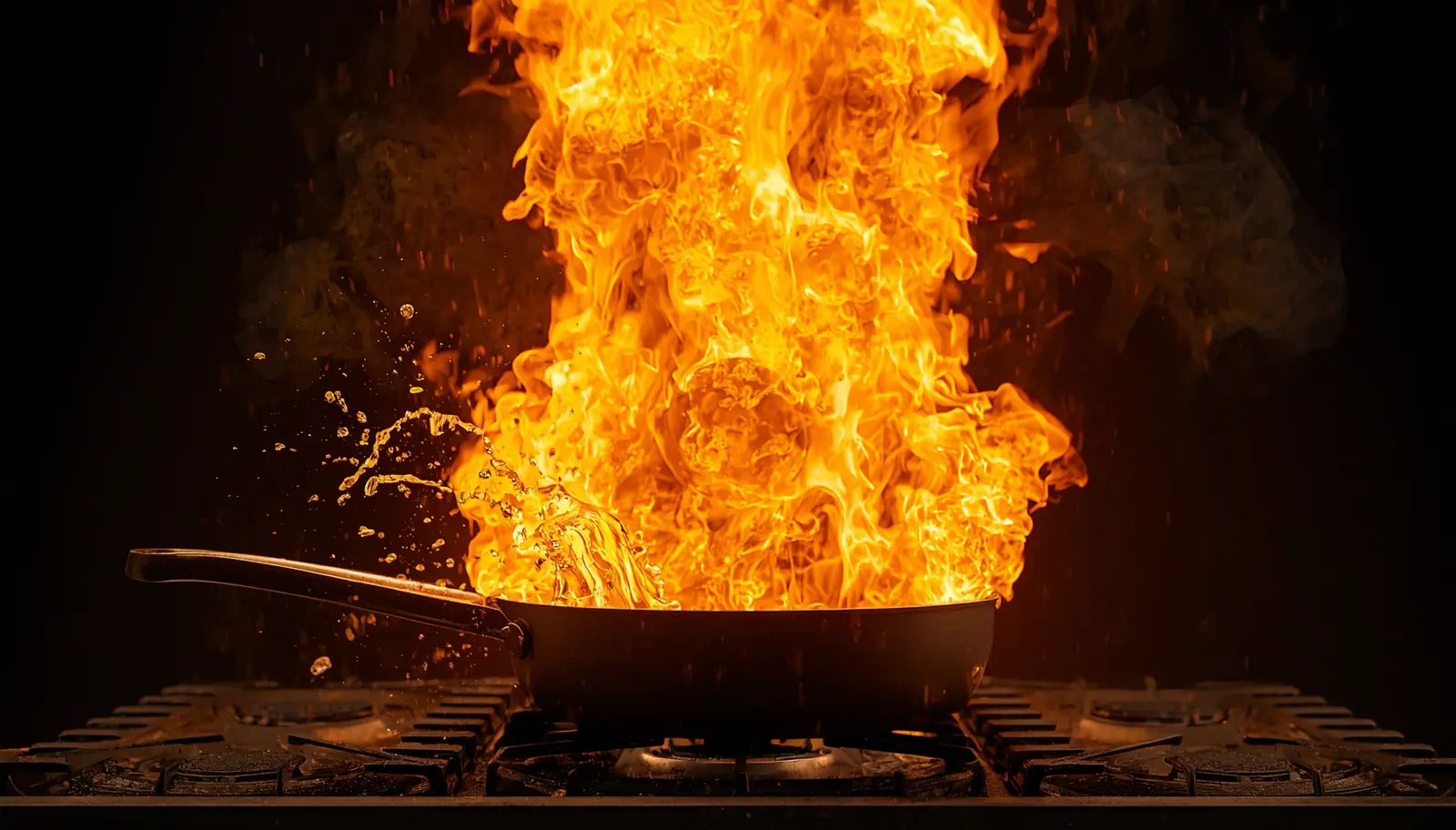
Water on a grease fire does not extinguish it. It causes an explosion. Here is the physics of why, because understanding it makes it impossible to forget.
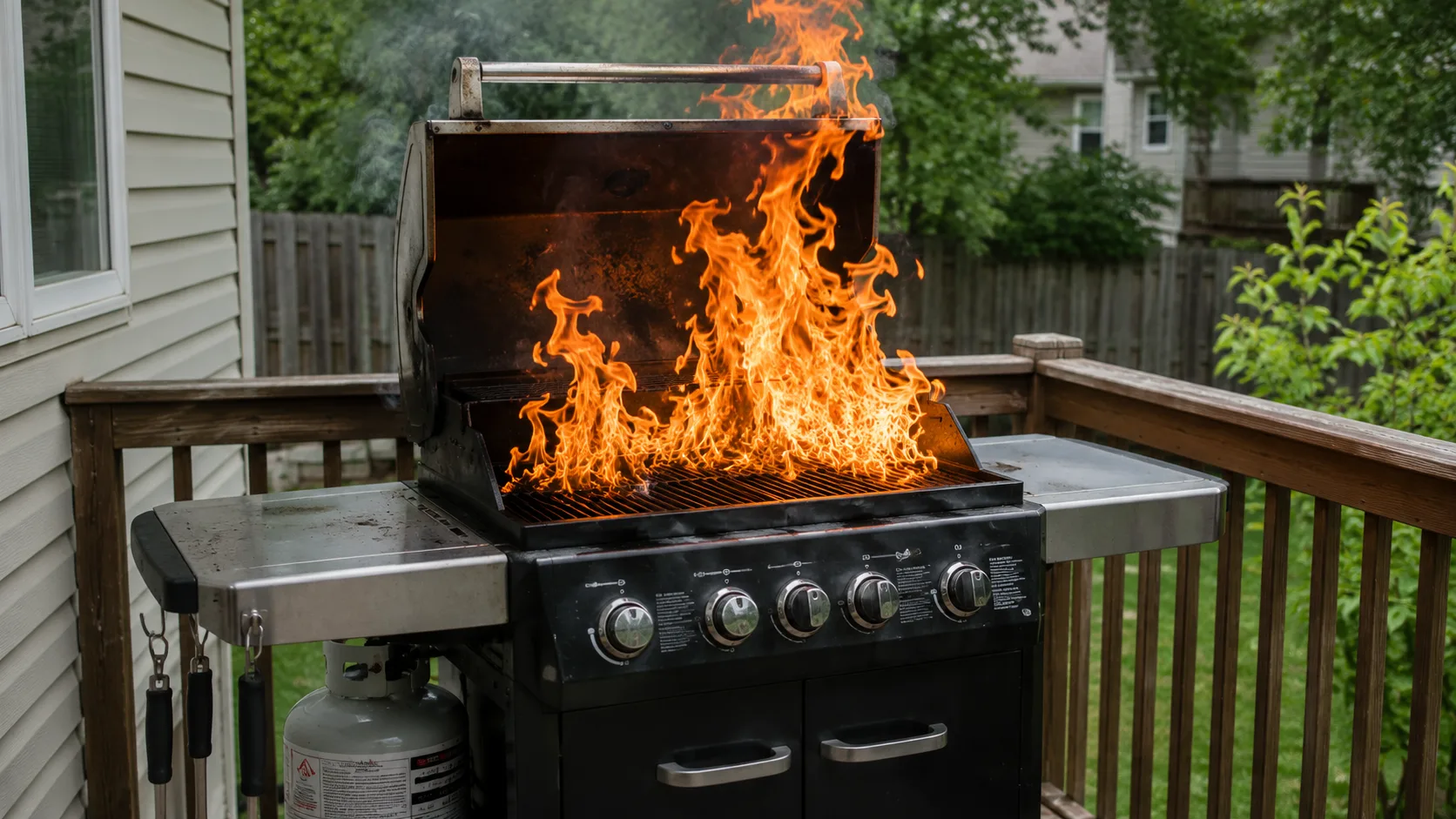
Cooking oil on fire is burning at around 600°F (315°C). Water boils at 212°F (100°C). When water hits oil at 600°F, it does not mix with the oil — it instantly vaporizes. That vaporization is the problem. Water expands approximately 1,700 times in volume when it turns to steam. In a fraction of a second, a small amount of water turns into a large amount of steam, and that steam expansion happens underneath and throughout the burning oil. The steam blast propels burning oil droplets in every direction — upward, outward, onto nearby surfaces, onto you. What was a pan fire becomes a fireball in the space of a heartbeat.
This is not a theoretical risk. It happens every single time. Even a small amount of water — a splash from a wet spoon, condensation from a frozen item — can cause a significant flare-up on a burning grease pan. The rule is absolute: no water, ever, on a burning grease fire.
Never put water on a grease fire. Never put a wet towel on a grease fire. Never put a frozen item into a burning pan. Never spray water from a distance thinking it will cool the oil. All of these cause the same steam explosion with the same result.
What To Do — Step by Step
You have seconds before a pan fire grows beyond what one person can handle. Here is the correct sequence, in order.
If you can safely reach the burner knob without putting your arm over the fire — turn it off. Removing the heat source is the most important first action. Do not skip this to grab a lid or an extinguisher first. No heat means the oil stops getting hotter and the fire becomes easier to control.
A tight-fitting metal lid cuts off the oxygen supply to the fire. Approach from the side, slide the lid horizontally over the pan, and set it down. Do not drop it from above — the impact can splash burning oil. Do not use a glass lid — extreme heat can shatter glass. Once the lid is on, leave it. Do not lift it to check. The fire needs the lid to stay on until the pan cools.
Baking soda (sodium bicarbonate) releases CO2 when heated and can smother a small grease fire. It takes a significant amount — not a pinch, but essentially dumping the entire box. A large cookie sheet or baking tray slid over the pan works the same way as a lid. Do not use flour (it is flammable and explodes similarly to water), baking powder, or any other powder you are not certain is baking soda.
Moving a burning pan of grease is one of the most common ways people get seriously burned and spread the fire. The oil sloshes, the fire follows, burning oil hits the floor or adjacent surfaces. Leave the pan exactly where it is. The stove is a contained area. The floor, the cabinet, and the wall are not.
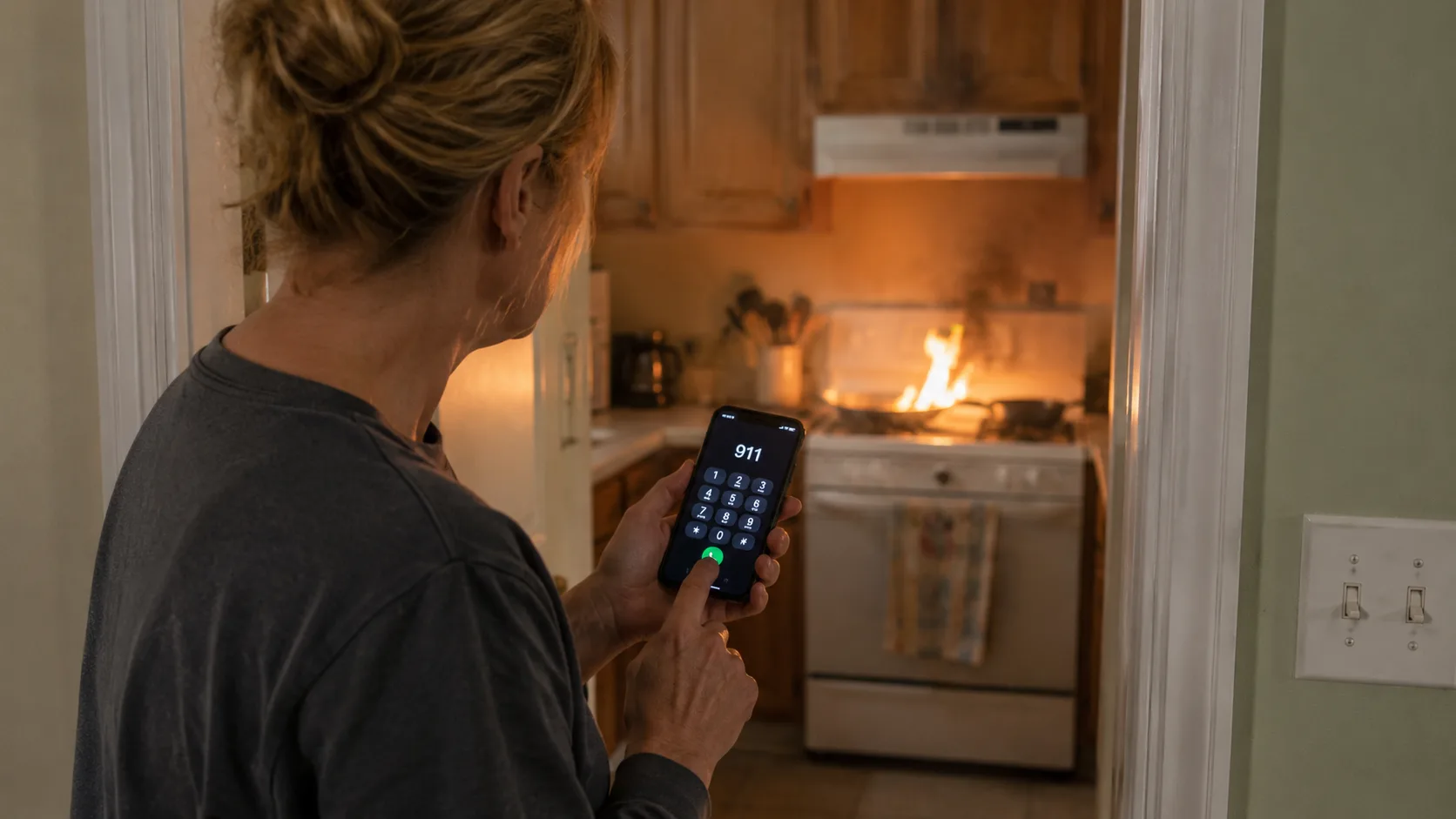
If the fire does not go out within 10-15 seconds of the lid going on, or if it spread beyond the pan before you could cover it — get out. Close the kitchen door behind you to slow the fire's spread. Alert others in the home. Call 911 from outside. Do not go back in.
✓ DO
- Turn off the burner first
- Slide a metal lid over the pan from the side
- Use baking soda if no lid is available
- Use a Class K or ABC extinguisher if trained
- Get out and call 911 if it spreads
- Close the kitchen door when you leave
- Stay low if there is smoke
✗ DO NOT
- Put water on it — ever
- Use a wet cloth or towel
- Put a frozen item in the pan
- Move the burning pan
- Use flour or baking powder
- Use a glass lid
- Open the oven if the fire is inside it
- Re-enter after evacuating
Which Fire Extinguisher Works on a Grease Fire
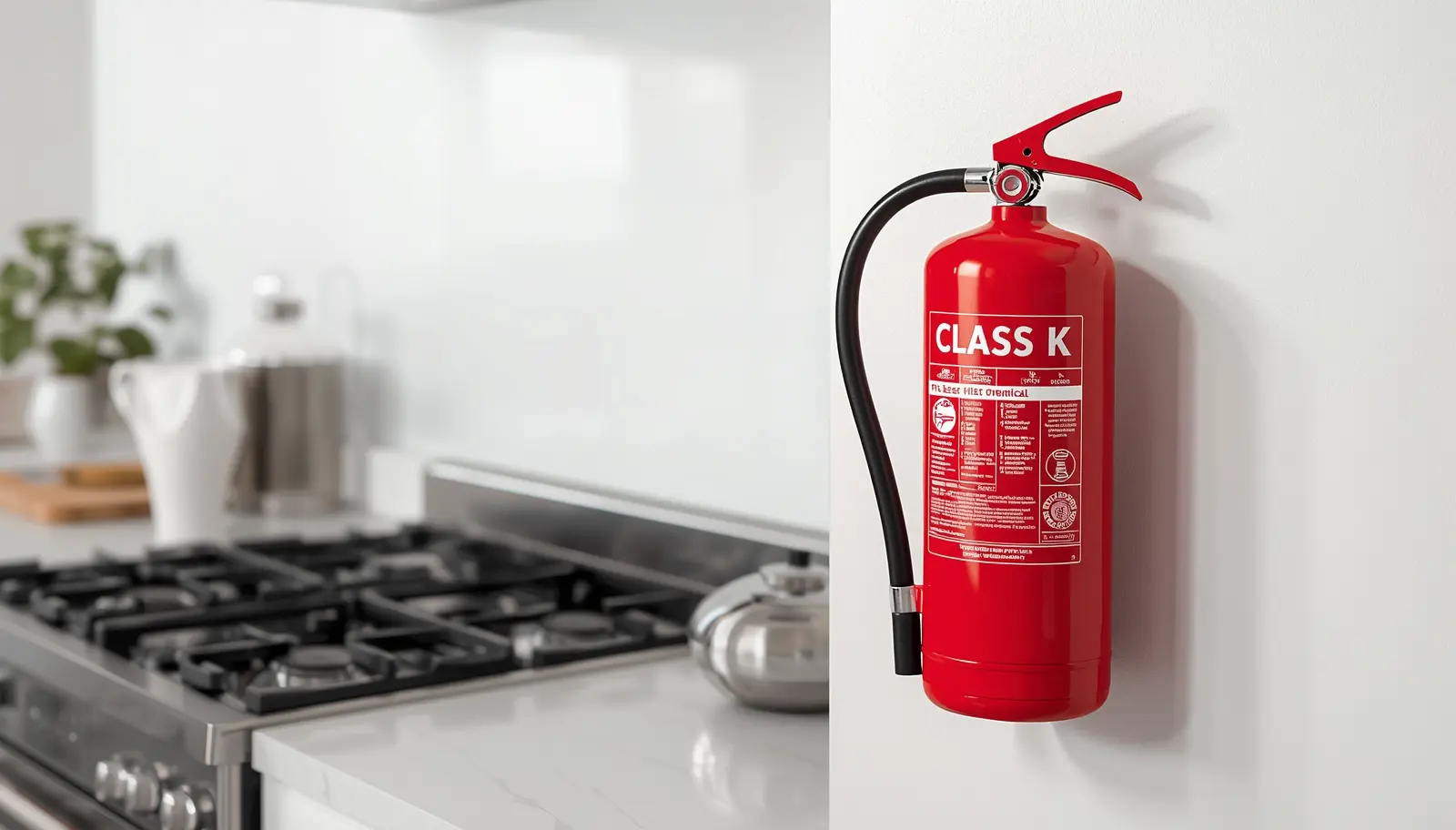
Not all fire extinguishers work the same way on grease fires, and using the wrong type can make things worse.
| Extinguisher Type | Works on Grease? | Why / Why Not |
|---|---|---|
| Class K (wet chemical) | ✅ Yes — best option | Wet chemical agent reacts with hot oil (saponification) to form a soapy blanket that seals the fuel surface and prevents re-ignition. Designed specifically for cooking fires. |
| ABC dry chemical | ⚠️ Works but with risks | Can knock down the fire but the pressure blast can also splash burning oil and spread the fire. The powder makes a mess and does not prevent re-ignition as reliably. Better than nothing, worse than Class K. |
| CO2 extinguisher | ⚠️ Partial — use carefully | Can displace oxygen and knock down flames but the high-pressure discharge can scatter burning oil. Does not cool the oil — re-ignition risk is high once the CO2 disperses. |
| Water extinguisher | ❌ No — dangerous | Same explosion risk as pouring water. Never use a water extinguisher on a grease fire. |
| Halon / clean agent | ⚠️ Limited | Works on the fire but does not cool the oil. Re-ignition risk without continued application. |
If you have a kitchen, buy a Class K extinguisher and mount it on the wall near the exit — not next to the stove. You want to be able to reach it without walking toward the fire. A typical residential Class K extinguisher costs $30–50. That is cheap compared to a kitchen fire.
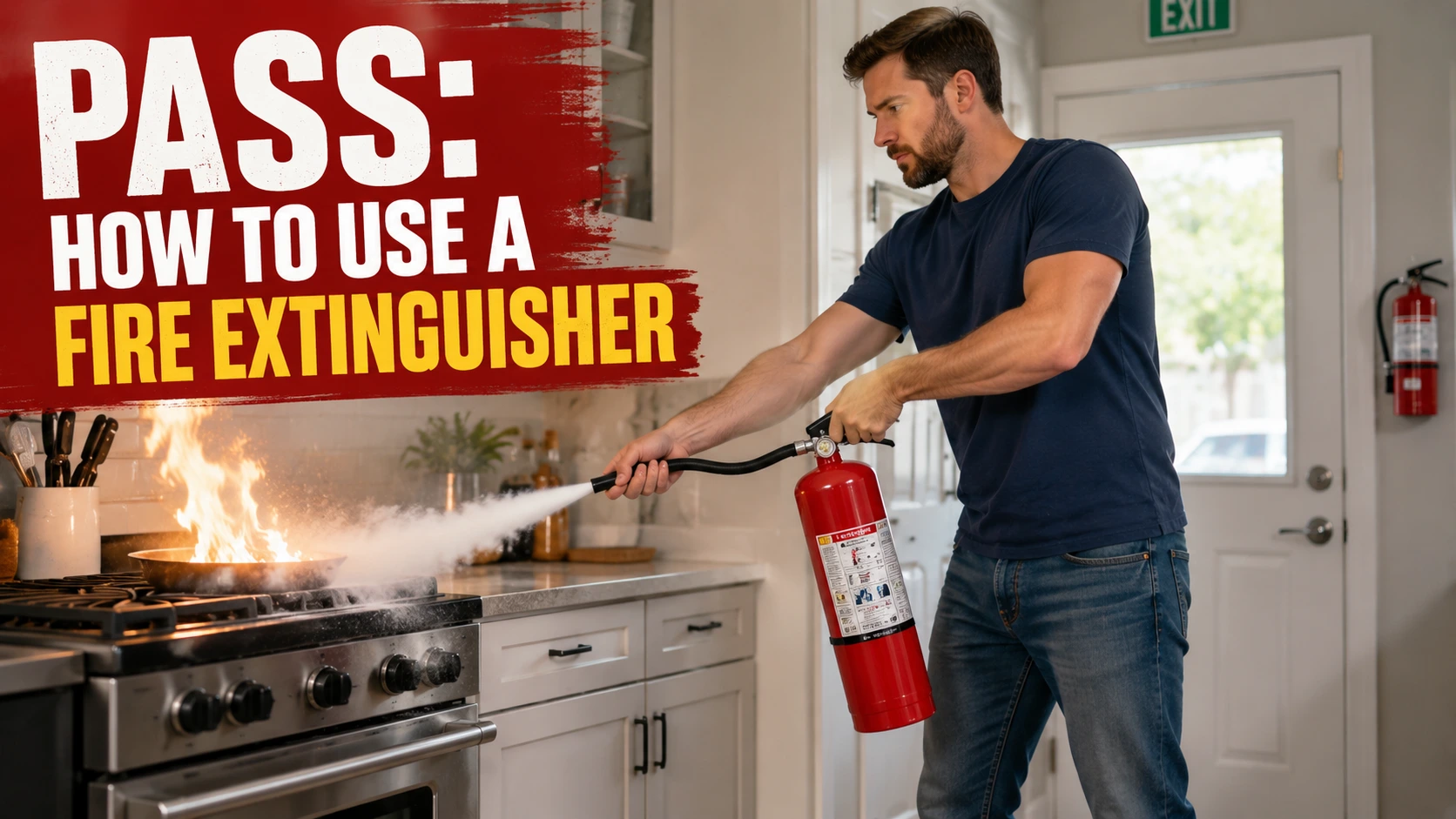
How to use an extinguisher on a grease fire: Stand back 6-8 feet. Use the PASS technique — Pull the pin, Aim at the base of the fire (not the flames), Squeeze the handle, Sweep side to side. With a Class K extinguisher, apply the agent in a gentle sweeping motion — you do not want to blast the oil the way a high-pressure dry chemical extinguisher might. After the fire appears out, watch for re-ignition for at least 15 minutes before turning away.
When to Stop Fighting and Get Out
There is a point in every kitchen fire where attempting to fight it yourself becomes the wrong decision. Knowing where that line is before you are standing in front of a burning stove is what keeps people alive.
Get out immediately if any of these are true:
- The fire has spread beyond the pan. If flames are on the cabinets, the range hood, the ceiling, or anywhere other than inside the pan — it is no longer a pan fire. Get out.
- There is heavy smoke in the kitchen. Smoke means the fire is producing toxic gases. Breathing kitchen fire smoke for more than a few seconds can incapacitate you before the fire itself reaches you.
- You do not have the right extinguisher immediately available. Going to another room to find an extinguisher while leaving a burning pan unattended is how fires spread through homes. If you have to search for it — leave.
- You are alone and any doubt exists about whether you can handle it. Pride is not worth your life. If anything about the situation makes you hesitate — go.
- Fifteen seconds have passed and the lid has not smothered it. A lid that is not working in 15 seconds means the fire is too large or the pan is too full. Go.
When you leave: close every door between you and the fire. A closed door slows fire spread dramatically — it can add 10–15 minutes before the fire breaks through. Alert everyone in the home loudly as you go. Call 911 from outside, not from inside the burning building. Give the dispatcher your address first — the rest of the information can follow.
Grease Fire Inside the Oven
Oven fires are less dramatic than stovetop fires but easy to handle wrong. If you open the oven door when there is a fire inside, you are adding oxygen. The fire gets bigger immediately. This is a mistake almost everyone makes instinctively.
What to do with an oven fire:
- Turn off the oven immediately.
- Leave the oven door closed. The oven is a sealed metal box — without added oxygen, most small oven fires self-extinguish within a few minutes.
- Watch the oven window if there is one. If the fire appears to be growing, the oven is not containing it — call 911.
- Do not open the door until the oven has cooled, even after the fire appears out. Hot grease in a sealed oven can re-ignite when exposed to air.
- After the fire is out and the oven is cool, clean the oven thoroughly before using it again. Residual grease will catch fire again on the next use.
If the fire is in the broiler drawer below the oven, the same rules apply — leave it closed, turn off the heat, and call 911 if it does not self-extinguish quickly.
After the Grease Fire Is Out
People make mistakes after the fire too, not just during it.
- Do not immediately lift the lid off the pan. The oil is still extremely hot. Introducing air can re-ignite it. Leave the lid on until the pan has cooled for at least 15-20 minutes.
- Do not assume the fire is completely out just because you cannot see flames. Grease can smolder without visible flame. Check the surrounding area — cabinet interiors, the underside of the range hood — for any sign of heat or smoke before considering the incident over.
- If you used a dry chemical extinguisher, ventilate the kitchen before going back in. The powder is irritating to airways and eyes. Open windows and doors, do not spend time in a powder-filled room.
- Have the range hood and any adjacent cabinets inspected before cooking again if the fire spread beyond the pan even briefly. Grease soaked into cabinet wood can re-ignite later.
- If you called 911 and firefighters responded, let them inspect the area even if the fire appears out. We carry thermal imaging cameras and can detect heat in walls and cabinets that you cannot see or feel.
How to Prevent a Grease Fire Next Time
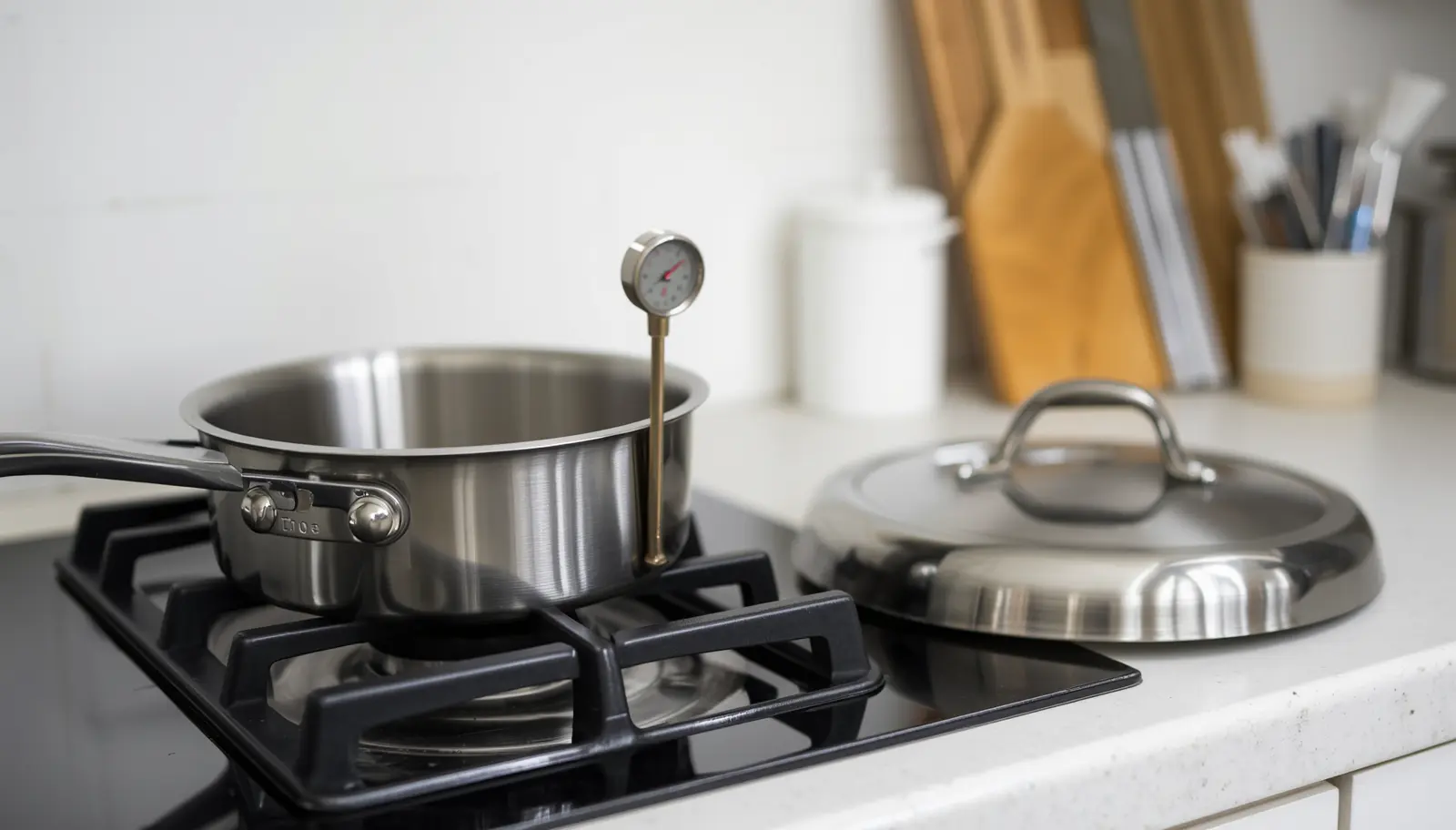
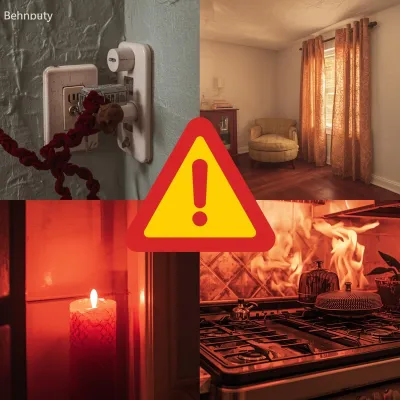
Most grease fires have the same two causes: oil left unattended on high heat, and oil heated beyond its smoke point in a pan that is too full. Both are completely preventable.
- Never leave oil heating on the stove unattended. Oil can reach its ignition temperature in under five minutes on high heat. The moment you walk out of the kitchen, the fire can start and grow before you return. If you have to leave the kitchen, turn the burner off.
- Use a thermometer when deep frying. Most cooking oils have a smoke point between 375°F and 450°F. Once oil begins smoking, it is approaching ignition temperature. A clip-on thermometer costs less than $15 and tells you exactly when to reduce heat.
- Keep the pan less than half full of oil. A full pan of hot oil is one bubble from a grease fire. The oil needs room to bubble without overflowing onto the burner.
- Dry food thoroughly before adding to hot oil. Water on food going into hot oil causes splattering. A lot of water causes a mini steam explosion that can ignite nearby surfaces.
- Keep the stovetop clean. Grease buildup on the burner area and range hood catches fire and can turn a small pan fire into a range fire. Clean the stovetop after every use involving oil.
- Keep a lid within reach whenever you are using oil. Not in the drawer, not in the cabinet — on the counter next to the stove. A lid you can grab in one second is the fastest and most effective fire response available.
- Install a working smoke alarm in or just outside the kitchen. Not inside — cooking steam triggers false alarms — but close enough to activate immediately when a fire starts. Check the battery every six months.
For more on smoke alarm placement and which type works best where, see the Smoke Alarm Placement guide. And if you want to know how fast a kitchen fire can become a whole-room fire, the House Fire Spread article covers that in detail — the numbers are worse than most people expect.
Quick Reference: Grease Fire Response
| Situation | Correct Action | What NOT to Do |
|---|---|---|
| Small pan fire, just started | Turn off heat, slide metal lid over pan from the side | Add water, move pan, use glass lid |
| No lid available | Pour large amount of baking soda, use cookie sheet | Use flour, baking powder, or any other powder |
| Fire is larger or spreading | Use Class K extinguisher if trained and immediately available | Fight with wrong extinguisher type, re-enter after leaving |
| Fire spread beyond pan | Get out, close doors, call 911 from outside | Stay to fight, go back in after leaving |
| Oven fire | Turn oven off, keep door closed, wait | Open the oven door |
| After fire is out | Leave lid on 20 min, inspect area, ventilate if powder used | Lift lid immediately, assume it's fully out without checking |
Grease fires are fast. They go from a shimmer of smoke to a ceiling-high fireball in seconds. The people who come out of these incidents without injury are almost always the ones who knew ahead of time what to do — not because they figured it out in the moment, but because they had thought about it before. Share this with whoever cooks in your home. It is worth two minutes of their time.
Comments 0
No comments yet. Be the first to share your thoughts!
Leave a Comment