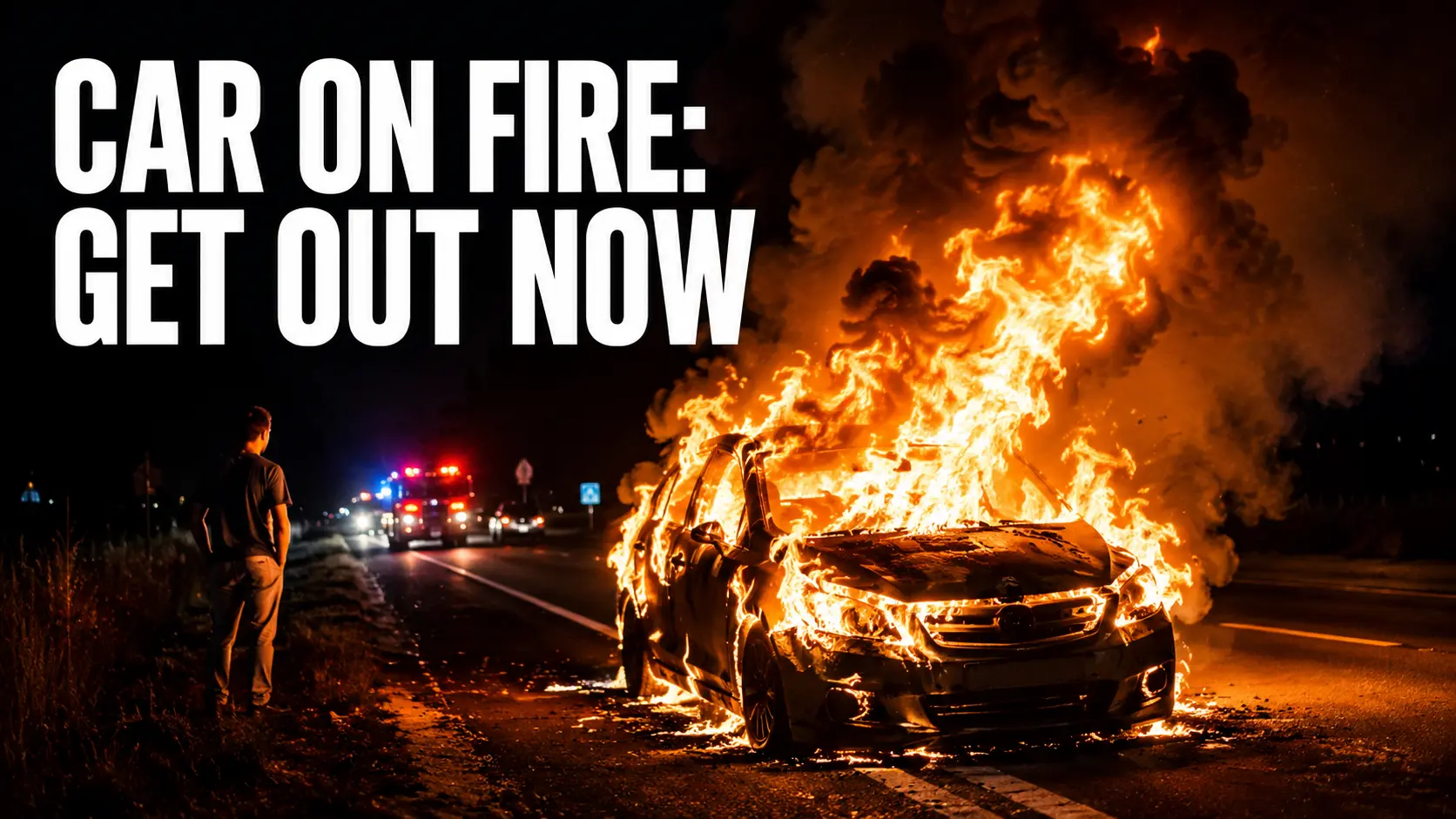

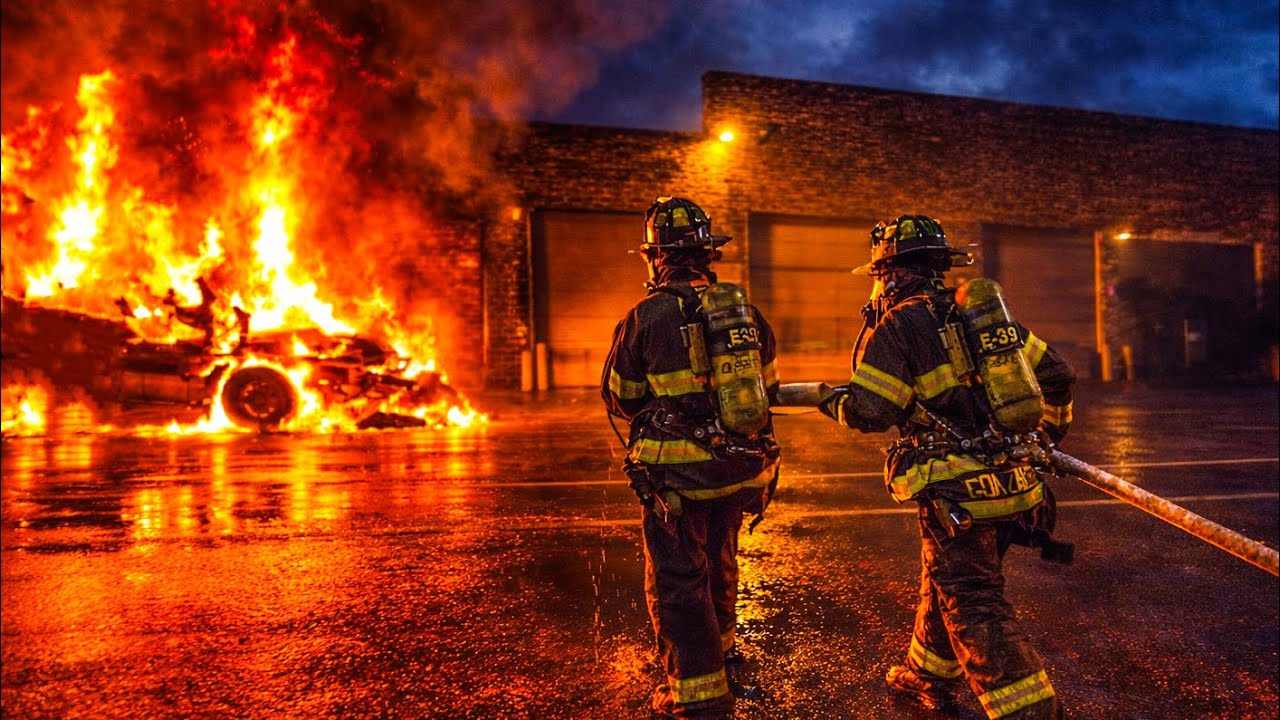
A car fire gives you less time than you think. I have responded to hundreds of vehicle fires over my career, and the pattern in the bad outcomes is almost always the same: the driver saw smoke, hesitated, tried to figure out what it was, grabbed something from the back seat, and then could not get out. The entire thing from first smoke to fully involved vehicle takes two to three minutes on average. In a bad case — fuel leak, electrical fire — it can be under sixty seconds. What you do in those first seconds is the only thing that matters.
What's in this article:
The First 60 Seconds
The single most important thing to know:
Get yourself and everyone else out of the vehicle immediately. Do not go back for anything. Do not try to drive it somewhere. Move at least 100 feet away and call 911. Everything else in this article is secondary to this.
People die in car fires because they go back. They go back for the phone, for the laptop, for the dog in the back, for the bag on the seat. The car is worth nothing. The phone is worth nothing. Your life and the lives of the people with you are the only things that matter when a car is on fire.
Here is the sequence that gives you the best outcome:
The moment you confirm something is wrong — smoke, flames, burning smell that does not go away, dashboard warning lights combined with heat smell — the decision is made. Everyone exits now. Do not wait to confirm what it is. Do not wait to finish a call. Get out.
Do not stand next to the car to watch it. One hundred feet minimum. Upwind if there is any wind direction you can identify. Car fires produce toxic smoke — burning plastic, rubber, upholstery, and fuel produce gases that can incapacitate you quickly. The tires can pop. The windows can shatter. Move away and stay away.
Give them your location first — highway name and mile marker, street address, or the nearest landmark. Then tell them a vehicle is on fire. Stay on the line. If you are on a highway, get behind a barrier if possible while you wait.
Not for the phone, not for a pet, not for medication, not to try to put it out, not to grab anything. The car can be replaced. You cannot. If a pet or a person is still inside and the fire is in the early stage, a trained decision can be made about a rescue attempt — but that decision must be made instantly and only if the fire is small and confined. It is not made by going back for belongings.
If You Are Driving When the Fire Starts
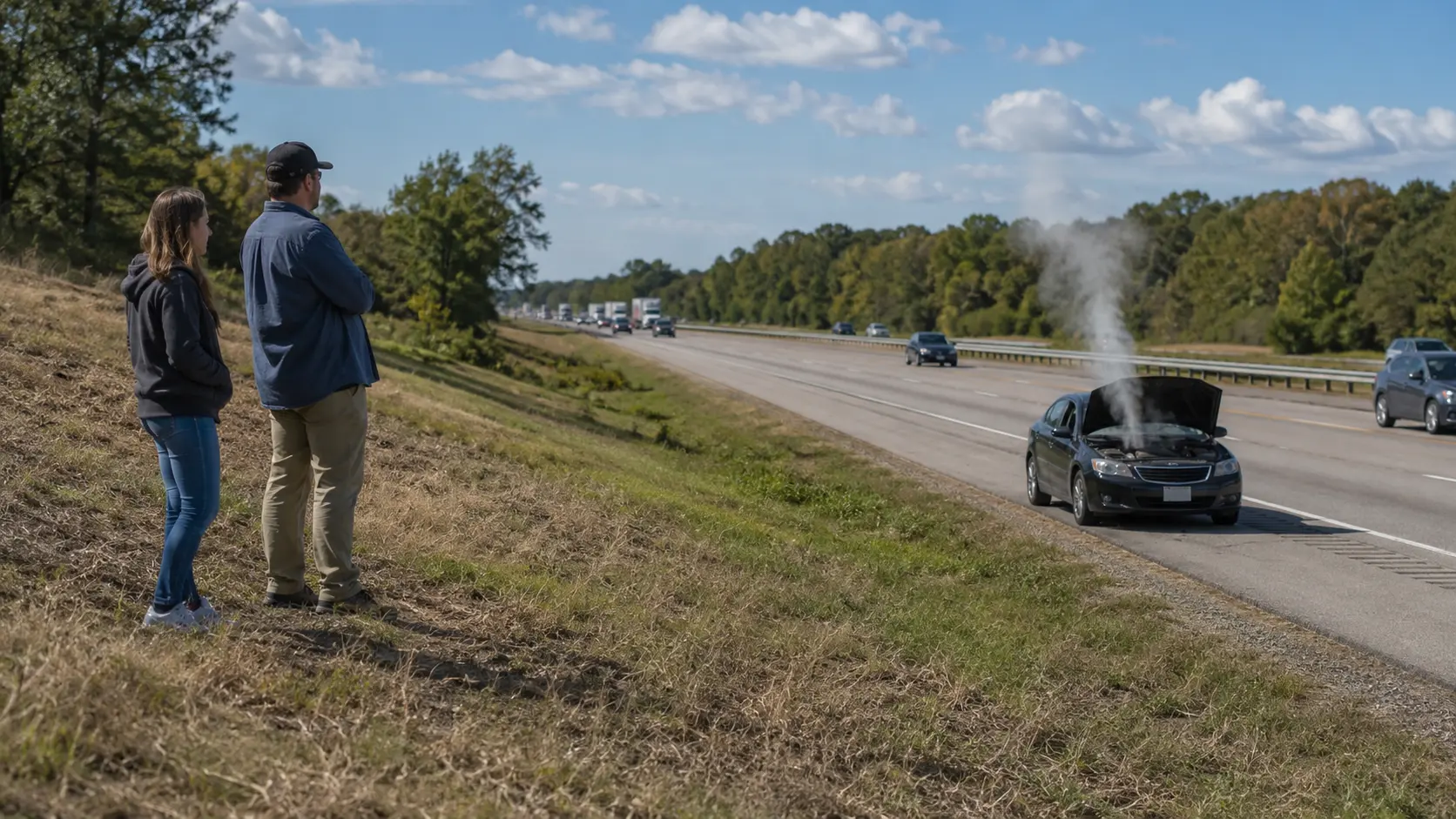
A fire that starts while you are moving is a two-part problem: stopping safely and getting out. Here is the sequence:
- Signal and pull over immediately. Do not wait for an exit or a better spot. Signal, pull as far right as possible — breakdown lane, road shoulder, off the road entirely if accessible. Turn the hazard lights on before you stop.
- Turn the engine off. This cuts fuel delivery to the engine. For an engine fire, this is the most useful thing you can do in the car before you get out.
- Get everyone out through the door farthest from the flames. If the fire is at the front of the car, exit through the rear doors. If doors are jammed, use the window. A window breaker kept in the glove compartment or door pocket is cheap and worth having for exactly this situation.
- Do not open the hood if you can see flames under it. Opening the hood introduces oxygen and the fire flares immediately into your face. The hood stays closed.
- Move away from traffic as well as away from the car. On a highway, a car fire in the breakdown lane is a distraction that causes secondary accidents. Get behind a barrier, behind a guardrail, or off the road entirely — not standing on the shoulder.
What if the door won't open?
Seatbelt first — cut it if necessary with a blade kept in the center console. Window next — try the electric window while power is still on. If not, break it. The corners of the window are the weakest point; hit with an elbow, a headrest post, or a window breaker. Push the broken glass out before climbing through. Move fast — you do not have time to be careful about cuts.
If Your Parked Car Catches Fire
A parked car fire is more common than people realize — electrical faults, catalytic converter heat on dry grass, arson, or a fire that starts in an adjacent vehicle and spreads. If you discover your parked car on fire:
- Do not get in to move it. A car on fire in your driveway is a driveway problem. A car on fire that you tried to move and stalled in the middle of the street is a different problem.
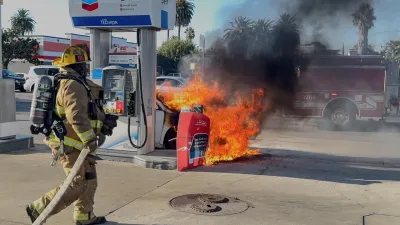
- If the fire is very small (a smoldering electrical smell, a tiny flame visible under the hood) and you have a car extinguisher immediately available and know how to use it, a quick attempt may be appropriate — but only if the fire has not yet involved the fuel system. One attempt. If it does not go out immediately, move away.
- Alert neighbors if the vehicle is near a structure, fence, or other vehicle. Fire spreads to adjacent vehicles fast — particularly in a garage or parking structure.
- If the car is in a closed garage: do not open the garage door into the house. Open the garage door to the outside and stay outside. A car fire in a garage is a garage fire within minutes.
Do Cars Actually Explode?
This is the question everyone has because of what they have seen in films. The honest answer: it depends on the vehicle, and real explosions are less common than Hollywood suggests — but they do happen, and the risks are real enough that the 100-foot distance rule is not exaggerated.
| What Can Cause an Explosion or Sudden Flare | How Likely | Danger Range |
|---|---|---|
| Gas tank explosion (fuel vapor ignition) | Less common than films suggest, but real — more likely with a fuel leak | 50-100+ feet — burning fuel can travel |
| Tire pop / blowout from heat | Very common | Startling, can scatter debris — stay back |
| Window shattering from heat | Common | Glass fragments — stay back and upwind |
| Airbag deployment from heat | Common in fully involved fires | Loud bang, debris — stay back |
| Aerosol cans in cabin (hairspray, washer fluid, etc.) | Common — most cars have aerosols in them | Explosive — can project debris at speed |
| EV battery thermal runaway | Lower probability but severe when it occurs | 100+ feet — produces toxic gas and extended burn |
The practical answer: treat every car fire as if an explosion is possible. The 100-foot rule exists because things you cannot predict can happen fast. Tires have popped and thrown burning rubber 30 feet. Windows have shattered into bystanders who were five feet away. Aerosol cans have projected like projectiles from burning interiors. The car is not safe to stand next to. Move away and stay away.
Should You Try to Fight a Car Fire?
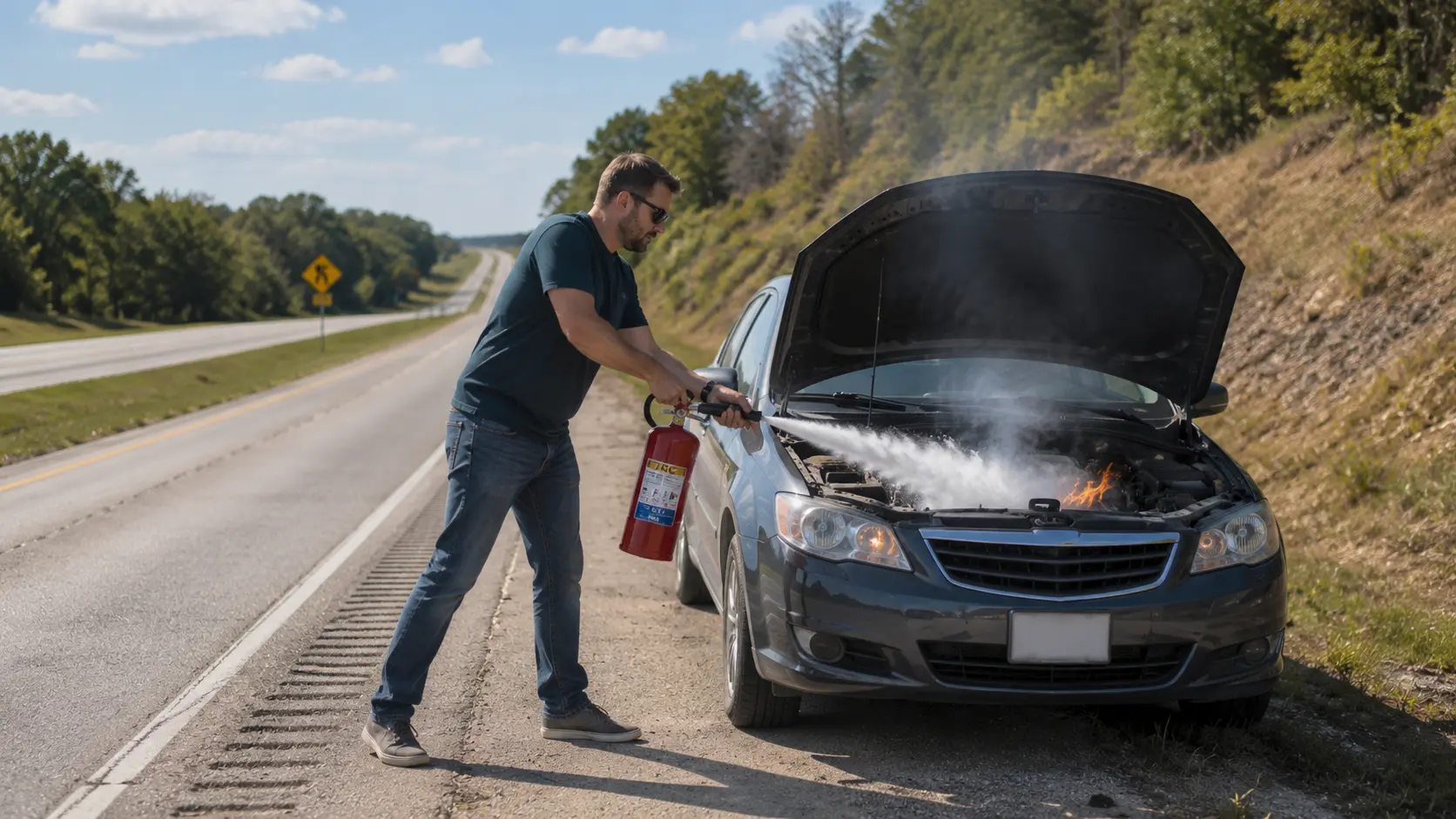
The short answer: only if the fire is very small, all occupants are already out of the car, and you have an appropriate extinguisher immediately available. Even then, one attempt. If it does not work immediately, leave.
The right extinguisher for a car fire is an ABC dry chemical extinguisher — rated for Class A (ordinary combustibles like seat foam and plastic), Class B (fuel fires), and Class C (electrical fires). A small 2.5 lb or 5 lb ABC extinguisher in the trunk is worth keeping. Not because you will always need it, but for the situations where a very early intervention makes the difference between a melted dashboard and a lost vehicle.
When not to attempt using an extinguisher:
- Anyone is still in or near the vehicle
- The fire is in the fuel tank area (rear of most vehicles)
- You cannot get to the extinguisher without approaching the fire
- The fire has spread beyond the engine compartment
- There is no clear escape route behind you
- You do not know how to use an extinguisher (PASS: Pull, Aim, Squeeze, Sweep)
Smoke or Burning Smell Inside the Cabin
Smoke inside the car without visible external flames is actually more dangerous in some ways than a visible fire — because people are more likely to think it is not an emergency. It is.
A burning electrical smell, plastic burning smell, or smoke coming from the dashboard, vents, or floor is a fire starting somewhere inside the car. These fires move through the cabin lining, the dash, and the wiring harness quickly and can flash to open flame without much warning. If you smell burning inside the car:
- Pull over immediately and turn the engine off.
- Get everyone out.
- Do not try to identify the source by looking under the dash or pulling panels. If it is electrical, disconnecting something can cause a spark. If it is already smoldering, introducing air helps it.
- Call 911. An electrical fire in the wall of a vehicle is not something you can handle with a car extinguisher.
Burning smell from under the car after a long highway drive? This is often the catalytic converter — the catalytic converter runs at extremely high temperatures (800–1,800°F) and can ignite dry grass or debris if you park over it. This is common in wildfire-prone areas in summer. Do not park over dry vegetation. If you smell burning after parking, check underneath from a distance before assuming it is safe.
Electric Vehicle Fires Are Different
If you drive an EV or are near one that catches fire, the rules are the same but the risks are higher. EV battery fires produce hydrogen fluoride gas — toxic at very low concentrations — and can re-ignite hours after appearing to be out. The water that firefighters use to suppress EV fires is contaminated with toxic chemicals.
If your EV catches fire: the evacuation rules are identical — get out, get 100 feet away, call 911. Do not attempt to fight an EV battery fire with a conventional extinguisher. Do not return to a recently extinguished EV fire area without being told it is safe by firefighters. For a detailed breakdown of EV fire behavior and risks, see the EV Fire Response article.
Warning Signs Before a Car Catches Fire
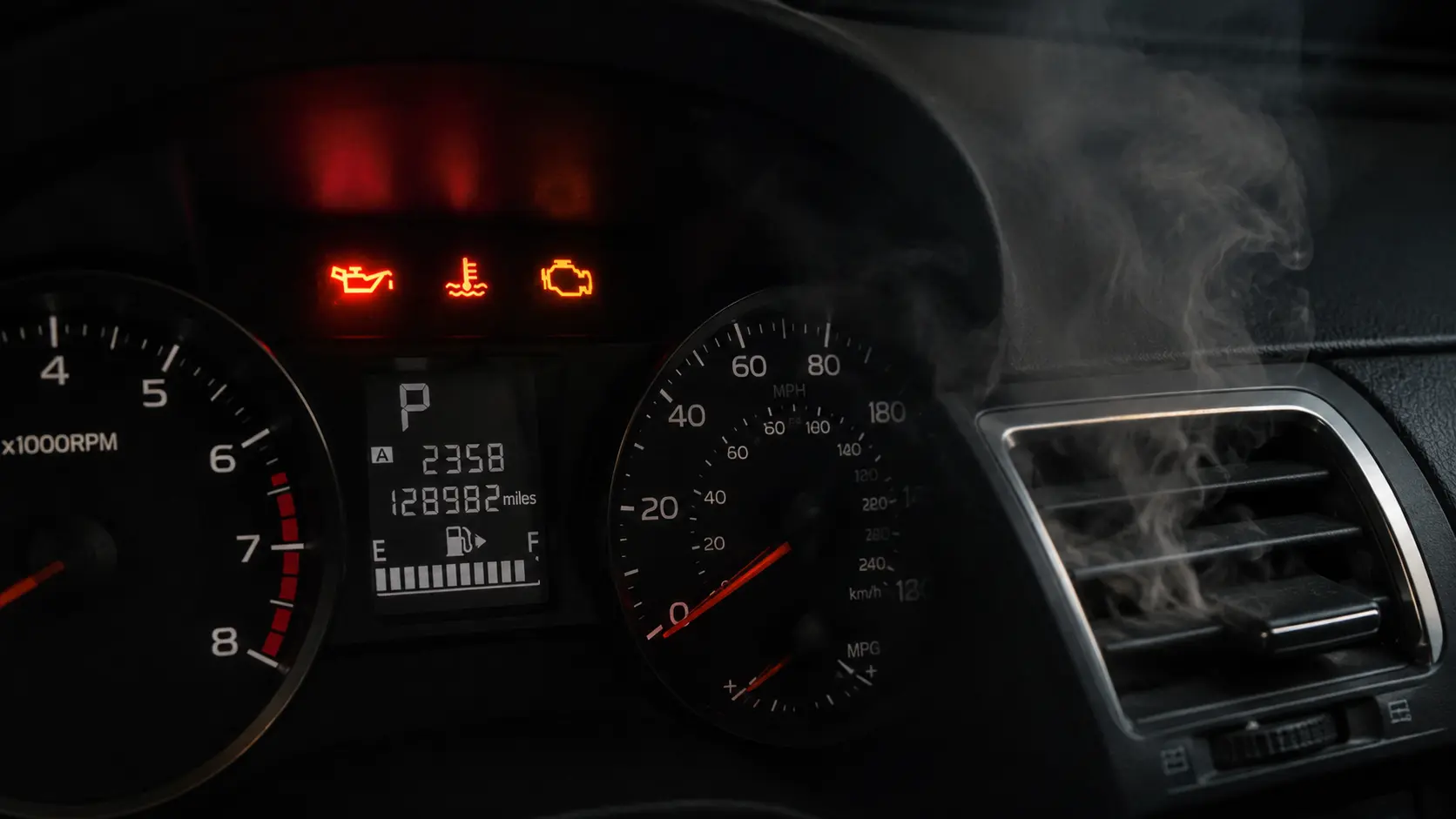
Most car fires do not start without warning. Here are the signs that something is wrong before the fire becomes obvious:
- Burning smell that does not go away. A brief burning smell when you first start a cold engine is sometimes normal. A persistent burning smell while driving is not. Pull over.
- Oil light plus burning smell. Oil dripping onto a hot exhaust manifold catches fire. This combination is an emergency.
- Smoke from under the hood. Not steam — smoke. Steam is white and dissipates quickly. Smoke is grey or black and lingers. Pull over immediately.
- Electrical issues combined with burning smell. Flickering lights, blown fuses repeatedly, or electrical components stopping working alongside any burning smell — this is an electrical fire in progress.
- Visible fluid leaks under the car after parking. Fuel, brake fluid, and power steering fluid are all flammable. A leak that reaches a hot exhaust component can ignite.
- Overheating beyond normal range. An overheating engine that goes unaddressed can eventually lead to oil and fuel ignition. When the temperature gauge goes into the red — pull over and turn off the engine.
None of these are situations to drive through to reach a mechanic. Pull over safely, get out, and figure out what is wrong from outside the vehicle. If you see smoke or smell burning, the answer is always the same: stop, get out, move away.
The One Thing to Remember
Everything in a car can be replaced. The car, the phone, the laptop, the bag, the purchases in the trunk. Nothing inside that car is worth going back for. The people who get hurt in car fires almost always made one decision wrong: they went back. Do not go back. Get out, get far, call 911, and let firefighters do their job.
Keep a small ABC extinguisher in the trunk, a window breaker on your keychain or in the door pocket, and a phone charger so your phone is working if you need to call for help. Those three things cover you for most vehicle emergency scenarios. The rest is knowing what to do — and now you do.


I find this bland