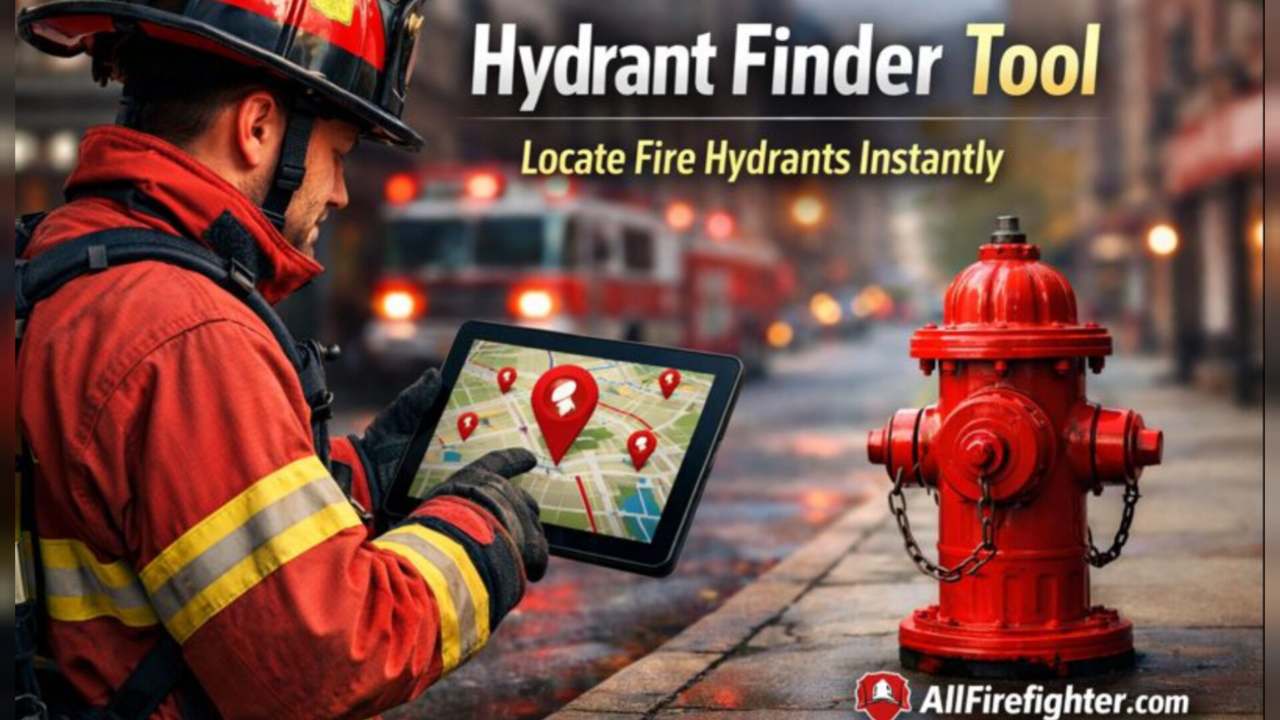

Hydrant Finder Guide – Build a First-Due Hydrant Plan (Primary/Secondary) + Field Verification Checklist
Last updated:
Hydrant maps are useful only if they turn into actionable first-due options. The goal is not to prove “a hydrant exists” — the goal is to select a primary hydrant, a secondary hydrant, and a fallback supply plan when access, operability, or coverage breaks down. This guide shows how to use Hydrant Finder for realistic preplans, then how to validate those choices in the field.
Jump to:How to use Hydrant Finder · Primary/secondary selection · A fast first-due workflow · Field verification checklist · Coverage gaps & fallback triggers · Common mistakes · FAQ
Open Hydrant FinderHydrant Flow CalculatorFriction Loss Calculator
How to Use Hydrant Finder (Map Scan in 60 Seconds)
Hydrant Finder is designed to be quick: go to a location, set a search radius, scan the visible map area, then review results as candidates—not guarantees.
- 1) Start with the target: search an address (target hazard, preplan location, first-due block) or use device location.
- 2) Choose a radius: dense city blocks can use small radius; suburban/rural areas often need a wider scan.
- 3) Move/zoom the map: center the map on your intended approach routes and likely apparatus positioning.
- 4) Scan the area: search the visible area and open the results list for candidate hydrants.
- 5) Build options: select a primary and secondary candidate—then plan field validation.
Primary vs Secondary Hydrant: How to Choose Like an Operator
Hydrant choice is an operational decision. Your primary hydrant should be your “fastest reliable” option. Your secondary hydrant should be your “if the primary fails” option—ideally from a different approach angle or with different access constraints.
| Option | What you’re optimizing for | What to document |
|---|---|---|
| Primary hydrant | Shortest realistic lay + safest placement + simplest routing | Approach path, likely connection point, any known obstructions |
| Secondary hydrant | Redundancy: alternate block/angle/access or likely different main | Alternate route, traffic hazards, backup lay plan |
| Fallback plan | What you do when hydrants are sparse or unreliable | Relay/tanker shuttle trigger, drafting options, staging notes |
After selecting candidates, connect the plan to flow and hose decisions:
- Hydrant Flow Calculator for training reference flow estimates and discussion
- Friction Loss Calculator to sanity-check long lays and high-flow packages
- Fire Flow Calculator to align expected demand with realistic supply options
A Fast First-Due Workflow (Preplan to Street)
This workflow keeps preplans usable. It fits in a quick company-level familiarization block:
- Identify the target hazard (or neighborhood) and open Hydrant Finder.
- Select 2 candidates (primary/secondary) based on approach and placement—not just distance.
- Walk/drive-by verify access and constraints. Document problems (gates, landscaping, snow berms, traffic patterns).
- Update your notes and teach the plan to the crew (who connects, where the engine spots, what the backup is).
- Re-check periodically—construction and seasonal issues can break a plan quickly.
Field Verification Checklist (What Maps Can’t Tell You)
Use this checklist during familiarization. It’s the difference between a “map pin” and an operational option.
- Access & clearance: can you reach it with your rig and connect safely (no fencing, snow berms, parked cars, landscaping)?
- Apparatus placement: does the hydrant location allow safe spotting without blocking egress or creating traffic hazards?
- Connections: caps present, threads intact, outlet orientation workable, no obvious damage or leaks.
- Ownership: public vs private hydrant (industrial/HOA/campus systems). Note restrictions and reliability concerns.
- Seasonal risk: snow/ice, flooding, vegetation growth, construction frequency.
- Hose routing: does your lay avoid sharp bends, pinch points, and high-traffic crossings?
- Document a one-liner: “clear access,” “behind gate,” “snow risk,” “private campus,” “busy intersection,” etc.
Coverage Gaps: When Hydrants Are Sparse (Fallback Triggers)
Hydrant coverage is not uniform. In fringe areas, new developments, industrial zones, and rural interfaces, you may see gaps. When gaps appear, preplan your trigger points:
- Distance/lay becomes inefficient: long lays that compromise pressure stability and response speed.
- Access is unreliable: gated communities, private roads, seasonal obstructions.
- Supply is uncertain: limited mains, unknown reliability, frequent construction zones.
When these triggers show up, plan alternatives early (relay, tanker shuttle, drafting, staging and water supply group assignments) based on your department’s playbook.
Common Mistakes (That Break Preplans)
- Picking the closest hydrant only: distance is not the same as reliability. Placement and access matter more.
- One-hydrant planning: always build primary + secondary options.
- Not re-checking: construction and seasonal changes can turn a “good hydrant” into a non-option.
- Ignoring hose lay realities: long lays and traffic crossings require friction-loss and routing discipline.
- Assuming map completeness: sparse results may reflect mapping gaps, not hydrant absence.
Open Hydrant FinderFire Station LocatorEMS Locator
FAQ – Hydrant Finder
Where does Hydrant Finder get hydrant locations?
Hydrant locations are sourced from OpenStreetMap (OSM) data. Coverage and completeness vary by region.
Why do I see no hydrants in my area?
Your area may be under-mapped, or hydrants may be sparse. Zoom out, expand the radius, and scan a wider area—then verify in the field.
Can I use this for operational decisions?
Use it for planning and familiarization. On-scene decisions must follow SOP/SOG and real-world conditions.
What should I do after I find hydrants on the map?
Select primary/secondary candidates, verify access and constraints in the field, document notes, and connect the plan to your hose lay and expected demand.








Comments 0
No comments yet. Be the first to share your thoughts!
Leave a Comment