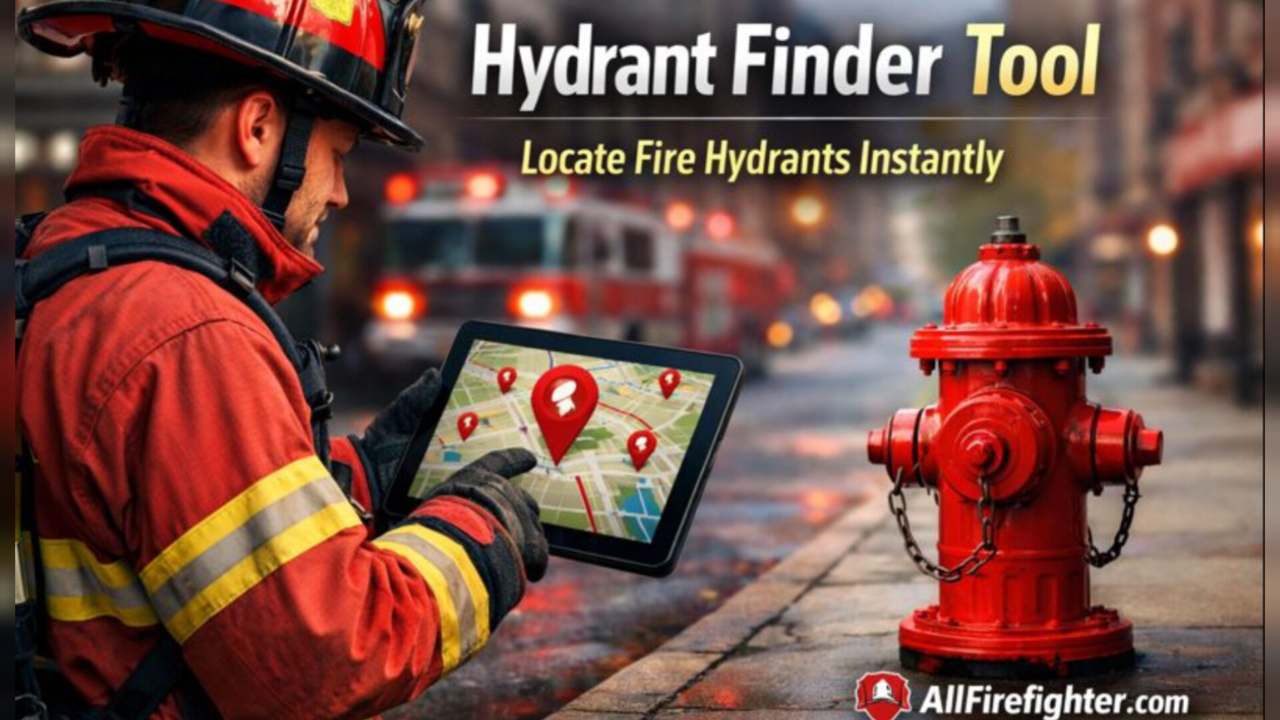

Hydrant Finder (Map) – Find Fire Hydrants Near You for Preplans, Water Supply & Engine Ops
Last updated:
Hydrants are a cornerstone of reliable water supply — but hydrant availability, access, and operability can change by block, season, and jurisdiction. This guide shows you how to use Hydrant Finder to build better preplans, identify likely water supply options, and ask the right verification questions before you’re under pressure on scene.
Jump to:How to use Hydrant Finder · Preplan workflow · Field verification checklist · Common pitfalls · Popular states · Popular countries · FAQ
Open Hydrant FinderHydrant Flow Calculator
How to Use Hydrant Finder (Fast Workflow)
Hydrant Finder is designed to be quick: jump to a location, choose a search radius, and scan the current map area for hydrant markers and results.
- Start with a target area: use the address search (target hazard, station area, or first-due) or use your device location.
- Set a realistic radius: start small in dense urban areas; go wider in suburban/rural districts.
- Move/zoom the map: center the map over the area you want to evaluate.
- Search the visible area: run the scan and review markers + results list.
- Open results in navigation: spot-check access routes and approach constraints.
Preplan Workflow: Turn Map Pins into Actionable Options
The goal isn’t to “prove a hydrant exists” — the goal is to build options and document constraints. A strong preplan creates redundancy: primary hydrant, secondary hydrant, and a fallback plan if both fail.
| Preplan Output | What to Capture | Why It Matters |
|---|---|---|
| Primary hydrant | Likely best access + shortest lay + safest apparatus placement | Fastest reliable supply option under real-world constraints |
| Secondary hydrant | Alternative approach route, different block, or different main | Redundancy for blocked access, damaged outlets, or dead-end mains |
| Coverage gap / fallback | Where hydrants are sparse; note tanker shuttle/relay/other sources | Prevents “hydrant surprise” and speeds up decision-making |
Once you’ve identified candidates, connect the dots with the rest of your water supply toolkit:
- Hydrant Flow Calculator for flow estimates (training/reference)
- Friction Loss Calculator for line selection and PDP checks
- Fire Flow Calculator for quick demand estimates during drills
Field Verification Checklist (What to Confirm Before You Trust It)
Map data can’t tell you what a walk-around can. Use this checklist during familiarization or preplan updates.
- Access: Is the hydrant reachable (no gates, fencing, snow berms, landscaping, or parked vehicles blocking the approach)?
- Apparatus placement: Can you safely position without creating an intake problem or traffic hazard?
- Connections: Caps present, threads intact, outlet orientation workable for your hose lay.
- Operability: Wrench fit, valve condition, barrel damage, visible leaks (testing per policy).
- Ownership: Public vs private hydrant (industrial campuses, HOA systems) — note restrictions.
- Seasonal constraints: snow, flooding, vegetation growth, construction patterns.
- Documentation: Add a one-line note: “clear access,” “behind gate,” “snow risk,” “private campus,” etc.
Common Pitfalls (and How to Avoid Them)
1) Treating mapped hydrants as guaranteed supply
Hydrant presence does not guarantee function, pressure, or access. Use the map to generate candidates, then verify in the field.
2) Planning with only one hydrant option
Build a primary + secondary plan. In real incidents, access can change quickly due to traffic, apparatus placement, or line-of-duty hazards.
3) Ignoring hose lay realities
Even a close hydrant can be a poor choice if it forces unsafe routing or conflicts with optimal apparatus placement. Validate with a quick friction loss/PDP check: Friction Loss Calculator.
4) Not accounting for incomplete map coverage
Some regions have partial hydrant mapping. If you see sparse results, expand radius and consider additional verification steps.
Quick Links: 5 Popular States (Career & Planning Resources)
These are commonly researched states for fire service careers and relocations. Use them as starting points while you build your local preplan resources.
Quick Links: 5 Popular Countries (Tools & Coverage)
If you’re outside the U.S., you can still use the map-based workflow for planning and familiarization. Start with the tools below and select your country/region inside the tool interface where available.
Note: These country links open the Hydrant Finder tool. Availability and completeness depend on regional mapping coverage.
FAQ – Hydrant Finder
Where does Hydrant Finder get hydrant locations?
Hydrant locations are sourced from OpenStreetMap (OSM) data. Coverage can vary widely by region and local mapping activity.
Why do I see no hydrants in my area?
Your area may be under-mapped. Zoom out, increase radius, and try scanning a broader area. If you still see nothing, plan on field verification and alternative water supply options.
Can I use this for operational decisions?
This is intended for planning, training, and familiarization. Always confirm hydrants on scene and follow your department SOP/SOG.
What should I do after I find hydrants on the map?
Pick a primary and secondary hydrant option, then verify access and operability in the field. Document constraints and connect your plan to hose lay and flow assumptions.







Comments 0
No comments yet. Be the first to share your thoughts!
Leave a Comment