📅 2025 firefighter training guide. Search and rescue tactics must always follow department SOPs, incident command direction, current training standards, staffing, building conditions, and risk assessment. This guide is educational and does not replace hands-on instruction from qualified fire service instructors.
Firefighter Search & Rescue Training 2025: Primary Search, Victim Drags & Zero Visibility Skills
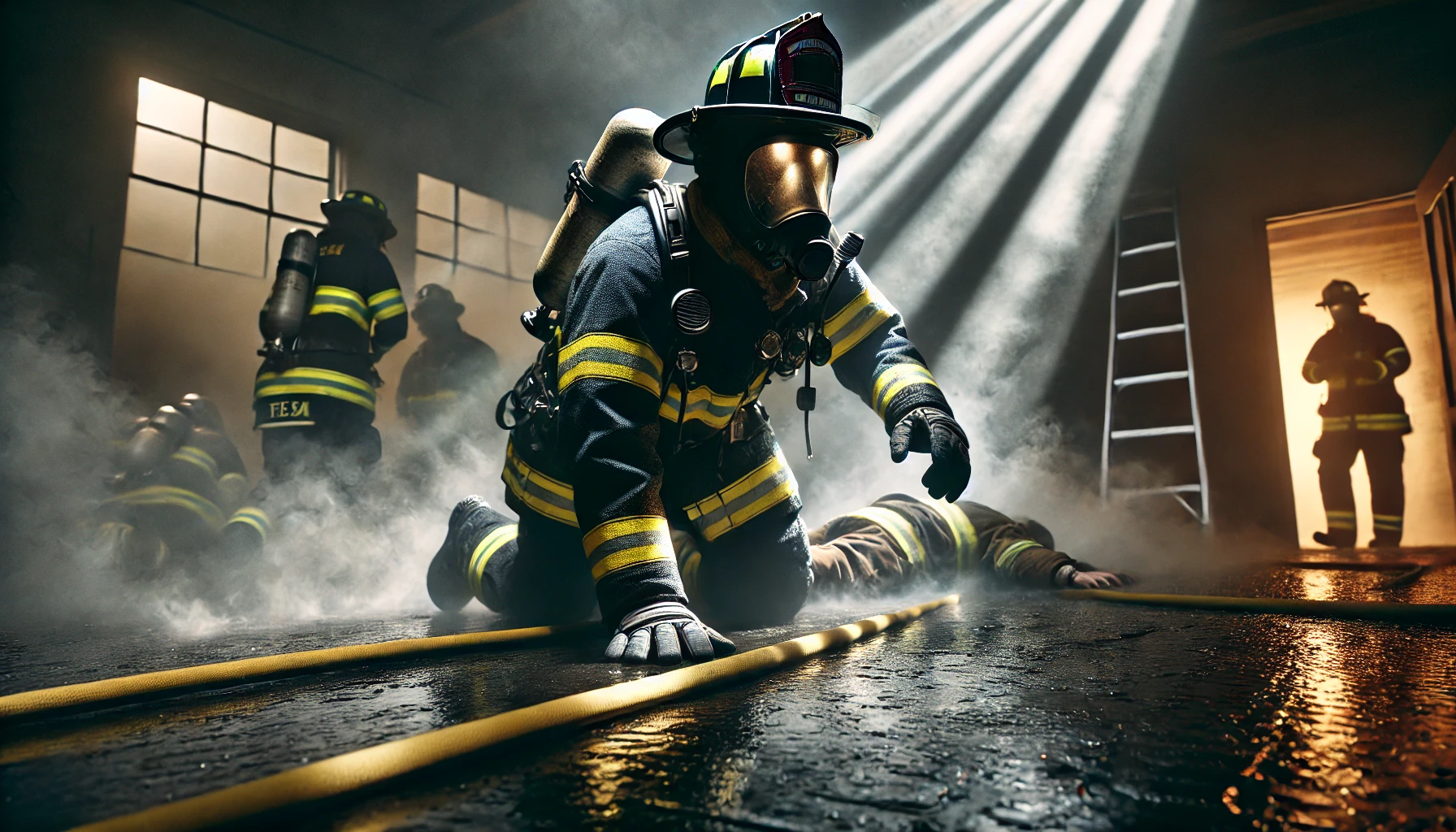
Search and rescue is one of the highest-risk and highest-value functions on the fireground. Firefighters may be asked to enter a smoke-filled structure, maintain orientation, locate victims, communicate conditions, remove occupants, and exit before conditions deteriorate. Successful search work depends on speed, discipline, communication, thermal imaging skills, crew integrity, air management, and the ability to operate in zero visibility without panic.
This 2025 guide covers the core skills firefighters and recruits should understand: primary search, oriented search, room search patterns, thermal imaging camera use, VEIS basics, zero-visibility movement, victim drag methods, firefighter survival, Mayday awareness, and rapid intervention team fundamentals.
Jump to:Search priorities · Primary search · Oriented search · TIC use · Zero visibility · Victim drags · VEIS basics · Survival and Mayday · RIT fundamentals · Training drills · FAQ
Search and Rescue Priorities
Fireground search is not random crawling. It is a coordinated, risk-based operation directed by incident priorities: life safety, incident stabilization, and property conservation. Search decisions should consider reports of trapped occupants, time of day, occupancy type, fire location, smoke conditions, survivability profile, entry point, hose line placement, ventilation status, and crew resources.
In many residential fires, victims are found near exits, bedrooms, hallways, bathrooms, behind doors, under windows, or in areas where they attempted to escape smoke. Children may hide in closets, under beds, or behind furniture. Elderly or mobility-impaired occupants may be found in bedrooms, bathrooms, hallways, or near furniture. Firefighters must search predictable locations while maintaining orientation and crew accountability.
| Search factor | Why it matters | Training focus |
|---|---|---|
| Fire location | Determines safest entry, likely victim areas, and survivability | Size-up, flow path awareness, room priority |
| Occupancy type | Bedrooms, apartments, commercial layouts, and care facilities differ | Layout recognition and search sequencing |
| Smoke conditions | Visibility, heat, and smoke velocity affect risk | Low-profile movement and TIC interpretation |
| Crew integrity | Search teams must stay oriented and accountable | Voice contact, touch contact, rope or hose reference |
| Air management | Search crews need enough air to enter, work, and exit safely | Work rate control and exit discipline |
Core rule: A fast search is only useful if it is organized, communicated, and survivable. Speed without orientation creates additional victims.
Primary Search Methods
The primary search is a rapid search for life performed early in the incident when survivable victims may still be inside. It is usually fast, systematic, and focused on likely victim locations. The primary search is not a detailed overhaul search; it is a life-safety operation performed under time pressure.
Common primary search principles
- Start with priority areas. Bedrooms, hallways, exits, bathrooms, and reported victim locations usually come first.
- Maintain orientation. Know your entry point, direction of travel, crew location, and exit path.
- Search behind doors. Victims and firefighters can both become trapped behind doors; check these areas carefully.
- Sweep low and around furniture. Victims may be below the smoke layer, under beds, near furniture, or against walls.
- Communicate findings. Report all clear, victim found, changing conditions, hazards, and location updates.
- Control doors when possible. Door control can influence flow path, heat, and smoke movement.
| Area | Why it is searched early | Search reminder |
|---|---|---|
| Bedrooms | Sleeping occupants may not wake or may be overcome quickly | Check bed, floor, closets, behind door, under windows |
| Hallways | Victims may attempt escape and collapse while moving | Maintain wall orientation and check near exits |
| Bathrooms | People may shelter or become trapped in small rooms | Check tub, floor, behind door, and corners |
| Living rooms | Common occupant location and furniture entrapment area | Sweep around couches, chairs, and windows |
| Exits/windows | Victims may move toward fresh air or light | Check below windows and near exterior doors |
Oriented Search Technique
Oriented search is designed to keep the team connected to a known reference point. One firefighter, often the oriented member or officer, remains near a hallway, doorway, hose line, search rope, or other anchor point while another firefighter searches the room. The searching firefighter returns to the oriented member before moving to the next area.
Why oriented search works
- Reduces disorientation risk in low visibility.
- Helps maintain a known exit path.
- Allows one member to monitor conditions and crew location.
- Supports systematic room-to-room coverage.
- Improves communication between search members and command.
Training tip: In drills, make recruits verbalize orientation: entry point, direction of travel, room searched, hazards found, and exit path. If they cannot explain where they are, the search is not controlled.
Thermal Imaging Camera Use
Thermal imaging cameras can dramatically improve search speed and situational awareness, but they are not magic. A TIC shows temperature differences, not normal vision. It can be affected by reflective surfaces, water, glass, shiny materials, heat saturation, battery limits, and user interpretation errors. Firefighters must learn to use TICs as a tool while still maintaining tactile search skills and orientation.
TIC search best practices
- Scan high, middle, low. Read the room from ceiling to floor instead of staring at one point.
- Use short sweeps. Pause, scan, move, then scan again. Do not walk while glued to the screen.
- Confirm with touch. A TIC may identify a shape, but hands confirm victim, furniture, or hazard.
- Watch heat flow. TICs help read heat movement, but changing fire conditions require constant reassessment.
- Do not outrun the crew. A firefighter with a TIC can move too fast and separate from the team.
| TIC mistake | Why it is dangerous | Better practice |
|---|---|---|
| Screen fixation | Firefighter loses orientation, hazards, and crew awareness | Scan briefly, then move deliberately |
| Ignoring tactile search | Victims may be missed under blankets, furniture, or debris | Use TIC and hands together |
| Misreading reflections | Glass, metal, or water may produce misleading images | Change angle and confirm physically |
| Moving too fast | Creates crew separation and missed spaces | Maintain search rhythm and communication |
Zero-Visibility Training
Zero-visibility drills teach firefighters to operate when sight is limited or gone. Blackout conditions can occur from dense smoke, power loss, interior layout complexity, or fire progression. Search crews must rely on touch, sound, hose line orientation, wall contact, communication, and controlled breathing. These drills build confidence, but they must be supervised and progressive.
Zero-visibility fundamentals
- Stay low when conditions require it. Heat and visibility may be better lower to the floor.
- Maintain contact. Use wall, hose, rope, tool, or crew contact as a reference.
- Control breathing. Panic increases air consumption and reduces decision-making.
- Search with purpose. Sweep, communicate, mark mentally, and move systematically.
- Listen. Victims, crew members, alarms, radio traffic, and fire conditions provide information.
- Do not crawl blindly into unknown hazards. Probe ahead with a tool and read the floor.
Safety warning: Blackout masks, confined-space props, entanglement props, SCBA emergency drills, and reduced-profile maneuvers should only be performed with qualified instructors, safety officers, and approved procedures.
Victim Drag Techniques
Finding a victim is only part of the rescue. Firefighters must remove the victim quickly and safely while maintaining crew safety and air management. Victim removal is physically demanding because victims may be unconscious, wet, heavy, awkwardly positioned, or located in tight spaces. Training should include multiple drag methods, not just one favorite technique.
Common victim movement methods
- Clothing drag: Fast when clothing is strong enough and conditions allow.
- Webbing-assisted drag: Uses webbing to create better grip and leverage.
- Blanket drag: Useful when available and when the victim can be loaded onto fabric.
- Two-firefighter extremity carry: Useful for short distances when space allows.
- Seat carry: Useful for conscious or semi-conscious victims in certain layouts.
- Stair removal methods: Require controlled movement, communication, and enough personnel.
| Method | Best use | Limitation |
|---|---|---|
| Clothing drag | Fast removal across floors or short hallways | Clothing can tear; grip may fail |
| Webbing drag | Improved grip and leverage in low visibility | Requires setup and practice |
| Two-firefighter drag | Heavier victims or longer movement | Requires space and crew coordination |
| Stair removal | Victim below or above grade | High injury risk without control and staffing |
Victim drag training should be progressive: start with technique, then add gear, then add low visibility, then add realistic distance and obstacles. Do not add every stressor at once.
VEIS Basics
VEIS stands for Vent-Enter-Isolate-Search. It is a targeted search tactic often used for specific rooms, especially bedrooms, when exterior access is available and conditions support the tactic. The key step is isolation: closing the door to separate the room from the fire area and improve survivability for the searching crew and potential victim.
VEIS training concepts
- Vent: Create or use an opening when directed and coordinated.
- Enter: Enter safely using ladder, window, or approved access point.
- Isolate: Close the room door as soon as possible to control conditions.
- Search: Search the room rapidly and systematically.
- Communicate: Report entry, conditions, room status, victim location, and exit.
VEIS caution: VEIS requires training, coordination, ventilation awareness, ladder competence, and command approval. Poorly timed ventilation or failure to isolate can worsen conditions.
Firefighter Survival and Mayday Awareness
Search crews must be trained not only to find victims but also to survive when conditions change. Firefighters can become disoriented, trapped, low on air, entangled, separated, or injured. Survival training teaches recognition and early communication. Waiting too long to declare a Mayday can reduce rescue options.
Survival skills often trained
- Low-profile movement through restricted spaces.
- Reduced-profile SCBA maneuvers when trained and approved.
- Entanglement recognition and calm self-removal techniques.
- Following a hose line or search rope to exit.
- Emergency air management and alarm awareness.
- Mayday communication using department format.
- Wall breaching or emergency egress concepts where taught.
Mayday mindset: Calling a Mayday early is not failure. It gives command and RIT time to act while you still have air, orientation, and options.
Rapid Intervention Team Fundamentals
Rapid Intervention Team or Rapid Intervention Crew training prepares firefighters to locate and assist firefighters in distress. RIT operations may require search rope deployment, air supply support, firefighter packaging, disentanglement, wall breaching, ladder rescue, stair removal, and communication with command. RIT is physically and mentally demanding because the victim may be a fully equipped firefighter in a complex environment.
RIT training priorities
- Size-up before entry: Know building layout, access points, fire location, and last known location.
- Air supply: Be prepared to provide emergency air or assist with air management.
- Search discipline: Use rope, hose, wall orientation, and communication to maintain exit path.
- Firefighter packaging: Convert a downed firefighter into a movable package using harness, webbing, or SCBA straps as trained.
- Removal plan: Consider stairs, windows, ladders, walls, and crew resources.
RIT training should be frequent, realistic, and progressive. It should include command communication, not just physical dragging. A technically strong RIT team that cannot communicate location, needs, and progress will struggle during a real rescue.
Search and Rescue Training Drills
Search skills improve through repetition. Good drills begin simple and become more realistic over time. Instructors should build skill layers: orientation first, then communication, then tools, then TIC, then low visibility, then victim removal, then scenario complexity.
| Drill | Setup | Goal |
|---|---|---|
| Room orientation drill | One room, furniture, low visibility | Maintain door orientation and complete a systematic room search |
| Oriented hallway search | One oriented member, one search member | Practice room-to-room search while maintaining exit reference |
| TIC confirmation drill | Warm objects, furniture, reflective surfaces | Teach TIC interpretation and physical confirmation |
| Victim drag circuit | Dummy, hallway, doorway, corner, stairs if supervised | Practice multiple drag methods and communication |
| Mayday recognition drill | Simulated low air, entanglement, disorientation | Practice early Mayday communication and survival actions |
Search team checklist
- Assignment understood before entry.
- Entry point identified and communicated.
- Search method selected: oriented, hose-line, rope, or TIC-assisted.
- Air checked before entry and monitored during work.
- Door control considered where applicable.
- Rooms searched systematically and reported clearly.
- Victim location and removal needs communicated immediately.
- Exit path maintained and crew integrity preserved.
Search and rescue training should connect with other academy skills. For related preparation, see the fire academy training guide, firefighter fitness training guide, and hose advancement training guide.
Common Search and Rescue Mistakes
- Searching without orientation: Crews that lose the exit path can become victims themselves.
- Over-relying on the TIC: TICs are useful but do not replace tactile search, communication, and orientation.
- Moving too fast: Speed without coverage can miss victims and hazards.
- Not checking behind doors: Victims, hazards, and flow path changes may be hidden behind doors.
- Poor air management: Search crews must leave enough air to exit safely.
- Weak communication: Command needs location, conditions, room status, victim findings, and crew needs.
- Skipping basic drills: Advanced scenarios fail when basic orientation and movement skills are weak.
Frequently Asked Questions
What is a primary search in firefighting?
A primary search is a rapid search for life performed early in the incident. Firefighters focus on likely victim locations such as bedrooms, hallways, exits, bathrooms, and reported victim areas while maintaining orientation and crew integrity.
What is oriented search?
Oriented search is a technique where one firefighter maintains orientation to the entry point, hallway, hose line, or known reference while another firefighter searches the room. It helps reduce disorientation and improves room-to-room coverage.
Can a thermal imaging camera replace hand searching?
No. A TIC is a powerful tool, but it can be misread and may not show everything clearly. Firefighters should use the TIC along with tactile search, communication, and orientation.
What are common victim drag techniques?
Common techniques include clothing drags, webbing-assisted drags, blanket drags, two-firefighter drags, seat carries, and stair removal methods. The right method depends on victim size, layout, staffing, and conditions.
What is RIT training?
RIT training prepares firefighters to locate, access, provide air to, package, and remove firefighters in distress. It includes search discipline, air supply support, firefighter removal, Mayday communication, and command coordination.


Comments 0
No comments yet. Be the first to share your thoughts!
Leave a Comment