Rural Water Supply Operations: Dry Hydrants, Tanker Shuttles & Draft Operations for Engine Companies
Approximately 60% of the U.S. land area is not served by municipal water systems with pressurized hydrants. In rural areas, engine companies must establish their own water supply from alternative sources — ponds, streams, dry hydrants, and tanker shuttle operations. A fire that would be knocked down in 5 minutes with a pressurized hydrant can be a 30-minute operation waiting for the third tanker. This guide covers the operational fundamentals of rural water supply: drafting, dry hydrant operations, tanker shuttles, and the math that determines whether you win or lose the water supply battle.
NFPA 1142 provides the U.S. fire-service framework for planning water supplies in suburban and rural areas where adequate municipal fire-protection water systems may not be available.
Jump to:The rural water supply challenge · Draft operations · Dry hydrant systems · Tanker shuttle operations · The shuttle math · Fill site setup · Dump site and nurse tanker · Establishing sustainable GPM · Tools for planning · FAQ
The Rural Water Supply Challenge
Rural fire operations face a fundamental resource equation: the fire needs water now, at a rate that matches or exceeds the fire's heat release rate. The ISO minimum for most residential fires is 500–1,000 GPM for 2 hours. A single tanker carrying 2,500 gallons provides approximately 5 minutes of sustained attack at 500 GPM. Without a sustainable supply established early, companies will either run out of water mid-attack or be forced to use water so conservatively that they cannot control the fire.
The goal of rural water supply is to establish a continuous, sustainable flow rate that meets the fire's demand before the initial water supply is exhausted. Everything else is logistics to support that goal.
Draft Operations: Taking Water from a Static Source
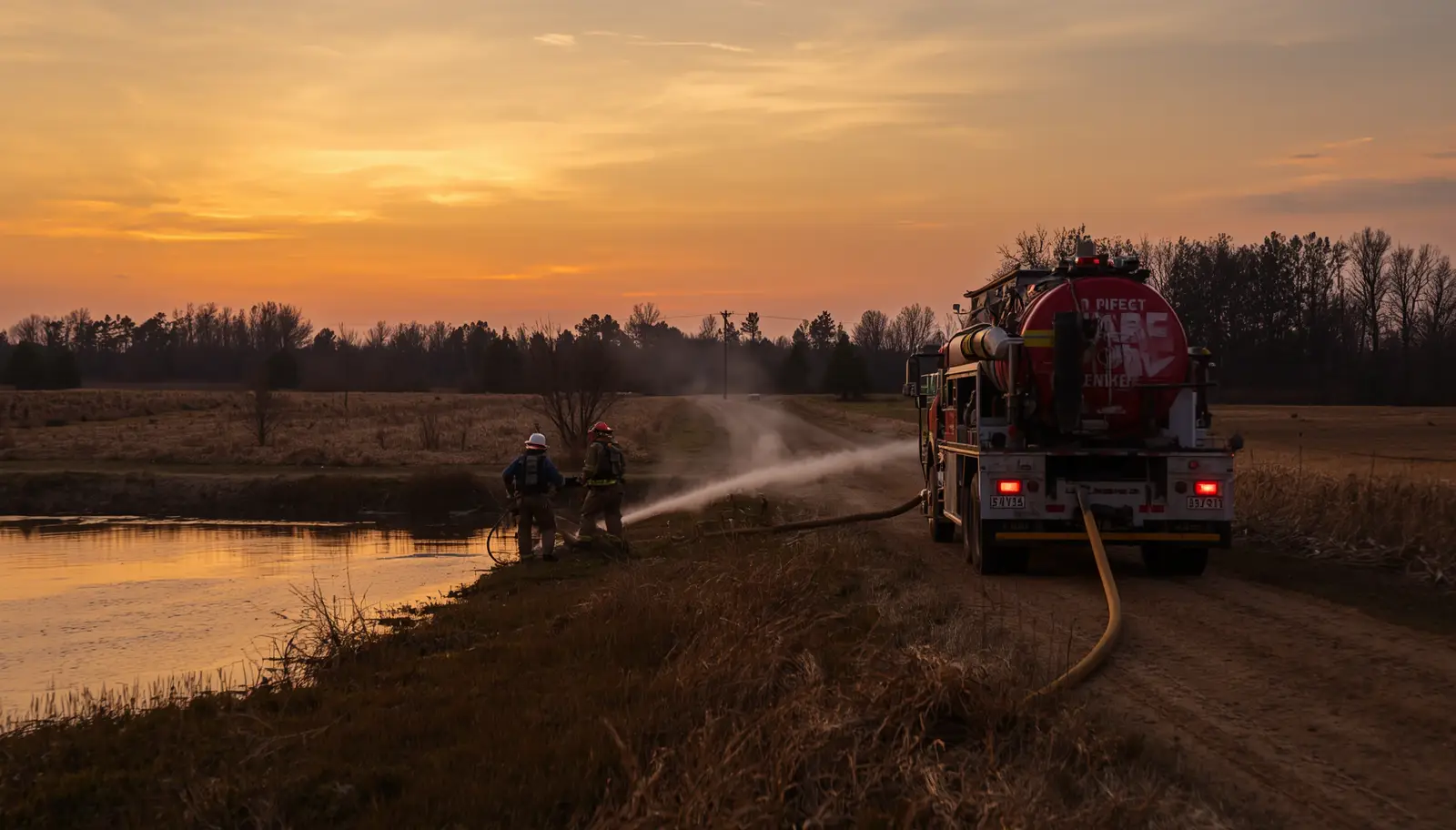
Drafting is the process of using a fire pump's primer to create a vacuum that draws water from a static source (pond, stream, pool, portable tank) into the pump. It is the foundational skill of rural water supply and the most reliable source of continuous water when a static source is accessible.
Drafting basics
- Maximum practical lift is 20 feet. Atmospheric pressure theoretically permits 34 feet of lift, but practical limits (pump primer capacity, suction hose friction loss, air leaks) make 20 feet the safe operational maximum. Attempting to draft from depths greater than 20 feet almost always results in prime failure or poor performance.
- Hard suction hose only. Soft supply hose collapses under the negative pressure created by drafting. Use 6-inch hard suction hose in the configuration your pump is designed for.
- Strainer must be submerged at least 2 feet. The suction strainer must have adequate submersion to prevent vortexing (air being drawn into the suction intake). In shallow sources, the strainer must be positioned horizontally and weighted to maintain submersion.
- Prime the pump before engaging the throttle. Engage the primer, wait for the pump to reach prime (water flowing from the primer discharge), then slowly engage the pump and increase throttle.
- Monitor for prime loss during operation. Any air leak in the suction connection, strainer, or hose will cause prime loss. Signs: pump pressure fluctuation, decreased flow, cavitation sound.
Positioning the apparatus for draft
- Engine must be on stable ground that will not shift, sink, or collapse under the weight of the apparatus
- Keep the suction inlet as close to the water as possible to minimize lift
- Wheel chocks on both wheels on the water side before any crew member positions at the water's edge
- Have a spotter when backing to a bank or edge — the ground may be unstable near water
Dry Hydrant Systems
A dry hydrant is a permanently installed suction pipe system that connects a static water source (pond, stream, cistern) to a roadside connection point. It eliminates the need to back apparatus to the water's edge, extends drafting access to remote sources, and reduces setup time significantly.
Dry hydrant components
- Suction pipe: PVC or HDPE pipe, typically 6-inch diameter, buried from the roadside connection to the water source
- Foot valve: A one-way check valve at the submerged end that keeps the pipe primed with water and prevents debris from entering during non-use
- Roadside connection: A 4½-inch storz or threaded coupling at the road level where the apparatus connects with hard suction
- Screen basket: At the submerged end to prevent large debris from entering the pipe
Drafting from a dry hydrant
- Remove the dry hydrant cap and connect hard suction hose from pump inlet to hydrant connection
- Open any isolation valve if present on the dry hydrant
- Prime the pump — the foot valve keeps the pipe filled with water, so prime should establish quickly
- Engage pump and establish flow to attack lines
- Monitor source level: if the source is limited, excessive flow rate will lower the source level and eventually cause prime loss
Know your dry hydrant locations before a fire. Pre-incident knowledge of dry hydrant locations, access road conditions, and approximate source capacity is essential for rural fire planning. The Hydrant Finder includes mapped water sources — supplement with department-specific pre-plan data for your response area.
Tanker Shuttle Operations
When no static source is accessible near the fire, tanker shuttle operations maintain a continuous water supply by cycling tankers between a remote fill site and a dump site at the fire. The shuttle is only sustainable when the fill rate exceeds or matches the consumption rate.
Key shuttle roles
- Attack engine: Positioned at the fire, flowing from its booster tank while the shuttle establishes. Signals when tank reaches 25% and needs dump tanker.
- Dump tanker(s): Full tankers staged at the dump site, ready to off-load to the portable tank or nurse tanker on demand. Move immediately to fill site when empty.
- Fill site engine or tender: At the hydrant or draft source, filling tankers as they arrive. Maximizes fill rate by using large-diameter fill connections.
- Nurse tanker (if used): A tanker staged at the fire scene as a buffer reserve, supplying the attack engine while dump tankers cycle. Eliminates dependency on any single tanker's arrival timing.
The Shuttle Math: Will You Have Enough Water?
The shuttle math determines whether your tanker fleet can sustain the required flow rate. Use the Tanker Shuttle Calculator for real-time calculation, but understanding the underlying math helps you make faster field decisions.
Sustainable GPM formula
The maximum sustainable GPM from a tanker shuttle is:
Sustainable GPM = (Tank capacity × Number of tankers) / Cycle time
Where cycle time = travel time to fill site + fill time + travel time back + dump time
Example calculation
3 tankers × 2,500 gallons each, fill site 5 miles away at 45 mph average speed:
- Travel to fill site: ~7 minutes
- Fill time at 1,000 GPM hydrant: ~2.5 minutes (2,500 gal ÷ 1,000 GPM)
- Travel back: ~7 minutes
- Dump time at 1,500 GPM dump rate: ~1.7 minutes
- Total cycle time: ~18 minutes
- Sustainable GPM = (2,500 × 3) ÷ 18 = ~417 GPM sustained
The fill rate limits everything. A 2,500-gallon tanker filled from a 500 GPM hydrant takes 5 minutes to fill. The same tanker filled from a 1,500 GPM hydrant takes under 2 minutes. Identify the highest-capacity fill point available and maximize your fill connection size — this is where you gain the most shuttle capacity.
Fill Site Setup: Maximizing Fill Rate
The fill site is typically a hydrant, engine drafting from a pond, or a high-capacity municipal connection. The goal is to fill arriving tankers as fast as possible and send them back to the fire.
- Use large-diameter fill connections. A 4-inch or 5-inch fill connection transfers water far faster than 2½-inch. Tankers should have large-diameter gravity fill inlets for maximum fill rate.
- Establish a single arrival/departure lane. Traffic management at the fill site prevents tanker congestion and maintains steady throughput. One tanker fills while the next queues — no stopping in the road.
- Keep the fill engine at the source, not moving. The fill site engine or tender should stay connected to the source and connected to the fill connections. Sending it elsewhere creates delays.
- Track fill times. Document when each tanker arrives empty and leaves full. Actual fill times vs. theoretical let you calculate real-world sustainable GPM and identify whether more tankers are needed.
Dump Site and Nurse Tanker Operations
The dump site is where tankers off-load water to the attack engine or portable tank. Setup determines how efficiently the water moves from tanker to pump:
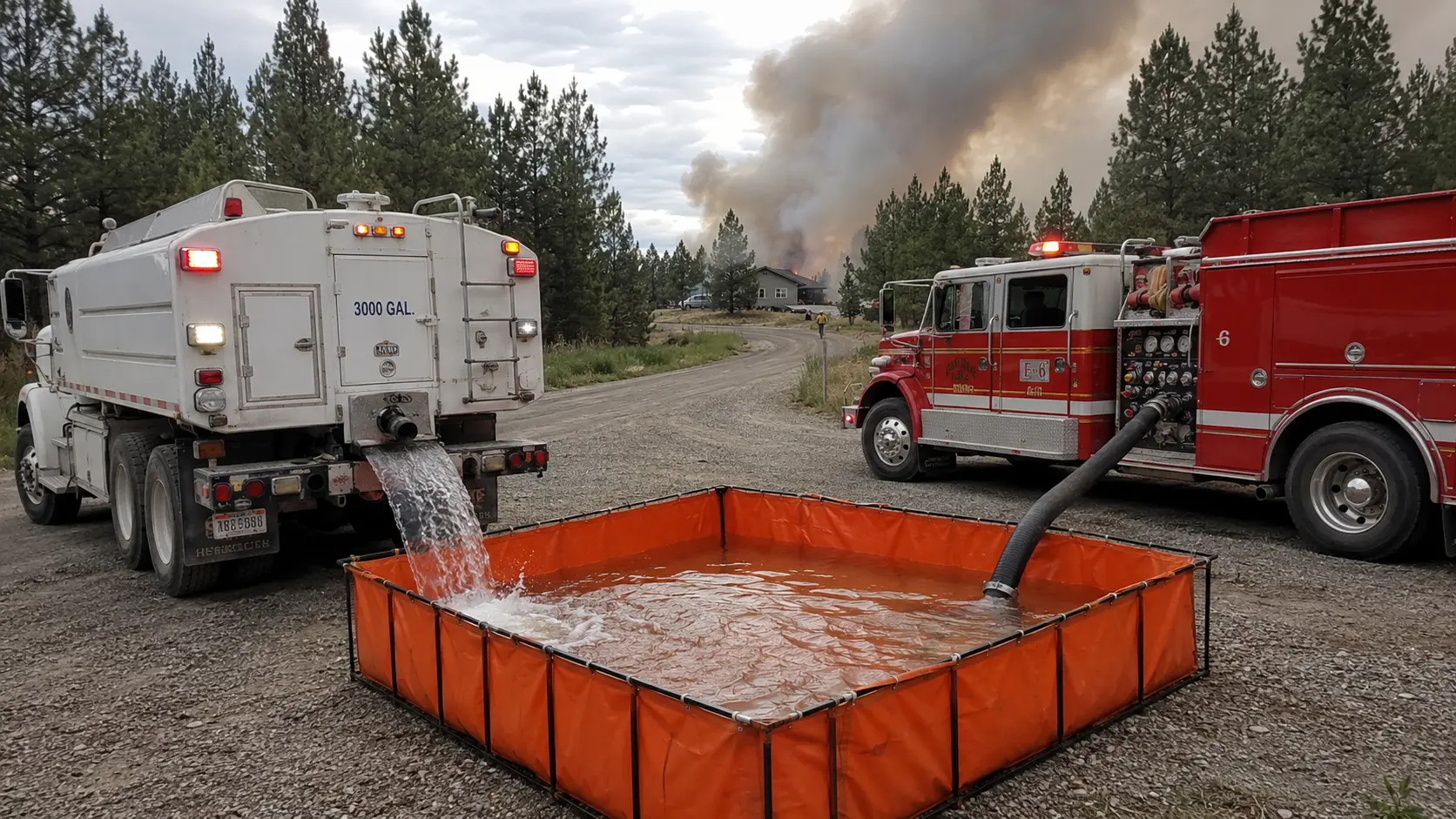
- Portable folding tank as buffer: A 1,500–3,000 gallon portable tank deployed at the fire scene allows multiple tankers to dump simultaneously and gives the attack engine a continuous supply that is not dependent on any single tanker's timing.
- Set up the portable tank before the booster tank runs low. Do not wait until the attack engine is nearly empty. The portable tank should be filled and the attack engine connected to it before the initial tank drops below 50%.
- Dump rate matters. Gravity dump connections (6-inch or 4-inch gravity valves on the tanker) can off-load a 2,500-gallon tanker in under 2 minutes. Pump-off operations take longer. Know your tankers' dump capabilities.
- Nurse tanker staging: A nurse tanker staged adjacent to the attack engine provides an additional buffer and eliminates the gap between when a tanker leaves the dump site and the next one arrives. In extended operations, nurse tanker staging is the difference between continuous flow and repeated flow interruptions.
Establishing Sustainable GPM: The Decision Point
The first 10 minutes of a rural fire operation are a race between water consumption and shuttle establishment. The attack engine's booster tank has a finite supply. The critical decision: is the initial water being used aggressively to knock down the fire, or is it being conserved while waiting for the shuttle?
The answer depends on your calculated sustainable GPM and the fire's flow requirement:
- If sustainable GPM ≥ required flow: Attack aggressively. The shuttle will sustain the attack.
- If sustainable GPM < required flow: Either request more tankers to increase shuttle capacity, or shift to a defensive posture with reduced flow while maintaining exposure protection.
- If sustainable GPM is unknown: Protect the booster tank supply while establishing the shuttle. Do not commit to an attack you cannot sustain.
Tools for Rural Water Supply Planning
Use the Tanker Shuttle Calculator to determine sustainable GPM for your specific tanker fleet, fill rate, and cycle distance. The Fire Flow Calculator gives you the required GPM estimate for the structure. The Hydrant Finder maps water sources in your response area including open water sources and municipal hydrants.
Frequently Asked Questions
What is rural water supply in firefighting?
Rural water supply refers to the methods used to establish a continuous water supply for fire suppression in areas without municipal pressurized hydrants. The primary methods are drafting from static sources (ponds, streams, cisterns), dry hydrant systems, and tanker shuttle operations that cycle water from a distant fill point to the fire scene.
What is a dry hydrant?
A dry hydrant is a permanently installed suction pipe that connects a static water source to a roadside connection point where fire apparatus can connect and draft water. Unlike a municipal hydrant, it has no internal pressure — it relies on the fire pump's primer to draw water through the pipe. The foot valve at the submerged end keeps the pipe primed with water for faster setup.
How many tankers do you need for a rural fire?
The number depends on the sustainable GPM required, the distance to the fill site, and each tanker's capacity and dump rate. Use the Tanker Shuttle Calculator to determine the minimum tanker fleet needed to sustain your required flow rate. As a general rule, the longer the distance to the fill site, the more tankers are required to maintain a given GPM.
What is the maximum practical drafting lift for a fire pump?
The practical maximum is approximately 20 feet, despite the theoretical atmospheric pressure limit of 34 feet. Beyond 20 feet, prime failure risk, suction hose friction loss, and pump performance limitations make reliable drafting very difficult. Always attempt to minimize lift by positioning the apparatus as close to the water surface as safely possible.



Comments 0
No comments yet. Be the first to share your thoughts!
Leave a Comment