SCBA Selection Guide: MSA G1 vs Scott Air-Pak X3 Pro vs Dräger PSS 7000 Compared
Last updated: · 11 min read
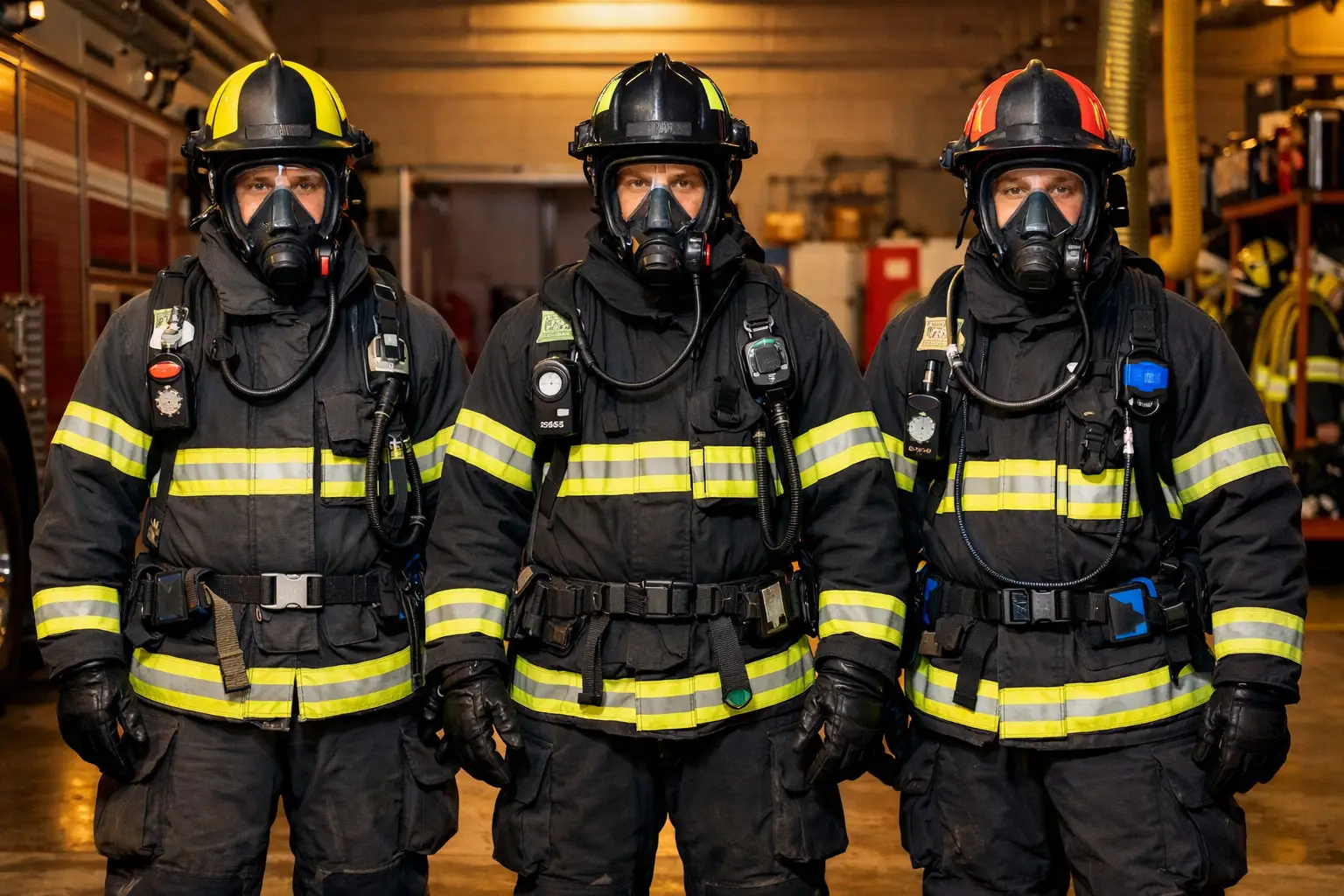
Self-contained breathing apparatus (SCBA) is the single most critical piece of firefighter PPE. When everything else fails, your SCBA keeps you alive. The U.S. structural fire service is dominated by three major SCBA manufacturers — MSA Safety, Scott (3M), and Dräger — with Interspiro and Honeywell holding smaller market shares. Choosing between them is a department-level procurement decision that affects every firefighter for 10–15 years. This guide covers NFPA 1981 requirements, the key technical and ergonomic differences between the three dominant systems, and what to evaluate in a head-to-head field trial.
NFPA 1981 (Standard on Open-Circuit Self-Contained Breathing Apparatus for Emergency Services) establishes minimum performance requirements for all SCBA used in structural firefighting. Key requirements:
Facepiece seal: The facepiece must maintain a positive pressure seal against the face under all conditions, preventing contaminated atmosphere from entering even during exertion and speech.
Low-air alarm: Audible alarm activating at 25% of rated cylinder capacity (approximately 1,125–1,200 PSI for a 4,500 PSI cylinder) with a minimum 75 dB alarm audible level.
PASS device integration: Integrated personal alert safety system (PASS) device that activates automatically after 30 seconds of inactivity and can be manually activated.
Rated service life: 30, 45, or 60 minutes rated duration at a specific work rate.
Thermal resistance: Complete SCBA assembly must survive 1 minute in a radiant heat environment of 95–260°C without facepiece or harness failure.
Heads-Up Display (HUD): NFPA 1981 2018 edition requires a HUD in the facepiece that shows remaining air pressure to the wearer without looking at the gauge.
Bluetooth/radio integration: Required to allow voice communications without removing the facepiece.
NFPA 1981 2018 edition is the current standard. SCBA purchased after 2018 must meet the 2018 edition requirements including HUD display. If your department is evaluating older SCBA inventory, verify which edition it meets — pre-2018 SCBA may lack HUD and Bluetooth requirements now considered standard.
MSA G1 SCBA
MSA G1 SCBA
Manufacturer: MSA Safety (Pittsburgh, Pennsylvania, USA)
NFPA edition: 2018 compliant
Facepiece: MSA Advantage 5000 facepiece with heads-up display (HUD) integrated into the lens
Regulator: Push-to-connect positive pressure demand regulator with emergency bypass
PASS: Fully integrated; activates automatically at 30 seconds inactivity; manual activation button on the frame
Telemetry: MSA eDRAFT system allows Incident Commander to monitor all crew members' air status on a tablet in real time (optional; requires eDRAFT receiver)
Standout features: The HUD in the MSA G1 is projected into the facepiece lens — the firefighter sees remaining air as a bar graph without looking down at the gauge. The Advantage 5000 facepiece has broad market adoption and is compatible with communications systems from multiple vendors. The G1 frame is designed for compatibility with the Gallet F1 XF helmet. Total system weight (45-min): approximately 15.5 lbs.
Approximate cost: $7,000–$8,500 per unit (45-min cylinder; without extended options)
Scott Air-Pak X3 Pro SCBA
Scott Air-Pak X3 Pro
Manufacturer: Scott Safety (3M Company) — manufactured in Lancaster, Pennsylvania
NFPA edition: 2018 compliant
Facepiece: Scott AV-3000 SurVisor facepiece with integrated HUD and heads-up voice amplification
Cylinder options: 30, 45, and 60-minute carbon composite cylinders at 4,500 PSI
Regulator: Scott EZ-Flo regulator with positive pressure on donning; emergency bypass valve accessible through the facepiece port
PASS: Fully integrated; PASS Plus system with 4 alert levels; remote activation via radio or from the IC terminal (with optional telemetry)
Telemetry: Scott Sight thermal imager can be integrated into the facepiece (optional add-on); PASS telemetry system for IC air monitoring
Standout features: The Scott AV-3000 facepiece is one of the most widely used facepieces in the U.S. fire service and has the broadest aftermarket accessories ecosystem. The X3 Pro frame features a cylinder quick-change system for rapid air resupply. The RIT Air Management System (RAMS) port allows air sharing with a transfill hose without the need for an additional connection. Total system weight (45-min): approximately 15.2 lbs.
Approximate cost: $6,800–$8,200 per unit (45-min)
Dräger PSS 7000 SCBA
Dräger PSS 7000
Manufacturer: Dräger (Lübeck, Germany; U.S. operations in Pittsburgh, Pennsylvania)
NFPA edition: 2018 compliant
Facepiece: Dräger Panorama Nova SCBA facepiece with integrated HUD and voice diaphragm
Cylinder options: 30, 45, and 60-minute steel and carbon composite cylinders at 4,500 PSI; Dräger also offers 300-bar European cylinders for international specifications
PASS: Fully integrated PSS 7000 PASS; multiple alarm levels; compatible with Dräger BODYGUARD telemetry system
Telemetry: Dräger BODYGUARD system tracks all crew members' PSI, location, and PASS status; can integrate with incident command displays
Standout features: The Panorama Nova facepiece has the widest field of view of the three systems due to its panoramic design — significantly more peripheral vision than the MSA or Scott offerings. The PSS 7000 frame is designed to be extremely lightweight for its protection level. The Dräger HPS 7000 helmet is specifically designed to integrate with the PSS 7000 frame and SCBA head harness. Total system weight (45-min): approximately 14.8 lbs (lightest of the three).
Approximate cost: $7,500–$9,000 per unit (45-min)
Side-by-Side Comparison
Feature
MSA G1
Scott X3 Pro
Dräger PSS 7000
Facepiece
Advantage 5000
AV-3000 SurVisor
Panorama Nova
Field of view
Good
Good
Excellent (panoramic)
HUD type
Lens-projected bar graph
Lens-projected; color-coded
Lens-projected; analog-style gauge display
Weight (45-min)
~15.5 lbs
~15.2 lbs
~14.8 lbs
PASS
Integrated; 30-sec auto
Integrated PASS Plus; 4 levels
Integrated; multi-level
Telemetry
eDRAFT (optional)
IC terminal (optional)
BODYGUARD (optional)
Cylinder swap
Standard connection
Quick-change system
Standard connection
RIT/air share
Transfill port standard
RAMS port standard
Transfill port standard
Helmet compatibility
Designed for MSA Gallet
Compatible with most helmets
Optimized for Dräger HPS 7000
Approx. price (45-min)
$7,000–$8,500
$6,800–$8,200
$7,500–$9,000
Market share (U.S.)
~35%
~40%
~15%
Key Features to Evaluate in Any SCBA
Facepiece fit and seal
The facepiece seal is the most critical performance variable and the most individual. A facepiece that seals perfectly on one firefighter may not seal on another due to facial geometry. Most departments require fit testing (OSHA 29 CFR 1910.134) for every individual firefighter wearing an SCBA. Before any department SCBA purchase decision, run quantitative or qualitative fit tests on a representative sample of firefighters across the range of facial structures in your department. An SCBA that cannot achieve a positive fit on 15% of your workforce is not a viable choice for your department regardless of its other features.
Heads-up display (HUD) readability
The HUD must be readable under the conditions of actual use: smoke, heat, sweat condensation on the lens, stress-narrowed field of attention. All three systems project the HUD differently. Evaluate HUD readability with actual firefighters during training scenarios, not in a showroom. HUD designs that work well in clean conditions may be unreadable in real fire conditions for some wearers.
Regulator performance
The demand regulator must deliver air smoothly at all work rates from rest to maximum exertion. Test the regulator during high-intensity work (stair climbing, hose advancement, search crawling) to confirm it delivers air without excessive breathing resistance. Breathing resistance that is acceptable at rest may become a physiological burden during fire suppression.
Harness ergonomics and fit
The harness must distribute the cylinder weight evenly across the torso without creating pressure points at the shoulders, sternum, or lower back. Evaluate harness fit for firefighters with different torso lengths and body types. A harness that fits well in a medium frame may be poorly adjusted for tall or short firefighters even at the limits of the adjustment range.
Telemetry integration
If your department operates an Incident Commander accountability and air monitoring system (or plans to), verify that the SCBA's telemetry system integrates with your existing IC technology. Switching SCBA brands typically requires replacing the IC receiver/display system as well, since telemetry systems are not cross-compatible between manufacturers.
Long-term parts and service support
SCBA are long-service equipment — departments typically replace them every 10–15 years. Evaluate manufacturer service network depth, parts availability, and the projected length of parts support for the current generation. An SCBA that is discontinued or unsupported in 7 years creates significant operational and compliance problems.
Most structural firefighting departments; the most common choice in U.S. fire service
60-minute
~2,260–2,400 L
Heaviest; adds ~2–3 lbs over 45-min
Hazmat operations; confined space rescue; industrial fire brigades; any operation with extended SCBA demand
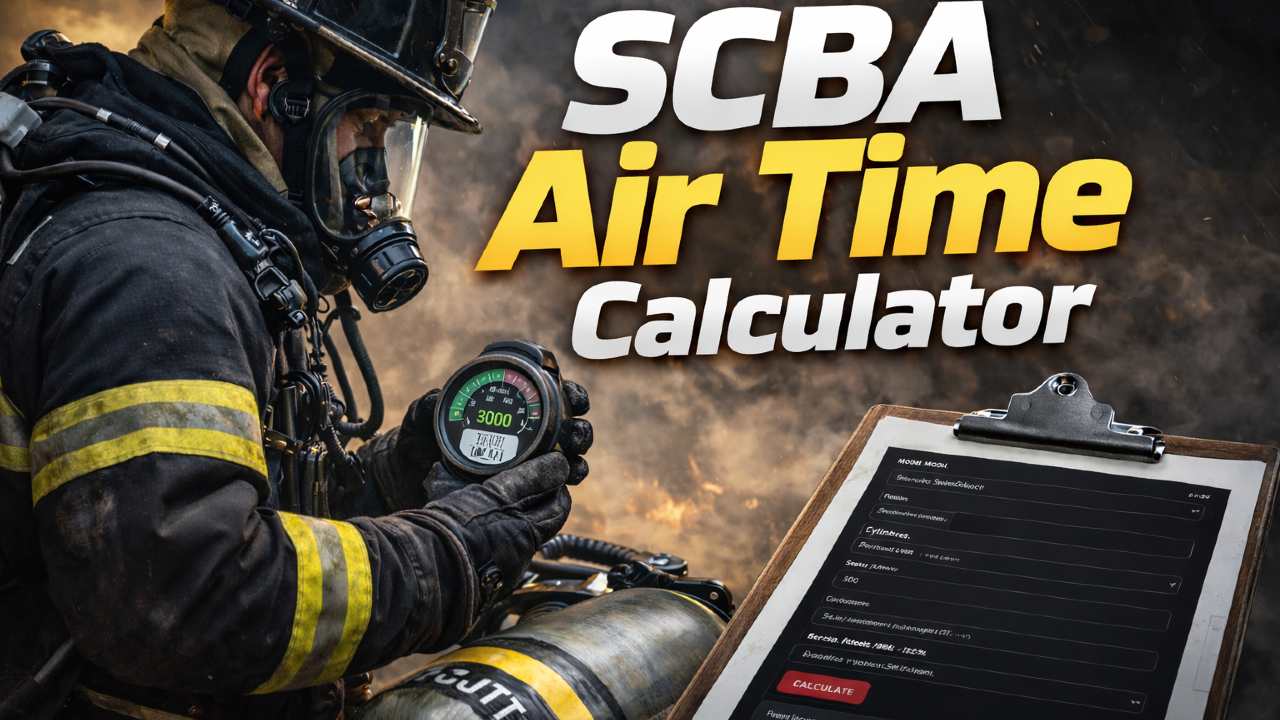
All cylinders are rated at a specific work rate. At heavy exertion (80–100+ L/min RMV), actual duration is 40–50% of the rated time. Use the SCBA Air Time Calculator to calculate real-world duration at your crew's expected work rates for your specific cylinder.
Maintenance, Inspection, and Service Life
NFPA 1981 and OSHA 29 CFR 1910.134 require:
Pre-use inspection: Before every deployment — cylinder pressure, PASS function, regulator connection, facepiece seal, HUD function
Monthly inspection: Functional test of all components including PASS alarm test, regulator flow test, harness hardware
Annual inspection: Comprehensive inspection and flow test by a qualified service technician; cylinder hydrostatic test per DOT schedule
Cylinder hydrostatic testing: Carbon composite cylinders require hydrostatic testing every 5 years; steel cylinders every 5 years. Cylinders must be retired at 15 years from manufacture date regardless of condition.
SCBA retirement: Most manufacturers recommend retiring the SCBA unit (frame, regulator, harness) at 10–15 years from date of manufacture per NFPA 1981 guidance and manufacturer recommendations.
How to Run a Proper Field Trial
When a department is selecting a new SCBA, a structured field trial produces better decisions than a vendor demonstration:
Select 6–10 representative firefighters covering the range of body types, facial geometries, and experience levels in your department
Run each system through identical scenarios: Interior attack simulation (hose advancement, door opening, search crawl), stair climb with full gear, donning and doffing timed trials, emergency bypass activation (gloves on, blindfolded)
Quantitative fit test all participants with each facepiece system and document pass/fail rates
Collect written feedback from each participant on HUD readability, regulator breathing resistance, harness comfort, donning/doffing ease, and overall preference
Evaluate the total system cost including SCBA units, spare cylinders, cylinder fill station compatibility, telemetry receivers, and projected service contract costs over 15 years
Check compatibility with existing helmets, communications systems, and IC accountability software
Frequently Asked Questions
What standard does firefighter SCBA have to meet?
NFPA 1981 (Standard on Open-Circuit Self-Contained Breathing Apparatus for Emergency Services) governs SCBA performance in the U.S. fire service. The 2018 edition is current and adds requirements for heads-up display (HUD), Bluetooth voice communication, and enhanced PASS performance. Additionally, OSHA 29 CFR 1910.134 regulates SCBA use, fit testing, and maintenance in the workplace.
Which SCBA is most commonly used in the U.S. fire service?
Scott Safety (3M) holds approximately 40% of the U.S. structural firefighting SCBA market, making the Scott Air-Pak the most widely used SCBA. MSA holds approximately 35%, and Dräger approximately 15%. The remainder is split between Interspiro, Honeywell, and smaller manufacturers. Market share reflects procurement inertia as much as performance — departments tend to stay with their existing manufacturer's ecosystem when replacing units.
How long does firefighter SCBA last?
Carbon composite cylinders must be retired at 15 years from manufacture. The SCBA unit (frame, harness, regulator) service life is typically 10–15 years per manufacturer recommendation and NFPA 1981 guidance. Facepieces may have a shorter service life (often 10 years) due to lens degradation. All components are subject to inspection-based retirement regardless of age if any defect is identified.
What is the difference between a 30, 45, and 60-minute SCBA?
The rating refers to the cylinder's duration at a standardized moderate work rate. A 45-minute cylinder provides approximately 45 minutes of air at moderate exertion (~40 L/min), but only 15–20 minutes during heavy exertion (80–100+ L/min). The low-air alarm activates at 25% remaining cylinder pressure regardless of rated duration. Most departments use 45-minute cylinders as the standard; 60-minute cylinders are used for hazmat, confined space, and other extended-duration operations.