Hazmat Initial Response Guide: Placard Reading, ERG, Isolation Zones & Decontamination
Every firefighter who responds to a hazardous materials incident — whether a highway tanker spill, a warehouse fire, or a residential chemical exposure — must know the initial hazmat response framework. NFPA 1072 defines the Operations level competencies that all firefighters are expected to have. This guide covers the essential knowledge: placard and label reading, Emergency Response Guidebook (ERG) use, isolation and protective action zones, and basic decontamination. For incidents beyond Operations level, a Hazmat Technician or Specialist team must be involved.
Jump to:Hazmat recognition · Placard and label reading · 9 hazard classes · ERG use · Isolation and protective action · ERG isolation distances · Emergency decontamination · PPE levels · Reference tools · FAQ
Operations level reminder: Firefighters at the Operations level may take defensive actions to protect life and the environment but must not enter the hot zone or take offensive action without Hazmat Technician oversight. If in doubt, isolate, deny entry, and call for Hazmat.
Hazmat Recognition: How to Know It Is Hazmat
Hazardous materials can be recognized through multiple indicators. A thorough size-up uses all available sources before approaching:
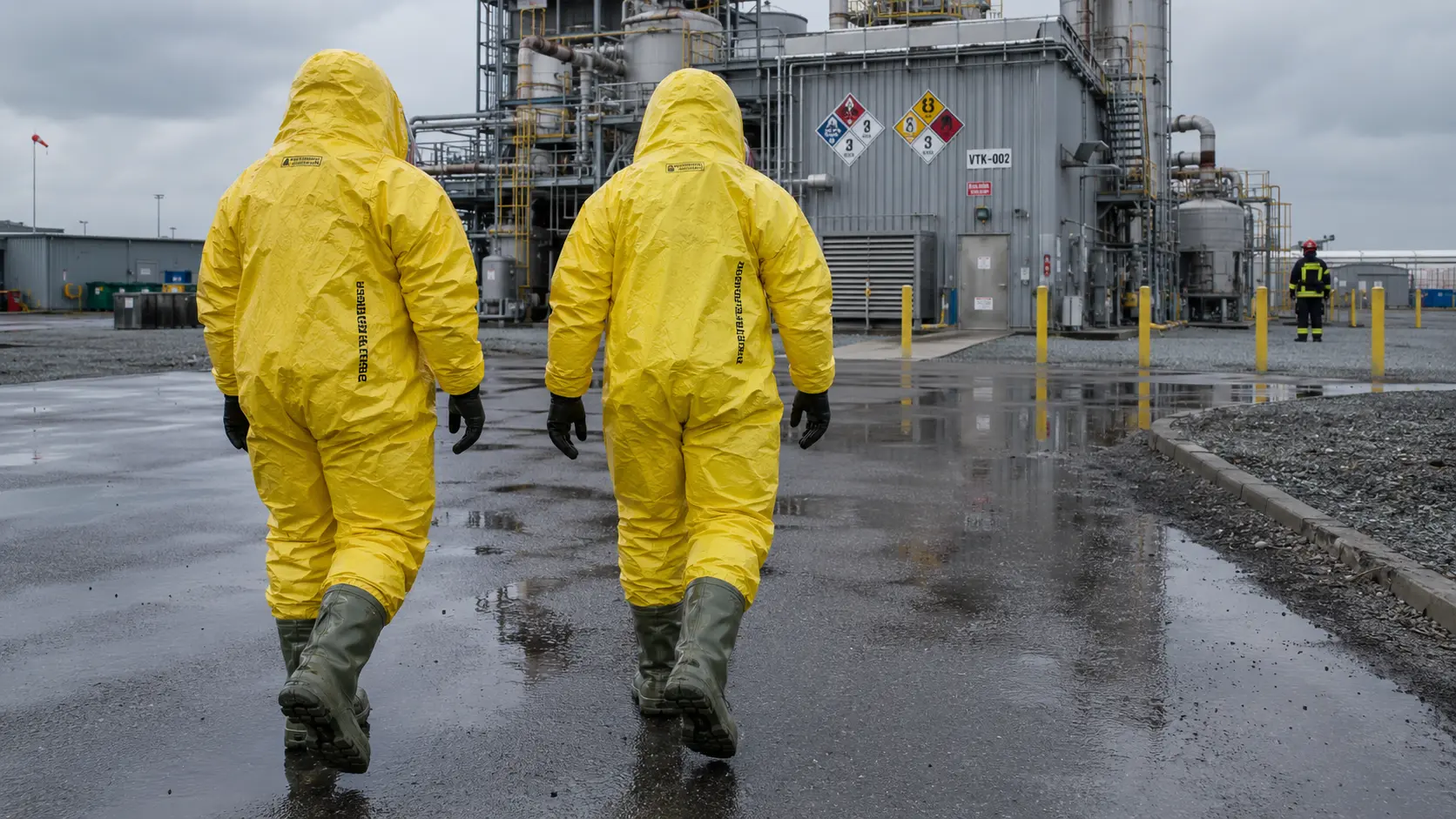
- Placards: Diamond-shaped signs on transport vehicles (trains, trucks, tank cars) required by DOT when carrying hazardous materials in threshold quantities
- Labels: Smaller diamond-shaped labels on individual packages and containers (same color/number system as placards)
- Shipping papers: Bill of lading (truck), waybill (rail), or dangerous goods declaration (air/ship) — carried in the cab or at the front end of the train
- Material Safety Data Sheets (SDS/MSDS): Required at fixed facilities; describes hazards, health effects, and emergency response
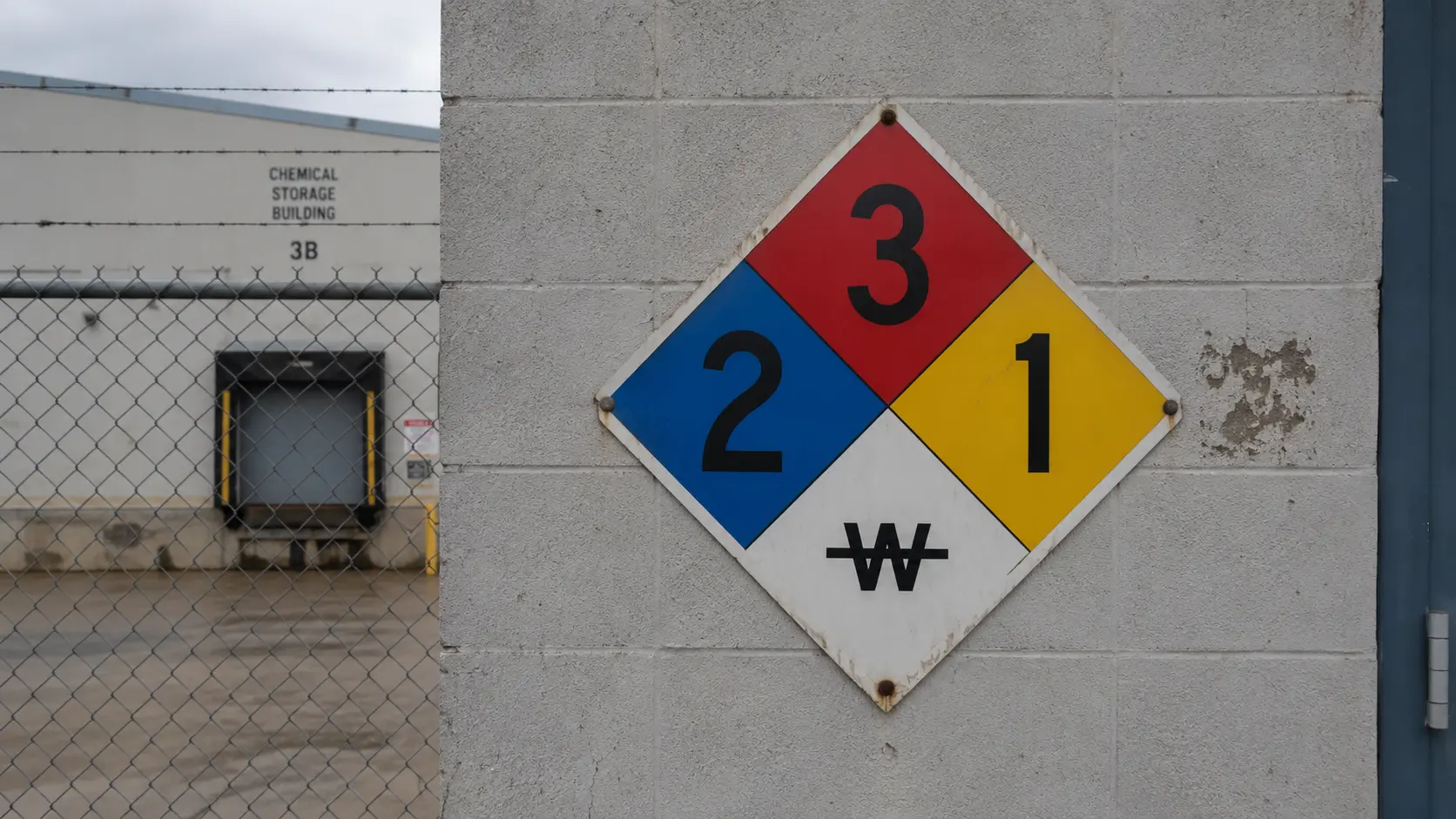
- Facility markings: NFPA 704 diamond on fixed facilities; process identifiers in industrial settings
- Sensory indicators: Unusual odor, visible vapor cloud, liquid pooling, dead vegetation, multiple victims with similar symptoms — all suggest possible hazmat
- Container shape: Tank car shape and fittings suggest contents class (see ERG yellow pages for tank car shapes)
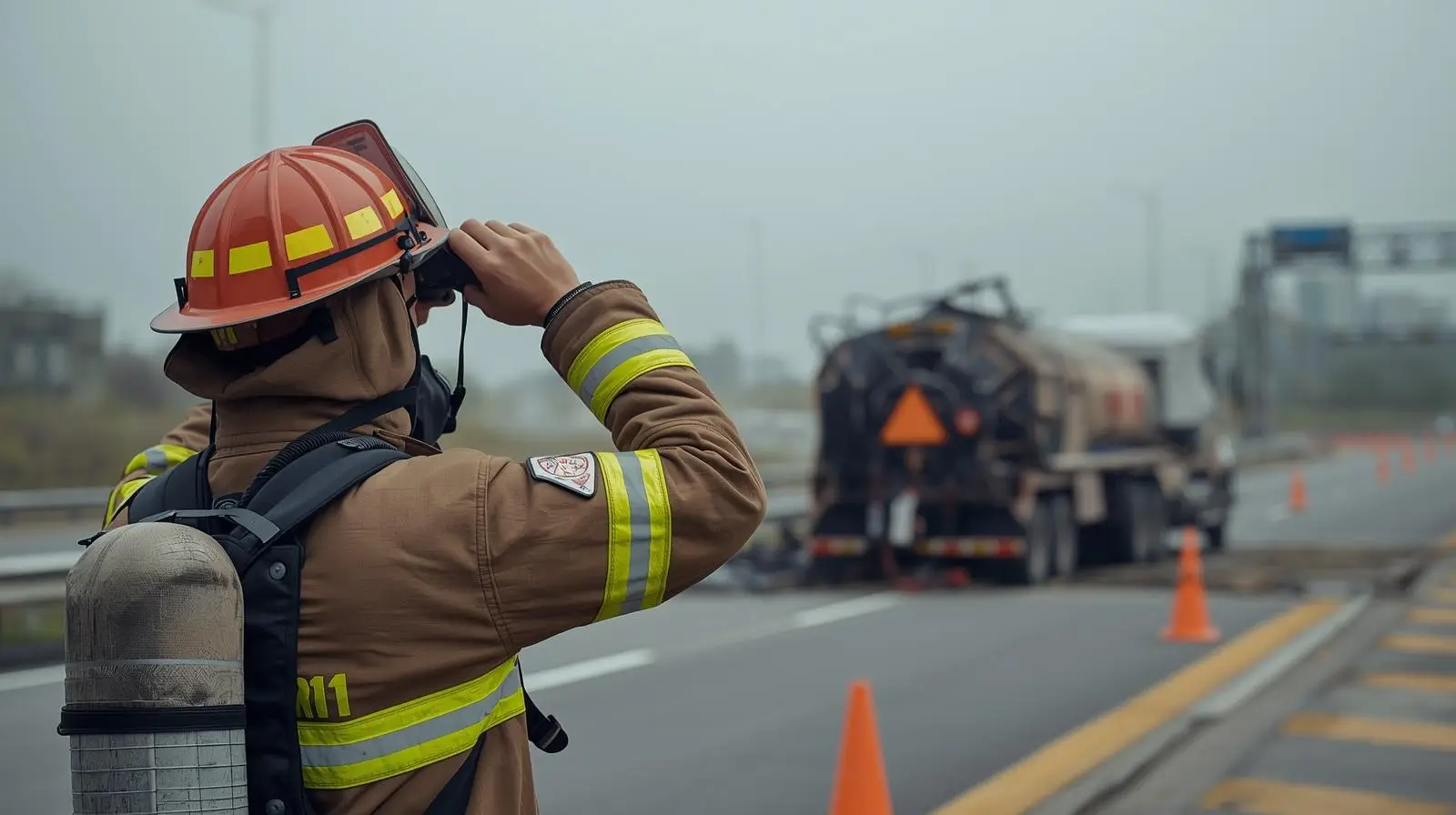
Read from a distance first. Always identify the placard number from the maximum safe distance using binoculars before approaching. Approach only from upwind, uphill, and upstream of any suspected release.
Placard and Label Reading
DOT placards follow a standardized format:
- Color: Each hazard class has a designated color (orange = explosives/flammable, red = flammable, yellow = oxidizer, white = inhalation hazard, green = non-flammable gas, blue = dangerous when wet)
- 4-digit UN number: Identifies the specific material. The UN number on the placard or on an orange panel is your key to the ERG.
- Hazard class number: 1–9, displayed at the bottom of the placard diamond. Some placards show the class name instead (FLAMMABLE, CORROSIVE, etc.)
- Symbol: Flame, skull, radiation trefoil, etc. — provides quick visual identification of primary hazard type
NFPA 704 diamond (fixed facilities)
The NFPA 704 diamond on buildings and tanks uses a four-quadrant system:
- Blue (left) = Health hazard: 0–4 scale (0=minimal, 4=lethal with brief exposure)
- Red (top) = Flammability: 0–4 scale (0=will not burn, 4=flash point below 73°F)
- Yellow (right) = Instability/Reactivity: 0–4 scale (0=stable, 4=may detonate)
- White (bottom) = Special hazards: OX (oxidizer), W with line through it (water reactive), SA (simple asphyxiant), etc.
The 9 DOT Hazard Classes
| Class | Hazard type | Placard color | Key concern |
|---|---|---|---|
| 1 | Explosives | Orange | Mass detonation, fragmentation, fire risk. Stay back 300–1,000 ft minimum. |
| 2 | Gases (flammable, non-flammable, toxic) | Red/Green/White | BLEVE risk from pressurized containers; asphyxiation; flammability |
| 3 | Flammable/Combustible liquids | Red | Ignition and fire spread; vapor density heavier than air |
| 4 | Flammable solids; spontaneous combustion; water reactive | Red/white stripes; Yellow | Self-heating; violent reaction with water (Class 4.3 water reactive) |
| 5 | Oxidizers and organic peroxides | Yellow | Supplies oxygen to fire; can intensify burning of other materials; unstable |
| 6 | Toxic and infectious substances | White | Inhalation, skin, and ingestion hazard; infectious disease risk (6.2) |
| 7 | Radioactive materials | Yellow/white | Radiation exposure; contamination; specialized response |
| 8 | Corrosives | Black/white | Skin and tissue destruction; metal corrosion; secondary fire risk (some) |
| 9 | Miscellaneous hazardous materials | Black/white stripes | Varies; includes lithium batteries, dry ice, magnetized materials, elevated temperature materials |
Use the AllFirefighter Hazmat Hub to look up any UN number and get class, division, ERG guide number, and emergency response information.
Emergency Response Guidebook (ERG): How to Use It
The ERG is published by PHMSA and Transport Canada every four years and is the primary field reference for initial hazmat response. Every apparatus should carry a current edition. The ERG has four color-coded sections:
Yellow pages — Index by UN/ID number
If you have the 4-digit UN number from the placard: look it up in the yellow pages to get the Guide number. Some materials are highlighted in green, indicating they may produce toxic inhalation hazards (TIH) and require use of the green page isolation distances instead of the orange page distances.
Blue pages — Index by material name
If you know the name of the material but not the UN number: look it up alphabetically in the blue pages to get the Guide number. Same green highlighting for TIH materials applies.
Orange pages — Guide numbers (primary reference)
Each orange Guide page covers a group of materials with similar hazard properties. The Guide provides:
- Potential hazards: Fire/explosion risk, health risk
- Public safety: Immediate isolation distances, protective clothing recommendations, evacuation distances
- Emergency response: Fire suppression guidance, spill response guidance, first aid
Green pages — Initial isolation and protective action distances for TIH materials
For materials highlighted in green (toxic inhalation hazards), the green pages provide specific isolation distances based on:
- Day vs. night (atmospheric stability is different)
- Small spill vs. large spill
- Initial isolation distance (radius around the spill)
- Protective action distance (downwind distance to shelter or evacuate)
Green page distances are conservative. They represent worst-case scenarios for planning. Actual conditions (wind, terrain, temperature, actual spill size) may result in different exposure zones. Use the green page distances as a starting point and adjust based on actual conditions and available monitoring equipment.
Initial Isolation and Protective Action
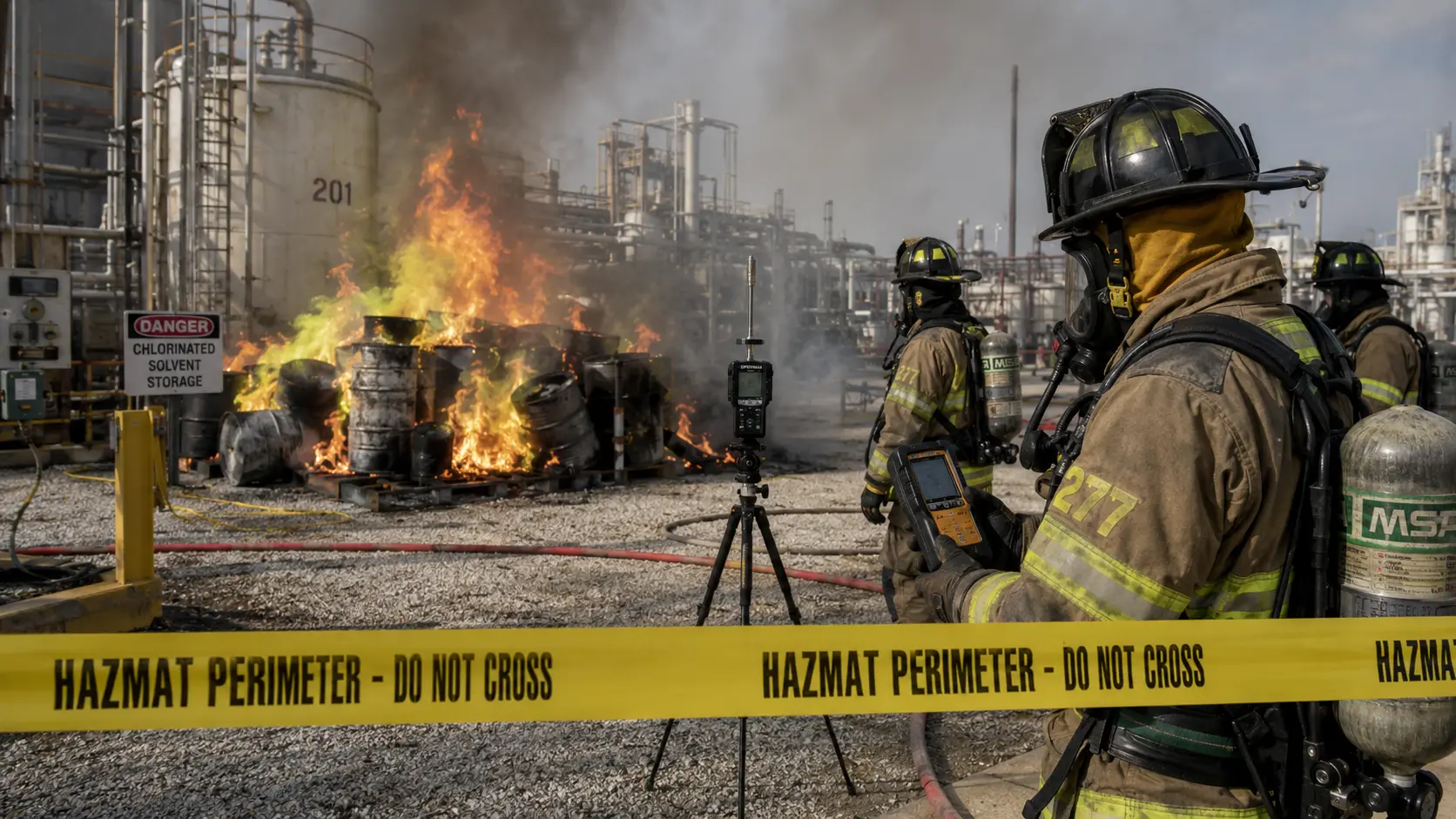
Initial isolation and protective action are the two primary Operations-level responses to a hazmat release. They are established before any technical hazmat response arrives:
Initial isolation zone
A circle drawn around the point of release — all persons within this radius should be moved out regardless of wind direction. The ERG provides specific isolation distances for each Guide. Default minimum: 50–100 feet for unknown materials; use green pages for identified TIH materials.
Protective action zone
The downwind area where sheltering or evacuation is recommended based on the likely vapor or gas plume. Shape: not a circle, but a downwind sector. The ERG green pages give specific protective action distances for TIH materials under different atmospheric conditions.
Shelter in place vs. evacuation
The choice between sheltering in place (keeping people inside buildings with windows and doors closed) and evacuation depends on:
- Evacuation time vs. plume arrival time: If the plume will arrive before evacuation can be completed, sheltering in place is safer for people in the path of the plume
- Plume duration: Short-duration releases may pass before evacuation is complete; long-duration releases favor evacuation
- Building integrity: Well-sealed buildings provide meaningful protection; leaky old buildings provide limited protection
Hazmat Operational Zones
| Zone | Also called | Who enters | Access control |
|---|---|---|---|
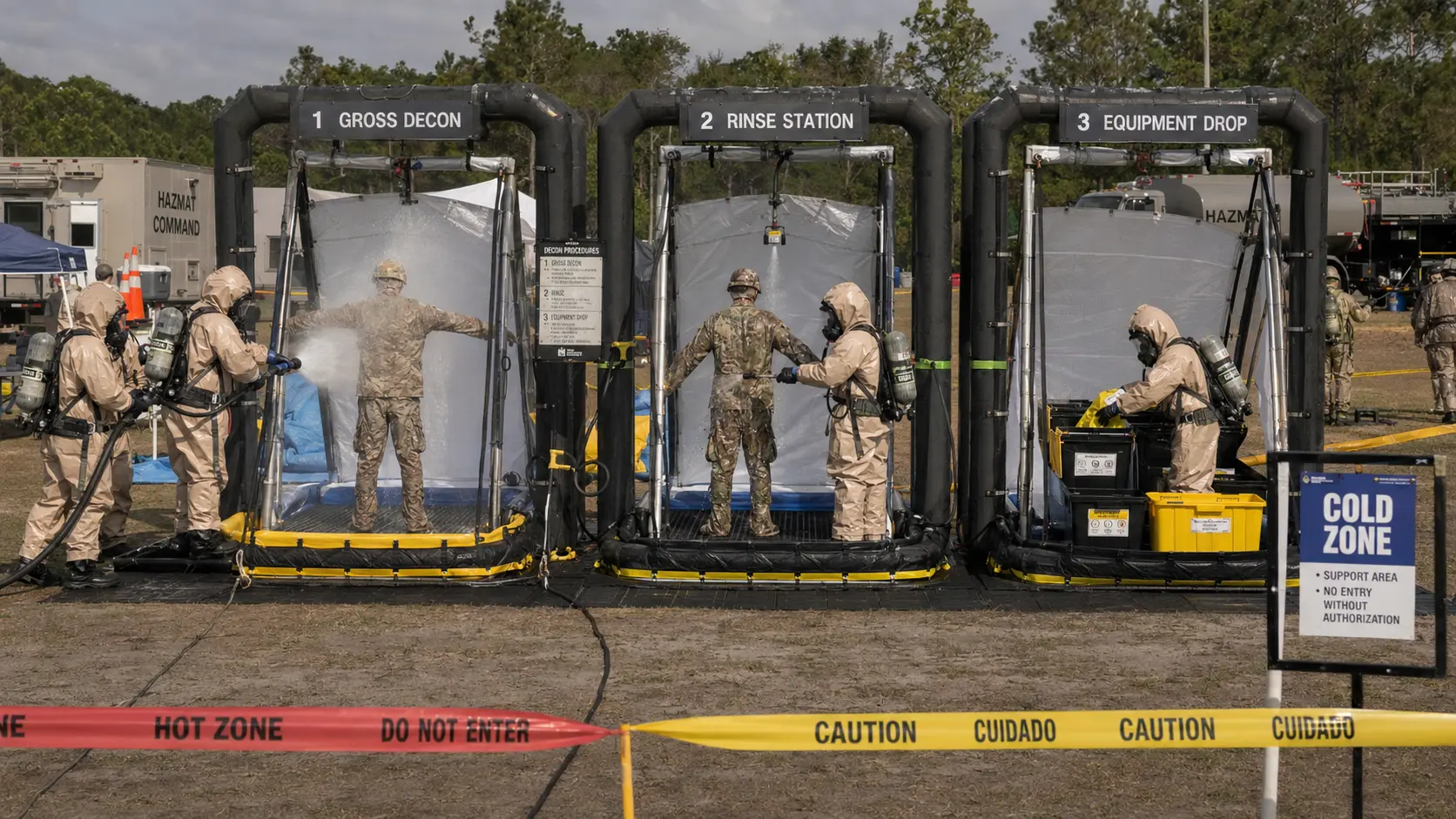
| Hot zone | Exclusion zone | Hazmat Technicians in appropriate PPE only | Strict; no entry without technical level training and PPE |
| Warm zone | Contamination reduction zone | Hazmat team members; decontamination operations | Controlled; PPE required; decon corridor established here |
| Cold zone | Support zone | Command, EMS, logistics, Operations-level firefighters | Open access for authorized personnel; upwind/uphill of warm zone |
Operations-level firefighters establish and control the perimeter of the hot zone. They do not enter it.
Emergency Decontamination
Emergency decontamination (emergency decon) is the rapid removal of contaminants from a person who has been exposed, to prevent further harm and prevent secondary contamination of responders and treatment facilities.
Emergency decon sequence
- Remove clothing and PPE. Removing outer clothing removes approximately 80% of surface contamination. Do not remove contact lenses (traps contaminants against eye). Cut clothing off if necessary to minimize skin contact.
- Flush with copious amounts of water. Large volumes of water for a minimum of 15–20 minutes for skin and eye exposures. Water dilutes and physically removes contaminants. Do not use neutralizing agents in emergency decon unless specifically indicated by the material's SDS.
- Move the patient to the warm zone. After initial flush, move the patient out of contamination and into the decontamination corridor for secondary decon and EMS assessment.
- Collect runoff. Decontamination water is contaminated waste and should not be allowed to enter storm drains or waterways. Establish containment when resources allow.
Water is the universal emergency decon agent. For most chemical exposures, copious water flushing is the correct immediate action. The exception is water-reactive materials (Class 4.3) where water contact causes violent reaction. Verify the hazard class before applying water to an exposed patient if time allows.
PPE Levels for Hazmat Response
| Level | PPE components | Protection | Who uses it |
|---|---|---|---|
| Level A | Fully encapsulating chemical-resistant suit + SCBA | Highest vapor and liquid protection | Hazmat Technicians in immediately dangerous environments |
| Level B | Chemical-resistant suit (not fully encapsulating) + SCBA | High respiratory protection; moderate skin protection | Hazmat Technicians in high liquid/particulate hazard |
| Level C | Chemical-resistant suit + air-purifying respirator (APR/PAPR) | Moderate protection; requires known atmospheric conditions | Decontamination corridor; warm zone with monitoring |
| Level D | Standard work uniform; no respiratory protection beyond surgical mask if applicable | Minimal protection; not suitable for chemical hazard | Cold zone only; no chemical exposure risk |
Structural firefighting PPE (turnout gear + SCBA) provides limited chemical protection. It is appropriate for defensive operations in the warm zone and brief emergency rescues in the hot zone when Level A/B is unavailable, but it is not chemical protective equipment and should not be treated as equivalent to Level B.
Reference Tools
Use the AllFirefighter Hazmat Hub to look up any UN number for immediate hazard class, ERG guide number, and emergency response information. The UN Number Search covers 3,000+ UN numbers with class, division, packing group, and first response guidance. The NFPA Standard Explorer includes NFPA 472 (Hazmat Competencies) and related standards.
Frequently Asked Questions
What is the first action at a hazmat incident?
Approach from upwind, uphill, and upstream. Identify the material from a safe distance using binoculars to read the placard UN number. Do not approach or enter the area until you have identified the material and established safe approach distance from the ERG. Establish isolation zones and deny entry before doing anything else.
How do you read a hazmat placard?
The placard diamond has four elements: color (indicates hazard class), the 4-digit UN number (identifies the specific material), the class number at the bottom (1–9), and a symbol (flame, skull, radiation symbol, etc.). Use the UN number in the ERG yellow pages to find the appropriate Guide number for emergency response information.
What does the ERG green page mean?
The green pages in the Emergency Response Guidebook contain initial isolation and protective action distances for toxic inhalation hazard (TIH) materials. If a material is highlighted in green in the yellow or blue pages, use the green pages for isolation distances instead of the orange Guide page distances. Green page distances are specific to the material, spill size, and day vs. night conditions.
What PPE do firefighters use at a hazmat scene?
Operations-level firefighters in the cold zone wear standard structural PPE. In the warm zone or for emergency decon, Level C (chemical-resistant suit + APR) may be used with monitoring confirmation. Entry into the hot zone requires Level A or B PPE and Hazmat Technician certification. Structural turnout gear is not chemical protective equipment and provides limited protection against most chemical hazards.
Comments 0
No comments yet. Be the first to share your thoughts!
Leave a Comment