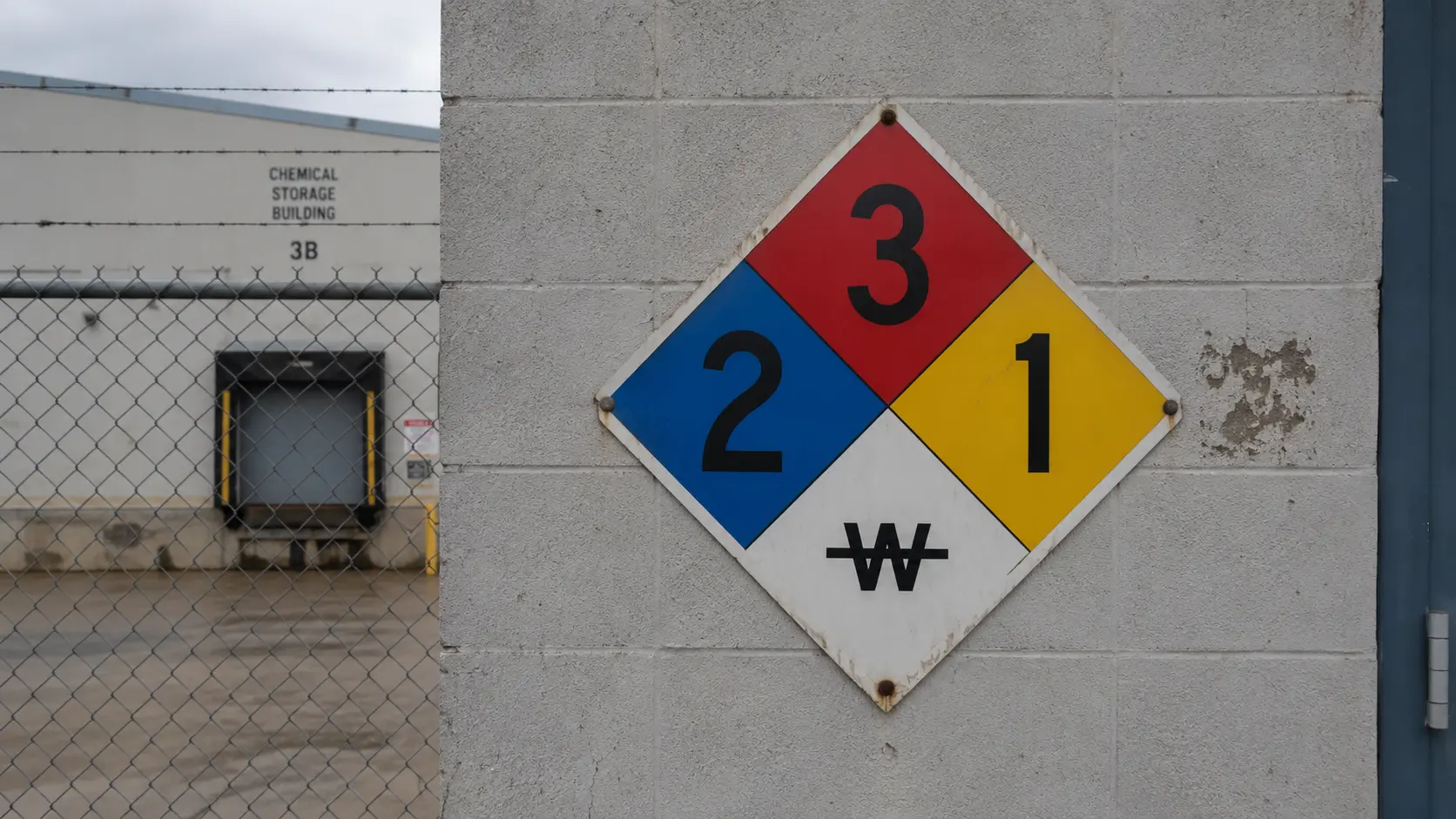

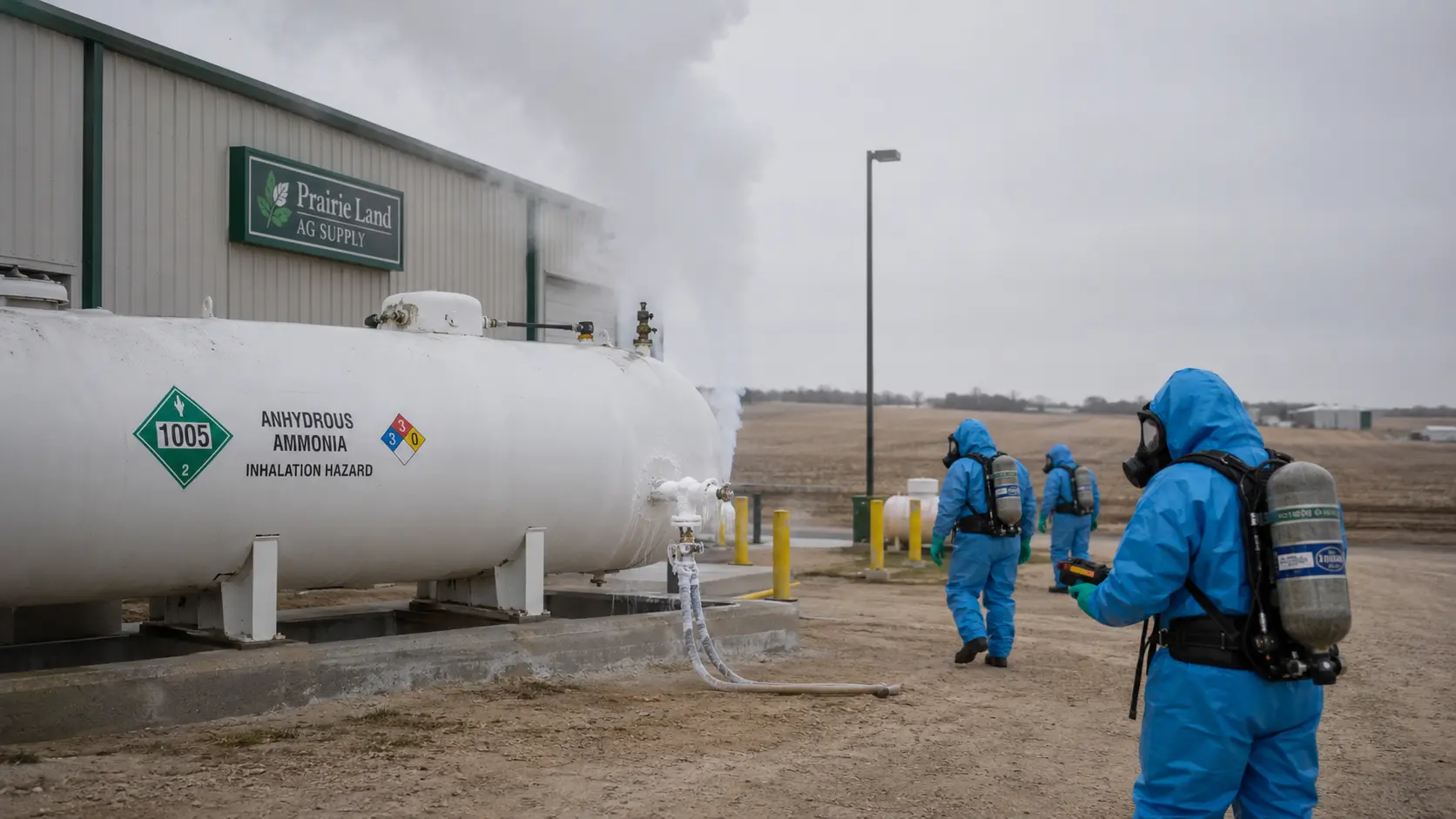
The NFPA 704 diamond identifies a material's acute health, flammability, instability and special hazards for emergency responders. It can appear on buildings, doors and storage tanks. It is distinct from the DOT transportation placards used on trucks and rail tank cars. Read it alongside product identification and the safety data sheet (SDS); the diamond alone does not prescribe protective equipment or a suppression tactic.
The system is straightforward once you understand the logic. It is also frequently misread, frequently incomplete in the field, and not the only hazard communication system you will encounter — which is where confusion enters.
In this article:
- The diamond layout: what goes where
- Blue (health hazard): what the numbers mean
- Red (flammability): what the numbers mean
- Yellow (instability/reactivity): what the numbers mean
- White (special hazards): W, OX, SA, and the rest
- How firefighters use it on approach
- What NFPA 704 does not tell you
- NFPA 704 vs. GHS: two different systems, one facility
The Diamond Layout: What Goes Where

The NFPA 704 diamond is oriented with points at the top, bottom, left, and right — like a square rotated 45 degrees. Each quadrant has a fixed assignment:
- Blue (left): Health hazard
- Red (top): Flammability
- Yellow (right): Instability (reactivity)
- White (bottom): Special hazards
The color coding is mnemonic: blue for health (think cyanotic, ill), red for fire (flames), yellow for reactivity (chemical reactivity symbols often appear on yellow backgrounds), and white for the catch-all special category. The numbers in the blue, red, and yellow quadrants run from 0 (no special hazard) to 4 (most severe hazard), with each level defined by specific criteria.
The tables below are abbreviated reading aids, not the complete classification criteria. Specific product examples have been omitted because formulation, concentration and SDS details matter. Use the applicable NFPA 704 edition and product SDS for an actual rating.
Blue (Health Hazard): What the Numbers Mean
| Rating | Abbreviated description |
|---|---|
| 4 | Acute exposure can be lethal. |
| 3 | Acute exposure can cause serious injury. |
| 2 | Intense or continued acute exposure can cause incapacitation or residual injury. |
| 1 | Acute exposure can cause significant irritation. |
| 0 | No significant acute health hazard beyond ordinary combustible materials. |
The blue number describes acute health hazard severity. It is not a conversion table for PPE Levels A, B, C or D. Protective equipment selection also depends on the identified substance, exposure route, concentration, monitoring, compatibility data and the incident assessment. Structural firefighting clothing and SCBA should not be assumed to provide chemical protection simply because a health number is low.
Red (Flammability): What the Numbers Mean
| Rating | Abbreviated description |
|---|---|
| 4 | Flammable gases and other materials that ignite readily; qualifying liquids include those with flash point below 73°F and boiling point below 100°F. |
| 3 | Liquids that ignite under most ambient conditions: flash point below 73°F with boiling point at or above 100°F, or flash point from 73°F to below 100°F. |
| 2 | Materials requiring moderate heating to ignite; qualifying liquids have flash point from 100°F to below 200°F. |
| 1 | Materials requiring substantial preheating; qualifying liquids have flash point at or above 200°F. |
| 0 | Materials that do not burn under the standard's specified test conditions. |
The red number describes flammability, not a stand-alone instruction to extinguish a fire or let it burn. For liquid ratings, flash point alone may be insufficient: boiling point also distinguishes some rating 3 and rating 4 liquids. Verify the actual product rating against its SDS and the applicable edition of NFPA 704.
Yellow (Instability/Reactivity): What the Numbers Mean
| Rating | Abbreviated description |
|---|---|
| 4 | Can detonate or undergo explosive decomposition at normal temperature and pressure. |
| 3 | Can detonate or undergo explosive decomposition with strong initiation or heating under confinement. |
| 2 | Can undergo violent chemical change at elevated temperature and pressure. |
| 1 | Normally stable, but can become unstable at elevated temperature and pressure. |
| 0 | Normally stable, including under fire conditions. |
The yellow number identifies instability hazards. Do not use it as a stand-alone evacuation distance or a substitute for container and pressure assessment. A BLEVE is a pressure-vessel failure mechanism and must not be inferred from the yellow number alone. Use material-specific references and agency procedures for tactical decisions.
White (Special Hazards): W, OX, SA, and the Rest
The white quadrant carries symbols rather than numbers. NFPA 704 defines three official special hazard designations:
- W with a horizontal line through it: Water reactive — the material reacts dangerously with water, producing heat, fire, or toxic gases. Using water for suppression on a water-reactive material can make the situation significantly worse. Sodium metal, potassium, lithium, and many other materials carry this designation.
- OX: Oxidizer. The material can cause or intensify combustion. This does not mean every oxidizer releases molecular oxygen; verify the product properties and incompatibilities in its SDS.
- SA: Simple asphyxiant designation, used as defined in the applicable edition of NFPA 704. Nitrogen and helium are examples. A gas that can displace oxygen does not automatically qualify for this mark; verify the specific material and application.
Some facilities add non-standard symbols — a radioactive symbol, a biohazard symbol, or others. These are not part of the NFPA 704 standard but are sometimes added by facility safety managers. They are informative but should not be interpreted as having the same standardized meaning as the official W, OX, and SA designations.
How Firefighters Use It on Approach
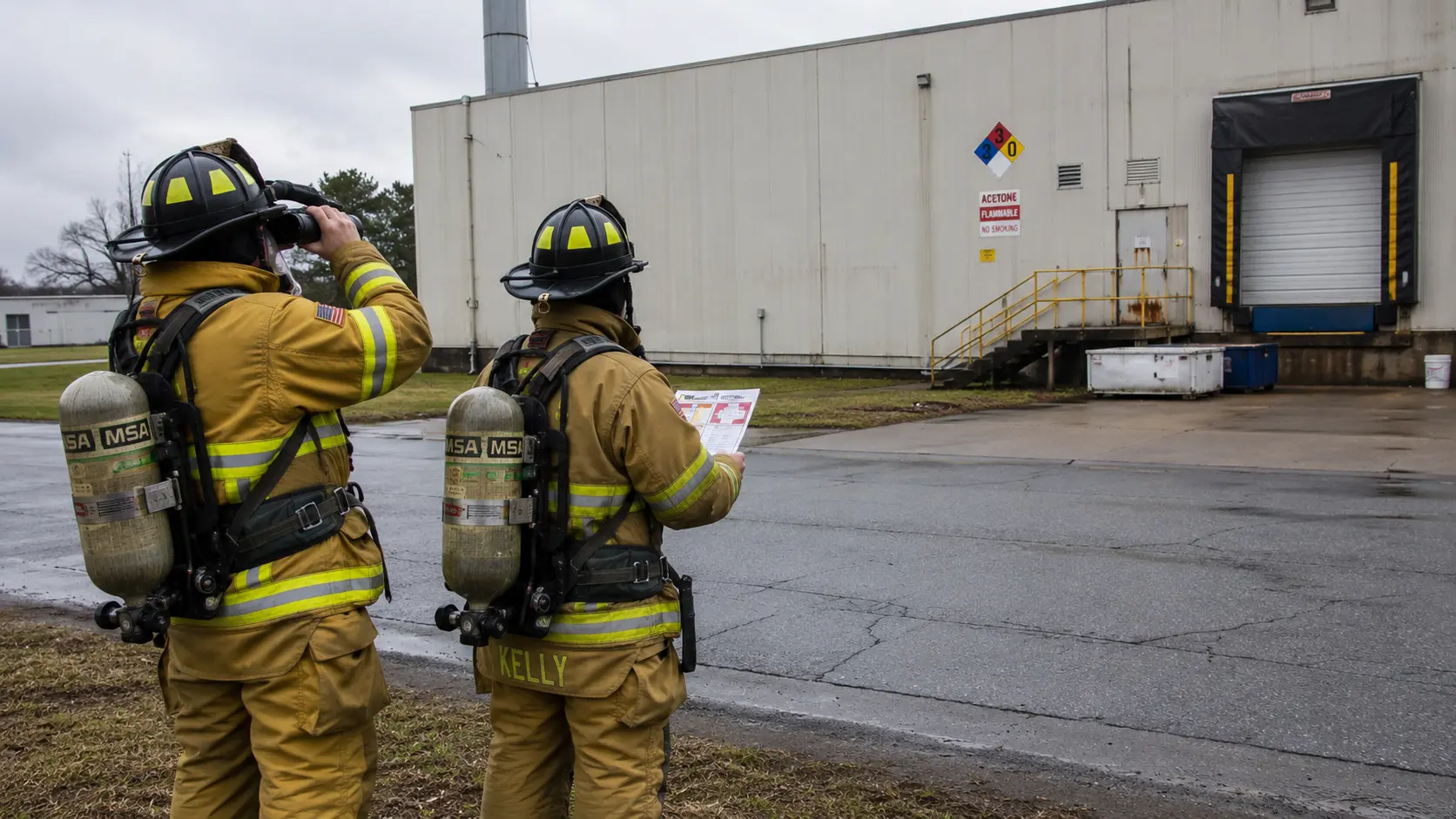
Use the diamond as one part of the incident identification and assessment process:
- Read all four quadrants from a safe position and confirm which material or storage area the sign describes.
- Identify the product and consult its SDS, including the physical properties, incompatibilities and protective-equipment information.
- Treat the barred W as a water-reactivity warning and OX as an oxidizer warning. Neither mark by itself provides a complete suppression plan.
- Combine the hazard information with monitoring, container condition, agency procedures and qualified Hazmat assessment before selecting tactics.
What NFPA 704 Does Not Tell You
The 704 system has specific limitations that are important to understand:
- It describes material hazards, not measured exposure at this incident. A rating does not report the current airborne concentration, dose or extent of a release. Monitoring and incident-specific assessment remain necessary.
- It is not a universal container-label requirement. Applicability depends on the adopted code and the authority having jurisdiction. NFPA 704, workplace labels and transportation placards have different purposes.
- Mixtures require assessment of the mixture. Use the mixture's SDS and the NFPA 704 criteria. Multiple chemicals in a storage area are a separate rating problem; the standard provides methods for that situation. Do not assume the rating of one ingredient represents the whole mixture.
- Placards are only required where mandated by local code. Many facilities are not required to post 704 placards even when they store regulated quantities of hazardous materials.
NFPA 704 vs. GHS: Two Different Systems, One Facility
The Globally Harmonized System (GHS), as implemented through OSHA Hazard Communication requirements, communicates workplace chemical hazards through labels and SDSs. NFPA 704 serves emergency-response hazard identification. Where permitted, NFPA or HMIS information can also be part of a workplace labeling system; GHS adoption did not simply prohibit every older workplace label. Neither system replaces DOT transportation placards.
A facility may have a 704 diamond on the outside of the building and GHS labels on individual containers inside. They use different rating scales and different symbols. A chemical with a GHS health hazard category 1 (most severe) does not correspond directly to an NFPA 704 health rating of 4 — the scales are different. Firefighters and hazmat teams working with specific container labels during an incident are reading GHS; firefighters doing approach assessment from outside a facility are reading NFPA 704. Confusing the two systems produces incorrect hazard assessments.
Sources and verification
Technical corrections recorded October 15, 2026. Consult the NFPA 704 standard page for the applicable edition and the joint NFPA/OSHA label comparison card for the distinction between emergency-response ratings and workplace hazard categories. NFPA's technical FAQ, including mixture and storage-area ratings explains the principles; that older FAQ is not a substitute for the current standard. The NIOSH emergency-response glossary provides additional terminology.
For response roles and qualifications, see our Hazmat operations and technician guide. For product identification, use the Hazmat UN lookup and verify the result against current official references.
Comments 0
No comments yet. Be the first to share your thoughts!
Leave a Comment