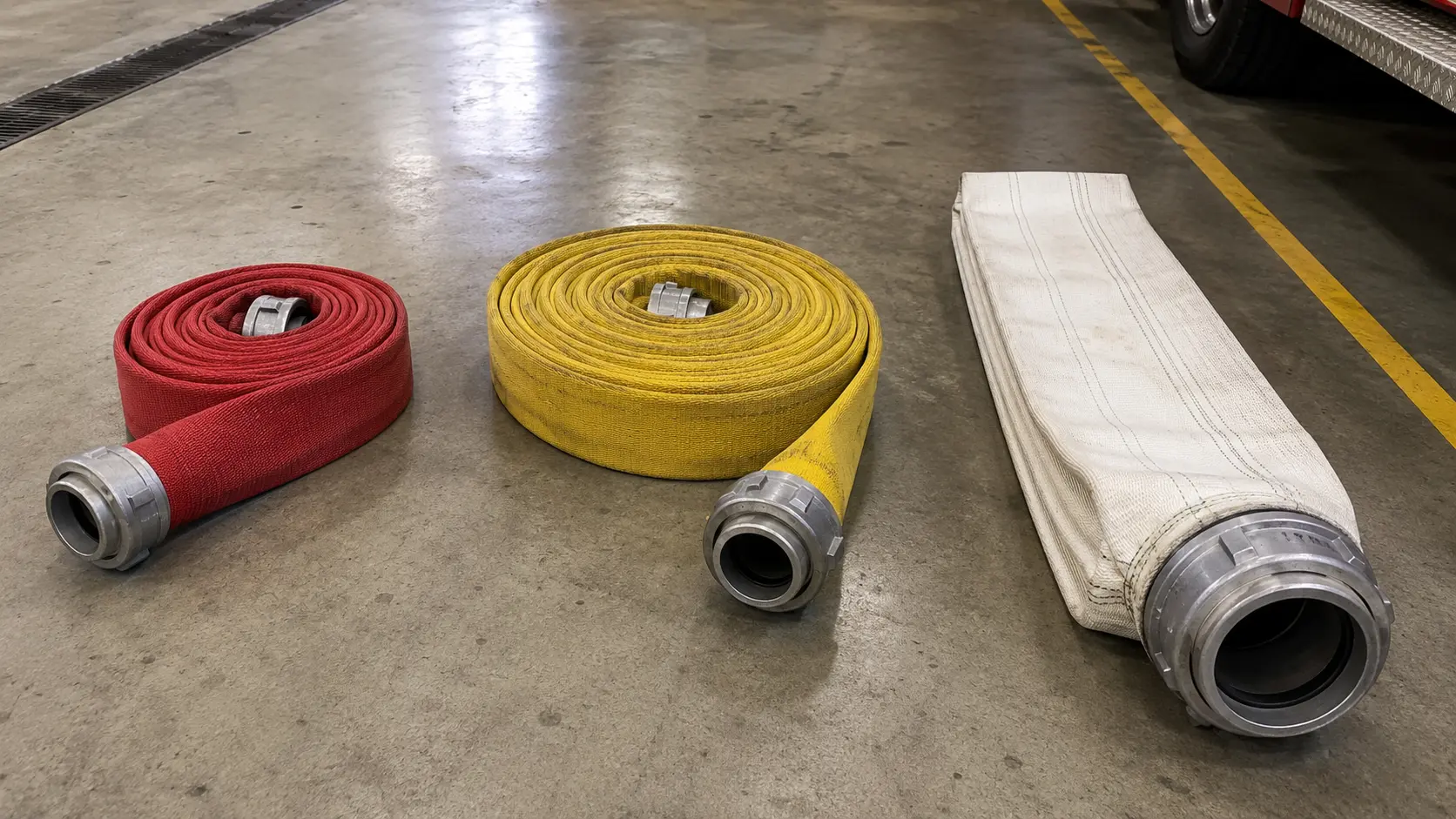
The hose carried on a fire apparatus is not a single product type. It is a collection of hoses with different diameters, different pressure ratings, different constructions, and completely different operational roles — selected based on whether water is being transported toward the fire (attack hose), from the hydrant to the pump (supply hose), or from a static water source to the pump (suction hose). Getting the wrong hose for the application is not a minor inefficiency. A 1¾-inch hose connected as a supply line from a hydrant will not flow enough water to supply the pump. A 4-inch LDH connected as an attack line is too large and stiff to advance into a structure.
The hose selection decisions happen automatically and correctly in a well-trained department because the crew knows what each hose is for. They become visible as operational problems when someone has to explain why a particular hose is being used — which is a sign that the understanding, not just the habit, needs to be there.
In this article:
Attack Hose: 1¾-Inch and 2½-Inch
1¾-inch attack hose
The standard residential structure fire attack line. It flows approximately 150 to 185 gallons per minute with a smooth-bore nozzle tip and 50 psi nozzle pressure — enough flow for a standard room-and-contents residential fire. At this diameter, a 150-foot length of charged hose weighs approximately 60 to 80 pounds and is manageable by two firefighters advancing into a structure. The 1¾-inch is the workhorse attack hose for approximately 80 percent of residential and light commercial structural fire applications.
Its limitation is flow rate. A large fire — a fully involved commercial structure, a high-rise floor, or any fire where 150 to 185 GPM is insufficient to knock down the fire — requires a larger diameter line.
2½-inch attack hose
The heavy attack line — used when the 1¾-inch is insufficient for fire conditions. At 2½-inch diameter with a 1¼-inch smooth-bore tip, the flow is approximately 325 gallons per minute at 50 psi nozzle pressure. This is the line that handles large commercial fires, warehouse fires, defensive exterior operations, and any scenario where high-volume suppression is needed at close range.
The trade-off: a charged 2½-inch line is significantly heavier and stiffer than a 1¾-inch — a 150-foot length weighs approximately 130 to 150 pounds charged. It requires two to three firefighters to advance effectively and is considerably harder to move through interior spaces. Departments sometimes hesitate to pull the 2½-inch when conditions warrant it because the work involved is intimidating. The 2½-inch that is not pulled when it should be is not protecting the crew who is using the 1¾-inch against a fire that outflows it.
Supply Hose: Large Diameter Hose (LDH)
Large diameter hose — 4-inch and 5-inch diameter — is the supply hose that connects fire hydrants to the pumping apparatus. Its purpose is moving large volumes of water over distances where smaller hose would produce excessive friction loss, and doing so with fewer hose sections. A single 5-inch LDH can supply an engine at 1,000 GPM from a hydrant 1,000 feet away with acceptable friction loss. Achieving the same supply with 2½-inch hose would require multiple parallel lines and significantly more connection points.
LDH is not maneuverable in the way that attack hose is. A 5-inch hose is 10 to 12 inches in outer diameter when charged — stiff, heavy, and physically difficult to reposition once laid. LDH is deployed from the apparatus in a forward lay (from the hydrant toward the fire) or reverse lay (from the scene back to the hydrant), typically by a crew member who rides the apparatus step and connects the hose to the hydrant as the engine drives away. Once the lay is made, repositioning it requires significant effort.
Booster Hose
Booster hose — typically 1-inch or ¾-inch diameter — is the small-diameter, hard-rubber-lined hose wound on a reel (the "booster reel") mounted on the apparatus. It carries the engine's booster tank water to small fires: trash fires, car fires, grass fires, and minor structural fires that do not warrant a charged attack line. Flow rates at booster hose diameters are low — 15 to 30 GPM — which is adequate for small fires and completely inadequate for any working structure fire.
The booster reel's operational role is initial knockdown of small fires and exposure protection. Its limitation is its flow rate — a structure fire that requires booster hose immediately suggests the fire is small enough that an attack line may not be necessary. A structure fire that progresses beyond what booster hose can address requires pulling a 1¾-inch attack line from the bed, which takes time that was consumed trying booster hose first.
Forestry and Wildland Hose
Forestry hose — typically 1-inch diameter in lightweight construction — is designed for wildland and interface firefighting where weight and packability matter more than high flow rates. A standard structure attack hose is too heavy and too inflexible for hand crews moving across terrain carrying tools and equipment. Forestry hose weighs a fraction of standard attack hose per foot, can be rolled into a small pack that a single firefighter carries, and provides the 15 to 30 GPM flows that are appropriate for direct attack on grass and light brush fires.
Forestry hose is not used for structural fire suppression — its diameter and pressure rating are insufficient. At wildland-urban interface incidents, the decision about which hose to deploy depends on whether the crew is operating in the wildland environment (forestry hose) or defending a structure (standard attack hose from the apparatus).
Hard Suction vs. Soft Suction
Suction hose is the connection between a static water source and the pump intake. Two types serve this function:
Hard suction hose: Rigid, corrugated construction that maintains its circular cross-section under negative pressure (vacuum). This is critical — the pump creates suction at its intake, which means the hose is below atmospheric pressure. A flexible hose under negative pressure would collapse, cutting off water flow. Hard suction hose resists collapse and maintains flow. It is used for drafting from ponds, streams, and portable tanks. Standard lengths are 10 feet, and a 20-foot draft requires two sections coupled together.
Soft suction hose (soft sleeve): Large-diameter flexible hose — 4 to 6 inches — used to connect a pressurized hydrant to the pump intake. Because the hydrant is under positive pressure, the hose does not need to resist collapse. Soft suction is shorter and easier to handle than hard suction and is the standard hydrant-to-pump connection in urban operations. It cannot be used for drafting — it collapses under suction.
Hose Construction: Jacket, Liner, and Coupling
Fire hose has three structural components. The jacket — the outer layer — provides abrasion resistance, UV resistance, and protection of the liner from mechanical damage. Jackets are typically woven from polyester, nylon, or a blend, in single-jacket or double-jacket construction. Double-jacket hose has higher abrasion resistance and is preferred for attack hose that is dragged across rough surfaces during advance.
The liner — the inner layer that contacts water — must be watertight, flexible enough to handle repeated pressurization cycles, and resistant to the biological growth that occurs in stored water. EPDM rubber and thermoplastic elastomers are the most common liner materials for modern fire hose. The liner's integrity is the primary performance factor — a liner that has cracked, torn, or delaminated from the jacket will leak under pressure, reducing flow to the nozzle and potentially causing hose failure at operating pressure.
Couplings — the metal fittings at each end that connect hose sections together — must mate with the thread pattern and diameter standard used by the department. Most North American departments use the National Standard Thread (NST/NH) for attack hose couplings. Incompatible thread patterns between departments — a documented problem in mutual aid responses where different departments use different coupling standards — are addressed by maintaining thread adapters on each apparatus.
The Flow-Pressure Relationship by Diameter
| Hose diameter | Typical flow range | Friction loss per 100 ft at max flow | Primary application |
|---|---|---|---|
| ¾ inch (booster) | 15–30 GPM | High — not practical over long distances | Small fires, exposure protection |
| 1 inch (forestry) | 20–40 GPM | High | Wildland operations |
| 1¾ inch (attack) | 125–200 GPM | ~15 psi at 150 GPM per 100 ft | Residential structure fires |
| 2½ inch (attack) | 250–350 GPM | ~5–10 psi at 300 GPM per 100 ft | Large structure fires, defensive ops |
| 4 inch (LDH) | 500–700 GPM | ~2–3 psi at 600 GPM per 100 ft | Hydrant-to-pump supply |
| 5 inch (LDH) | 750–1,500 GPM | ~1–2 psi at 1,000 GPM per 100 ft | Hydrant-to-pump, tanker supply |
Friction loss — the pressure drop per unit length of hose — increases dramatically as flow rate increases and decreases dramatically as diameter increases. A 1¾-inch hose flowing 200 GPM over a 300-foot lay loses approximately 45 psi to friction, which the pump must overcome on top of the nozzle pressure required. A 5-inch LDH flowing 1,000 GPM over the same 300 feet loses approximately 3 to 6 psi. This difference is why LDH pays for itself in operational capability on every long hydrant lay.
Annual Service Testing
NFPA 1962 requires fire hose to be service-tested annually. The test pressurizes each hose section to 300 psi (for attack hose) or 200 psi (for supply hose) and holds for 5 minutes while inspecting for leaks, jacket damage, coupling issues, and visible liner bulges. Hose that fails the service test is removed from service. Hose that passes is tagged with the test date and returned to the apparatus.
The annual test catches liner degradation and jacket damage that is not visible under normal inspection and that would produce failures under the operational pressures of a working fire. Hose that has not been service-tested to the current NFPA standard is not known-serviceable hose regardless of how it looks externally.
Hose Loading Methods
How hose is loaded on the apparatus determines how quickly it deploys and how likely it is to tangle when pulled.
Flat load: Hose folded flat in a single bed, layer by layer. Simple to load, reliable to deploy, but the first section pulls out in a flat configuration that must be gathered before the hose can run freely. Standard for supply and LDH beds.
Accordion load: Hose folded back and forth in a standing configuration — like an accordion — with the couplings accessible at the top. Deploys by pulling the top coupling and letting the hose fall in a Z-pattern. Less prone to tangling than flat load for attack lines.
Minuteman load: A pre-connected attack load designed for single-firefighter deployment. The hose is loaded so that the nozzle end is at the top, the working length is folded over the top of the bed, and the first person off the apparatus takes the nozzle and the working length over their shoulder, advancing toward the fire while the hose self-deploys from the bed. Allows rapid deployment without waiting for a second firefighter to pull the hose off the bed. Standard for pre-connected attack lines in many departments.



Comments 0
No comments yet. Be the first to share your thoughts!
Leave a Comment