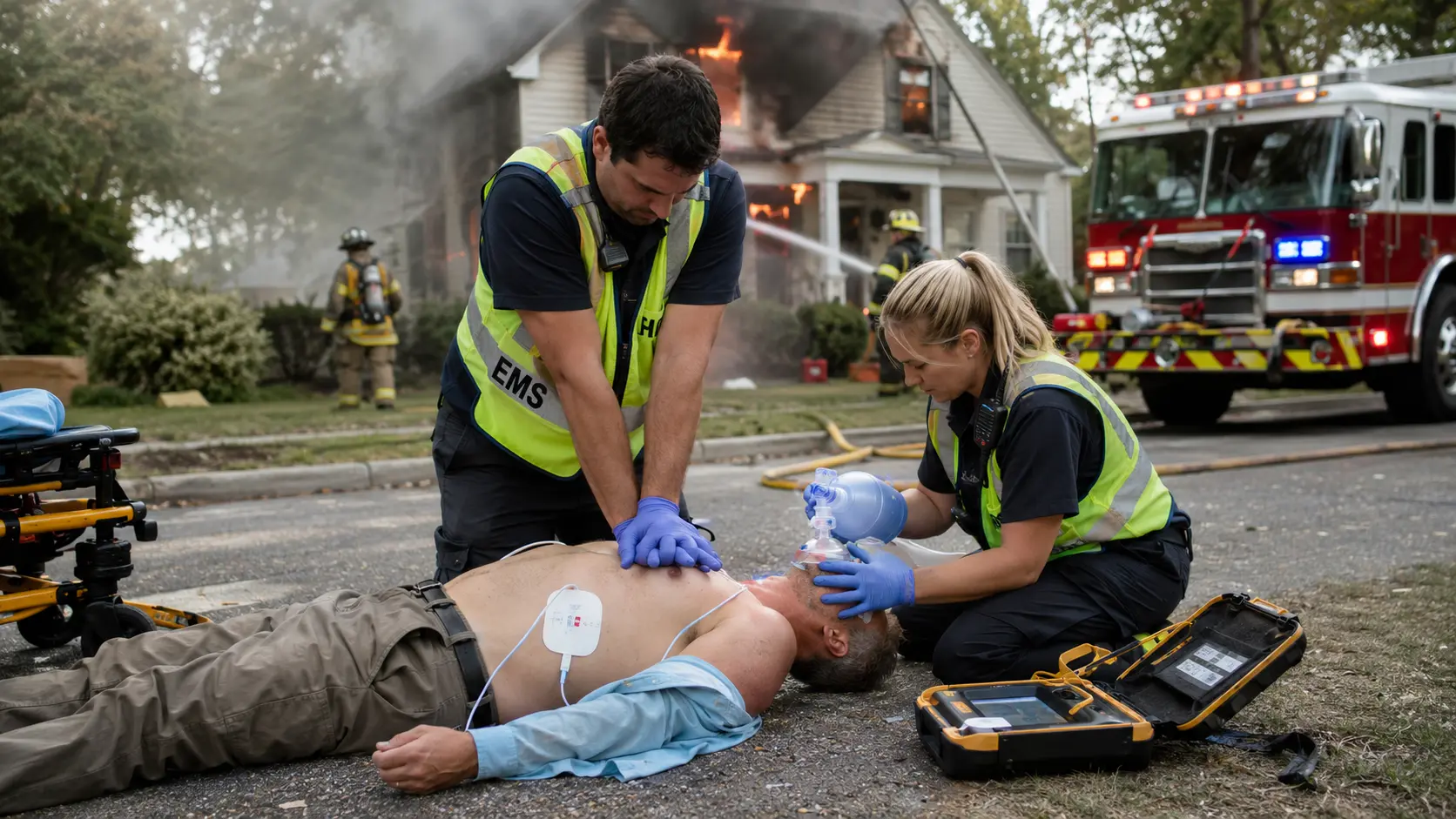
Cardiac arrest at a fire scene is not a rare event, and it does not always involve the occupants of the burning building. It involves three distinct patient populations: occupants who have been removed from the structure unconscious or pulseless, bystanders whose existing cardiac conditions are triggered by the physiological stress of a high-stress event, and firefighters — whose cardiac events represent 40 to 45 percent of all firefighter line-of-duty deaths every year, consistently, for decades.
In all three cases, the factor that most predicts survival is not the sophistication of the ALS crew that eventually arrives. It is the interval between cardiac arrest onset and the initiation of CPR. For every minute without CPR, survival probability declines by 7 to 10 percent. By the time ALS arrives — typically 8 to 12 minutes from dispatch — an arrest that began 3 minutes earlier has already used most of the survival window. The person closest to the patient when they arrest is the most important clinical resource in that arrest, regardless of their training level.
In this article:
Three Patient Populations at Fire Scene Cardiac Arrests
Structure fire occupants
Occupants removed from a burning structure in cardiac arrest may be in arrest from several causes: carbon monoxide poisoning that produced cardiac arrhythmia, smoke inhalation that caused hypoxic arrest, direct thermal injury, pre-existing cardiac conditions precipitated by the stress of the event, or traumatic injury from a fall or structural collapse. Each cause has a different clinical priority. CO poisoning requires high-flow oxygen as the first clinical intervention alongside CPR. Hypoxic arrest benefits from ventilation prioritized alongside compressions. The cause cannot always be determined quickly, so the standard ACLS protocol proceeds while history is gathered from bystanders and family.
Bystanders
Cardiac events in bystanders at fire scenes are well-documented and not uncommon. A significant percentage of bystander cardiac arrests at any high-stress public event involve individuals with pre-existing cardiac disease — coronary artery disease, heart failure, arrhythmia — whose conditions were not symptomatic at rest but were triggered by the catecholamine surge of witnessing a traumatic event, exerting themselves to respond, or simply the physiological response to extreme stress. The fire department's EMS resources are focused on the structure and its occupants; bystander arrests may be identified by other bystanders who notify arriving personnel.
Firefighters
Firefighter cardiac events during operations are a specific and documented risk. The physiological demands of structural firefighting — physical exertion in full gear, elevated core temperature, dehydration, CO exposure even with SCBA, and the psychological stress of high-stakes operations — create a cardiac demand profile that can precipitate events in firefighters with undiagnosed or known cardiovascular disease. Many of these events occur not during active interior operations but in the immediately following period — while removing gear, during overhaul, at the rehab sector, or while driving back to quarters. The post-exertion period, when cardiac demand drops suddenly but catecholamine levels remain elevated, is a high-risk window.
Firefighter Cardiac Events: The Specific Risk Factors
The NFPA's annual firefighter fatality reports show cardiovascular events accounting for 40 to 45 percent of line-of-duty deaths consistently across years and fire service types. This is not a statistical artifact — it reflects an occupational hazard that is well-characterized by research but incompletely addressed at the department level.
The specific risk factors that elevate firefighter cardiac risk beyond the general population include:
- Occupational CO exposure: Even with SCBA use, overhaul operations, smoke exposure during approach and scene clearing, and diesel exhaust in quarters contribute to cumulative CO exposure that is associated with increased cardiac risk.
- Extreme exertion with suppressed cardiovascular monitoring: A firefighter working interior operations is exercising at maximal or near-maximal intensity in an environment where the normal physiological warning signs of cardiac distress — anginal pain, breathlessness — may be masked by the environment and gear.
- Heat stress: Elevated core temperature directly affects cardiac function, increasing heart rate, reducing stroke volume, and in the context of existing coronary artery disease, increasing the probability of plaque rupture and acute MI.
- Dehydration: Reduces blood volume, increases blood viscosity, and increases cardiac work for the same output.
- Age and pre-existing disease: Firefighters can serve into their 50s and 60s in many departments, bringing the age-related cardiovascular risk profile that affects the general population. Annual medical evaluations that identify asymptomatic CAD, hypertension, and other risk factors are the primary preventive measure — and they are not uniformly implemented across departments.
The Time-to-CPR Evidence
The evidence on time to CPR and survival is among the most robust in emergency medicine. The cardiac arrest survival data is consistent across settings: for every minute from arrest to first CPR, survival probability decreases by approximately 7 to 10 percent. At 10 minutes without CPR, the probability of survival with good neurological outcome is under 10 percent for most patients in ventricular fibrillation, and approaches zero for asystole.
The intervening variable is brain viability — the brain tolerates approximately 4 to 6 minutes of complete ischemia before irreversible damage begins. CPR maintains a fraction of normal cardiac output — roughly 25 to 30 percent of normal blood flow to the brain — which is sufficient to extend this window. An arrest that receives CPR within 2 minutes of onset has a fundamentally different prognosis from one that receives CPR at 8 minutes, regardless of the ALS interventions that follow.
This is the argument for bystander CPR and for every fire scene bystander and fire crew member being trained and willing to initiate CPR before EMS arrival. The ALS crew's medications, advanced airway management, and defibrillation capability add incremental value — but they cannot recover the survival probability lost in the minutes before they arrived if no CPR was being performed.
Bystander CPR at Fire Scenes
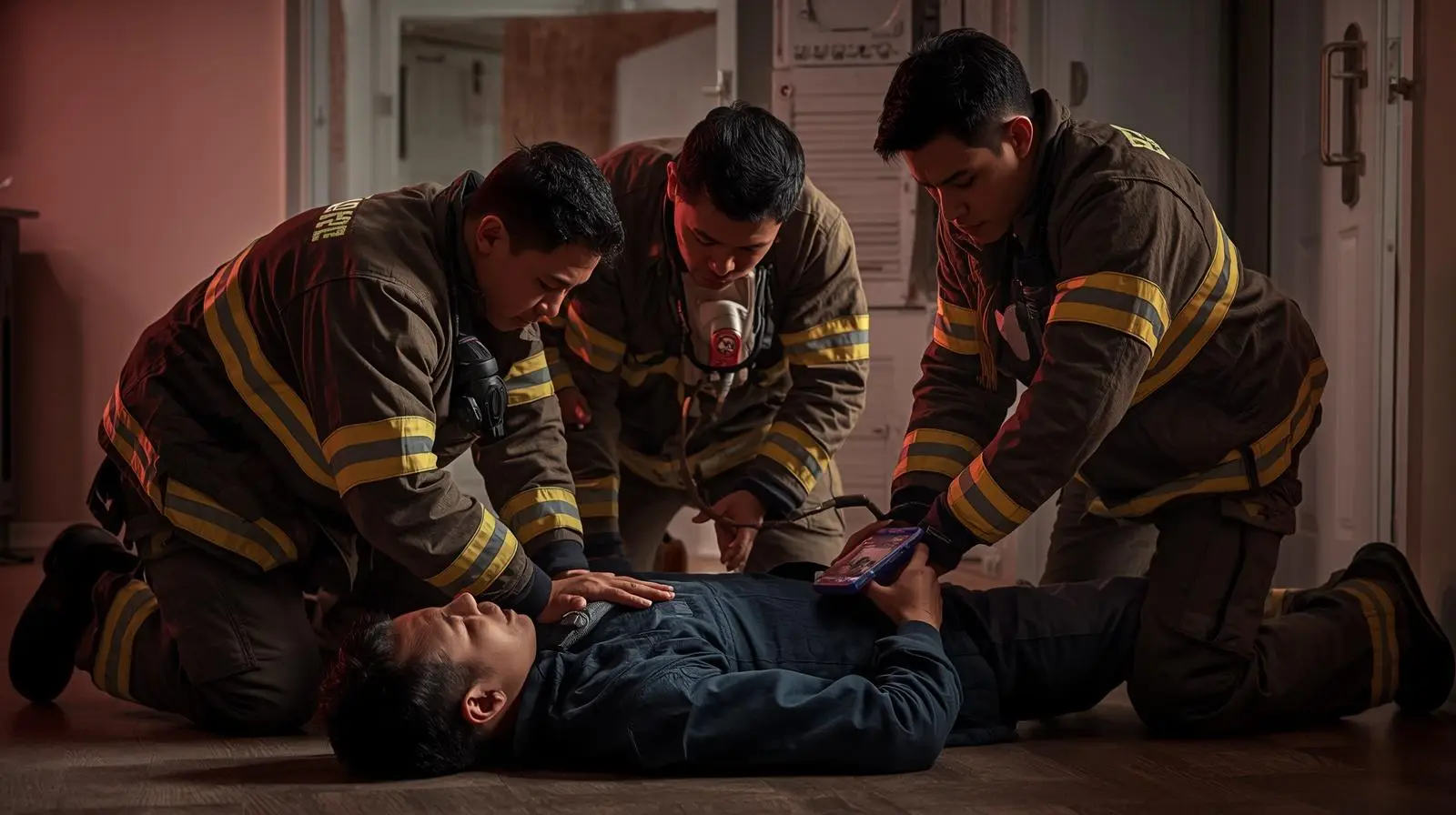
At a fire scene, the available bystanders are not random members of the public — they include the firefighters and EMS personnel already on scene. Any firefighter who is not committed to an active operational role is a potential CPR responder. The fire department's division of labor does not suspend cardiac arrest emergency response — when a person at the scene arrests, whoever is closest and available initiates CPR.
The practical challenge at a fire scene is resource competition. If the structure has occupants who have not been located, interior search crews cannot be withdrawn to respond to an exterior cardiac arrest. The incident commander manages this resource allocation — identifying who is available from the exterior operations to respond to the cardiac arrest patient while interior operations continue. In a department where every company responds with minimum staffing, this is a real constraint that produces real delays.
The response to this constraint: EMS units responding to the fire scene should be allocated a specific staging position that allows immediate access to the patient perimeter, separate from the apparatus positions that may be blocking direct patient access. An ambulance that arrives at a fire scene and parks behind three engines has lost the rapid access that its arrival is supposed to provide.
AED Access and Deployment
Automated External Defibrillators are carried on most ALS apparatus and on many engine and ladder companies. At a fire scene cardiac arrest, the AED should be applied as soon as it is retrieved — within the first minute of CPR if possible. Ventricular fibrillation (VF) is the most common initial rhythm in witnessed cardiac arrest, and defibrillation terminates VF with high effectiveness when delivered early. The probability of defibrillation successfully converting VF to a perfusing rhythm decreases rapidly with time — a rhythm that cardioverts easily at 2 minutes is significantly harder to convert at 8 minutes.
AED deployment is not contingent on ALS arrival. An AED on an engine or ladder provides effective defibrillation capability with basic training. The AED analyzes the rhythm, indicates whether a shock is advised, and delivers the shock — the operator does not need to interpret an EKG. Every fire service member with an AED on their apparatus should have used one in training on a mannequin, not just read the instructions.
Do not move a cardiac arrest patient to a more convenient location before establishing CPR and applying the AED. The movement delay costs survival probability that cannot be recovered. CPR starts where the patient is found; relocation occurs only when genuinely necessary for patient care and only with CPR continuing during movement.
What ALS Adds
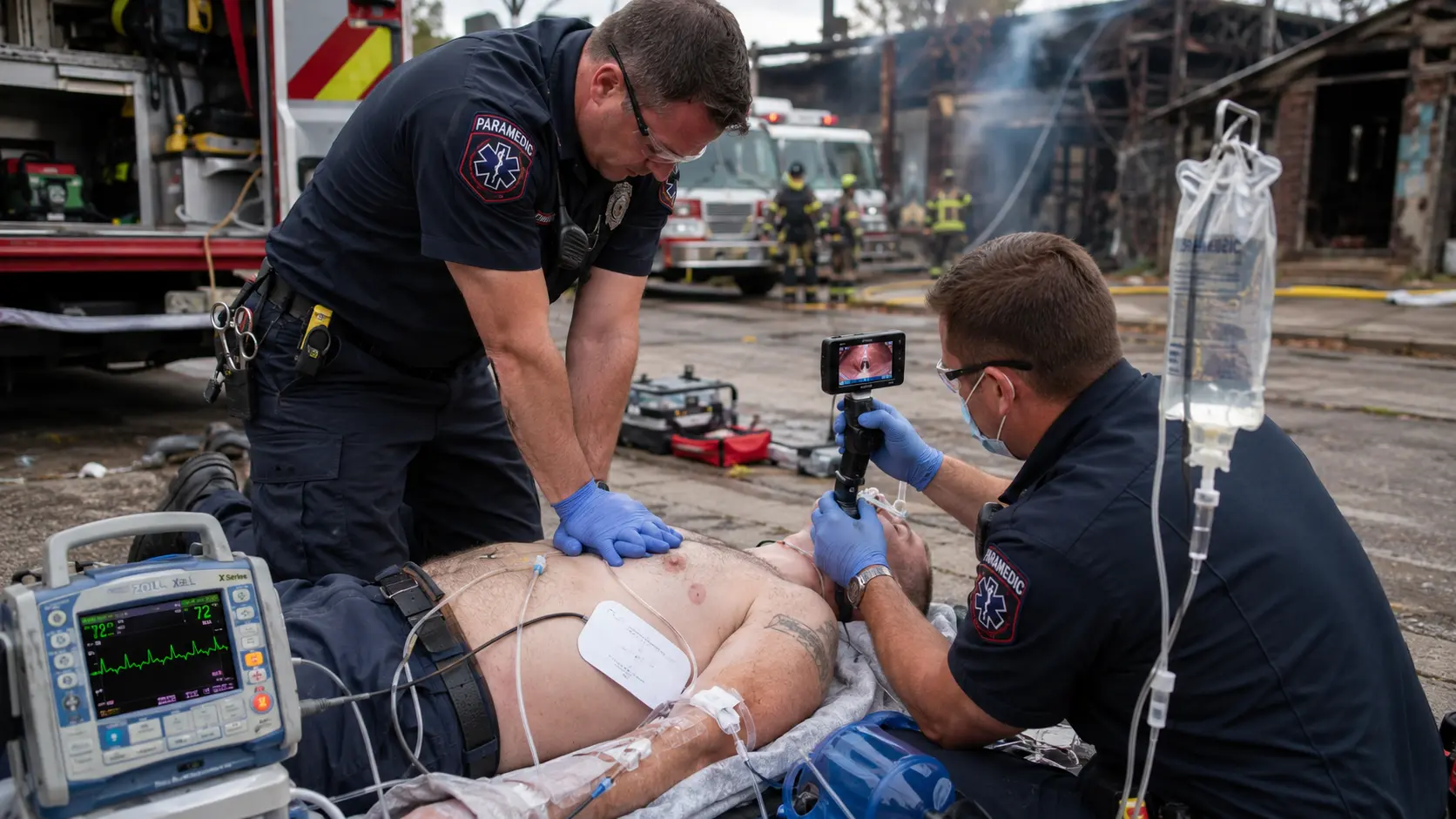
ALS interventions add meaningful value to cardiac arrest management beyond what basic CPR and AED provide — but they add that value to an arrest in which basic care was initiated promptly. An ALS crew arriving at an 8-minute arrest where no CPR has been performed faces a fundamentally different clinical situation from one arriving at the same arrest where CPR began within 2 minutes.
The specific ALS additions: advanced airway management (endotracheal intubation or supraglottic airway) ensures effective ventilation with 100% oxygen; epinephrine increases coronary and cerebral perfusion pressure during CPR; antiarrhythmic medications (amiodarone, lidocaine) can stabilize cardiac rhythm after defibrillation in refractory VF; and cardiac monitoring allows identification of rhythm and appropriate defibrillation or pacing decisions.
For CO-poisoned patients in cardiac arrest, high-flow 100% oxygen via the advanced airway is the specific ALS intervention most relevant to the cause — it accelerates CO elimination from hemoglobin during the resuscitation. The availability of 100% O2 via the ALS unit, combined with cardiac monitoring and defibrillation, represents the clinical combination most likely to achieve ROSC in a fire scene cardiac arrest.
Post-Resuscitation Care
Return of spontaneous circulation (ROSC) at a fire scene does not mean the patient is stable. Post-cardiac arrest syndrome — the systemic inflammatory and hemodynamic instability that follows any resuscitated cardiac arrest — produces ongoing risk of re-arrest and organ failure that requires intensive care management, not just transport to the nearest hospital. For fire scene arrests, the additional considerations include potential CO poisoning that may require hyperbaric oxygen therapy, thermal injury to the airway that was not apparent during the arrest, and the possibility of traumatic injury from the same event that caused the arrest.
The receiving hospital destination for a post-ROSC patient from a fire scene should ideally be a facility with cardiac catheterization capability (for ST-elevation MI that is the cause of many firefighter and bystander arrests), hyperbaric oxygen capability (for CO poisoning), and a burn unit (for patients with thermal injury). In regions where these capabilities are not in the same facility, transport destination decisions require real-time medical direction.
Logistical Challenges: CPR in Non-Ideal Locations
Cardiac arrests do not occur in flat, accessible locations. At a fire scene, they may occur inside a partially burned structure, on a stairway, in a basement, or in a position that requires moving the patient before effective CPR can be performed.
Stair CPR — moving a patient in cardiac arrest down stairs while maintaining compressions — is a specific skill that fire service and EMS personnel practice. It requires a minimum of three rescuers: one at the head maintaining airway and delivering compressions from above, two managing the descent. Compressions are continued during movement. The pause during stair negotiation is minimized — the movement takes priority over pausing for each step, and compressor fatigue is managed by rotation at the landing.
Mechanical CPR devices — commercially available devices that deliver automated, consistent compressions — are carried on some ALS units and rescue apparatus. These devices free human hands during transport and stair movement, maintain more consistent compression quality, and can continue compressions during defibrillation without rescuer withdrawal. For a complex extrication scenario or a lengthy transport, a mechanical device maintains CPR quality that manual compressions cannot sustain over 30 minutes of resuscitation.

Comments 0
No comments yet. Be the first to share your thoughts!
Leave a Comment