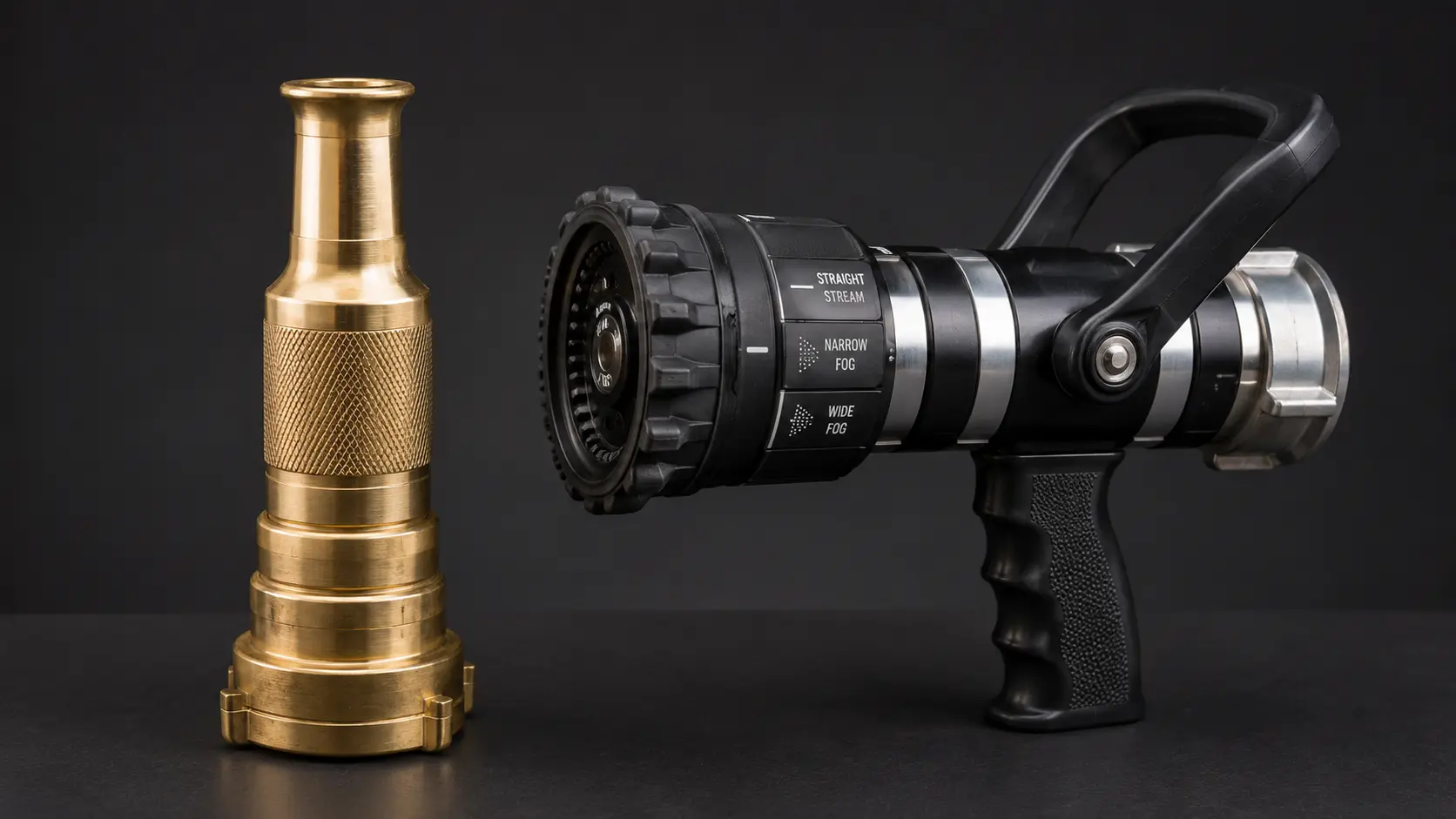

The nozzle is the last component in the water delivery chain — everything that happens in the pump, the hose, and the supply system is preparation for what the nozzle does at the fire. Two nozzles connected to identical hose systems in identical conditions will produce completely different water behavior if their pattern settings differ. A firefighter who selects fog when the situation requires a straight stream is applying the wrong tool regardless of how well everything before the nozzle performed.
Nozzle selection is not a preference. It is a tactical decision with direct consequences for suppression effectiveness, crew exposure, and water usage. Departments that standardize on one nozzle type regardless of incident type are making a default choice that will be correct in some scenarios and suboptimal in others.
In this article:
Smooth-Bore Nozzles: Reach, Penetration, and Flow
A smooth-bore nozzle — also called a solid-bore or fog-free nozzle — is the simplest nozzle design: a constricted orifice that shapes the water into a coherent, solid cylindrical stream. There are no moving parts, no adjustable pattern, and no internal mechanism. The tip size (the internal diameter of the orifice) determines the flow rate at a given pressure.
Common smooth-bore tip sizes and their flows at 50 psi nozzle pressure:
| Tip size | Flow at 50 psi NP | Typical application |
|---|---|---|
| 15/16" | ~185 GPM | 1¾" attack line |
| 1" | ~210 GPM | 1¾" or 2½" attack |
| 1⅛" | ~265 GPM | 2½" attack line |
| 1¼" | ~325 GPM | 2½" or master stream |
| 1½" | ~475 GPM | Master stream |
| 2" | ~850 GPM | Large master stream |
The smooth bore's advantages: maximum flow for a given pressure (no energy lost to pattern deflection), maximum reach (the coherent stream travels further before breaking up than a deflected fog pattern), and maximum penetration into burning material (the concentrated stream punches through fire and reaches the fuel surface). Its disadvantage: it cannot be varied in pattern. A smooth-bore tip is always a straight stream.
Combination Fog Nozzles: Pattern Control
A combination fog nozzle uses an internal deflector mechanism that can be adjusted to produce patterns from a narrow straight stream to a wide fog cone. The pattern is changed by rotating a control ring on the nozzle body — typically from "straight" through narrow fog to wide fog, in positions that correspond to different deflection angles of the internal mechanism.
The combination nozzle is the dominant nozzle type in American structural fire service, valued for its versatility: one nozzle covers the range from a nearly-straight stream (for reach into a room) to a wide fog (for cooling the thermal layer or creating a water shield). The trade-off is that no combination nozzle at any setting performs as well as a smooth bore at what the smooth bore does best — the deflection mechanism always reduces flow efficiency and reach compared to an equivalent smooth bore at the same pressure and flow rate.
Automatic Nozzles vs. Fixed Gallonage
The flow through a nozzle is determined by the pressure at the nozzle (nozzle pressure) and the nozzle's design. Two designs address this differently:
Fixed gallonage nozzles are designed to flow a specific GPM at a specific nozzle pressure. A 125-GPM fixed gallonage combination nozzle flows 125 GPM at 100 psi nozzle pressure, and if the pressure at the nozzle changes, so does the flow. The pump operator must maintain the correct pump discharge pressure to deliver the correct nozzle pressure for the design flow. Fixed gallonage nozzles provide consistent flow performance when pressure is managed correctly.
Automatic (constant pressure) nozzles use an internal spring mechanism that maintains approximately constant nozzle pressure over a range of flow rates. As pump discharge pressure changes — because another line opens, closes, or the supply pressure varies — the automatic nozzle adjusts its internal orifice to maintain approximately 100 psi nozzle pressure. The flow changes, but the pressure and therefore the stream characteristics remain more consistent. Automatic nozzles reduce the precision required of the pump operator but can produce flows anywhere in their design range depending on pump output.
Stream Patterns and What Each Does
Straight stream: On a combination nozzle, the straight position produces a stream that is similar to a smooth bore but with slightly less reach and efficiency due to the internal deflector. Used for reach into deep spaces, penetration of burning material, and situations requiring the water to travel a specific distance before dispersing.
Narrow fog (15–30°): A relatively tight cone that concentrates water in a smaller area than wide fog but provides more cooling effect and steam production than a straight stream. Used for interior attack at moderate distances, for creating a partial water shield, and for cooling exposed structural elements at close range.
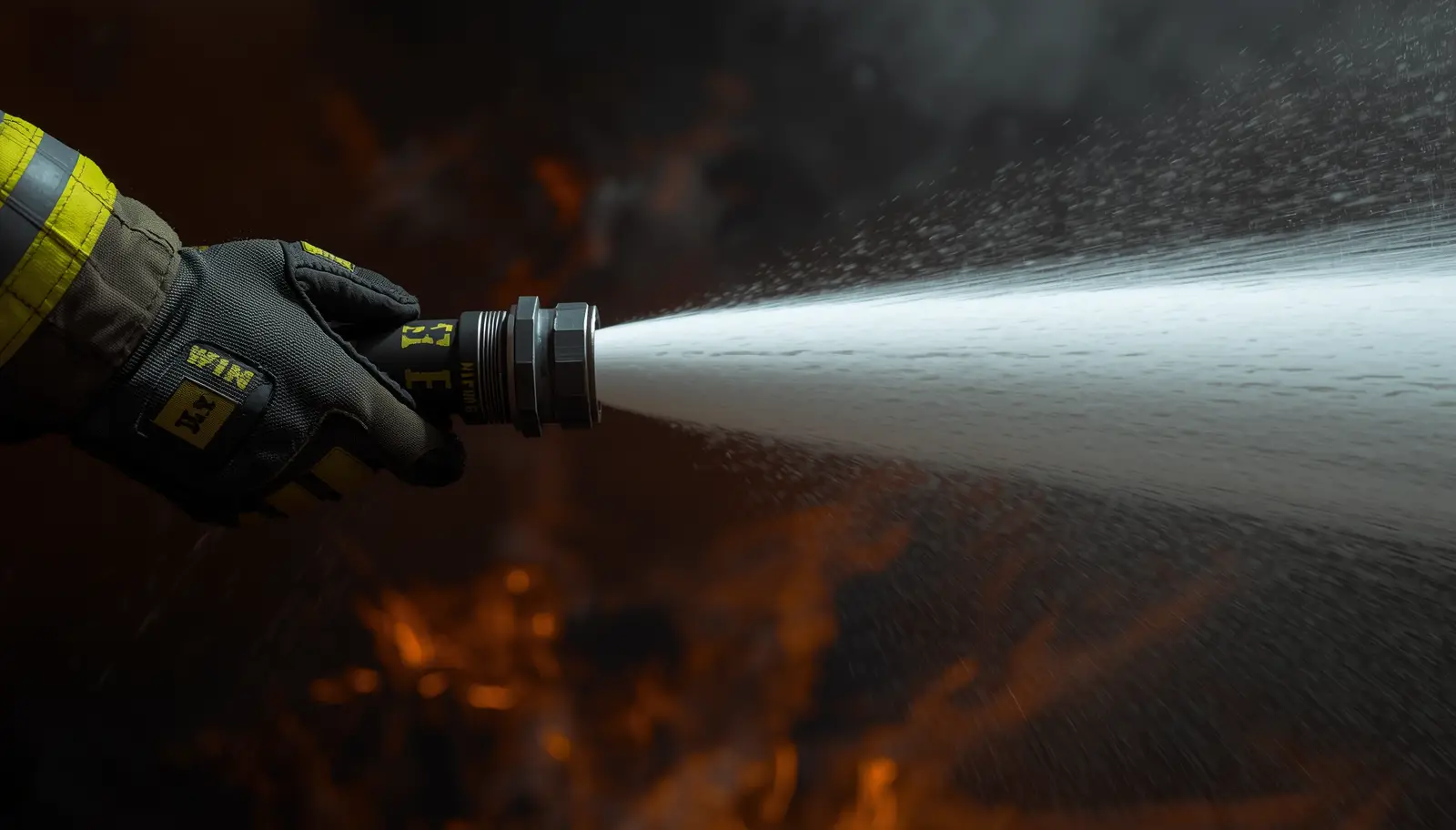
Wide fog (60–80°): A broad cone that maximizes the water surface area exposed to the fire environment, producing maximum steam generation and maximum cooling of the thermal layer per gallon applied. The trade-off: wide fog has very limited reach — the water disperses and decelerates rapidly, losing the ability to travel any significant distance toward the fire. Wide fog applied from the doorway of a burning room produces excellent steam generation but may not actually reach the burning fuel surface across the room.
Broken stream / modified fog: A middle position that combines some of the reach characteristics of a straight stream with some of the steam production of fog — useful for interior operations at moderate ranges where neither extreme is optimal.
When to Use Each Pattern
| Situation | Recommended pattern | Reason |
|---|---|---|
| Deep-seated fire in walls or ceiling | Straight stream or smooth bore | Penetration reaches the burning material |
| Room fire direct attack from doorway, fire across the room | Straight or narrow fog | Reach required to hit burning material; fog loses velocity too quickly |
| Cooling the thermal layer (ceiling fog) | Wide fog directed at ceiling | Maximum steam production from hot gas layer |
| Class B liquid fire | 30° fog applied as gentle rain-down | Direct stream plunges into fuel; fog deposits on surface without disruption |
| Crew protection from radiant heat | Wide fog pointed toward heat source | Water curtain absorbs/scatters radiant heat before reaching crew |
| Exposure protection on adjacent structure | Straight stream or smooth bore | Reach required to wet the exposure surface at distance |
| Wildland direct attack, pump-and-roll | Smooth bore or narrow fog | Penetration into fuel; coherent stream from moving apparatus |
Master Stream Nozzles
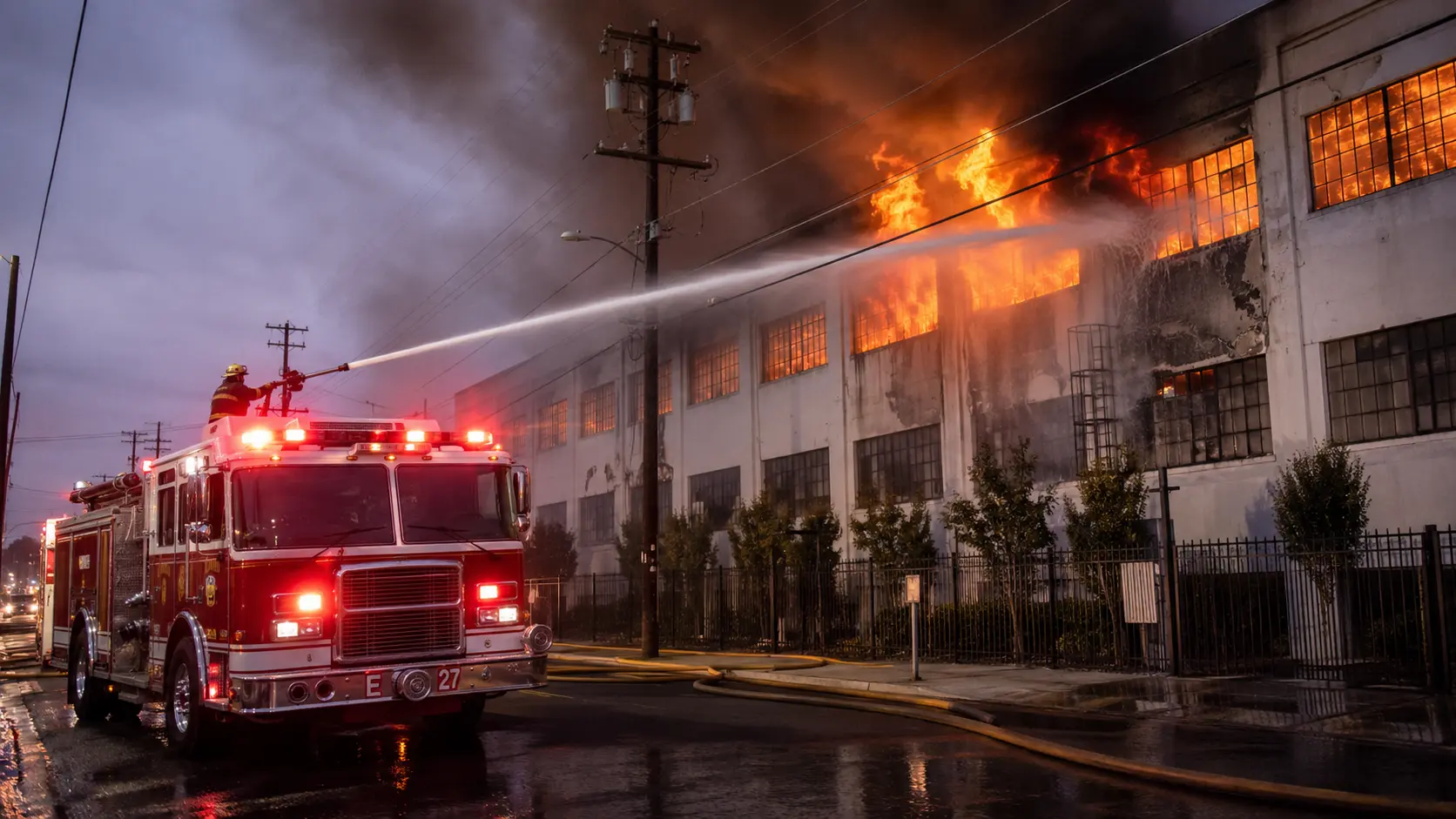
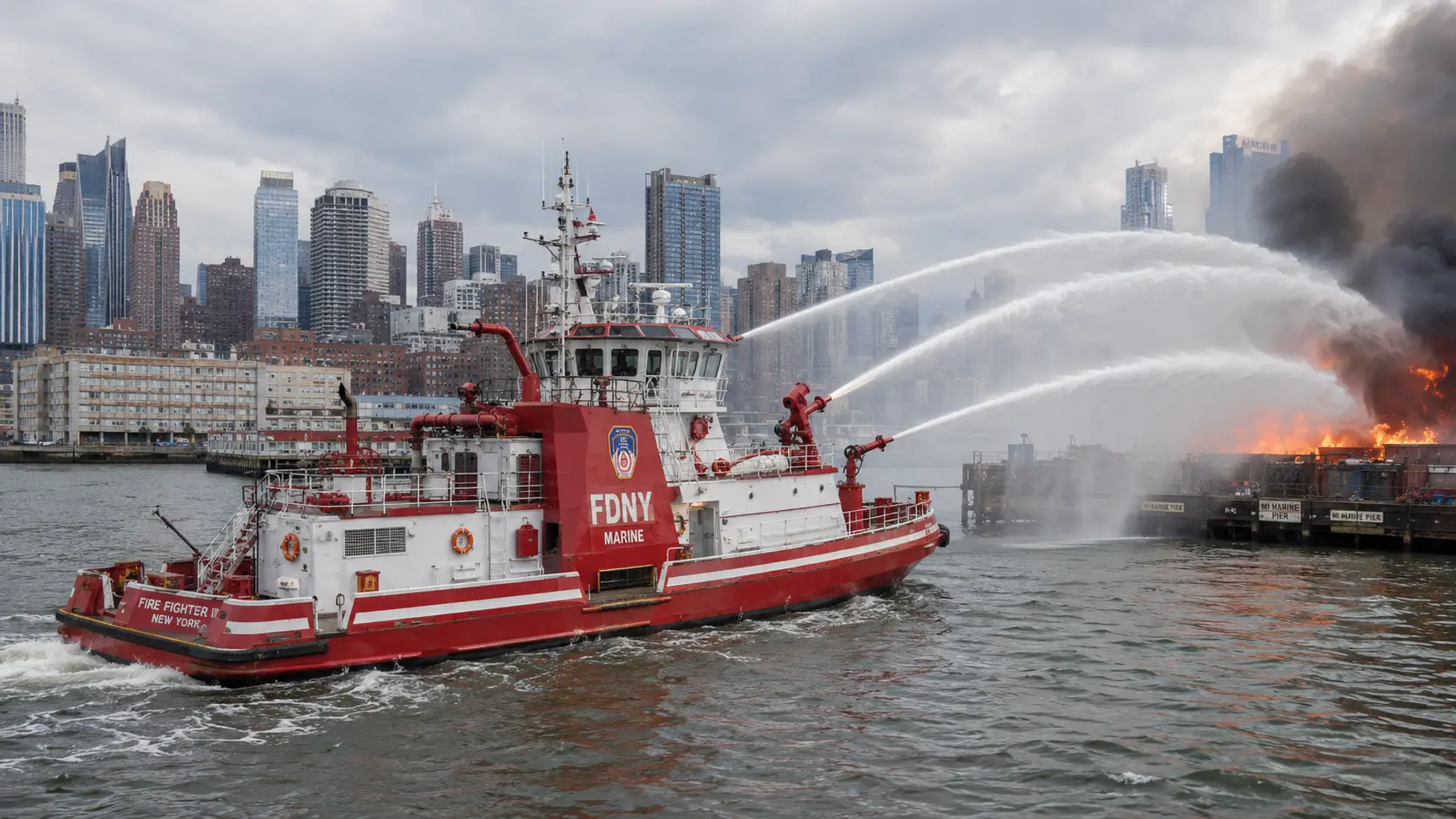
Master stream nozzles — deck guns on engines, ladder pipe monitors on aerials, portable ground monitors — deliver flows in the 500 to 2,000 GPM range through large-diameter smooth-bore tips or oscillating fog monitors. They are not carried by hand crews — they are fixed to apparatus or portable devices set up at the scene and operated from a distance or remotely.
Smooth-bore tips dominate master stream applications for structural fire attack because the coherent stream can reach the upper floors of a burning building or penetrate deeply into a large fire. Oscillating fog monitors are used for exposure protection and for rapid knockdown of large flammable liquid fires where the full perimeter needs water application simultaneously.
Class B Foam Nozzles
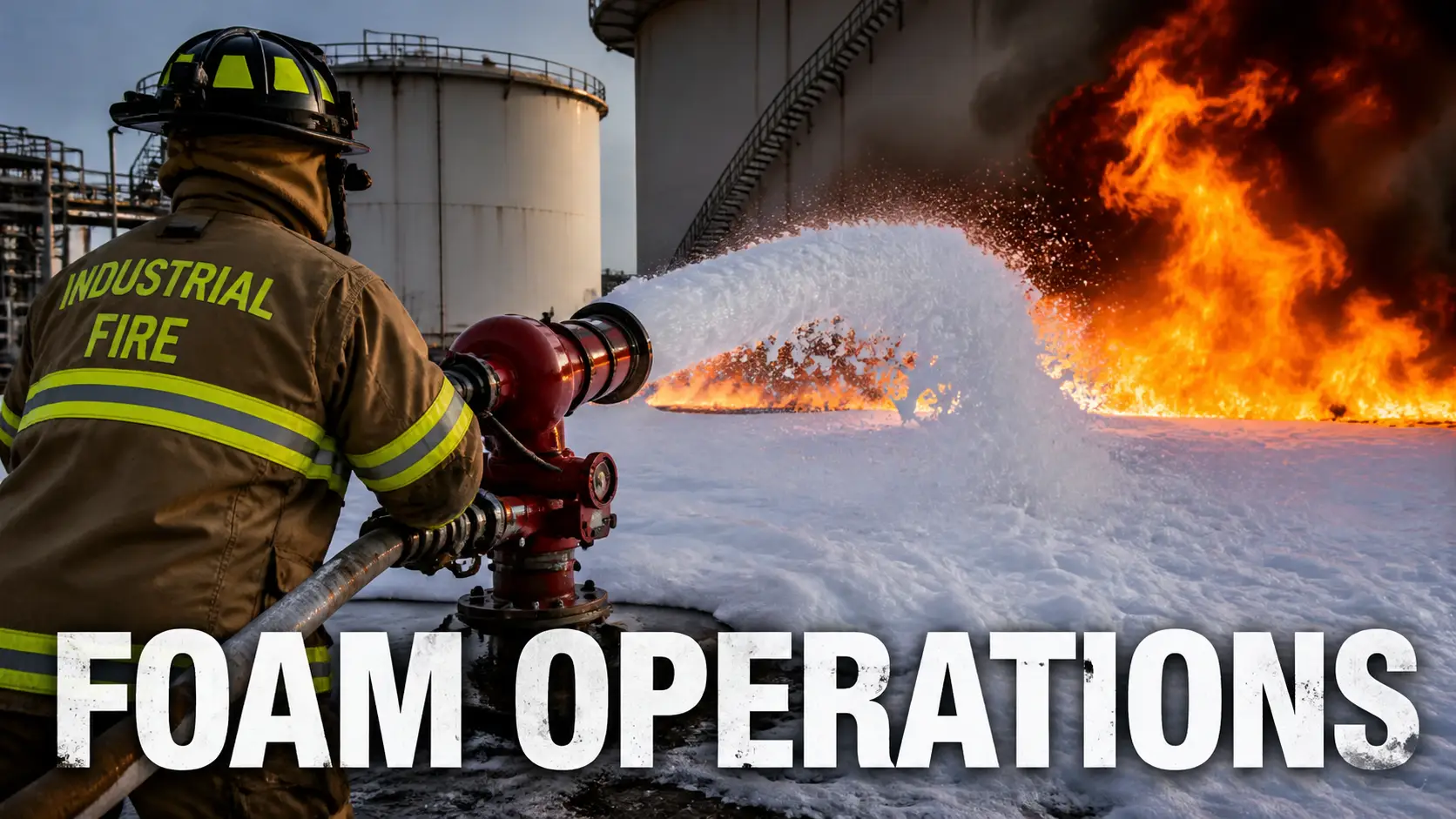
Applying foam to a flammable liquid fire requires nozzle types specifically designed to aspirate foam concentrate into the water stream, mix it to the correct expansion ratio, and deliver it to the fuel surface without plunging into the liquid. Standard attack nozzles — both smooth bore and combination — are not designed for foam delivery. Foam nozzles incorporate an air induction mechanism that draws air into the foam-water mixture to produce the expanded foam blanket.
The application technique requirement is equally important to the nozzle design. Foam must be applied gently — as a soft rain-down or banked off a retaining wall — rather than directly into the burning liquid. Direct stream application destroys the foam blanket before it establishes on the surface. The foam nozzle's pattern setting for Class B applications is typically a 30° to 45° deflected pattern that produces a soft, lobbing delivery trajectory rather than a direct-plunge trajectory.
Nozzle Reaction Force
Every flowing nozzle produces a reaction force in the direction opposite to the water flow — Newton's third law. This force pushes back against the firefighter holding the nozzle. At standard 1¾-inch attack flows (150 to 185 GPM at 50 psi nozzle pressure), the reaction force is approximately 75 to 95 pounds — manageable for a single firefighter in a braced position but difficult to control while moving, during low-visibility crawling, or while maintaining a door position.
The 2½-inch line at full flow (300+ GPM) produces 120 to 150 pounds of reaction force — a two-firefighter operation on the nozzle for interior attack. Operators who attempt to control a high-flow 2½-inch line in a narrow interior corridor without a second person on the line lose the ability to advance and may be pushed back by the reaction force in tight spaces.
Reaction force is also why high-fog patterns require more physical effort per GPM than straight streams — the wider deflection angle increases the lateral component of the reaction force, making the nozzle harder to aim precisely. A wide-fog nozzle at 100 GPM takes more physical control effort than a straight stream at 100 GPM at the same pressure.
Comments 0
No comments yet. Be the first to share your thoughts!
Leave a Comment