Fire does not simply "spread." It transfers energy to adjacent materials through three specific physical mechanisms, each of which operates differently, creates different hazards, and responds to different interventions. A firefighter who understands only that "fire is hot" is missing the information that determines which parts of a building are at risk of extension, why the floor gets hot before the fire reaches it, and why a structure half a mile from a wildfire can ignite from radiant heat while the structure beside it does not.
The three mechanisms — conduction, convection, and radiation — are not alternatives. They operate simultaneously in every fire, each dominating in different phases and different parts of the fire environment. Understanding how each works is the foundation of understanding why fires behave the way they do.
In this article:
Conduction: Heat Through Solids
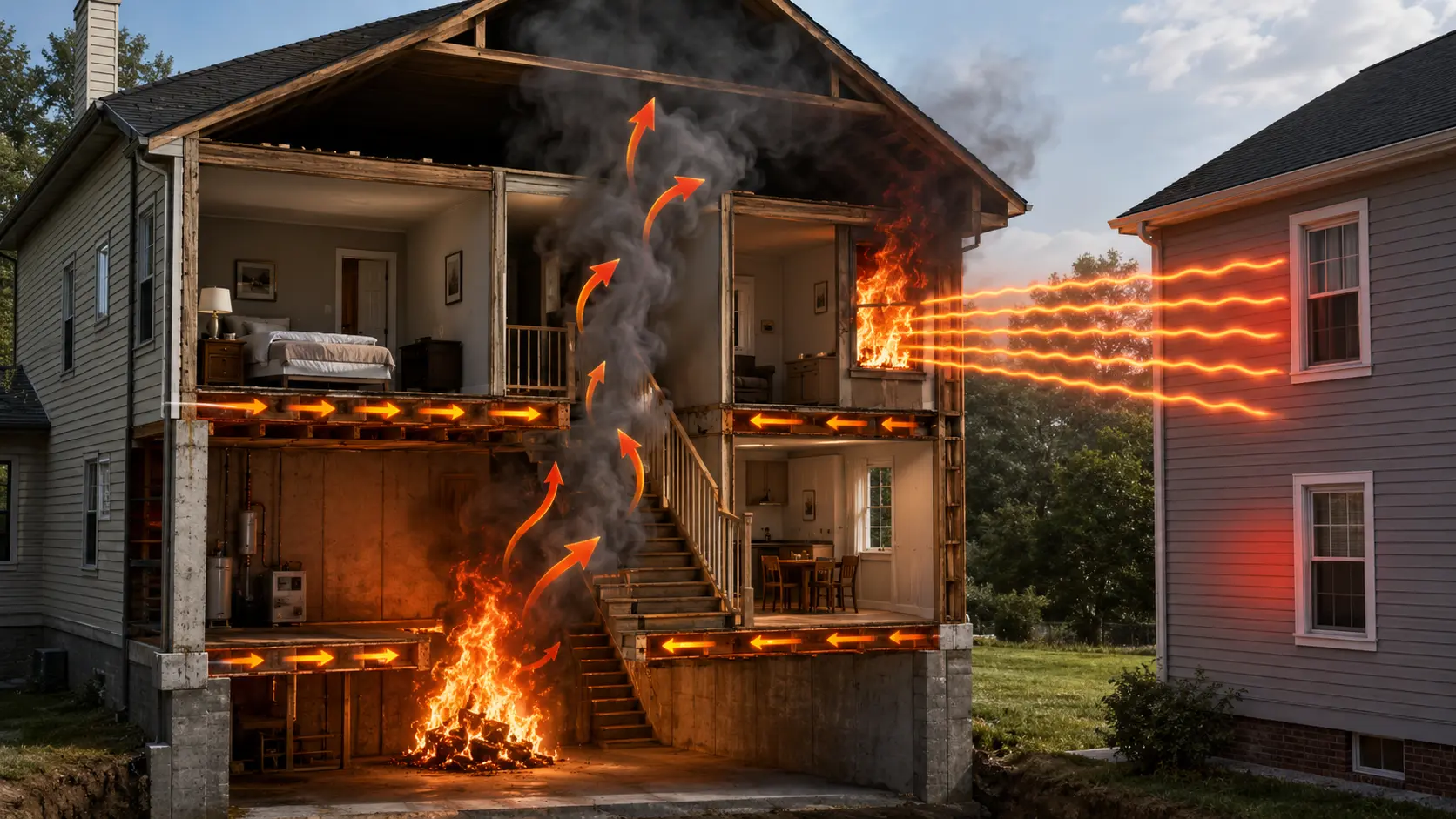
Conduction is heat transfer through direct material contact — energy moving from a higher-temperature region to a lower-temperature region within or between solid materials. In a building fire, conduction is responsible for heating structural elements that are not in direct contact with flames: floor joists below a burning room, steel beams embedded in the building structure, and wall studs adjacent to a burning wall cavity.
The rate of conduction depends on the thermal conductivity of the material. Steel conducts heat rapidly — a steel beam with one end in a fire will heat along its length quickly, potentially igniting adjacent materials far from the fire origin. Wood is a much poorer thermal conductor — a wood beam exposed to fire on one face will develop a char layer that actually insulates the interior wood and slows further conduction. Concrete is a poor conductor and provides useful thermal mass — it absorbs heat slowly and retards transfer to the reinforcing steel inside it.
The firefighter implication: extension fires in adjacent rooms or floors can be caused by conduction through structural elements, even when no flame or smoke has crossed the barrier. A wall that is hot to the touch on the unexposed side, or a floor that is warm above a basement fire before smoke is visible on the upper floor, indicates conduction heat transfer that may be preheating combustibles on the far side toward ignition temperature. Overhaul must address conductive heat transfer — opening walls and ceilings to check for hidden heat in structural elements — not just direct flame extension.
Convection: Heat Through Moving Gas
Convection is heat transfer by the movement of a fluid — in fire science, primarily by the movement of heated air and combustion gases. Hot gases rise because they are less dense than cooler surrounding air. As they rise, they carry their thermal energy upward and outward, preheating surfaces they contact and transporting combustion products to parts of the building remote from the fire origin.
Convection is the primary mechanism behind the thermal layer that develops in a room fire. Hot gases and smoke accumulate at ceiling level because they rise from the fire and cannot escape — they bank against the ceiling and build downward over time. The thermal layer represents enormous thermal energy stored in the hot gas mass: at pre-flashover conditions, the thermal layer may be at 600 to 800°F while the floor-level air is at 100 to 150°F. A firefighter operating at floor level is in a different thermal environment from the ceiling layer — a difference maintained only as long as the layer remains stable.
Convection is also responsible for chimney effect in vertical building elements. Hot gases rising through stairwells, elevator shafts, HVAC ducts, and wall cavities carry fire from lower floors to upper floors through pathways that horizontal fire barriers do not address. A fire in a basement that sends hot gas up an open stairwell can produce smoke and heated gas conditions on the third floor before the second floor is significantly involved. Vertical pathways are among the primary fire spread routes in multi-story buildings, and controlling them through fire doors and compartmentalization is a foundational element of high-rise fire safety design.
Radiation: Heat Through Space
Radiation is heat transfer by electromagnetic waves — infrared radiation — that travels at the speed of light through air and space without requiring direct contact or a material medium. A fire radiates energy outward in all directions, and any surface in the "view" of the fire receives some fraction of that energy depending on the distance, angle, and intervening obstructions.
Radiation is the dominant heat transfer mechanism over distance. At close range, convection is also significant. At distances of several feet or more, radiation accounts for most of the heat energy received by surfaces away from the fire. The radiant heat flux — the power of radiant heat per unit area — decreases with the square of the distance from the fire source. At twice the distance, you receive one-quarter of the radiant heat flux.
Radiation is the mechanism by which flashover is triggered. As the thermal layer builds and the fire grows, the entire ceiling-level hot gas mass radiates downward onto every fuel surface in the room simultaneously. When that radiant heat flux reaches approximately 20 kilowatts per square meter at floor level, it is sufficient to raise every combustible surface to ignition temperature simultaneously — the definition of flashover. The thermal layer is not just a smoke hazard; it is an energy radiating source that determines when the entire room ignites.
In wildland fires, radiation is the primary mechanism of structure ignition at distances beyond direct ember contact. A structure 300 feet from an active fire front with 50-foot flame heights receives significant radiant heat flux. Whether that flux is sufficient to ignite the structure depends on the material facing the fire — combustible wood siding may reach ignition temperature; masonry will not. This is the physical basis for siding material selection in wildfire structure hardening — radiation is the heat transfer mechanism the siding must resist.
How the Three Mechanisms Compare
| Mechanism | Medium | Range | Primary fire hazard | Addressed by |
|---|---|---|---|---|
| Conduction | Solid materials | Short (inches to feet) | Extension through structure; steel failure | Overhaul; fire-rated assemblies; compartmentalization |
| Convection | Gases and liquids | Building-wide via pathways | Thermal layer; smoke spread; vertical extension | Ventilation; fire doors; compartmentalization |
| Radiation | Electromagnetic waves | Medium to long (feet to hundreds of feet) | Pre-heating of remote surfaces; flashover; wildfire structure ignition | Distance; non-combustible surfaces; thermal barriers |
How Water Addresses Each Mechanism
Water's effectiveness as a fire suppressant derives from its impact on all three heat transfer mechanisms, though through different means for each.
Against conduction: Water applied to a hot structural element absorbs heat from the element by conduction — the temperature differential between the hot steel or wood and the cool water drives heat flow from the material into the water. This cooling prevents the material from reaching the temperatures at which structural failure occurs (for steel) or continued combustion occurs (for wood). Overhaul wetting of hot structural elements addresses conducted heat stored in building materials.
Against convection: Water applied to a burning fuel reduces the fuel's temperature and reduces its vapor production, which reduces the heat being added to the convective gas environment. Water fog applied to the thermal layer directly — a ceiling fog pattern — absorbs heat from the hot gas layer and produces steam, both cooling the layer directly and, through steam production, displacing some of the hot gas with water vapor. Cooling the thermal layer extends the time to flashover and improves the survivable conditions at floor level.
Against radiation: Water mist or spray curtains can absorb and scatter infrared radiation, reducing the radiant heat flux reaching protected surfaces. This is the mechanism behind water-spray systems used to protect exposures and the reason that firefighters operating between a fire and an exposure sometimes use a fog pattern to reduce radiation to the exposure. Water does not eliminate radiation but can reduce the effective flux reaching a target surface.
The most important thermal property of water in suppression is its extraordinarily high latent heat of vaporization — 970 BTU per pound. When water evaporates, it absorbs vastly more heat from the surrounding environment than when it simply heats from cold to 212°F. One pound of water absorbs about 180 BTU in heating from 32°F to 212°F, but absorbs 970 BTU in the transition from liquid to vapor at the same temperature. This is why steam production during fire suppression is not a secondary effect — it is the dominant cooling mechanism, absorbing heat from the convective gas environment far more efficiently than the liquid water alone.
Fireground Implications of Each Mechanism
Conduction implication: The floor above a basement fire may be close to ignition temperature before any visible signs of fire appear on the upper floor. A hand placed on the floor of a room above a reported fire tells a crew something real — if the floor is hot, conduction heat transfer is preheating the structure. Overhaul after knockdown must address conducted heat in wall and floor assemblies, not just visible fire extension.
Convection implication: The thermal layer is not just smoke — it is stored thermal energy that will descend to floor level and eventually produce flashover if the heat input from the fire continues. A crew operating in a room where the thermal layer is descending to waist height has very little time before conditions become untenable. Monitoring the layer's height is continuous situational awareness, not a one-time observation.
Radiation implication: In a room fire, the thermal layer is radiating heat downward onto everything in the room — including the crew on the floor and the floor surface itself. The floor temperature in a pre-flashover room is not ambient; it is being heated by radiation from above. The firefighter at floor level is in the cooler zone but not in a room-temperature zone. And in wildfire operations, structures at distances where crews expect no direct involvement can be receiving radiant heat flux sufficient to ignite combustible surfaces — a hazard that is invisible until it produces smoke or flame.

Comments 0
No comments yet. Be the first to share your thoughts!
Leave a Comment