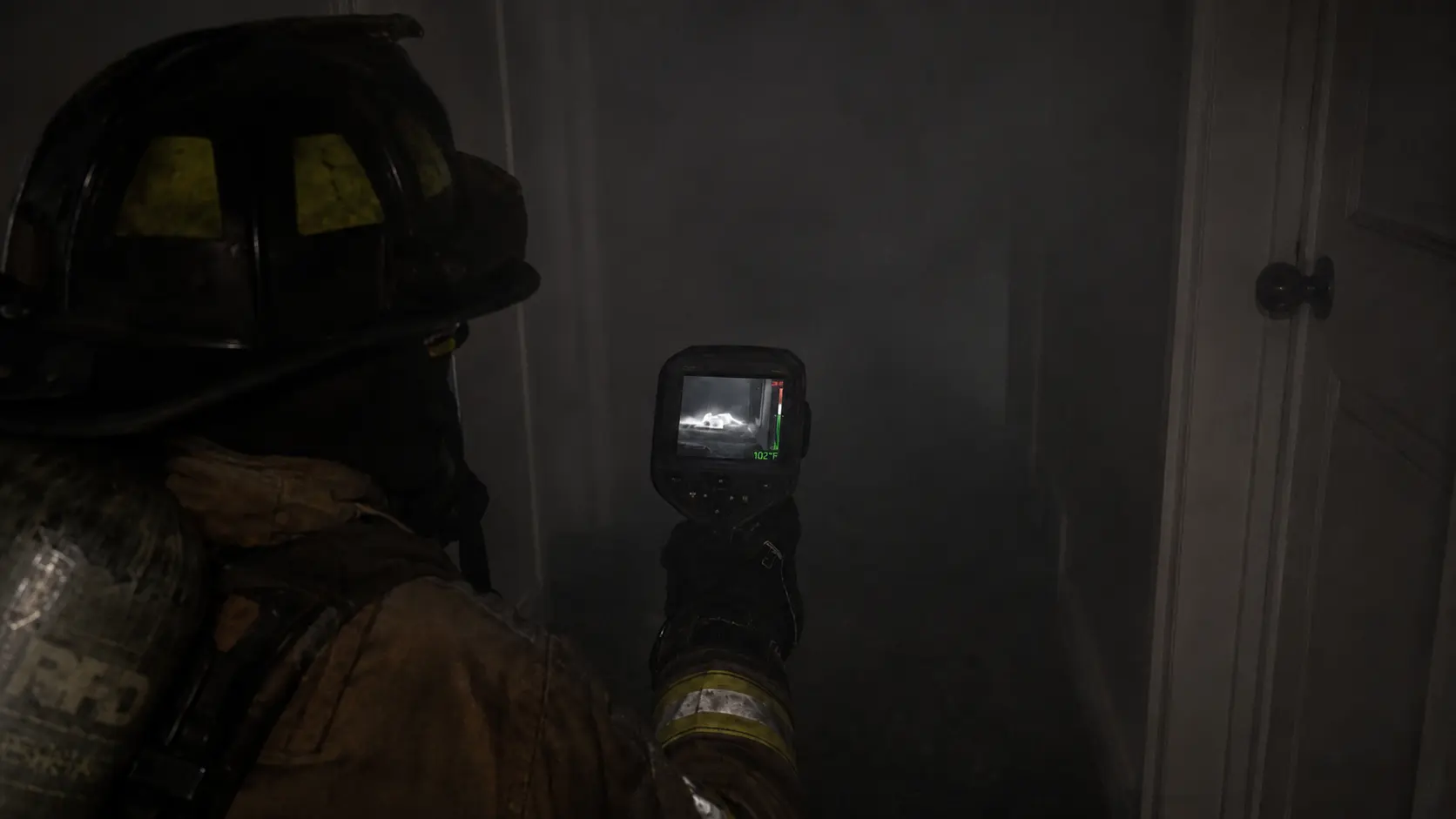
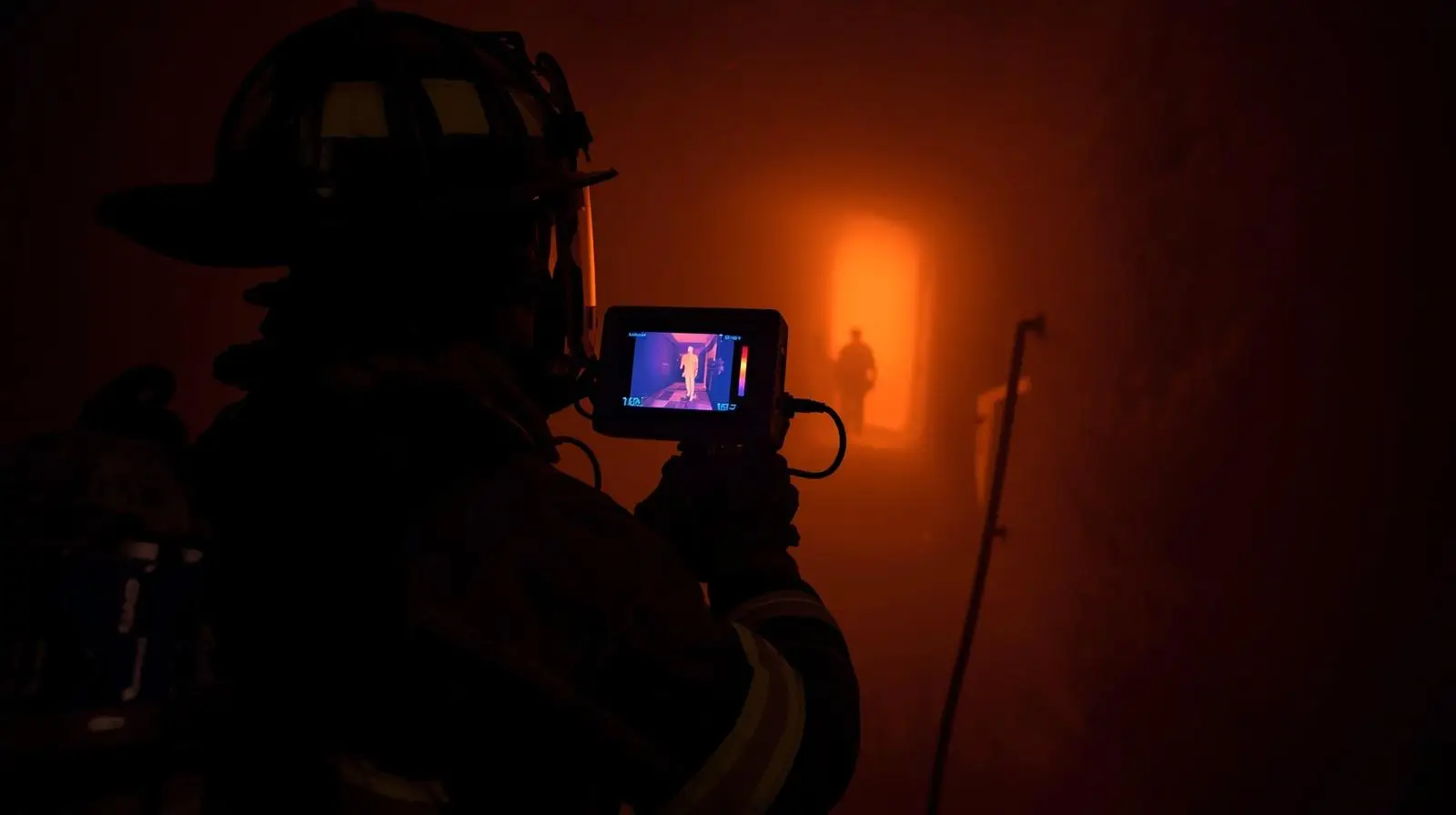
The thermal imaging camera fundamentally changed interior firefighting search capability when it became standard equipment in the mid-1990s. Before TICs, primary search in zero-visibility smoke conditions meant crawling on hands and knees, sweeping with one hand, following walls, and hoping that any victim encountered was accessible. After TICs, the same search could be conducted while holding a camera that showed the thermal environment — hot spots, heat signatures through smoke, and in many cases, the contrast signature of a living victim's body heat against a cooler background.
The TIC did not eliminate the limitations of zero-visibility interior search. It reduced them. The camera's failure modes — and every tool has failure modes — are less well understood than its capabilities, which produces situations where firefighters trust a TIC reading that is misleading and miss conditions the camera cannot display. Understanding both what TICs see and what they do not see is as important as knowing how to turn one on.
In this article:
- How TICs work: infrared radiation detection
- Reading the TIC display correctly
- White hot vs. black hot: display inversion
- The 'see through smoke' capability and its limits
- Finding victims with a TIC
- Fire location and extension detection
- Specific failure modes: glass, thermal equilibrium, masking
- Post-fire overhaul use
How TICs Work: Infrared Radiation Detection
Every object above absolute zero temperature emits infrared radiation — electromagnetic radiation in the infrared spectrum, which is wavelengths longer than visible light. The amount and wavelength distribution of that radiation depends on the object's temperature. A human body at 98.6°F emits infrared radiation in a specific wavelength range. A burning fire emits radiation across a broader range at much higher intensity. A concrete floor at 70°F emits infrared radiation at a lower intensity and in a slightly different peak wavelength.
A TIC's sensor detects this infrared radiation and converts it into a temperature map — each pixel on the display corresponds to a specific angular field of view from the camera, and the pixel's brightness (in white-hot mode) or darkness (in black-hot mode) represents the detected infrared intensity from that direction. Objects with higher infrared emission — hotter objects — appear brighter or darker depending on the display mode selected.
Crucially: the TIC is not seeing through smoke in the sense of penetrating a physical barrier. Smoke particles are small enough that they do not significantly absorb or scatter infrared radiation in the wavelength range that TICs use. The TIC "sees through" smoke for the same reason that infrared remote controls work across a room full of cigarette smoke — the infrared wavelengths are not significantly blocked by the smoke particle sizes encountered in structure fires. Visible light, with its shorter wavelengths, is scattered by those same particles and produces the zero-visibility condition. The TIC operates in a spectral range where the smoke is effectively transparent.
Reading the TIC Display Correctly
The TIC display shows temperature distribution as a grayscale (or false-color) image. In white-hot mode — the most common default setting — hotter objects appear brighter (whiter) and cooler objects appear darker (blacker). A person lying on a floor in a smoke-filled room appears as a bright white human-shaped region against a darker floor background.
Correct reading requires understanding what the camera is calibrating to. Most firefighter TICs use automatic gain control — the camera continuously adjusts its display to show the full temperature range of what it currently sees. If there is a fire visible in one part of the frame, the camera may calibrate to the fire's high temperature, compressing the temperature differences in the cooler parts of the image and making a warm human body look similar in brightness to the cool floor. The firefighter looking for a victim's heat signature while the camera is calibrated to a fire in the same frame may not see the contrast they expect.
Manual gain control or high-sensitivity mode — available on more advanced TICs — allows the camera to be set to a specific temperature range that preserves contrast between human body temperature and the ambient temperature, even when a higher-temperature fire is in the field of view. Understanding the camera's gain behavior is operational knowledge that determines how effectively the TIC is used.
White Hot vs. Black Hot: Display Inversion
Firefighter TICs typically allow the display to be switched between white-hot (hot objects appear white) and black-hot (hot objects appear black) modes. The choice between them is personal preference and environmental conditions — some users find white-hot more intuitive because it matches the mental model of "bright = hot" from visible flame. Others find black-hot more useful for certain scenarios because the dark regions stand out against the bright background in specific fire environments.
The operational implication of switching between modes: what appears as a bright region in white-hot mode appears as a dark region in black-hot mode. A firefighter who is trained on white-hot and picks up a camera set to black-hot will initially see the display in a way that is the inverse of their training — what they expect to look bright and hot appears dark. Training on both modes, and checking which mode the camera is in before entering the search environment, prevents misinterpretation.
The 'See Through Smoke' Capability and Its Limits
TICs do not see through smoke in terms of penetration distance. The effective range of a TIC in a smoke-filled environment depends on the smoke particle concentration, not just wavelength. In very dense smoke — the kind produced by burning synthetic materials at high heat — the infrared absorption and scattering can reduce effective TIC range significantly even though the camera is operating in the "smoke-transparent" wavelength range. The camera may show a clear image at 10 feet and a heavily degraded image at 30 feet in the same smoke-filled hallway, depending on smoke density.
TICs also cannot see through materials that absorb infrared radiation. Walls, floors, and ceilings do not transmit infrared through their full thickness — a TIC looking at a wall sees the surface temperature of the wall, not through it. A victim in the room behind a wall does not produce a detectible heat signature through the wall unless the victim has been in contact with the wall long enough to heat it to a detectible level, and the wall's thermal conductivity and thickness allow that heat to reach the surface facing the camera.
Finding Victims with a TIC
The thermal signature of a living victim in a structure fire is their body heat — approximately 98.6°F — against a cooler ambient background. In the early stages of a fire, the ambient temperature may still be close to normal room temperature, and the body heat contrast is high and easy to detect. As the fire develops and ambient temperatures rise, the contrast between the victim's body temperature and the ambient temperature decreases, making the victim harder to identify against the background.
A victim who has been in a hot environment for an extended period may have surface temperature close to the ambient temperature as their skin equilibrates with the surrounding heat. A victim in a post-flashover environment may be indistinguishable from their surroundings on the TIC display. This is not a failure of the TIC's sensitivity — it is the physics of thermal equilibrium. The camera displays what is there; if the temperature contrast is insufficient, the contrast on the display is insufficient.
Living victims also produce some metabolic heat output that may slightly exceed the ambient temperature even in warm environments — but this effect is small and may not be detectible above display noise in high-temperature environments. The TIC search is most effective in the early stages of a fire when temperature contrasts are still significant.
Fire Location and Extension Detection
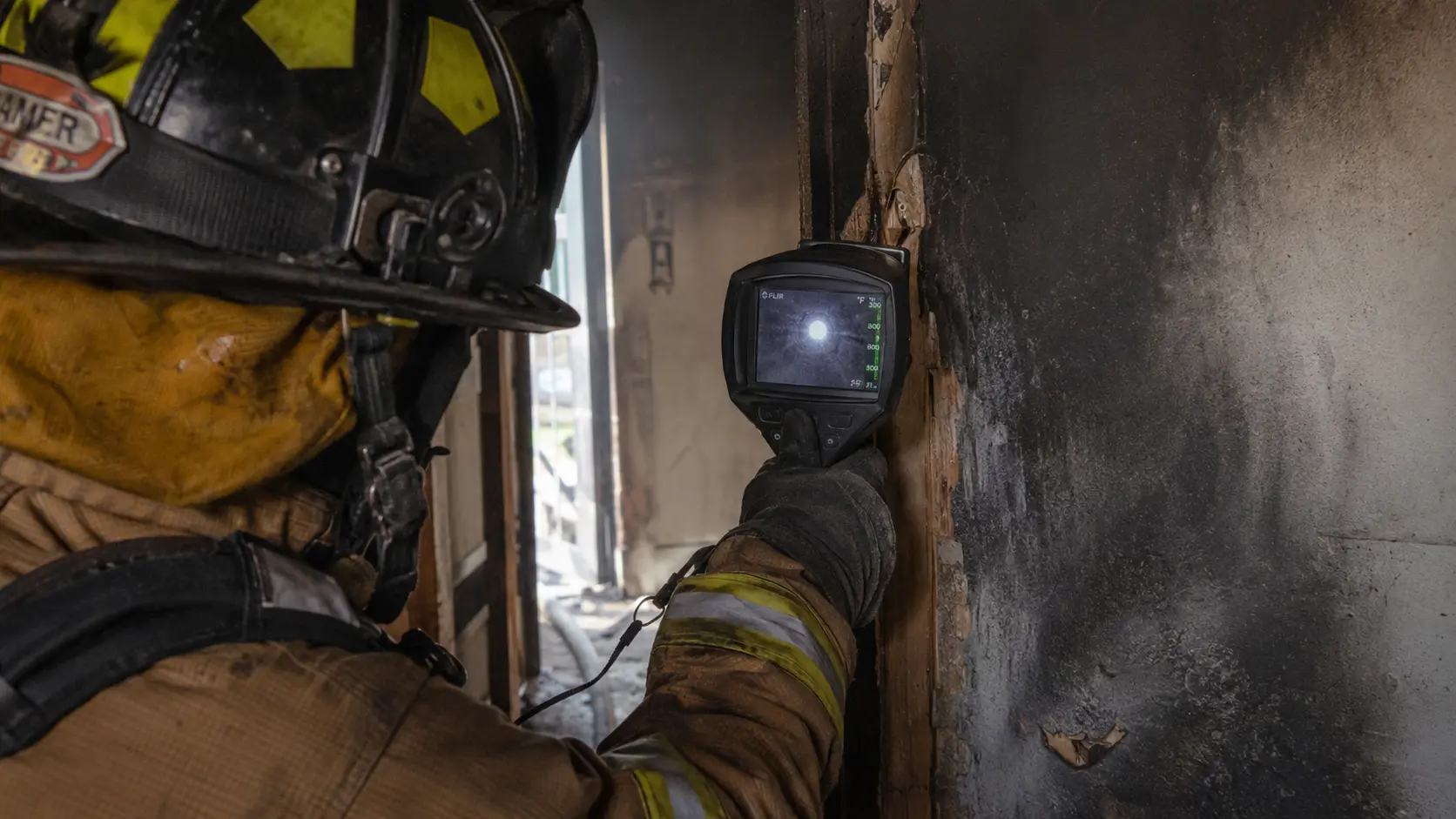
TICs are effective at identifying fire extension through walls, floors, and ceilings by detecting the surface temperature elevation produced by fire burning on the far side. A wall with fire extending through its internal cavity will show a warmer surface temperature at the extension location — detectible by TIC as a brighter region on the wall surface display.
The limitation: the wall's thermal conductivity and thickness determine how much of the fire's heat reaches the wall surface in a detectible time. A thick masonry wall may not show a significant surface temperature elevation from fire burning in an adjacent space for an extended period, even when the fire has been burning for hours. A thin drywall partition shows surface temperature elevation much more quickly. The TIC is most reliable for fire extension detection in light frame construction with thinner wall assemblies.
Specific Failure Modes: Glass, Thermal Equilibrium, Masking
Glass: Standard glass is essentially opaque to infrared radiation in the wavelength range that firefighter TICs use. A TIC pointed at a window sees the surface temperature of the glass, not what is on the other side. A victim visible through a window to the naked eye is not visible through that window on a TIC — the camera sees the glass surface, not the person behind it. This failure mode surprises firefighters who expect the TIC to show them "through" the window the way it shows "through" smoke.
Thermal equilibrium: Any object that has been in a hot environment for long enough will equilibrate to the ambient temperature. A cold victim brought into a hot fire environment, or a warm victim in a very hot post-flashover room, may show insufficient temperature contrast for detection. Overhaul areas where everything is at elevated temperature produce TIC images where the entire scene is uniformly bright — the camera cannot distinguish between objects at slightly different temperatures when the display is calibrated to a high-temperature range.
Surface emissivity masking: Some materials have low thermal emissivity — they reflect infrared radiation from surrounding hot objects rather than emitting their own thermal radiation corresponding to their actual temperature. Shiny metallic surfaces (aluminum, polished steel) appear cooler on a TIC than they actually are because they reflect the cooler sky or room in the direction of the camera rather than emitting their own temperature. A hot aluminum tank in a fire may appear cool on a TIC because its low-emissivity surface reflects the cooler environment rather than showing its actual temperature. This failure mode is relevant at industrial and vehicle fires where metallic surfaces are prevalent.
Post-Fire Overhaul Use
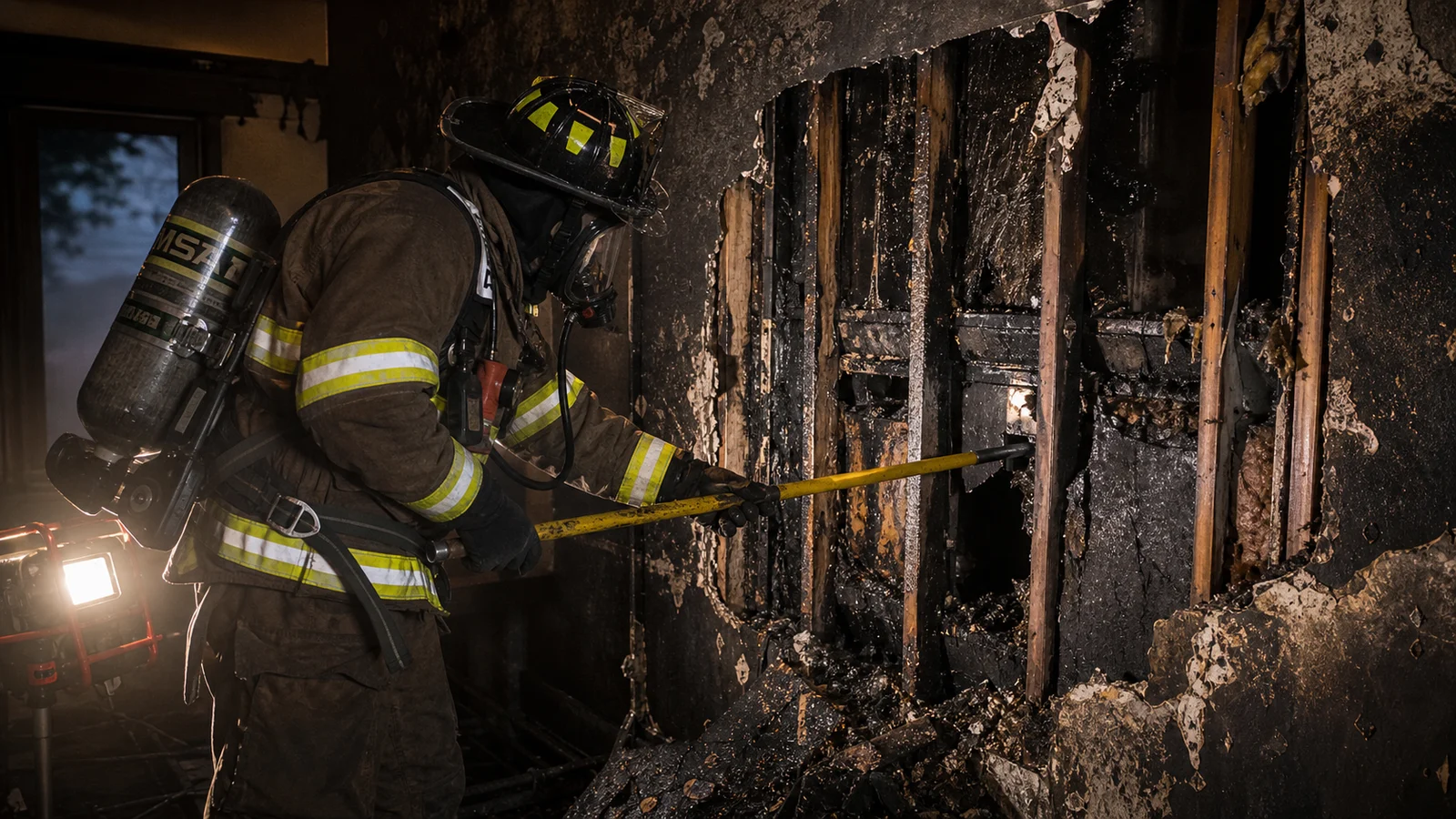
The TIC's overhaul application — scanning walls, floors, and ceilings for residual hot spots after apparent knockdown — is one of its highest-value functions. A TIC overhaul scan can identify hidden fire pockets in wall cavities, insulation, and structural voids that would require destructive opening of the wall section to locate by other means. The TIC-guided overhaul allows crews to open only the sections that show thermal elevation, reducing the damage done to the structure during overhaul while maintaining thoroughness.
Effective overhaul with a TIC requires moving the camera slowly across each wall, floor, and ceiling surface, giving the display time to register temperature variations. Scanning too quickly can miss hot spots — the camera's update rate means that rapid movement produces a display that averages multiple points and can obscure a localized hot spot. Systematic coverage of all surfaces, section by section, produces reliable results.
Post-fire, when the structure has cooled significantly and the TIC's temperature range is calibrated to lower temperatures, the sensitivity to hot spots improves — the contrast between a 150°F smoldering location and a 70°F ambient wall surface is much more detectible than the same hot spot during active fire operations when ambient temperatures are elevated. The TIC is more useful for hot spot detection during overhaul than during the active fire phase, in the sense that the temperature contrasts it needs to display are more favorable after knockdown.
Comments 0
No comments yet. Be the first to share your thoughts!
Leave a Comment