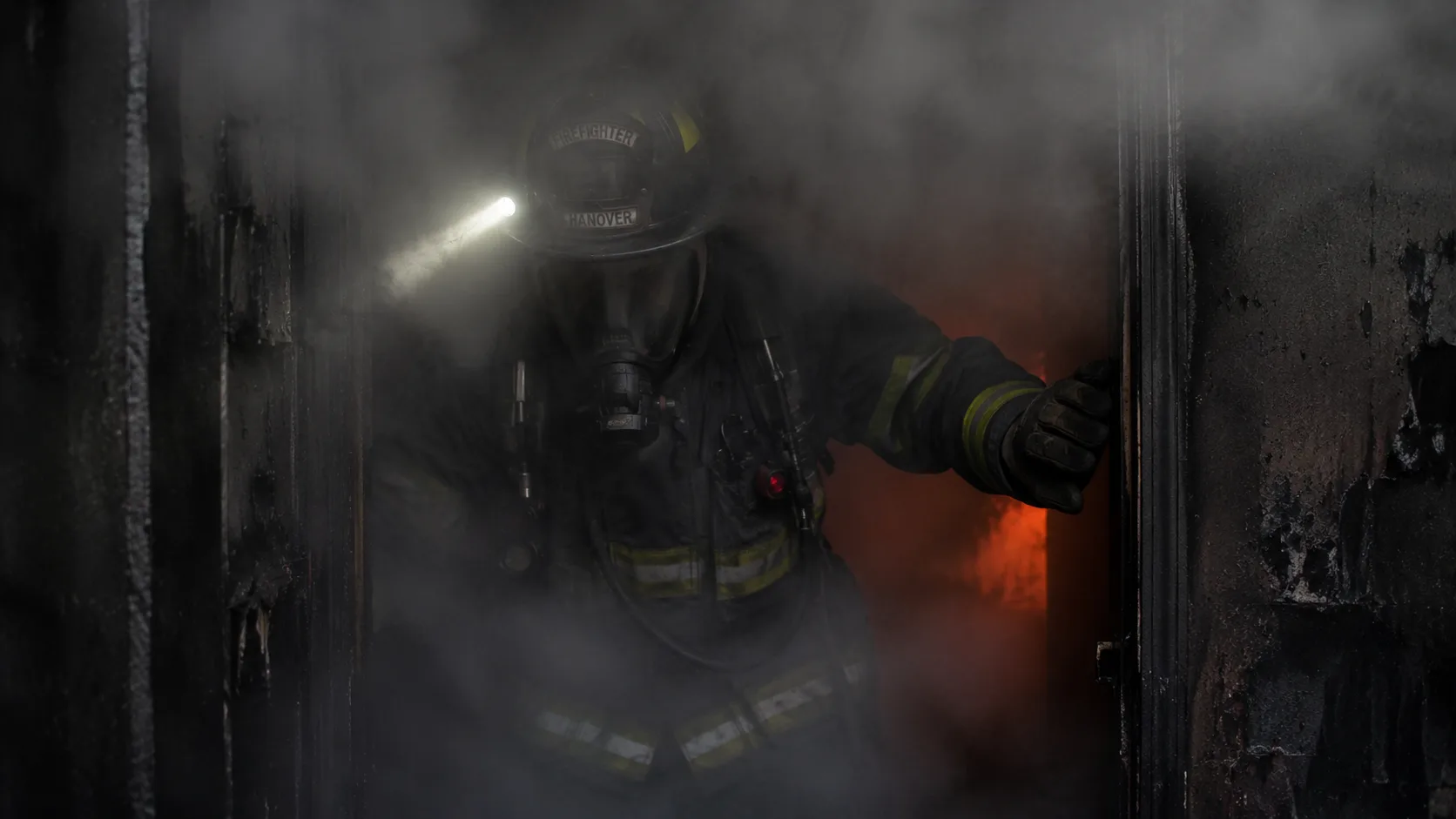
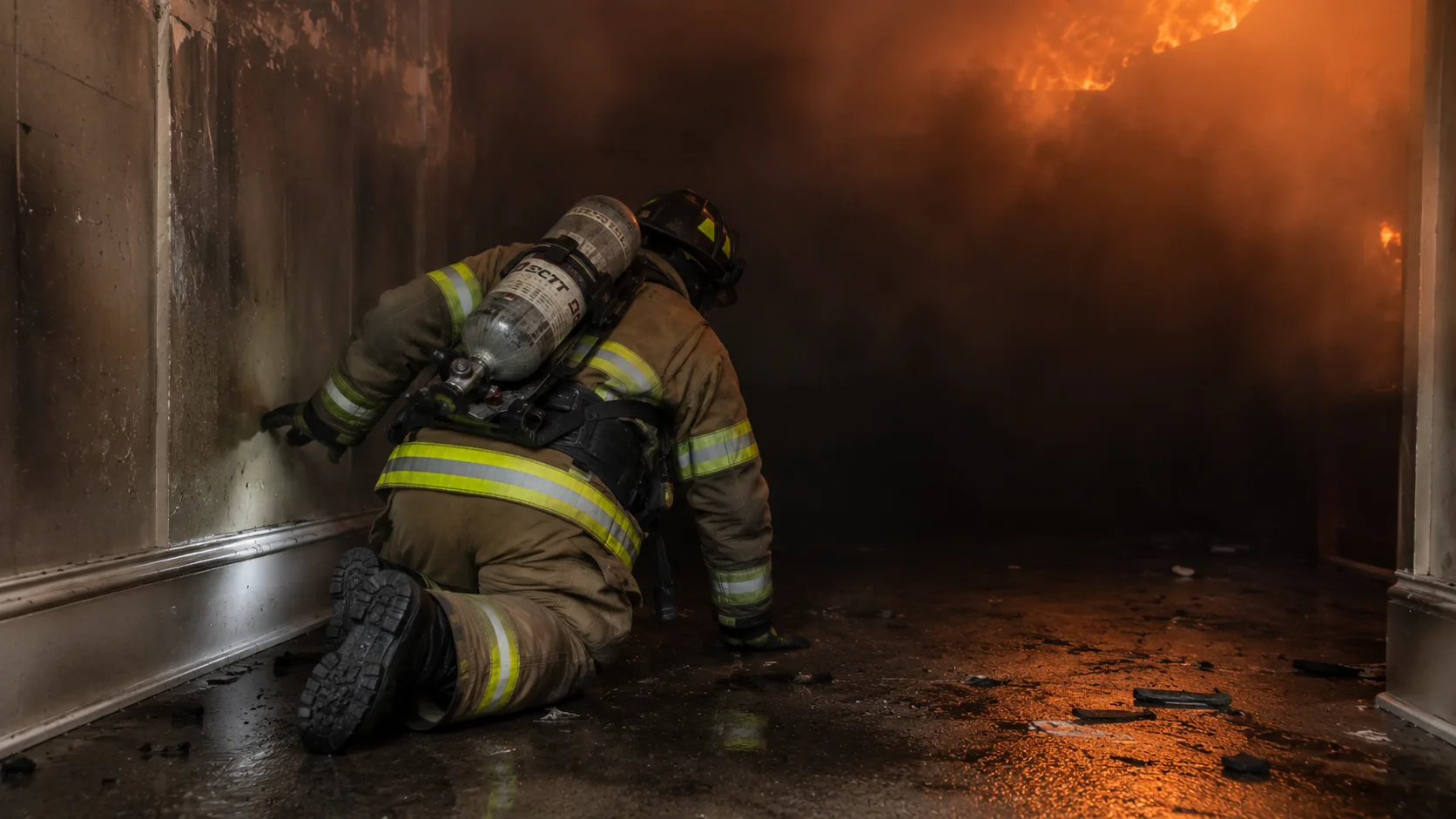
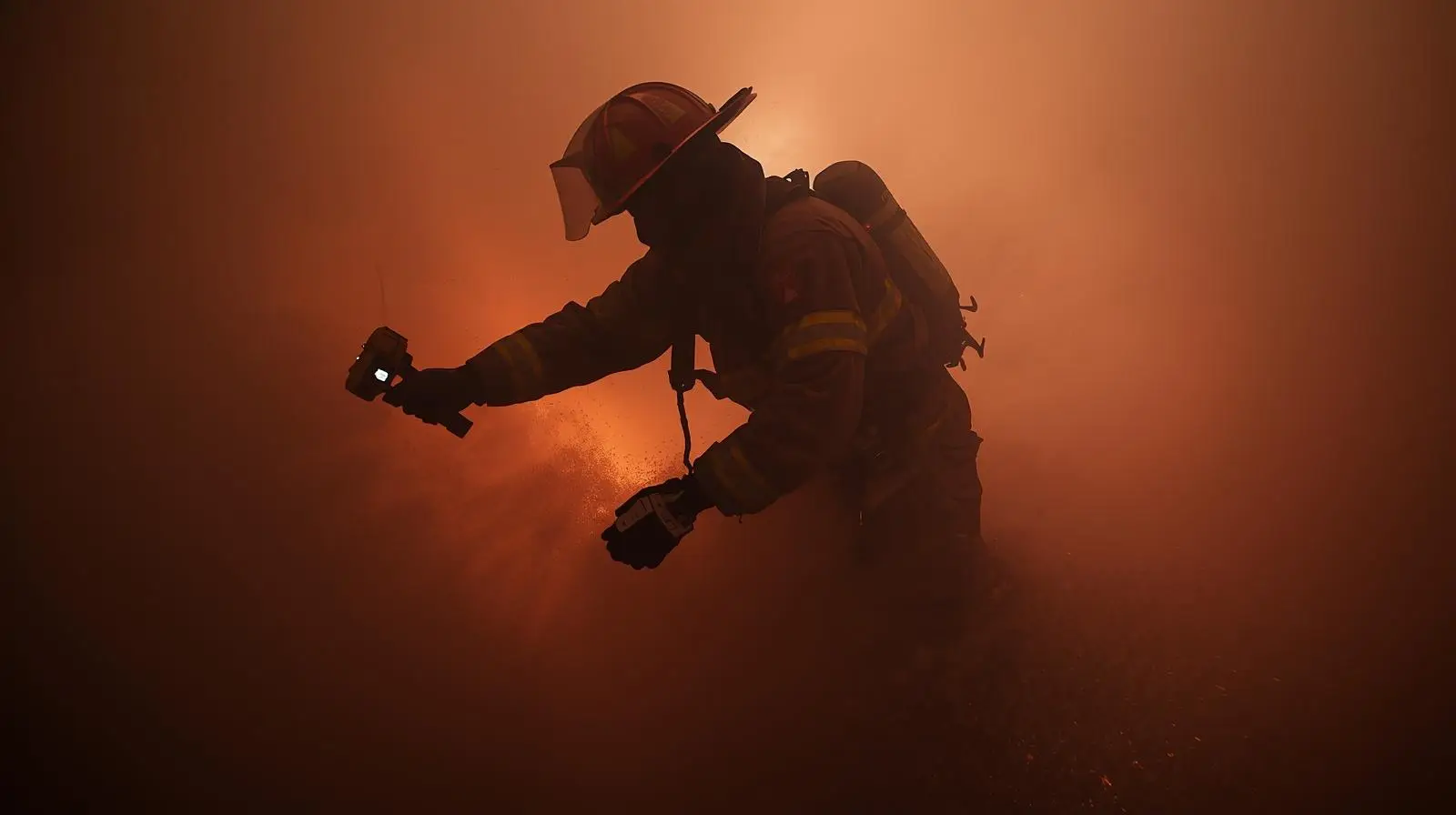
There is a specific moment in a working structural fire when visibility drops to absolute zero — not dim, not hazy, but zero. You cannot see your glove in front of your facepiece. The thermal layer is at floor level. The noise is constant: your regulator, the PASS device ticking, the fire working somewhere in the structure, your crew member's breathing a few feet away. You are on your hands and knees on an interior floor that may or may not hold your weight, moving toward a fire you cannot see, looking for a victim who may or may not be alive.
Zero-visibility operations are not a rare edge case in structural firefighting. They are the standard condition on any working interior fire once smoke has filled a structure. Every firefighter who goes through a door in a working fire is operating under the assumption that they may lose visibility entirely and need to function regardless. The techniques, the discipline, and the training that make that possible are what this piece covers.
In this article:
- What zero-visibility actually feels like
- Navigation techniques: wall following, floor probing, door counting
- Thermal imaging in low-visibility: what it does and what it misses
- How disorientation happens — and why experience doesn't prevent it
- Sound as a tool: what you can hear and what it tells you
- Maintaining crew integrity in zero-vis
- Night fires: why nighttime residential fires are specifically more dangerous
- How low-visibility conditions are trained
What Zero-Visibility Actually Feels Like
The SCBA facepiece already limits peripheral vision significantly — the mask frame cuts your visual field to roughly what you would see looking through a rectangular window. Add smoke dense enough to reduce visibility to zero and you lose that window entirely. The facepiece becomes opaque. What remains is sound, touch, and whatever spatial awareness you have built from the entry to your current position.
The physical experience is disorienting in a way that is difficult to convey to someone who has not been through it. Your spatial sense — the proprioceptive feeling of where your body is in space — becomes the primary navigational tool, and it is not reliable under stress in an unfamiliar environment. Rooms that feel large in normal conditions feel enormous in zero visibility. Distances become impossible to estimate. The wall you were following can feel like it has disappeared if you drift a foot away from it.
Temperature is a constant presence. The heat coming from above — the thermal layer building near the ceiling — is detectable through gear as a directional pressure. Moving toward the fire generally means moving toward increasing heat. Moving away from it means finding cooler air. This is not a precise navigation system, but it is information — and in zero visibility, every piece of information matters.
Navigation Techniques: Wall Following, Floor Probing, Door Counting
Structured navigation in zero-visibility conditions is not improvised. It uses specific techniques that provide consistent orientation when visual reference is gone.
Wall following
The primary technique for moving through a structure in zero visibility is maintaining continuous contact with a wall — one hand or one shoulder in contact with the wall surface at all times while moving. The wall provides orientation, prevents drifting into the center of a room where all reference is lost, and guides movement toward doorways and eventually toward exit. The specific technique matters: following the wall on the right going in means following the wall on the right coming out would return you to the entry point — depending on the room configuration. In a search, switching hands systematically covers rooms without doubling back.
Wall following has limits. Open floor plans, large commercial spaces, and rooms where furniture or debris blocks wall access all complicate it. A crew following a wall in a hoarding structure may lose wall contact when stacked material takes its place — which is part of why hoarding fires require guideline deployment from entry.
Floor probing
In conditions where floor integrity is uncertain — fire-damaged structures, older buildings, hoarding fires — the lead firefighter probes the floor ahead before committing weight to it. The technique uses a tool (typically a halligan bar or an axe handle) extended forward to test whether the floor is solid before advancing. A floor that sounds hollow, feels soft, or shifts when probed is a floor that should not be loaded. The probe takes two to three seconds per step and slows advance significantly — a deliberate tradeoff between speed and falling through a weakened floor.
Door counting
Covered in the context of hotel fires earlier in this series, but fundamental to interior residential search: counting doorframes by touch while moving down a corridor provides positional reference when visibility is zero. A firefighter who entered at the third doorframe on the left and has passed two more doorframes since knows their approximate position even without seeing anything. The count is maintained verbally between crew members to prevent disagreement about position.
Guideline deployment
A search rope or hoseline provides a physical connection back to the entry point. The lead firefighter carries a rope bag; the rope unspools as they advance. To exit, they follow the rope back. In large or complex structures, branching guidelines — secondary ropes tied to the main line — extend coverage to rooms off the primary path. The guideline does not tell you where you are; it tells you how to get back. In zero visibility, that is often the more valuable piece of information.
Thermal Imaging in Low-Visibility: What It Does and What It Misses
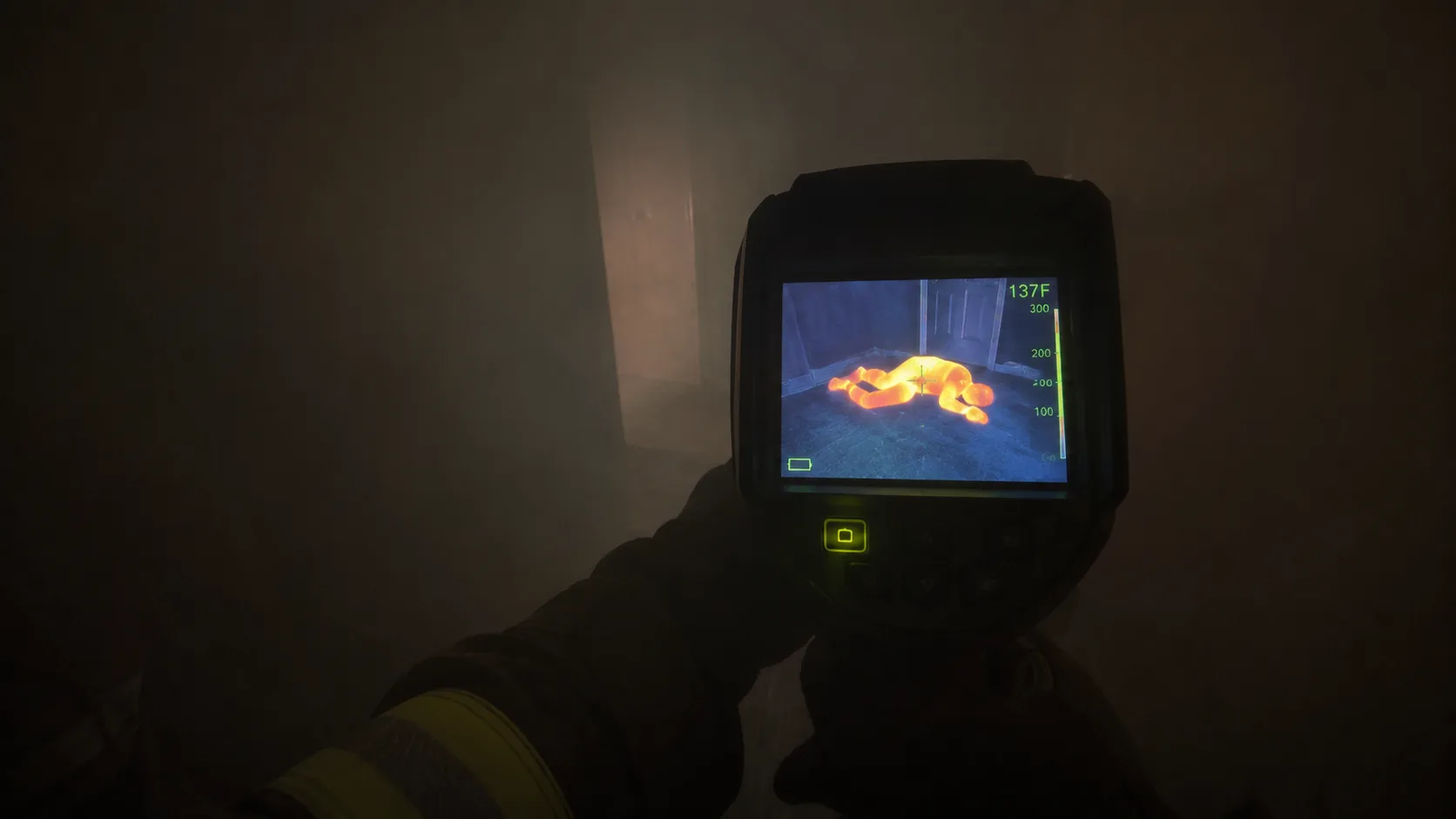
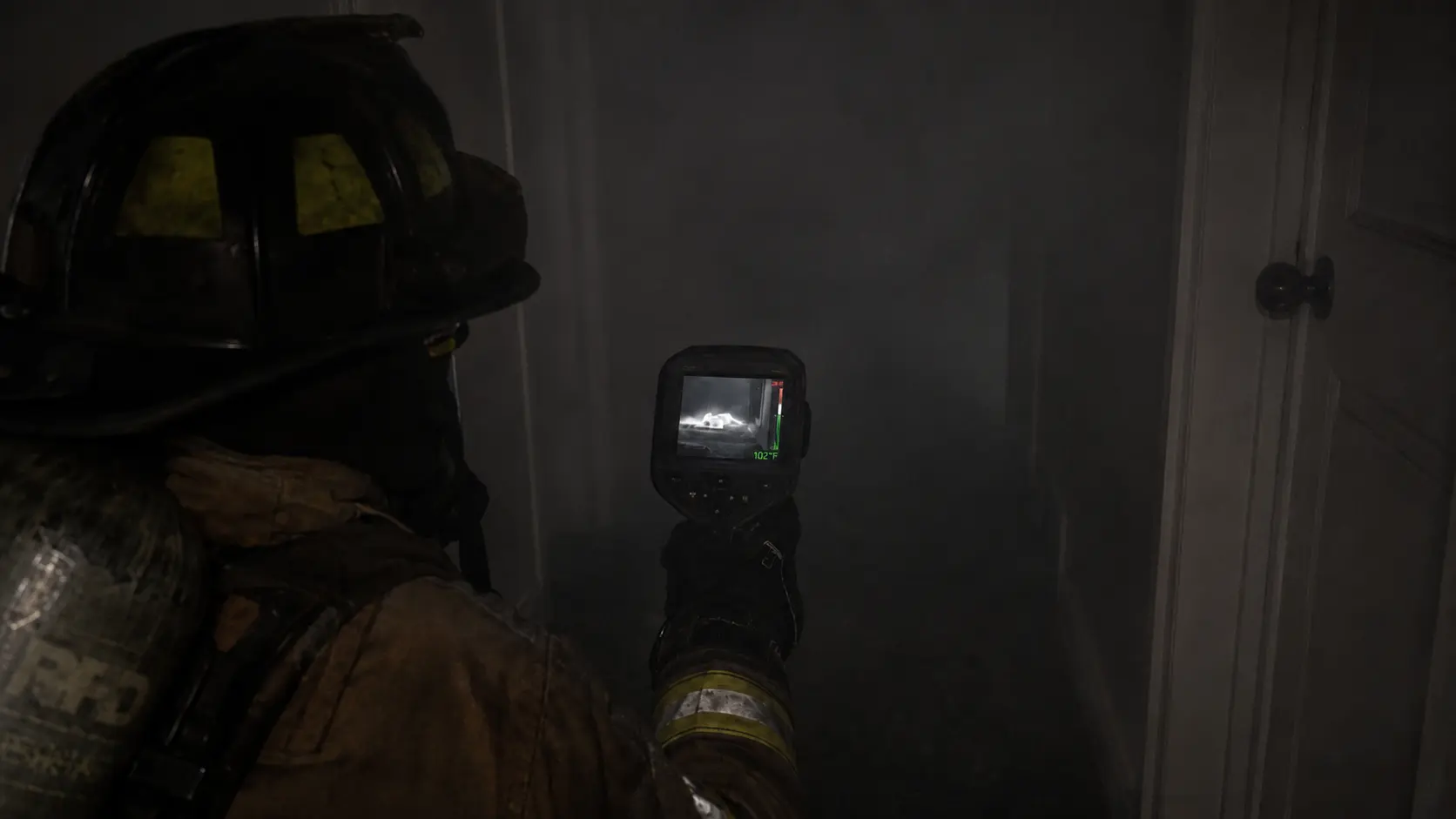
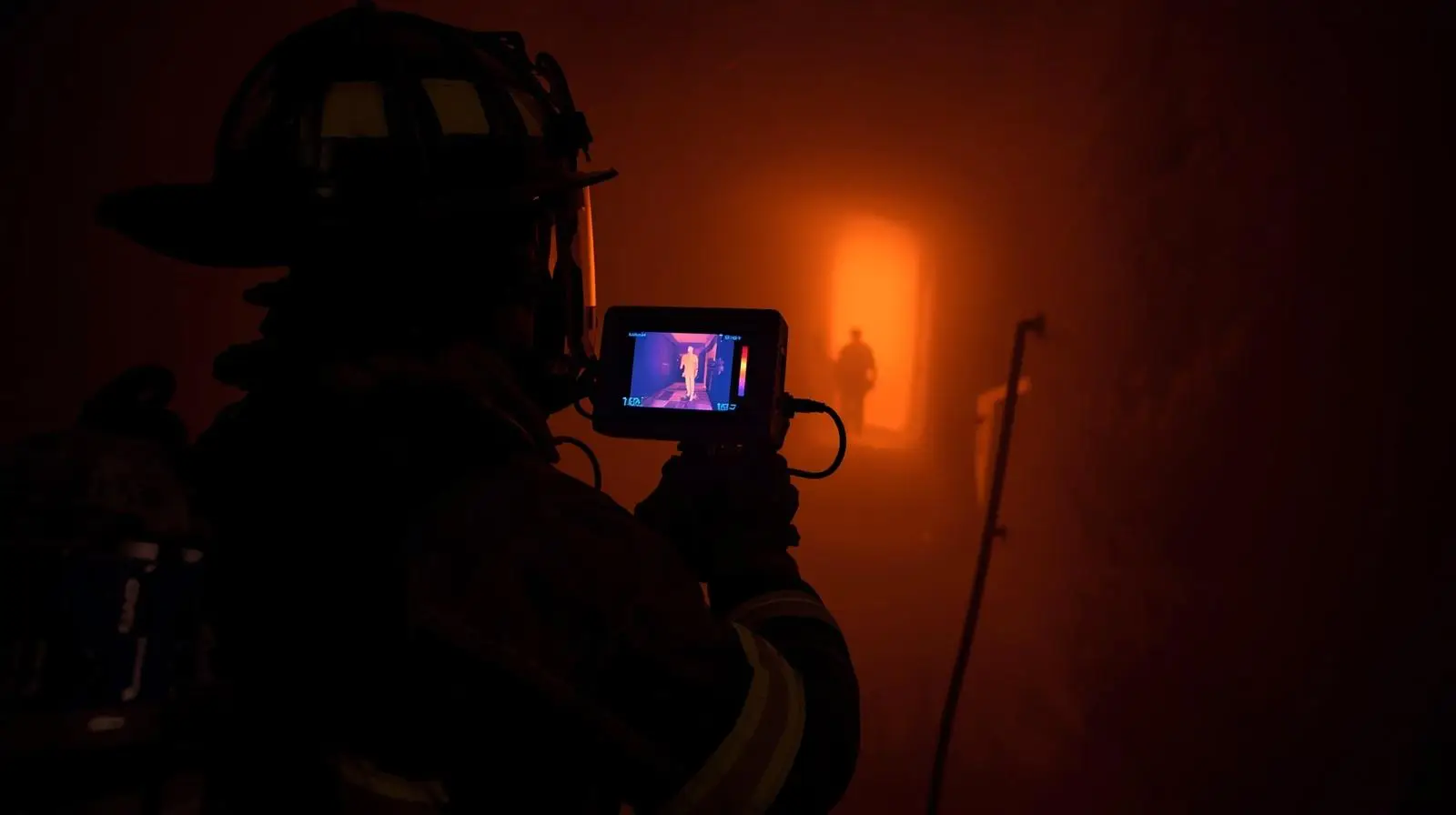
Thermal imaging cameras detect infrared radiation rather than visible light. Smoke, which is opaque to visible light, is largely transparent to infrared. A TIC in a smoke-filled room can show the outlines of walls, doorframes, furniture, and most importantly, victims — heat signatures against the cooler background of the floor or walls.
What the TIC does well: victim location (a living person is warmer than their surroundings and shows as a bright signature), fire location (hot gases and burning surfaces are visible through smoke), and structural orientation (walls and doorframes show as temperature differentials even when invisible to the eye). A search that might take eight minutes by tactile method alone can be reduced to under two minutes with a TIC showing a victim's location clearly.
What the TIC misses: it requires one hand to hold, leaving one hand for wall contact rather than two — a significant limitation in a crawl. The camera screen requires focus at arm's length while the firefighter is also navigating a dark, hot, debris-covered environment. And in conditions where ambient temperature is very high — a post-flashover environment, or a fire that has been burning long enough to heat every surface uniformly — the temperature differential that makes victims visible disappears. A victim in a room where the floor, walls, and air are all near body temperature may not show a distinguishable signature at all.
TIC is a tool, not a solution. The departments that use it most effectively train crews to integrate it with tactile navigation rather than replace tactile navigation with it.
How Disorientation Happens — and Why Experience Doesn't Prevent It
Spatial disorientation in zero-visibility conditions does not discriminate by experience level. The physiological mechanism is the same for a ten-year veteran as for a probie. When visual reference is removed, the vestibular system — the inner ear mechanism that provides balance and orientation — becomes the dominant spatial sense. Under stress, with elevated heart rate and cognitive load, the vestibular system is unreliable. It can generate convincing false signals about which direction is up, which direction you came from, and how far you have traveled.
The specific trigger in structural firefighting is often rotation. A firefighter who turns to search a room, then turns again to avoid an obstacle, then turns to follow a wall, has lost track of which direction they entered from. In a house with a regular grid layout, this is recoverable — follow any wall to a doorframe, follow the doorframe to the exit corridor, follow the corridor to the entry point. In an open-plan space, a large room, or an irregular floor plan, the recovery path is not obvious.
The documented pattern in firefighter fatality cases involving disorientation: the firefighter becomes separated from their crew or their guideline, loses wall contact, turns in a direction they believe is toward the exit, and moves deeper into the structure instead. The PASS device activates when they stop moving. By the time RIT locates the signal, the outcome may already be determined by air supply.
The prevention is structural, not cognitive: the techniques — wall contact, guideline deployment, crew integrity — exist specifically because individual orientation cannot be relied upon. Following the technique works regardless of whether your internal sense of direction is correct. Trusting your internal sense of direction in zero visibility when it conflicts with the technique is the error.
If you lose your guideline and wall contact simultaneously in zero visibility, stop moving. Activate your PASS manually. Transmit your LUNAR report. Moving without reference in zero-visibility conditions makes the RIT's search harder — your position changes and your air supply depletes faster. The firefighter who stops, activates PASS, and transmits gives RIT a fixed target. The one who keeps moving looking for the exit may be found 30 feet away from where they stopped.
Sound as a Tool: What You Can Hear and What It Tells You
In zero visibility, sound provides navigational information that visual sense cannot. Learning to read a fire's sound environment is part of interior firefighting experience that is difficult to teach in a classroom.
The fire itself has a sound signature that varies with intensity and location. A fire burning freely in a room has a roaring, continuous sound that is louder and more distinct than the background noise of the structure. Moving toward that sound means moving toward the fire. Hearing the fire change — becoming louder, taking on a new pitch, developing a cracking or structural sound — indicates the fire is growing or finding new fuel.
Victims can sometimes be heard when they cannot be seen. Coughing, moaning, tapping on walls or floors — all of these carry through smoke in a way that allows directional orientation. A crew searching in zero visibility that hears a cough can orient toward it even without TIC confirmation. The search pattern pivots toward the sound.
PASS alarms from other crews are both informational and critically important. A PASS alarm that activates during your interior operation tells you someone is down — it also tells you where they are relative to your position if the sound is directional. Training on what PASS sounds like under interior conditions, with the background noise of a working fire and the muffling of SCBA, is part of why firefighters drill with the devices rather than just reading about them.
Maintaining Crew Integrity in Zero-Vis
Crew integrity — keeping every member of the crew in contact with or in very close proximity to another crew member — is the primary safeguard against disorientation becoming a MAYDAY. A firefighter who is lost in zero visibility and is also alone is in the worst possible position. A firefighter who is lost in zero visibility but is in contact with a crew member has a partner who knows where they both are relative to the guideline, who has a radio, and who can transmit position and begin navigating out.
The specific technique for maintaining crew integrity in zero visibility is physical contact. Not voice contact — the noise environment of a working fire makes voice communication unreliable even at close range without radio. Physical contact means a hand on the boot, a grip on the SCBA shoulder strap, a tether line between crew members in high-risk environments. You know where your crew member is because you can feel them, not because you can hear them or assume they are nearby.
Crew separation in zero visibility happens fast. One crew member turns to check a corner while the other continues down the hall. They lose contact. Neither realizes it immediately. By the time the separation is recognized, the gap may be 15 feet in a smoke-filled corridor — enough to lose each other completely. The rule is simple and difficult to maintain under the urgency of an interior search: maintain physical contact with your crew member at all times when visibility is zero.
Night Fires: Why Nighttime Residential Fires Are Specifically More Dangerous
Nighttime residential fires kill at a higher rate than daytime fires for reasons that compound each other. Occupants are asleep and take longer to detect the fire and respond. The fire may have been burning for several minutes before the smoke detector wakes anyone, meaning the structure is further into its fire progression when the response begins. The occupants who do wake are disoriented, in the dark, and may make decisions — like opening a door without feeling it first — that are dangerous. And the fire department, if dispatched from a sleeping position, adds seconds to turnout time.
For firefighters, nighttime fires have an additional layer: the structure is in normal-use condition, meaning beds are occupied, interior doors may be closed (which slows fire spread but also slows search), and windows that would provide natural light during the day provide none. The TIC becomes even more valuable at night because victim signatures are more distinct against a background that has not been heated by daytime solar gain.
The working fire at 3am in a residential structure is the scenario that the full weight of structural firefighting training is built around. The alignment of sleeping occupants, a late-detected fire, a dark structure, and zero-visibility conditions from a fire that had time to develop before anyone called — it is the combination that produces the highest civilian and firefighter fatality rates in residential fire data.
How Low-Visibility Conditions Are Trained
Training for zero-visibility operations cannot be fully replicated in a classroom. The techniques can be taught cognitively, but the experience of being unable to see in a hot, noisy environment under the stress of SCBA and turnout gear requires physical training environments.
The primary training method is the blackout mask drill: a standard SCBA facepiece with a blacked-out lens, preventing any visual input while maintaining the physical sensation of wearing the mask. Recruits navigate training structures — purpose-built mazes with adjustable layouts, or real structures set up for training — using wall-following and crew-contact techniques in full blackout. The drill is uncomfortable, disorienting, and physically demanding. It is designed to be, because the conditions it replicates are all of those things.
Live fire training adds heat and smoke to the cognitive load. A recruit who has successfully navigated a blackout maze in a cool, quiet training building is not prepared for the same navigation in a structure where the floor is at 200°F and the air is acrid. Live fire training with low-visibility conditions is conducted in acquired structures or purpose-built burn buildings, under close instructor supervision, with safety crews staged at every entry point. It is the closest replication of actual interior conditions that can be achieved legally and safely.
Experienced firefighters retrain on these skills annually. Zero-visibility navigation does not become fully automatic — the disorientation mechanisms that affect a probie also affect a 20-year veteran, just with better-ingrained technique responses. The technique has to be rehearsed to remain reliable under stress.
Comments 0
No comments yet. Be the first to share your thoughts!
Leave a Comment