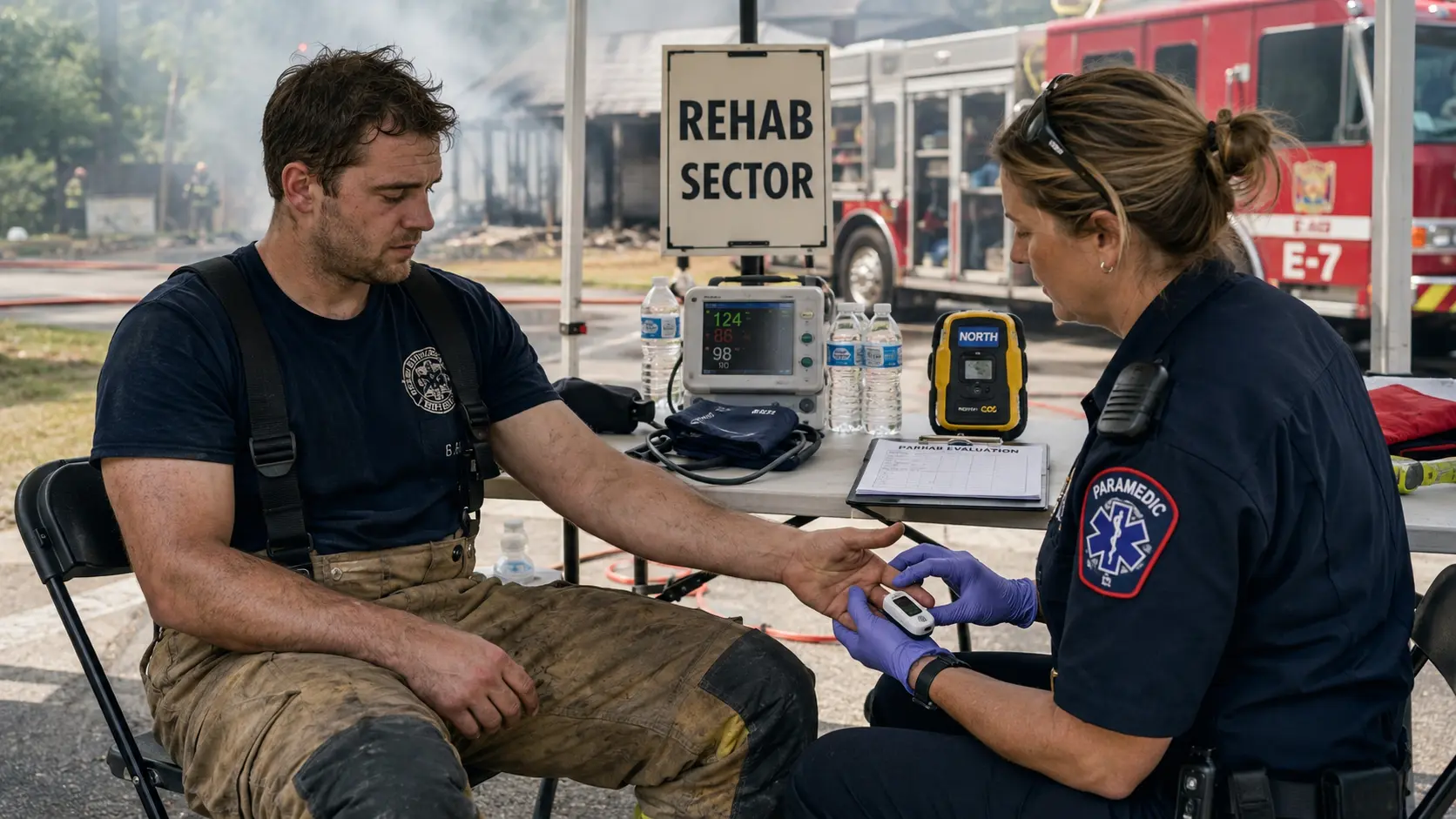
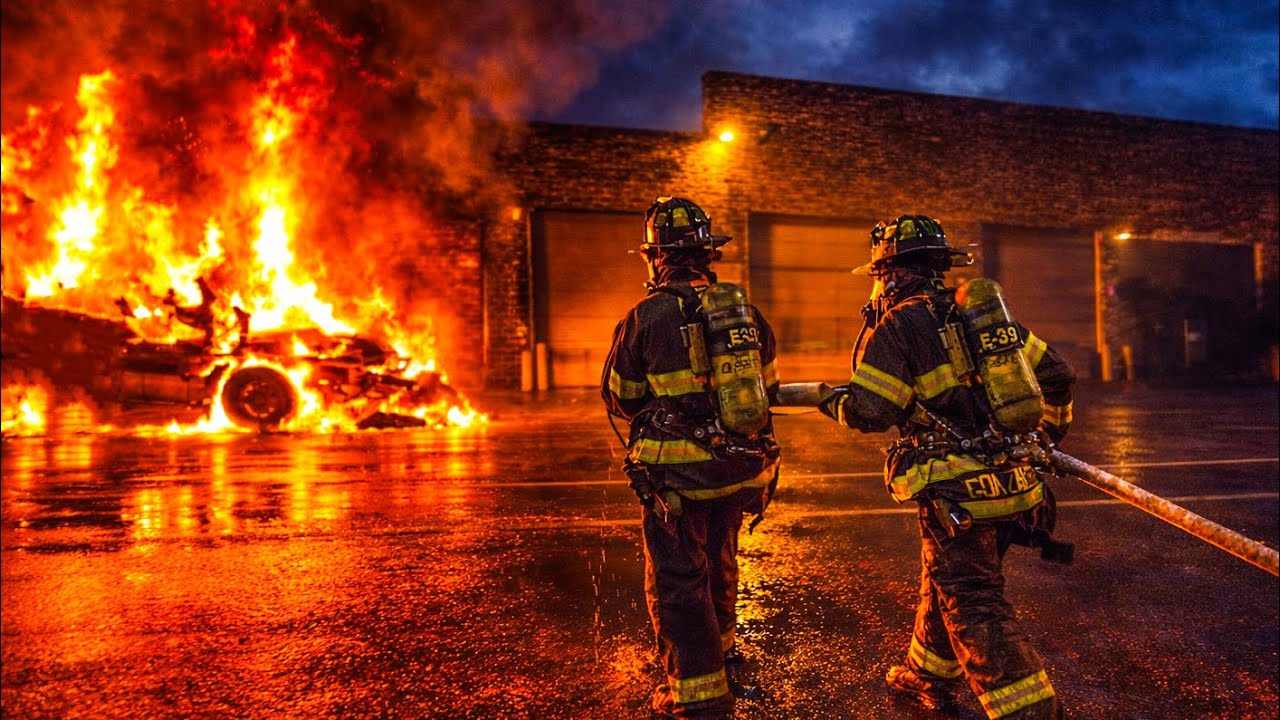
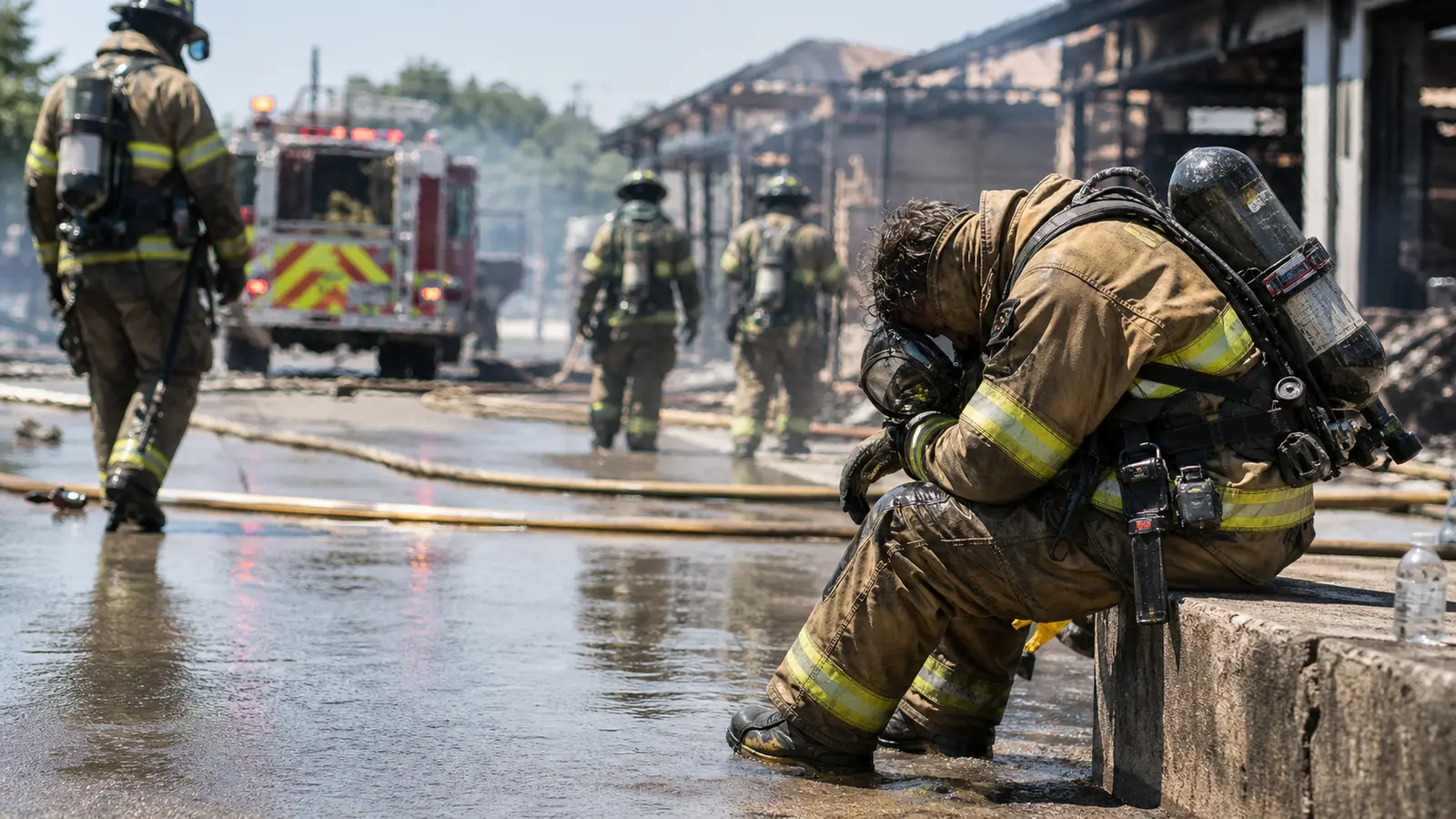
Every firefighter who exits a working fire scene after a rotation in the hot zone goes through rehab before they can be reassigned to interior operations. Not because it is a break. Because interior firefighting produces physiological stress — core temperature elevation, dehydration, cardiac strain, and CO exposure — that accumulates with each rotation and that, left unmonitored, produces medical emergencies in the middle of active fire operations. Rehab is the mechanism for catching those emergencies before they happen.
NFPA 1584 — the standard for the rehabilitation process for members operating at incident scene operations — defines what rehab requires, when it is established, and what the evaluation must include. Many departments meet the minimum standard. The departments that run rehab well treat it not as a paperwork requirement but as an active medical surveillance operation that tracks each firefighter's physiological state through an incident that may last hours.
In this article:
When Rehab Is Established
NFPA 1584 requires rehab to be established at any incident that requires a second alarm or more, at any incident expected to last more than 30 minutes, or at any incident where the incident commander determines that crew members need rest and evaluation. The standard sets a minimum — incidents that do not meet these criteria can still benefit from rehab, and experienced incident commanders establish it earlier rather than later.
Rehab is positioned at a specific location on the incident: outside the hot zone, in a location with shade and access to water, separate from the command post but within communication range. The position matters for the same reason that a medical triage area at a mass casualty incident is positioned out of the hazard zone — so that the medical personnel and the firefighters in rehab are not themselves at risk while the evaluation is happening.
The Medical Evaluation: What EMS Checks

The minimum medical evaluation in rehab per NFPA 1584 includes:
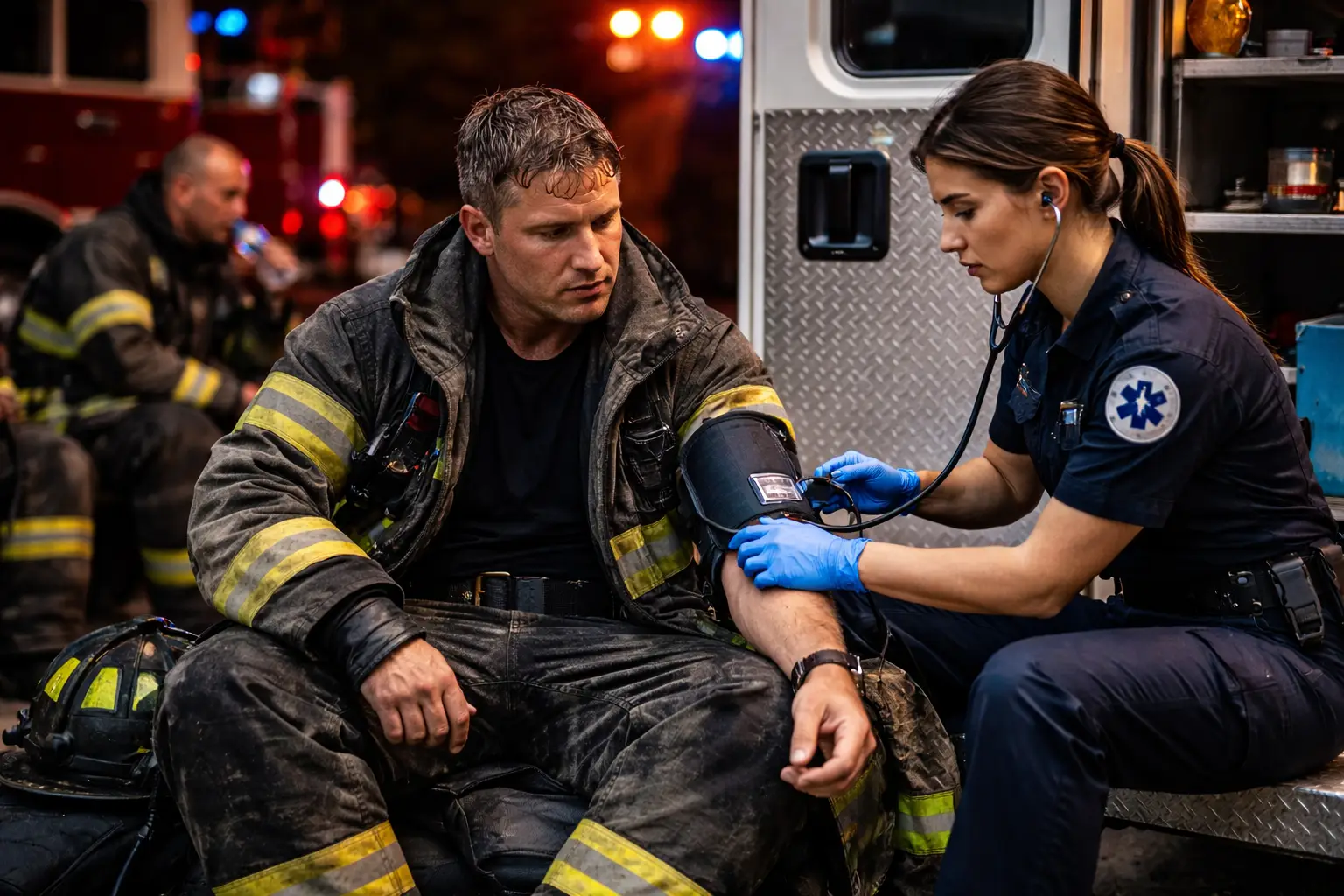
- Heart rate and blood pressure: Elevated HR that does not recover toward baseline during the rest period, or hypertensive blood pressure readings, indicate cardiovascular stress that may warrant extended rest or medical evaluation beyond rehab. A firefighter with resting BP above 180/110 after the rest period should not return to interior operations without medical clearance.
- Oxygen saturation (SpO2): Standard pulse oximetry — noting its limitation with CO poisoning, covered below.
- Skin temperature, color, and moisture: Pale, cool, clammy skin suggests heat exhaustion developing. Red, hot, dry skin suggests heat stroke — a medical emergency requiring immediate cooling and transport. Skin assessment combined with HR and BP gives a more complete picture of heat stress than any single measurement.
- Level of consciousness and orientation: A firefighter who is confused, disoriented, or showing cognitive impairment after a rotation is not returning to interior operations. They are a potential patient.
CO Monitoring: Why It Belongs in Rehab
Standard pulse oximeters cannot distinguish between oxyhemoglobin and carboxyhemoglobin — a firefighter with significant CO poisoning may have a pulse ox reading in the normal range because the device measures the percentage of hemoglobin bound to any gas, not specifically oxygen. This limitation makes standard SpO2 measurement inadequate as the sole screen for CO exposure in firefighters coming out of smoke.
CO-oximetry — either via a dedicated CO-oximeter or a pulse CO-oximeter that specifically measures carboxyhemoglobin — is the appropriate screening tool in rehab. Normal carboxyhemoglobin (COHb) in a non-smoker is under 3 percent. Smokers may run 3 to 10 percent at baseline. A firefighter coming out of interior operations with COHb above 15 to 20 percent has significant CO exposure that requires extended monitoring and possibly treatment with high-flow oxygen even if they feel subjectively fine. A reading above 25 percent warrants transport for evaluation.
The argument for CO monitoring in rehab is the same as the argument for any medical surveillance: CO poisoning impairs cognition before producing symptoms that the affected person can identify in themselves. A firefighter with 20 percent COHb who says they feel fine is making that assessment with impaired judgment. The monitoring tool, not the firefighter's self-report, is the reliable data point.
Heat Stress and Core Temperature
Structural firefighting gear provides thermal protection at the cost of complete evaporative cooling suppression. A firefighter working in full gear cannot cool through sweat evaporation — the moisture barrier prevents evaporation to the environment. Core temperature rises continuously during interior operations, and the rate of rise increases with exertion level and ambient temperature.
NFPA 1584 sets 102°F as the oral temperature threshold above which a firefighter should not return to operations. At 103°F and above, heat exhaustion is likely. At 105°F and above, heat stroke — a life-threatening emergency — is possible. The problem is that core temperature cannot be accurately assessed by oral thermometer during active rehab cooling — the firefighter has just exited a hot environment and is drinking cold water. Ear (tympanic) or rectal temperature assessment is more accurate but is rarely practical in a rehab sector setting. Most departments use the combination of HR recovery, skin assessment, and orientation as a functional proxy for core temperature when direct measurement is impractical.
Hydration and Rehydration in Rehab
Firefighters lose fluid through sweat at rates of 1 to 2 liters per hour during active interior operations. That fluid loss is not replaced during operations — nobody stops to drink water while advancing a charged hoseline in a burning building. Cumulative dehydration across multiple rotations degrades cardiovascular performance, impairs thermoregulation, and reduces cognitive function. Rehydration in rehab is not optional — it is the physiological recovery that makes subsequent rotations safer.
NFPA 1584 recommends consuming 8 ounces of cool water or a sports drink immediately upon entering rehab, followed by continued fluid intake. Sports drinks with electrolytes are appropriate when rehab intervals are extended and sweat losses have been significant — plain water replaces fluid volume but not electrolytes, and electrolyte depletion (particularly sodium) can produce hyponatremia if large volumes of plain water are consumed rapidly. The practical guideline: water for the first 8 to 16 ounces, then alternate with a sports drink if the rotation continues.
Caffeinated beverages — coffee, energy drinks — are contraindicated in rehab. Caffeine is a mild diuretic and a cardiac stimulant, both of which work against the recovery goals of a firefighter who already has an elevated heart rate, is dehydrated, and has had significant cardiovascular stress in the previous rotation.
Cooling Methods
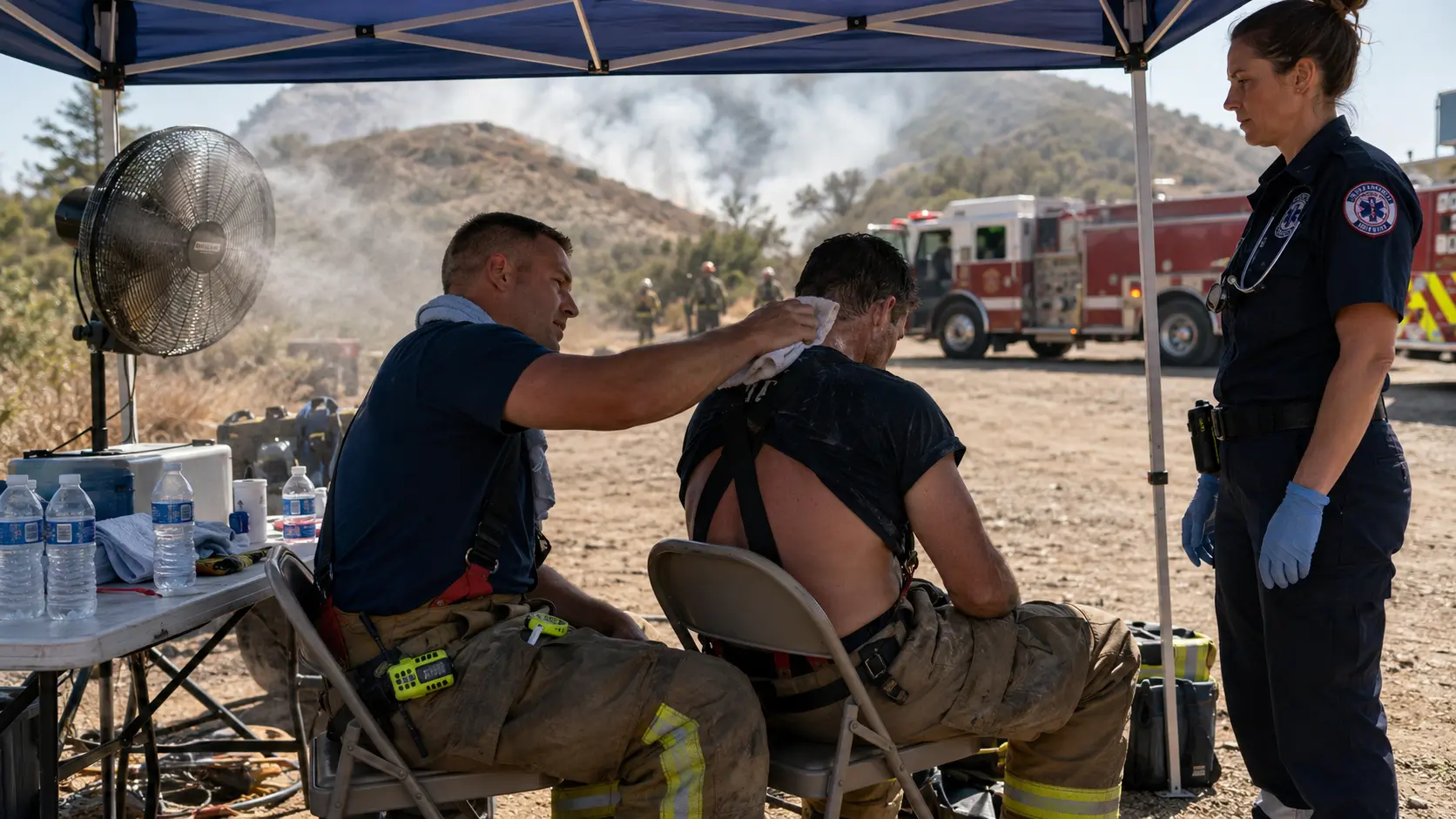
Cooling in rehab is active, not passive. Simply sitting down does not adequately reduce core temperature in a firefighter who has been working in full gear. The cooling interventions in priority order:
- Remove the turnout coat and helmet immediately. The coat's moisture barrier completely suppresses evaporative cooling. Removing it activates evaporation from the station wear — the most efficient physiological cooling mechanism — immediately.
- Shade: A canopy, a building shadow, or any overhead cover reduces radiant heat gain from solar exposure. A firefighter sitting in full sun in July with heat stress developing is adding to their thermal load, not recovering from it.
- Cold towels or ice packs at neck, wrists, and axillae: Major blood vessels run close to the skin surface at these locations — carotid, radial, and axillary arteries respectively. Cold application here cools the blood passing through these vessels and distributes cooled blood systemically faster than cold application to the torso or extremities.
- Misting fans: Evaporative cooling from a fine water mist combined with moving air is effective in low-humidity environments. In high-humidity conditions (above 75 percent relative humidity), evaporative cooling is less effective and shade plus cold towels become the primary interventions.
Return-to-Duty Criteria
A firefighter returning to interior operations from rehab should meet all of the following before re-assignment:
- ✓Heart rate below 100 bpm after the minimum 20-minute rest period
- ✓Blood pressure within acceptable range for that individual's baseline
- ✓Oral temperature below 102°F (or equivalent functional assessment)
- ✓Alert, oriented, and not showing cognitive impairment or confusion
- ✓COHb below the department's established return threshold (commonly 10–15%)
- ✓No signs of heat exhaustion (diaphoresis, nausea, weakness, muscle cramps)
- ✗Do not return anyone who self-reports chest pain, palpitations, or shortness of breath — EMS evaluation and transport consideration
- ✗Do not return anyone with HR that has not recovered after 20 minutes — extended rehab and medical evaluation
What Rehab Finds That Surprises People
Departments that run rigorous rehab operations — full medical evaluation with CO monitoring on every crew rotation — consistently find pre-existing cardiac conditions, hypertension that the firefighter was unaware of, and CO levels that would have produced impairment in subsequent rotations if not caught. These are not rare discoveries. They are common enough that the data from rehab medical evaluations has influenced NFPA standards for firefighter medical clearance requirements.
The firefighter who comes to rehab with a heart rate of 150 that does not recover to 100 after 20 minutes of rest may have a cardiac arrhythmia that the exertion of firefighting has unmasked. The firefighter with BP of 200/115 in rehab may have hypertension that is managed at rest but becomes critical under the physiological stress of interior operations. The firefighter who is slightly confused after a rotation may have 22 percent COHb. None of these individuals should return to operations. All of them might have, in the absence of a medical evaluation that catches the finding.
Comments 0
No comments yet. Be the first to share your thoughts!
Leave a Comment