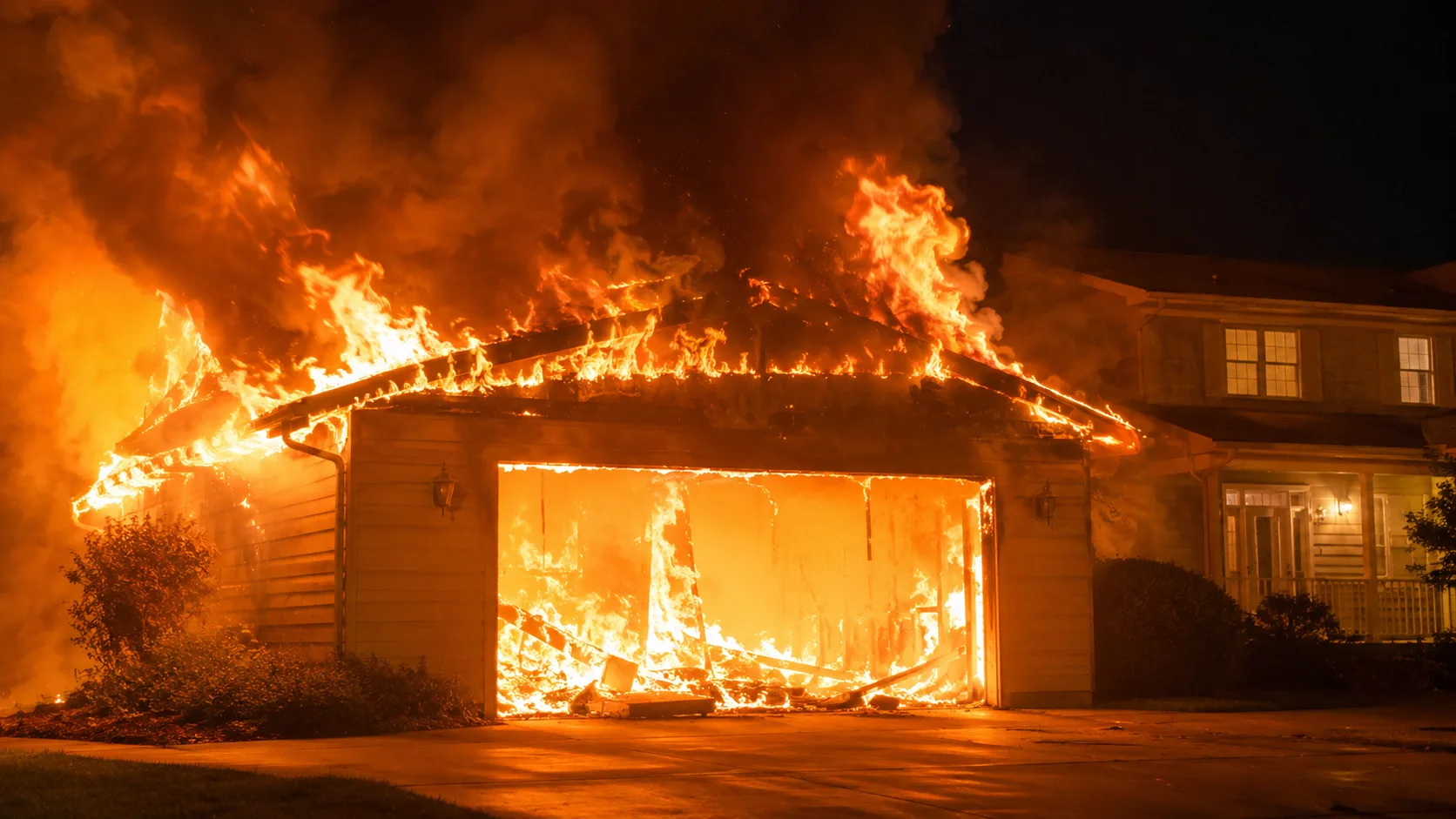

An attached garage fire gives the occupants of a house roughly two to four minutes before fire reaches the living space. That is not a long time — and it gets shorter every year, because garages have gotten more dangerous. The average garage today contains a car or two, fuel cans, oil, paint, solvents, propane cylinders, a lawn mower with a partial tank of gas, and frequently a workshop's worth of power tools and finishing supplies. The fuel load in a typical two-car garage is higher than almost any room in the house. When that fuel load ignites, it does not burn slowly.
Most people think of the garage as a peripheral space. Firefighters think of it as the room most likely to kill the family sleeping on the other side of the door.
In this article:
Why Garages Burn Faster Than Any Room in the House
Fire spread speed is determined by fuel load, fuel type, and ventilation. Garages score high on all three. The fuel load — the total combustible material per square foot — rivals or exceeds a warehouse in many homes. Gasoline, motor oil, paint thinner, lacquer, propane, and fertilizer are all materials that would require special storage permits in a commercial setting. In a residential garage, they sit on shelves next to cardboard boxes and old furniture.
The fuel types in a garage burn hot and fast. Gasoline vapor — not the liquid, the vapor that sits above a gas can with a loose cap — ignites at concentrations as low as 1.4% in air and burns at over 1,300°F. Paint and lacquer fumes behave similarly. A garage does not need an open flame to ignite: a water heater pilot light, a refrigerator compressor cycling on, or a light switch spark can all serve as ignition sources for accumulated flammable vapors.
Ventilation works against you in a garage fire. Most garages have a large opening — the garage door — that once a fire is going, supplies oxygen at a rate that accelerates combustion faster than in a closed room. A fire that might take ten minutes to consume a bedroom takes three minutes in a well-ventilated garage bay.
The Door Between Your Garage and Your House
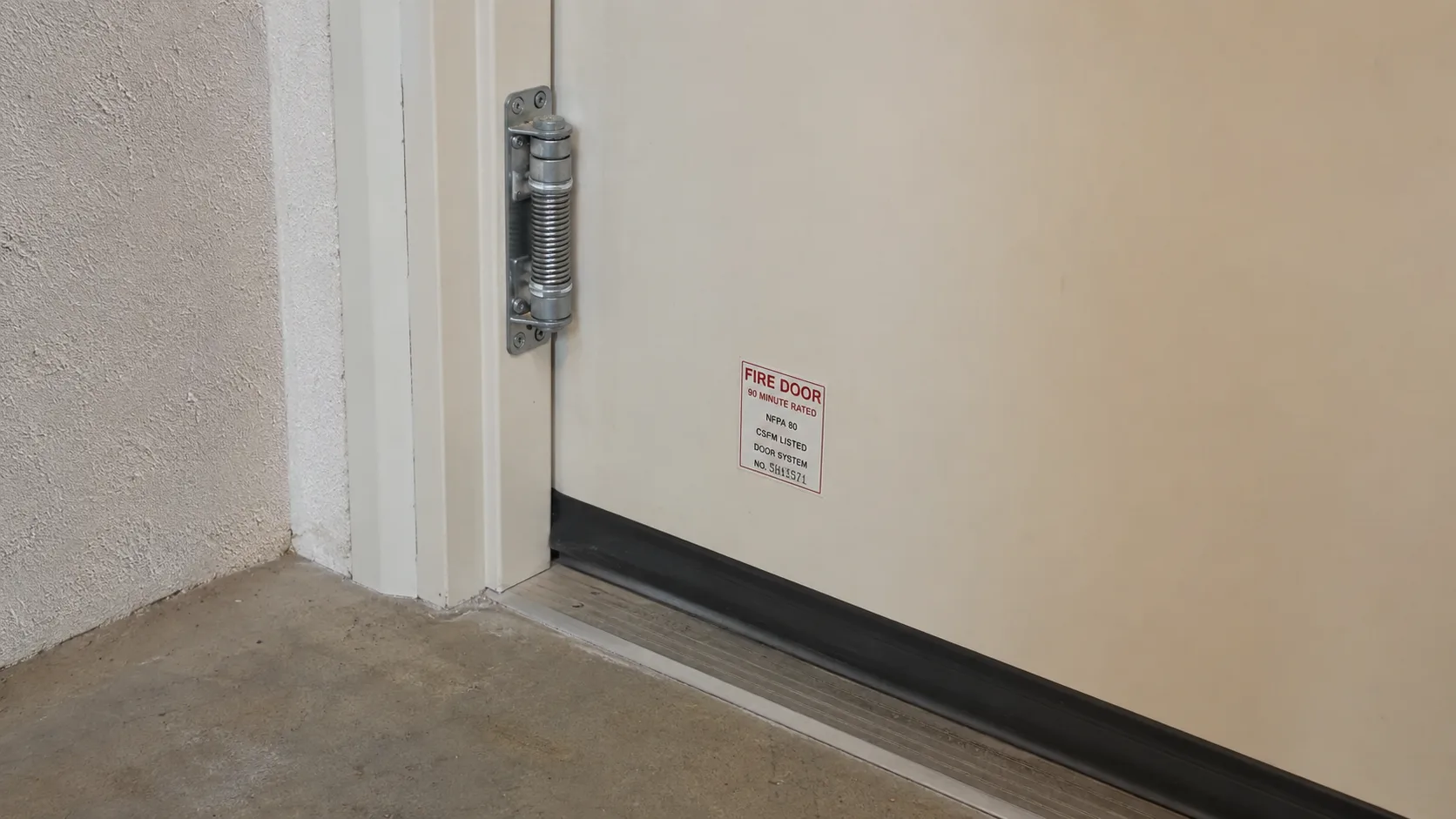
In any home built to modern code, the door separating an attached garage from the living space is required to be fire-rated — minimum 20 minutes, typically a solid-core door with a self-closing mechanism. That 20-minute rating is the buffer between a garage fire and the occupants of the house. It is also one of the most commonly undermined safety features in any home.
What degrades the door's rating
The self-closing mechanism — usually a spring hinge or hydraulic closer — is the first thing to fail. It gets adjusted or disabled because people find it inconvenient to have the door pull shut behind them. When the self-closer is disabled or broken, the door no longer closes automatically in a fire. It stays open at whatever angle it was left, and a 20-minute fire-rated door propped open provides zero minutes of protection.
The door sweep at the base is the second failure point. A gap at the bottom of the garage door — even a quarter inch — allows smoke and heat to transfer into the house within seconds. Run your hand along the bottom of that door and feel whether it seals against the threshold. A replacement door sweep costs under $15 and installs in 20 minutes.
The door frame itself matters too. A fire-rated door hung in a damaged or hollow frame does not perform to its rating. If the door frame shows rot, gaps, or damage, the door's integrity is compromised regardless of its rating label.
What the code actually requires
Current IRC (International Residential Code) requires that the door between an attached garage and the living space be solid wood or solid steel at minimum 1-3/8 inches thick, or a 20-minute fire-rated door. The door must be self-closing and self-latching. Homes built before these requirements — and homes where the original door has been replaced with something cheaper and convenient — may not comply. Check yours.
Gasoline Storage: What Most People Get Wrong
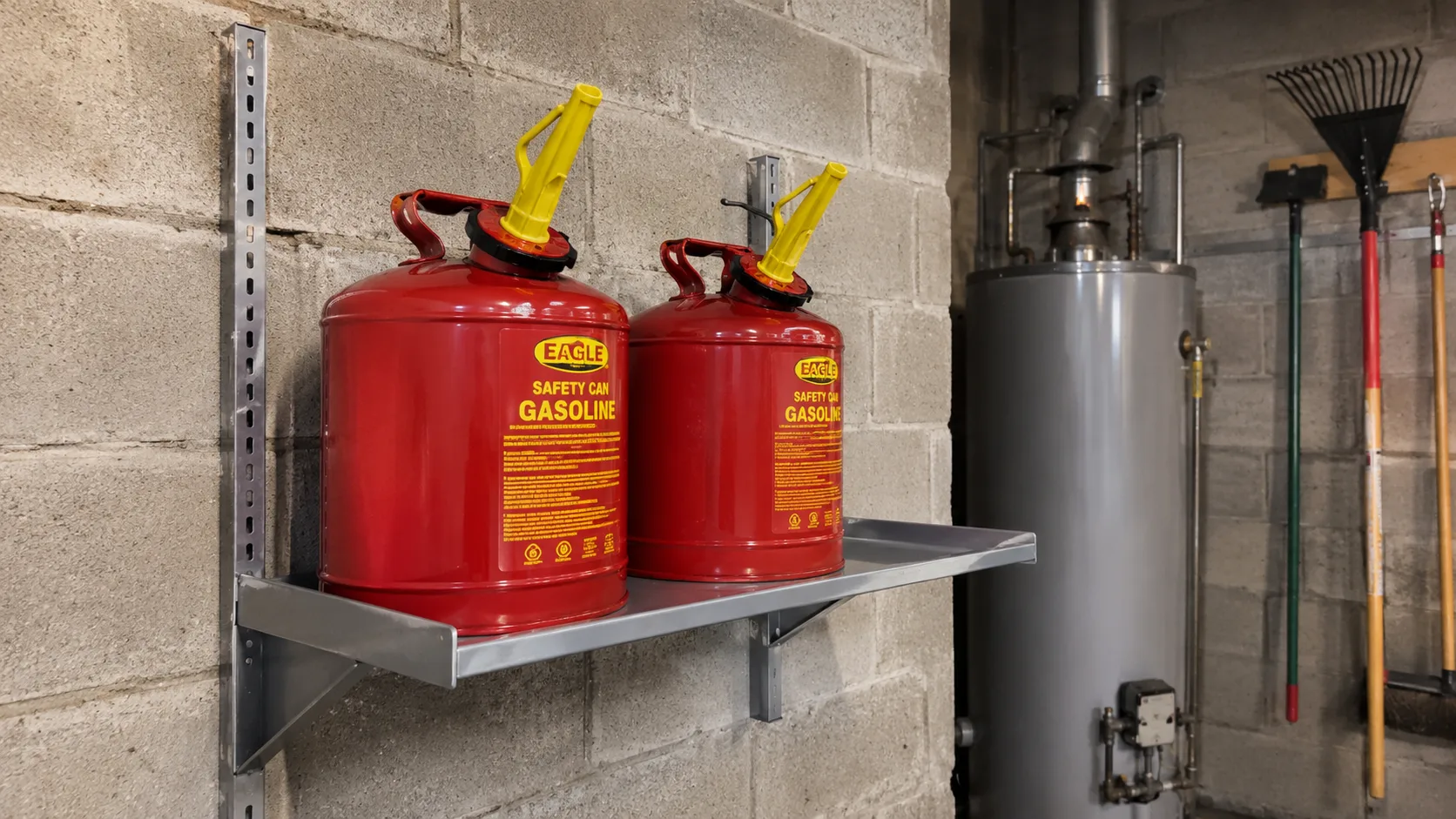
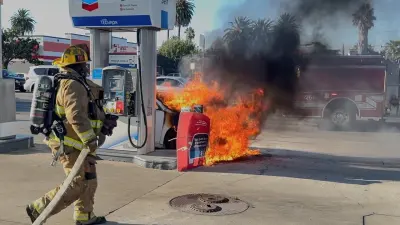
Gasoline stored in a garage is the single most common serious fuel hazard in residential fire investigations. People store far more of it than they realize, in containers that are not approved for it, near ignition sources that should disqualify the storage location entirely.
The container problem
Gasoline must be stored in containers specifically approved for flammable liquid storage — red containers with flame-arresting spouts, listed by UL or FM. An old milk jug, a water bottle, a generic plastic container, or any container without the flame-arrester spout is not an approved gasoline container. Gasoline vapors permeate through non-approved plastics over time, and the containers are not designed to prevent vapor release at the cap. A garage with an old plastic container of gasoline near a water heater pilot has a potential ignition condition that is one warm day away from being active.
The quantity problem
Most residential fire codes permit no more than 25 gallons of gasoline storage in a private garage. Most homeowners with a lawn mower, a generator, a snowblower, and a boat motor have no idea how many gallons they are storing in total. Add it up: a five-gallon can, a two-gallon spare, three gallons left in the boat motor can, two gallons in the generator reserve. That is not a hypothetical inventory.
The location problem
Gasoline must be stored at least 50 feet from any ignition source. In a garage, that rules out storage near the water heater, the furnace, the refrigerator compressor, the electrical panel, and any power tools. In a single-car garage, achieving 50 feet of clearance from all of these simultaneously is geometrically difficult. The correct answer for most garages is an outdoor, ventilated fuel storage box specifically designed for flammable liquids — these exist, they are inexpensive, and they move the most hazardous fuel out of the garage structure entirely.
Electric Vehicles and Garage Fires
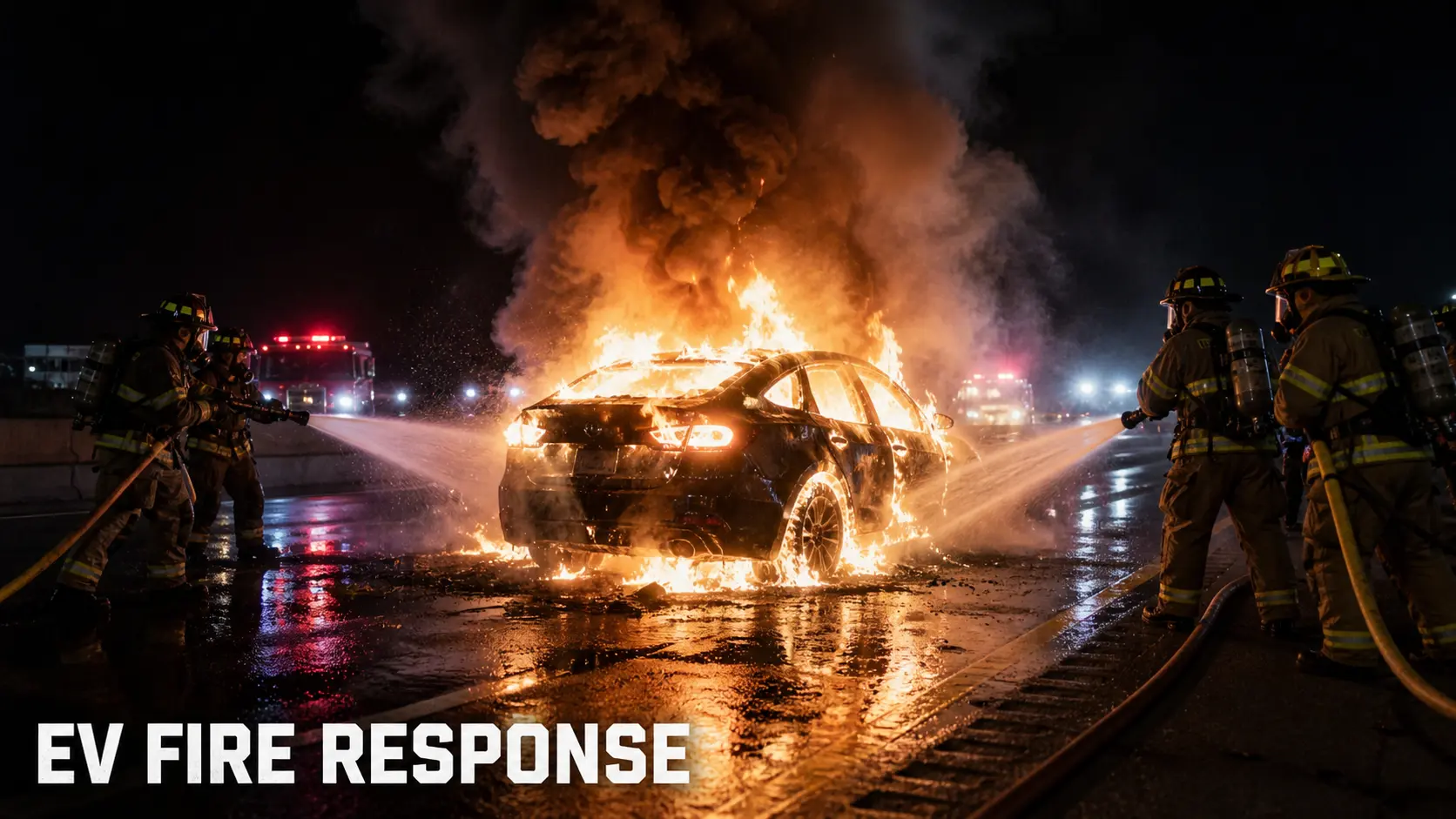
EV battery fires — specifically lithium-ion thermal runaway — are different from conventional vehicle fires in ways that matter for garage safety. A standard car fire can typically be controlled by a fire department within minutes using water. A lithium-ion thermal runaway fire burns at much higher temperatures, can reignite hours or days after appearing to be extinguished, and produces hydrogen fluoride gas — a highly toxic compound — that firefighters must now plan around when responding to EV fires in enclosed spaces.
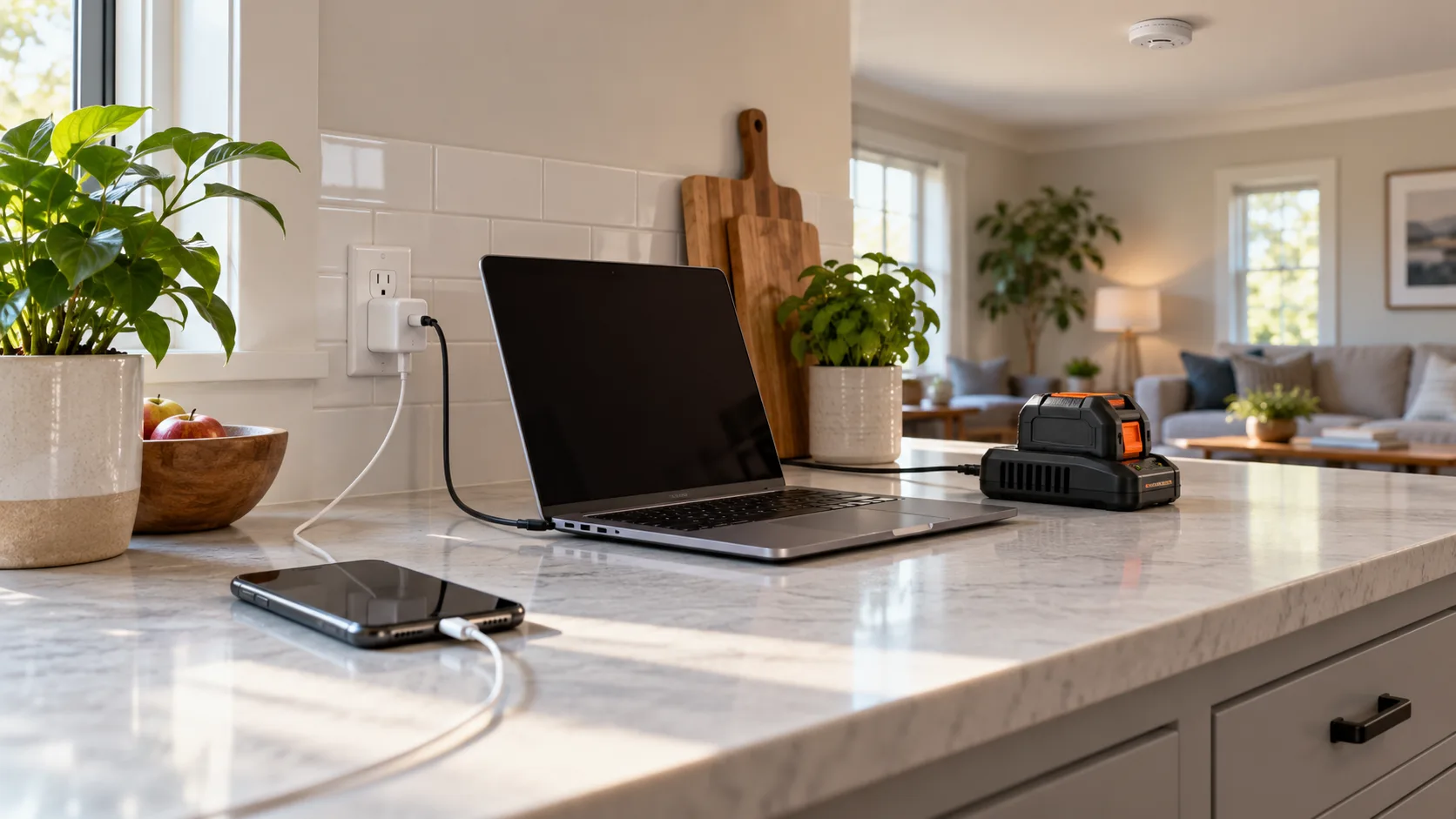
The risk during home charging is not zero, but it is low when the vehicle and charging equipment are maintained. The failure modes that produce garage EV fires are: damaged battery packs from collision trauma that was not assessed by a dealer, aftermarket charging equipment that is not rated for the vehicle, and extension cords used for Level 2 charging (which draws significantly more current than a standard outlet is designed to handle continuously).
The specific guidance: charge with the manufacturer-specified equipment, have any significant collision — even a minor one — inspected before charging again, and do not charge a vehicle that has been in standing water. If a lithium-ion battery fire starts in a garage, exit immediately and call 911. Do not attempt to fight it with a standard fire extinguisher. Move other vehicles away from the garage if it is safe to do so — EV battery fires spread to adjacent vehicles and can burn for extended periods.
Workshop Ignition Sources
Garages used as workshops add ignition sources that are not present in a standard storage garage. Angle grinders produce sparks that travel 15 to 20 feet from the point of contact. A spark landing on a rag soaked in paint thinner, a pile of sawdust, or an open solvent container is sufficient for ignition. Welding operations require a 35-foot clearance radius from combustibles per NFPA 51B — a standard almost no residential workshop meets.
The combination of solvent-based finishes and power tool sparks is the specific workshop hazard that kills people. Lacquer and oil-based paint fumes are heavier than air — they settle at floor level, accumulate to ignitable concentrations, and then detonate when an ignition source is introduced. A workshop that was ventilated 20 minutes ago may still have flammable vapor concentrations at floor level. The rule for any solvent work: ventilate for at least 30 minutes after the last application before introducing any ignition source, including power tools and light switches.
Smoke Detection in Garages
Standard smoke detectors should not be installed inside a garage — vehicle exhaust fumes will trigger them continuously, which leads to the detector being disabled or removed. The correct detection for a garage is a heat detector, not a smoke detector. Heat detectors trigger on temperature rise rather than particles in the air. They do not false-alarm from exhaust, and they activate at the point in a fire when temperature rise is rapid enough to confirm a real fire event.
A heat detector mounted on the garage ceiling, connected to the home's alarm system or to a separate audible alarm inside the living space, gives the household warning of a garage fire that a wall between them would otherwise delay. The connection to an audible alarm inside the house is the part most people skip — a detector that only sounds in the garage does not wake the family sleeping on the other side of the fire-rated door.
Garage Fire Safety Checklist
- ✓Fire-rated door between garage and house — solid core, self-closing, intact sweep at base.
- ✓Self-closing mechanism tested and working — door must close and latch on its own when released.
- ✓Heat detector installed on garage ceiling — connected to an audible alarm inside the home.
- ✓Gasoline in approved containers only — red UL-listed containers with flame-arresting spouts.
- ✓Total fuel storage under 25 gallons — add up all containers in the garage.
- ✓Fuels stored at least 50 feet from ignition sources — or in an outdoor flammable storage box.
- ✓Ventilate 30 minutes after any solvent work before using power tools or switching lights.
- ✓EV charged with manufacturer-specified equipment only — no extension cords for Level 2 charging.
- ✗Never store gasoline in unapproved containers or near water heaters, furnaces, or refrigerators.
- ✗Never disable the self-closer on the house-garage door.
- ✗Never grind or weld near open solvent containers or sawdust accumulation.
- ✗Never attempt to fight a lithium-ion battery fire with a standard extinguisher — exit and call 911.
The garage gets treated as a space outside the house's fire protection system — no smoke detector, no sprinklers in most homes, no fire safety walkthrough at move-in. But it connects directly to the house, holds the most hazardous fuel load of any room in the building, and burns faster than any other space. Treating it accordingly takes an afternoon and costs less than a dinner out.




Comments 0
No comments yet. Be the first to share your thoughts!
Leave a Comment