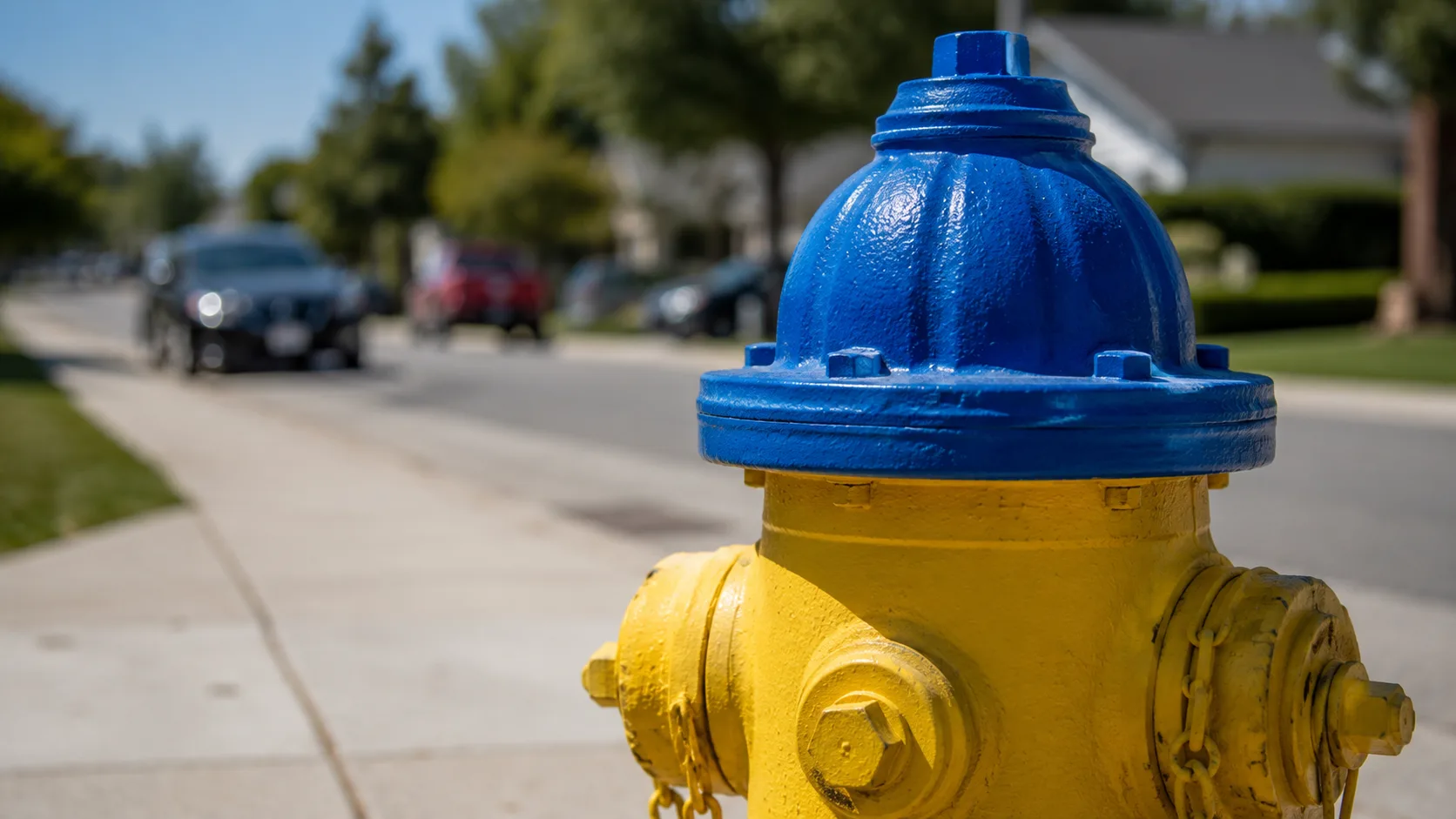

Most people assume fire hydrant colors are either decorative or arbitrary — that a red hydrant is red because fire trucks are red, or that a yellow hydrant is yellow because the city chose yellow. Some of that is true for the overall body color, which varies by municipality and tells you mostly about local convention. But the color of the bonnet — the top cap — and sometimes the barrel itself follows a national standard that tells firefighters something operationally specific: how much water that hydrant can deliver.
That number matters enormously at a working fire. A hydrant that can deliver 250 gallons per minute is not equivalent to one that delivers 1,500 gallons per minute. Connecting to an inadequate hydrant for an operation that demands more flow than it can supply wastes the critical minutes it takes to find a better source. The color coding, when applied correctly, gives the first-arriving engine company that information before they pull a single inch of hose.
In this article:
NFPA 291 and What It Actually Standardizes
NFPA 291 — Recommended Practice for Fire Flow Testing and Marking of Hydrants — is the document that establishes the color coding system. The word "recommended" is significant: NFPA 291 is a recommended practice, not a mandatory code. Jurisdictions are not legally required to adopt it. Many do, many do so partially, and some use entirely different local color conventions. Before assuming NFPA 291 applies to a specific hydrant, verify with the local water utility or fire department.
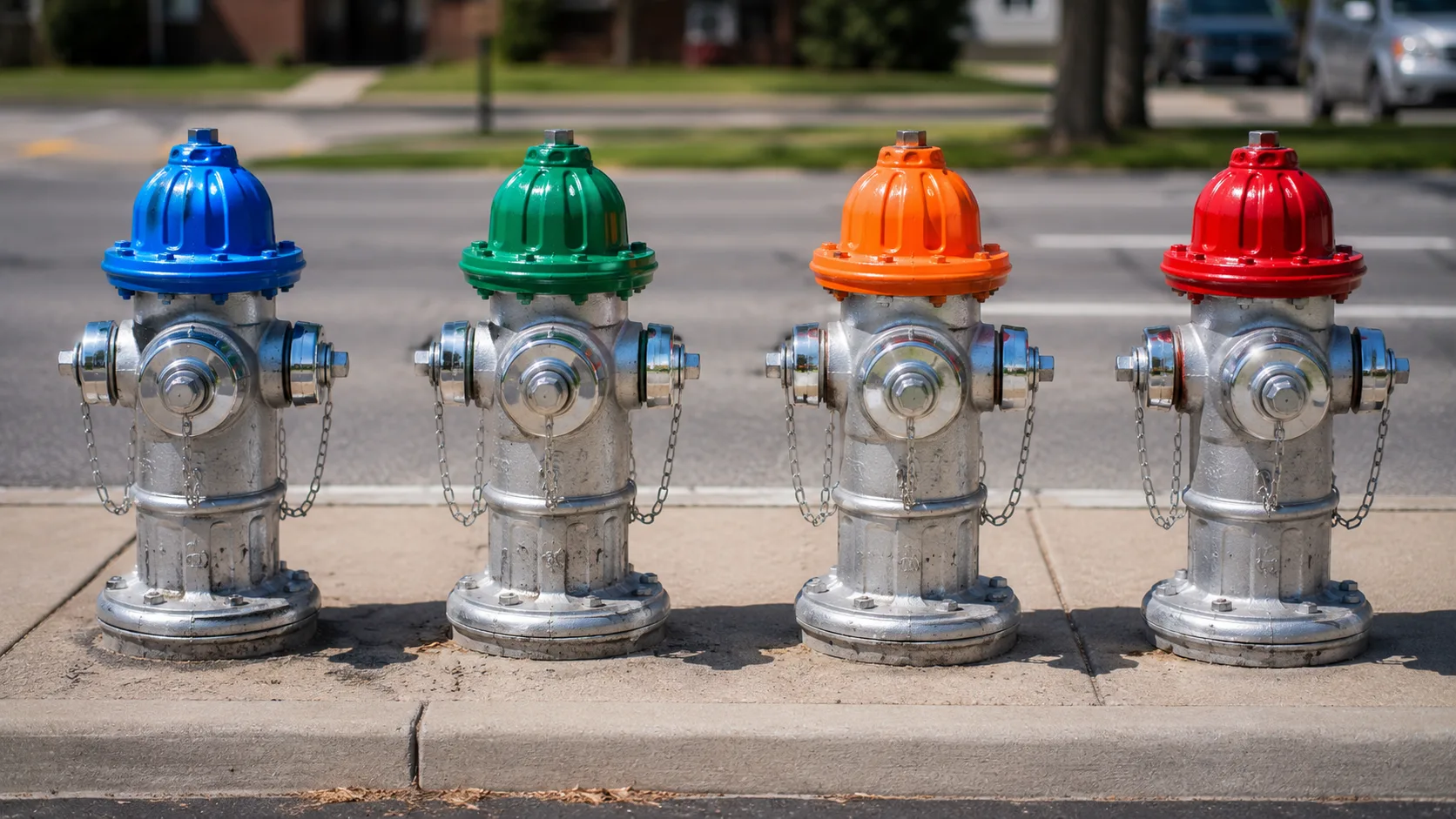
What NFPA 291 standardizes is the bonnet color — the top cap of the hydrant — as an indicator of the hydrant's flow rate class. Flow rate is measured in gallons per minute (GPM) at 20 psi residual pressure — a standardized testing condition that allows comparison between hydrants. The colors are assigned to four classes.
The Four Bonnet Colors and Their Flow Rates
| Bonnet Color | Class | Flow Rate | What it means operationally |
|---|---|---|---|
| Blue | Class AA | Above 1,500 GPM | Excellent supply — sufficient for multiple lines and large-volume operations |
| Green | Class A | 1,000–1,499 GPM | Good supply — adequate for most residential and light commercial operations |
| Orange | Class B | 500–999 GPM | Marginal — sufficient for a single residential attack line; may limit large operations |
| Red | Class C | Below 500 GPM | Insufficient for most structural firefighting; supplemental supply required |
The 500 GPM threshold for Class B is operationally significant because 500 GPM is approximately the minimum flow rate needed to sustain an offensive interior attack on a working residential structure fire with a single 1¾-inch attack line flowing around 150 to 200 GPM — leaving margin for a backup line, exposure protection, and supply to the aerial if needed. A Class C hydrant (below 500 GPM) cannot support even a basic residential interior attack without supplemental supply from additional hydrants or a tanker.
In practice, the difference between a blue hydrant and a red hydrant at a working fire is the difference between having abundant water and rationing it. The engine captain who connects to the best available hydrant first — identified by bonnet color — makes every subsequent tactical decision easier.
Body Color vs. Bonnet Color: Different Information
The body color of a fire hydrant — the main barrel — is typically set by the local water utility or fire department and does not follow NFPA 291. In many cities, all hydrants are painted a single color (chrome yellow is the NFPA-recommended body color for visibility, but red, yellow, silver, and other colors are widely used). The body color may indicate the water system supplying the hydrant (public vs. private, different water pressure zones, different utilities), or it may simply be the color the jurisdiction chose.
The operational information is in the bonnet and sometimes the outlet caps. NFPA 291 specifies that outlet caps — the covers over the hose connections — can also be color-coded to indicate the size of the outlet: chrome or brass for 2½-inch outlets, and various colors for larger steamer connections. Some departments use the outlet cap color to carry additional flow information when the bonnet color has been painted over or standardized to a single color.
When you see a hydrant that is entirely one color — all red, all yellow — you are looking at a hydrant where either the body color and bonnet color happen to match, or where the bonnet has been painted the same as the body without the flow rate color coding applied. The latter is common in jurisdictions that have not adopted NFPA 291 marking.
Why This Matters Operationally
The first-arriving engine at a working structure fire has a water supply decision to make within the first 60 seconds: which hydrant to connect to, and whether to lay supply hose from the hydrant to the scene or from the scene back to the hydrant. Both decisions are informed by knowing the hydrant's flow capacity before connecting.
An engine that drops a supply line to a red-bonneted hydrant — below 500 GPM — and then discovers that the fire requires significantly more flow than that hydrant can supply now has a problem that requires mutual aid, a second engine, and additional setup time. The same engine that identified the orange or blue hydrant two blocks away and made a longer lay to reach it has adequate supply from the first connection.
Pre-fire planning — which fire departments conduct for commercial properties and which some departments do for residential areas — includes hydrant flow data. A department that has tested and mapped its hydrants knows which streets have adequate supply and which do not, and that information factors into how apparatus is pre-positioned and how mutual aid is requested. The color coding on the hydrant is the field version of that information for any crew that did not pre-plan a specific address.
Dry Barrel vs. Wet Barrel Hydrants
The color system addresses flow rate. A separate characteristic — dry barrel vs. wet barrel — addresses how the hydrant stores water and what happens when it is damaged.
Wet barrel hydrants, common in warm climates where freezing is not a concern, hold water in the barrel at all times under normal operating pressure. Opening a wet barrel hydrant valve releases water immediately. Damage to a wet barrel hydrant — a vehicle striking it — results in immediate, uncontrolled water release from the main until the underground shutoff is closed. The volume of water released before a shutoff can be reached is substantial.
Dry barrel hydrants, standard in freeze-prone climates, hold no water in the barrel during normal conditions. The water supply valve is underground, below the frost line. Opening the hydrant's operating nut opens that underground valve, allowing water to fill the barrel and flow from the open outlet. When the operating nut is closed, the barrel drains back underground through a small drain valve — preventing freeze damage. Damage to a dry barrel hydrant above grade is less catastrophic because the main water supply is underground and unaffected until an operator opens the operating nut.
Private Hydrants
Not all hydrants on a property are public water system hydrants. Many commercial properties — shopping centers, industrial facilities, hospitals, large campuses — have private hydrants supplied by the property's own fire suppression water supply system. These hydrants are the property owner's responsibility for maintenance and testing, not the municipal water utility's.
NFPA 291 recommends that private hydrants be painted red to distinguish them from public hydrants — regardless of their flow rate class. The reasoning: the public fire department cannot guarantee the condition or flow rate of a private hydrant the way they can for a hydrant in their own tested and maintained public system. A red private hydrant is not necessarily a Class C flow hydrant — it is a hydrant whose supply conditions are outside the public system's normal accountability.
The Reflective Road Marker
Blue reflective markers embedded in road surfaces — those small raised dots that catch headlights — typically mark the location of a fire hydrant on the nearest curb or sidewalk. They are placed to help apparatus operators locate hydrants at night or in snow-covered conditions when the hydrant itself may be obscured.
The specific placement convention: the marker is usually positioned in the roadway lane nearest the hydrant, offset toward the center line to be visible from the approaching direction without being in the direct travel path. In jurisdictions that use this system, a blue road marker that appears ahead on a response tells the apparatus operator where to look for the hydrant without requiring them to scan the sidewalk.
Why Some Hydrants Don't Follow the Standard
Several reasons account for hydrants that do not carry NFPA 291 color coding:
- The jurisdiction adopted a local convention before or instead of NFPA 291 — many major cities have their own hydrant painting standards that predate the NFPA recommendation.
- Hydrants have been repainted for maintenance without re-applying the flow rate coding — a fresh coat of paint in the body color applied over a bonnet that should be orange or blue is common in departments with budget constraints on hydrant maintenance.
- The local water utility and the fire department use different systems — the utility paints hydrants by pressure zone and the fire department codes them by flow rate, producing inconsistency across the system.
- The hydrant has not been flow-tested and coded — newly installed hydrants may not be tested and color-coded for months after installation.
The practical takeaway: NFPA 291 color coding, when present and current, is reliable operational information. When absent, inconsistent, or uncertain, the engine operator falls back on pre-planned hydrant data or measures flow at connection. The color is a shortcut, not a substitute for knowing your district's water supply.





Comments 0
No comments yet. Be the first to share your thoughts!
Leave a Comment