
Published: · Written by a firefighter sergeant with direct fire prevention and inspection experience.
Every commercial business in the United States must pass a fire inspection before it can legally open. That process is not a paperwork exercise. It is the last line of defense between a building full of customers and a code violation that a responding engine crew might have to manage under the worst possible conditions. A restaurant kitchen with a failing hood suppression system, a retail store with a blocked exit corridor, a warehouse where rack storage height has outpaced the sprinkler system design — these are not hypothetical scenarios. Fire inspectors find them during routine visits every week, in every jurisdiction that runs an active fire prevention program.
This article covers the inspection process from the fire service side: what inspectors check, which NFPA codes apply by occupancy type, how violations are classified and corrected, and how the pre-opening inspection connects to a business receiving its Certificate of Occupancy. It is written for firefighters assigned to prevention duties, company officers learning the inspection process, and recruits preparing for a career in fire prevention.
Inspector note: This article covers common items under NFPA 1, 10, 13, 72, 96, and 101. Requirements vary by jurisdiction, adopted code edition, and local amendments. Always confirm the code version your AHJ has adopted before conducting official inspections.
In this article:
- What is a business fire inspection?
- Who conducts business fire inspections?
- Common requirements for all occupancies
- Restaurant and food service inspections
- Retail store inspections
- Warehouse and storage facility inspections
- Office and commercial occupancy inspections
- Assembly venue inspections
- What happens when a business fails inspection?
- Certificate of Occupancy and fire inspection
- Field tips for fire inspectors
What Is a Business Fire Inspection?
A business fire inspection is a systematic evaluation of a commercial property to verify that it meets the fire and life safety code requirements adopted by the local authority having jurisdiction. The inspection covers physical conditions — fire suppression systems, egress paths, detection equipment, electrical panels, stored materials — and in some jurisdictions includes documentation review such as sprinkler maintenance logs, hood suppression service tags, fire drill records, and Material Safety Data Sheets for hazardous materials stored on site.
Inspections happen at predictable points in a business lifecycle. The most significant is the pre-opening inspection required before a new business receives its Certificate of Occupancy and can legally operate. After opening, routine inspections typically follow an annual cycle for most commercial occupancies. Higher-hazard uses — restaurants, nightclubs, industrial facilities — may be inspected more frequently under local ordinance or department policy.
Complaint-based inspections happen outside the routine cycle when a neighbor, employee, or 911 caller reports a suspected violation. Change-of-use inspections are triggered when a business changes what it does with a space — a retail store converting to a restaurant, for example, or a warehouse adding a mezzanine office level. Each change can alter the occupancy classification under NFPA 101 and trigger a full reassessment of the space's code compliance.
The primary codes governing these inspections in the United States are NFPA 1 (Fire Code), NFPA 101 (Life Safety Code), NFPA 72 (Fire Alarm Code), NFPA 13 (Sprinkler Systems), NFPA 10 (Portable Fire Extinguishers), and for food service, NFPA 96 (Commercial Cooking Operations). Many jurisdictions also adopt the International Fire Code (IFC) as an alternative to NFPA 1. Inspectors need to know which edition and which code set their jurisdiction has adopted because specific numbers — clearances, quantities, service frequencies — can vary between editions and between NFPA and IFC frameworks.
Who Conducts Business Fire Inspections?
Business fire inspections are conducted by fire inspectors, fire prevention officers, or fire marshals. In larger departments, a dedicated fire prevention bureau handles all commercial inspections. Bureau inspectors may be civilians with fire prevention certification or sworn fire officers assigned to prevention duties. Either way, the position requires detailed knowledge of adopted codes, occupancy classifications, egress requirements, suppression system types, and the documentation process for violations and re-inspections.
In smaller and mid-sized departments, line firefighters often handle routine commercial inspections as part of their pre-incident planning responsibilities. NFPA 1 Chapter 11 establishes the framework for this kind of field inspection program. A company officer conducting a pre-plan walk-through who spots a code violation is performing a real prevention function. The deficiency gets documented, reported to the prevention bureau, and tracked to resolution.
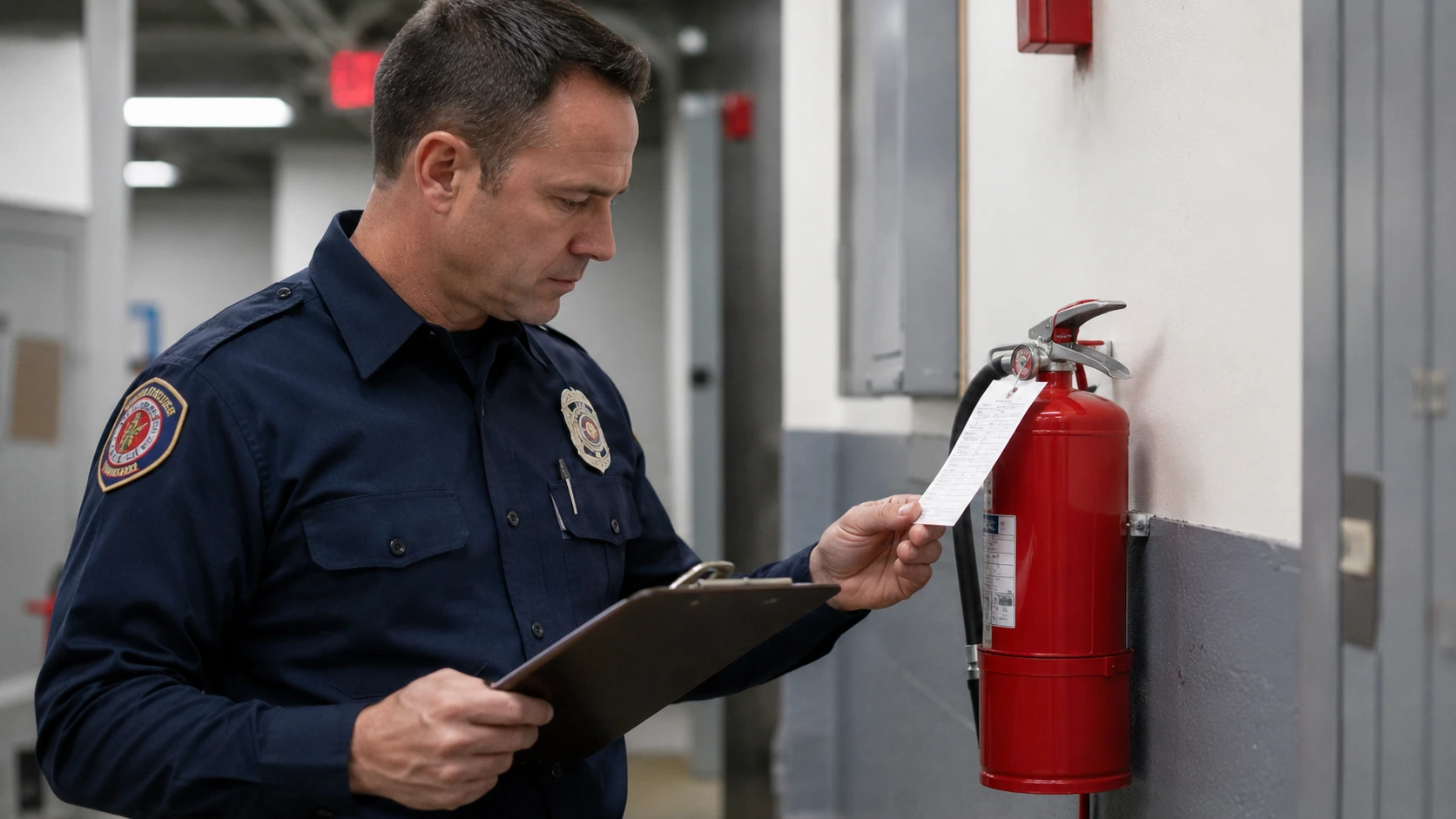
Regardless of who conducts the inspection, the legal authority comes from the local fire code adoption and the jurisdiction's inspection ordinance. Inspectors generally have the authority to enter commercial properties during business hours without a warrant for routine code compliance inspections. Refusal to allow entry can result in an administrative warrant and, depending on jurisdiction, citations or permit holds that prevent the business from operating.
The inspector's role is enforcement and education in equal measure. Most business owners and managers have limited familiarity with fire codes. An inspector who explains why a requirement exists — why sprinkler heads need 18 inches of clearance, why exit signs need battery backup, why a fire door cannot be propped open — is more likely to achieve lasting compliance than one who issues violations without context. Prevention work requires communication skills as much as code knowledge.
Common Requirements for All Occupancies
Certain fire safety items apply across virtually every commercial occupancy type. These are the baseline checks that inspectors perform in every building they enter, regardless of what the business does or how many people it serves.
Fire extinguishers must be the correct agent type for the hazard class present, mounted in visible and accessible locations, and showing a current annual inspection tag under NFPA 10. The tag date, inspector signature, and next service year must all be legible. An extinguisher with a tag that expired 14 months ago is a violation even if the gauge reads full pressure.
Exit signs must be illuminated on all required egress paths at all times. NFPA 101 Section 7.10 requires either continuous illumination or at least 90 minutes of battery backup. Inspectors test backup power by disconnecting primary power or pressing the test button where one is provided. A sign that goes dark during the test is a violation regardless of how new it looks.
Emergency lighting must function independently of the normal lighting circuit and provide a minimum of 90 minutes of floor-level illumination along means of egress under NFPA 101 Section 7.9. Battery pack test indicators must be functional. Burned-out test lamps inside emergency lighting units are one of the most common findings across all occupancy types.
Means of egress must be unobstructed along their entire path from any occupied area to the public way. NFPA 101 Section 7.1 is the governing provision, but the practical reality is that storage, retail displays, furniture, equipment, and seasonal merchandise routinely end up blocking exit corridors, exit doors, and the paths leading to them. This is one of the most frequent violations inspectors encounter, and it recurs because the configuration of a space changes continuously between visits.
Exit doors must open from the inside without special knowledge, a key, or a tool under NFPA 101 Section 7.2.1. Panic hardware is required on certain egress doors above occupancy thresholds. Exit doors serving an occupancy load of 50 or more must swing in the direction of egress travel. A door that is padlocked, chained, blocked by a dumpster on the exterior, or swing-locked in the wrong direction is a potentially life-safety-critical violation that warrants immediate attention.
Fire doors must be self-closing, self-latching, and not propped or wedged open under NFPA 101 Section 8.3. A fire door held open with a doorstop, a trash can, or a piece of duct tape over the latch is a failed fire door. The inconvenience of letting a door close every time someone passes through it is not a code basis for any exemption.
Fire alarm panels must show no active alarms, supervisory conditions, or trouble signals. Inspectors visually examine the panel and document any active conditions. A trouble signal that has been present for weeks indicates a disconnected device, a system in bypass, or maintenance that was never completed — all of which need to be resolved before the inspection can pass.
Sprinkler heads must maintain 18 inches of clearance below them under NFPA 13 Section 8.6.6. Merchandise, shelving, insulation wrapping, and ceiling materials stacked or installed below a sprinkler head can obstruct the water distribution pattern and significantly reduce system effectiveness. The sprinkler control valve must be fully open and in a supervised or locked-open position. The fire department connection must be accessible, capped, and properly identified.
Electrical panels must have 36 inches of unobstructed working space in front of all panel faces under NEC Section 110.26. Storage placed in front of or around electrical panels is found in nearly every stockroom, mechanical room, and back-of-house area that is not actively managed.
The maximum occupancy load must be posted at the primary entrance and must reflect the approved figure from the Certificate of Occupancy or the occupancy load calculation. The posted limit is a legal ceiling, not a suggestion. An event that routinely exceeds it is both a code violation and a liability for the property owner.
Restaurant and Food Service Inspections
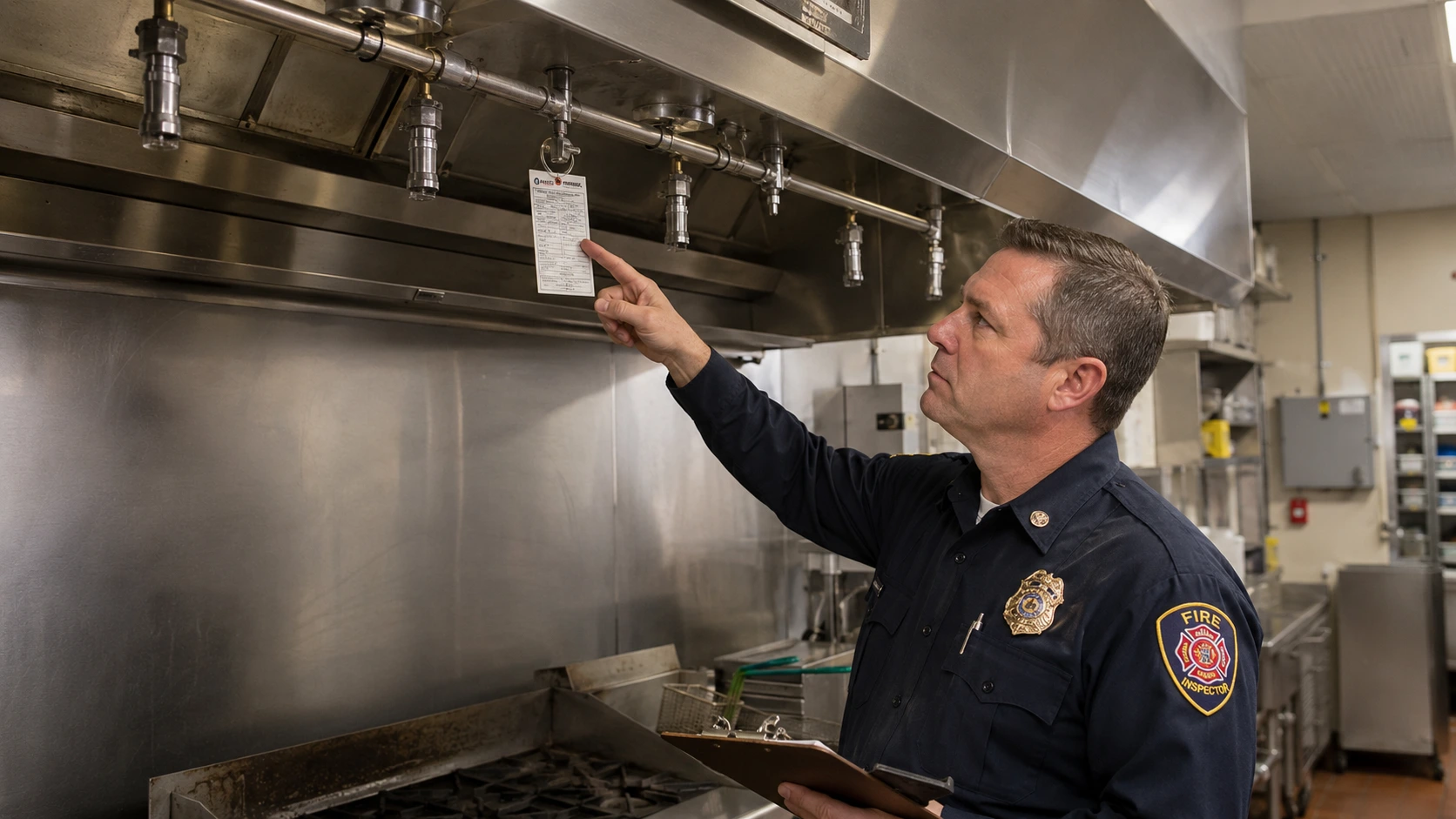
Restaurant and food service occupancies receive more inspection attention than most commercial occupancy types, and for good reason. Commercial cooking produces grease-laden vapors that accumulate in ductwork, on filters, and across surfaces throughout the exhaust path. Grease fires that escape the confines of the hood and duct system move fast, generate intense heat, and are among the most dangerous commercial structure fires for occupants and firefighters alike.
The Type I hood and grease filters are the starting point. NFPA 96 Chapter 11 covers hood design and maintenance requirements. The inspector looks for heavy grease accumulation on the filters, damaged or missing baffles, grease dripping from the filter track, and any modification to the hood geometry that was not part of the original listed system. A restaurant operating with a hood that has not been professionally cleaned in six months or more in a high-volume operation is a serious hazard.
The hood fire suppression system — typically a wet chemical system — must show a current service tag under NFPA 96 Chapter 14. Service is required every six months without exception. An annual tag is not compliant. The suppression nozzles must be in place and unobstructed, the pull station must be accessible and clearly identified, and the system must cover all cooking appliances beneath the hood. Any new cooking equipment added after the suppression system was installed may not be covered by the original system design and may require modification.
The exhaust ductwork from the hood to the roof termination must be intact, properly sealed at joints, and free of excessive grease accumulation beyond the filters. Inspectors who can access duct cleanout panels should verify the internal condition. Ductwork that has not been cleaned in over a year in a high-volume operation is a significant hidden hazard.
The gas shutoff for the cooking line must be clearly labeled and accessible to all staff without tools or special knowledge, not hidden behind equipment or in a locked mechanical room. NFPA 96 Section 10.2 requires readily accessible manual gas shutoffs. Staff must know where it is and how to use it, because the first action in any commercial cooking fire is to cut the fuel supply.
Walk-in cooler and freezer doors must have functioning interior release handles that allow anyone who becomes trapped inside to open the door from within. This is a life safety requirement that often gets missed in older installations and in equipment brought in from other locations.
Retail Store Inspections
Retail occupancies present a different challenge: the constant tension between maximizing floor space for merchandise and maintaining required means of egress. Store layouts change with seasons, promotions, and new inventory arrivals, and each change has the potential to introduce a violation that was not present during the last inspection.
The primary concern in any retail inspection is that merchandise and shelving do not obstruct egress paths, exit signs, or exit doors. Seasonal retail in particular tends to crowd extra fixtures, display racks, and promotional signage into areas that narrow or obscure required egress routes. End-cap displays near exit corridors and merchandise stacked against exit doors are two of the most consistently found violations in retail inspections.
The 18-inch clearance below sprinkler heads must be maintained even as shelving is restocked and rearranged week to week. High shelving with merchandise that reaches within a few inches of the ceiling is a common sprinkler obstruction in warehouse-style retail environments where staff and management are focused on inventory turnover rather than code compliance.
Back-of-house areas in retail stores accumulate violations at a higher rate than the sales floor. Cardboard, packaging material, and returned merchandise stored near water heaters and electrical panels, extension cords used as permanent wiring for stockroom equipment, and fire-rated stock room doors propped open for convenience are found on nearly every inspection. These areas rarely receive the same daily attention as the customer-facing floor.
Warehouse and Storage Facility Inspections
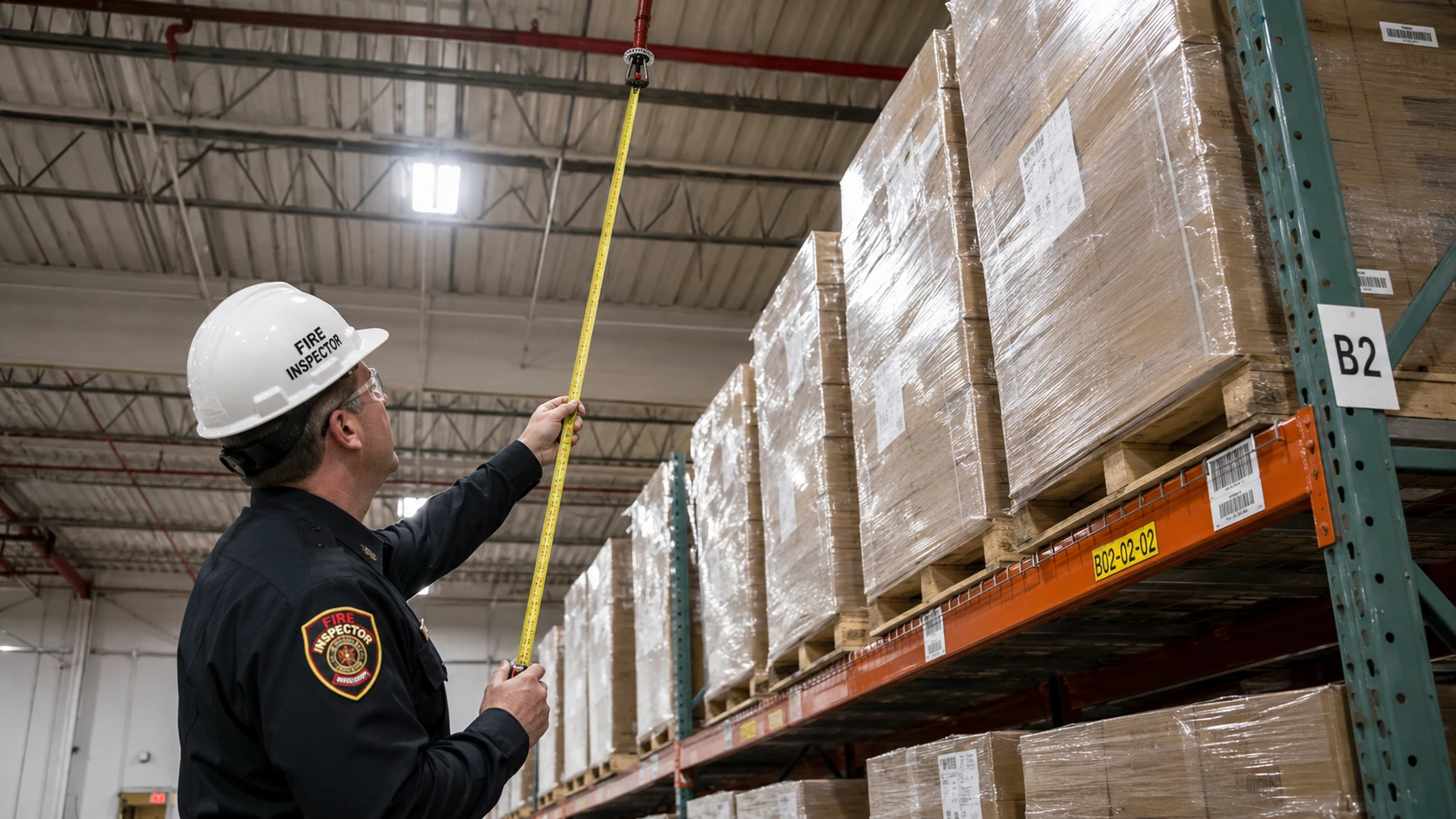
Warehouse and storage facility inspections focus heavily on the relationship between what is stored, how high it is stored, and whether the sprinkler system was designed to protect that storage configuration. A sprinkler system engineered for storage up to 12 feet does not become more capable when the warehouse begins stacking pallets to 18 feet. The design is specific, and violations of the approved storage height represent a genuine suppression failure risk in the event of a fire.
Rack storage height must remain within the approved sprinkler system design parameters. NFPA 13 Chapter 17 governs storage sprinkler design. An inspector who finds product stacked above the approved limit must issue a violation and may require a halt to storage operations in that area until the suppression design is updated to cover the new height or the storage is brought back into compliance.
Main aisle clearance of at least eight feet must be maintained per NFPA 13 and IFC Section 315. Blocked or narrowed aisles impede fire department access into the structure and may prevent hose advancement to the fire area. Warehouses under continuous throughput operations often drift out of compliance between inspections as material accumulates in transit areas and overflow zones.
Flammable and combustible liquids must be stored in listed safety cabinets or in approved storage rooms designed for flammable liquid storage under NFPA 30. Quantities must not exceed NFPA 30 Maximum Allowable Quantities for the building area and sprinkler protection status. Warehouses that receive a wide variety of products often have unknown quantities of flammable materials mixed into general stock without staff being aware of the specific code implications.
Forklift battery charging areas must be ventilated, have ignition sources controlled, and be properly marked under NFPA 505. Charging lithium-ion forklift batteries presents different hazards than traditional lead-acid charging, and many warehouse operators are not current on the ventilation and separation requirements as the equipment mix in their fleet has evolved.
Material Safety Data Sheets must be accessible for all hazardous materials stored on site under OSHA 1910.1200. Fire inspectors who identify hazardous materials storage have a direct operational interest in confirming that emergency responders would have product information available in the event of an incident at that address.
Office and Commercial Occupancy Inspections
Office occupancies are often approached as lower-hazard environments, and in many respects they are — moderate fire loads, mobile and alert daytime occupants, modern construction with passive fire protection built in. But specific violations appear in office buildings at a consistent rate that makes the inspection worthwhile in every cycle.
Storage and utility rooms in office buildings frequently accumulate materials without the space ever being designed or approved for storage. File archives, surplus furniture, holiday decorations, and obsolete equipment all end up in spaces that have fire-rated self-closing doors precisely because they contain ignition hazard concentrations. Those doors must be functional, self-closing, and latching fully every time they close — not propped open for the convenience of people moving materials in and out.
Server and IT rooms present specific concerns because they combine continuous high-value electrical loads with small, enclosed spaces and 24-hour unattended operation. NFPA 75 governs IT equipment fire protection. Rooms with significant server density may require suppression systems, early-warning smoke detection, or both, depending on the floor area and value of the equipment.
Break rooms and kitchenettes are a consistent source of extension cord violations. Toasters, microwaves, coffee makers, and refrigerators share circuits via multi-outlet strips and extension cords that were not designed for continuous-duty kitchen loads. NEC Section 400.8 is unambiguous: extension cords cannot serve as permanent wiring regardless of how long they have been in place.
Corridor width under NFPA 101 Section 7.3.4 requires a minimum 44-inch clear egress width in corridors serving occupant loads above specific thresholds. Copy machines, recycling stations, coat racks, and file carts regularly reduce measured corridor widths below the minimum during normal business operations.
Assembly Venue Inspections
Assembly occupancies — event venues, theaters, banquet halls, nightclubs, houses of worship used for large gatherings — receive some of the most intensive code scrutiny because they combine large numbers of people with conditions that can actively impair egress: low lighting, noise, crowds, alcohol, and the social momentum of an event that makes people reluctant to stop and look for exits when something goes wrong.
Maximum occupancy load posting at all primary and secondary entrances is required under NFPA 101 Section 12.7.9. But posting the number is only part of the requirement. The business must have a practical means to enforce it, because an assembly occupancy that admits twice its posted capacity on a busy night has eliminated half its egress capacity in the same moment it doubled the number of people who need to use it.
All exit doors must be unlocked and operable outward during any period of occupancy under NFPA 101 Section 12.2.2. Doors locked during an event for crowd management reasons or to control noise are a life-safety violation. The solution to crowd management in an assembly occupancy is trained crowd managers and defined entry points, not locked egress doors.
Main aisles must maintain minimum 44-inch clear width throughout the event including during setup and teardown. Chair and table configurations for banquet events are frequently tighter than the approved floor plan, and event staff who rearrange seating to accommodate extra guests routinely create aisle violations that were not present at the time of the last inspection.
Open flames and pyrotechnic effects in assembly occupancies require specific permits under NFPA 160. Any event using candles, torches, sparkler effects, or pyrotechnics without an active permit is a code violation that carries significant life-safety risk in any space with a large number of people and limited egress time.
Trained crowd managers are required for assembly occupancies with 250 or more occupants under NFPA 101 Section 1.7.14. A crowd manager is a designated, trained individual whose role includes occupant load monitoring, egress management during an emergency, and coordination with responding fire units — not a general-duty security role.
What Happens When a Business Fails Inspection?
A failed inspection results in a Notice of Violation — a formal document listing each deficiency found, the applicable code section, and a correction deadline. The format and terminology vary by jurisdiction, but the underlying process is consistent: the inspector documents what was found, the business receives formal written notice, and a follow-up inspection is scheduled to verify correction.
Violations are typically classified by severity. Minor violations with limited immediate life-safety impact may have correction deadlines of 30 to 90 days. Major violations — blocked exits, non-functional suppression systems, missing or outdated hood suppression service — may require immediate correction or result in the authority having jurisdiction ordering the business to cease operations in the affected area until the hazard is resolved.
Serious life-safety hazards found during a pre-opening inspection prevent the Certificate of Occupancy from being issued until those hazards are corrected and re-inspected. A restaurant that fails its pre-opening inspection because the hood suppression system has not been installed or serviced cannot open — not even for a soft opening or a friends-and-family event — until the CO is issued.
Re-inspection fees: Most jurisdictions charge a re-inspection fee after the first follow-up visit. Businesses that require multiple return trips because violations have not been fully corrected can accumulate significant fees. Repeated failures can trigger escalating enforcement action including operating permit revocation and administrative fines.
The inspector's job during re-inspection is to verify that each item on the violation notice has been corrected. A business that corrected the original violations but introduced a new hazard in the process is not compliant, and the inspector documents the new condition on the re-inspection report. Every visit produces a written record that becomes part of the property's compliance history.
Certificate of Occupancy and Fire Inspection
The Certificate of Occupancy is the document issued by the local building or fire authority confirming that a structure meets applicable codes for its intended use and occupancy classification. No business can legally operate without one, and no CO is issued without a passing fire inspection in any jurisdiction that runs a functional prevention program.
In most jurisdictions, the CO requires sign-off from the building department, the fire authority, and potentially the health department and other agencies depending on the occupancy type. The fire inspection component may be a direct sign-off on the CO application or a separate clearance letter that becomes part of the CO package. Either way, the connection is direct: no passing fire inspection, no CO, no legal opening.
The timing of the fire inspection in the CO process matters practically. A building that passes its final building inspection but still has fire alarm components that are not commissioned, a sprinkler system that has not received its NFPA 13 acceptance test, or a commercial kitchen where hood installation is not complete cannot pass the fire inspection. Contractors and tenants who schedule these elements so that the fire inspection can follow immediately after the building inspection avoid delays that can cost weeks of lease payments on an unopened space.
The Occupancy Load Calculator on AllFirefighter lets inspectors and building officials verify posted occupancy limits against NFPA 101 and IBC side by side, which is particularly useful when an existing CO is being reviewed for a change-of-use application where the original classification may no longer reflect actual use.
📋 Business Fire Inspection Checklist Generator
Select an occupancy type — restaurant, retail, warehouse, office, assembly, healthcare, or educational — and generate a printable NFPA-referenced pass/fail checklist with a notes field for each item and a signature block at the bottom. Built for fire inspectors and prevention bureau personnel.
Open the Checklist Generator →Field Tips for Fire Inspectors
Experienced inspectors develop routines that help them cover every area of a commercial space without missing common violation categories. A few practices that are worth building into any inspection workflow:
Walk the egress path from the farthest point. Start at the most remote point of the occupancy — the back corner of the stockroom, the far end of the dining area — and walk toward the exits. This mirrors the experience of an occupant trying to leave during an emergency and reveals obstruction, inadequate exit signage, and door problems that may not be visible from the entrance.
Check above and below, not only at eye level. Sprinkler head clearance violations are overhead. Storage blocking electrical panels is at floor level. Extension cord daisy chains run behind equipment. The parts of a space that are not at eye level are exactly where violations accumulate between inspection cycles.
Test, do not assume. An emergency light that appears to have a charged battery is not confirmed functional until the test button produces illumination. A fire door that looks self-closing may have a damaged closer that fails to pull it fully latched. An exit door that appears unlocked may have a magnetic hold-open that defaults to locked on power loss. Testing produces results; observation produces assumptions.
Document with photographs. A photograph of the violation is more valuable than a written description when a business owner disputes a finding. Date-stamped photos tied to specific violation items make re-inspection verification faster and create a clear record if the matter proceeds to an administrative hearing.
Reference the NFPA Standard Explorer for specific citations. When a code section is in dispute or a business owner asks for the exact basis for a requirement, the NFPA Standard Explorer on AllFirefighter indexes 65+ NFPA standards by topic with summaries and official links. Having the reference available in the field reinforces the credibility of the inspection and reduces the time spent looking up specific provisions later.
Key Points for Fire Inspectors
- Baseline items — extinguishers, exit signs, egress paths, sprinkler clearance, panel access — apply to every commercial occupancy and should be checked without exception on every visit.
- Restaurant inspections hinge on the hood system: suppression service frequency under NFPA 96 is every six months, not annually. An annual tag is a violation.
- Warehouse inspections must verify that actual storage height matches the approved sprinkler system design configuration. Unauthorized height increases create a suppression gap the system was never built to handle.
- Assembly occupancies combine high occupant loads with conditions that impair egress. Verify actual event configurations and aisle widths, not only the approved floor plan on file.
- No Certificate of Occupancy is issued without a passing fire inspection. Timing inspection sign-off correctly in the CO process prevents costly delays at project completion.
- Testing is more reliable than visual inspection — test emergency lights, cycle exit doors, verify fire door latch engagement under spring tension, not just against a wedged-open doorstop.
- Use the Business Fire Inspection Checklist Generator to produce a printable pass/fail checklist by occupancy type with NFPA code references and notes fields for each item.
References
- NFPA 1 — Fire Code, current edition (nfpa.org)
- NFPA 10 — Standard for Portable Fire Extinguishers, current edition
- NFPA 13 — Standard for the Installation of Sprinkler Systems, current edition
- NFPA 72 — National Fire Alarm and Signaling Code, current edition
- NFPA 96 — Standard for Ventilation Control and Fire Protection of Commercial Cooking Operations, current edition
- NFPA 101 — Life Safety Code, current edition
- International Fire Code (IFC), current edition (iccsafe.org)
- OSHA 1910.1200 — Hazard Communication Standard (osha.gov)



Comments 0
No comments yet. Be the first to share your thoughts!
Leave a Comment