
Published: · Written by an active firefighter sergeant with direct ICS and incident documentation experience.
Every major incident in the United States fire service generates paperwork. Not because someone in an office decided to add bureaucracy to emergency response, but because structured documentation is what separates a coordinated, accountable operation from organized chaos. The Incident Command System forms — ICS 201 through ICS 215 — are the backbone of that structure. They record who is on scene, what they are doing, how they are communicating, and what the plan is for the next operational period. Without them, multi-agency incidents fall apart. With them, a hundred responders from a dozen different departments can work from the same objectives, on the same radio channels, with the same medical plan, under a single unified accountability system.
This guide covers the eight most commonly used ICS forms in the fire service: ICS 201, 202, 204, 205, 206, 213, 214, and 215. It explains what each form does, who fills it out, when it is used, and what gets written in each section. It is written for firefighters at any level — from recruits learning ICS for the first time to company officers preparing for ICS 300 or 400 coursework.
Operational note: ICS forms are standardized NIMS documents maintained by the NIMS Integration Center. This guide covers the standard field use of each form. Your department or agency may use modified versions. Always follow your department's SOGs and the form version adopted by your jurisdiction's authority having jurisdiction.
In this guide:
- Why ICS forms matter for firefighters
- ICS 201 — Incident Briefing
- ICS 202 — Incident Objectives
- ICS 204 — Assignment List
- ICS 205 — Radio Communications Plan
- ICS 206 — Medical Plan
- ICS 213 — General Message
- ICS 214 — Unit Activity Log
- ICS 215 — Operational Planning Worksheet
- How ICS forms build the Incident Action Plan
- Common ICS documentation mistakes
Why ICS Forms Matter for Firefighters
ICS forms exist because large incidents are too complex to manage from memory. When a single engine company handles a rubbish fire, the incident commander can track everything mentally. When a structure fire expands to a working fire with multiple alarm assignments, mutual aid units, an exposure problem, and an EMS need, the incident commander cannot hold all of that information in their head and make good decisions at the same time. The forms offload that cognitive burden onto structured paper.
The forms also matter for legal and financial reasons that firefighters on the line rarely think about but that matter enormously to their departments. FEMA reimbursement for federally declared disasters requires documented incident action plans. Workers' compensation claims involving injuries during incidents depend on the unit activity log to establish where a person was and what they were doing. After-action reviews that actually drive improvement depend on the general message logs and activity records to reconstruct what happened in sequence.
And ICS forms are the documentation of accountability. When a mayday occurs, the incident commander needs to know instantly which unit was in the structure, how many personnel, who their supervisor was, and what assignment they had. That information lives on the ICS 204 assignment list. Without it, the accountability system collapses at exactly the moment it matters most.
ICS 201 — Incident Briefing
Incident Briefing
Who fills it: Incident Commander or Operations Section Chief • When: Initial response, before formal IAP development • Purpose: Capture the initial situation, actions taken, and resources before the planning section takes over
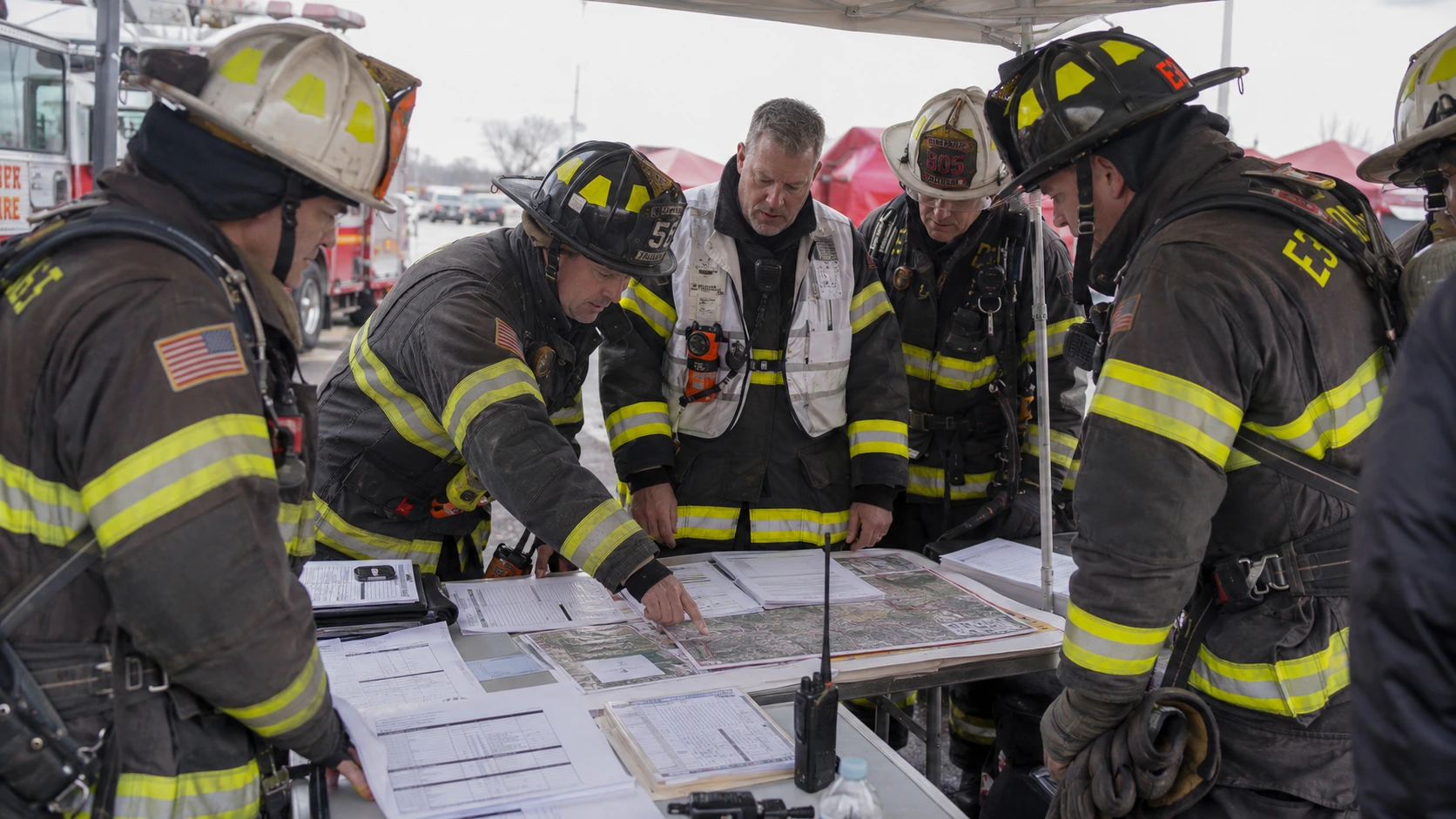
The ICS 201 is the first form used on any incident that grows beyond a single resource response. It is the initial briefing document — the bridge between the first-arriving officer's mental picture of the incident and the formal planning process. When a new incident commander arrives and assumes command, they are briefed from the ICS 201. When the planning section begins developing a formal incident action plan, they start with the ICS 201 as the baseline.
The form has four primary sections. The first is the incident summary, which describes what is happening: fire location and size, structures involved, exposure problems, life safety status, weather, and any known hazards. The second section covers initial actions taken — resources deployed, tactical assignments given, and tasks completed before the planning section came online. The third is a resource summary showing what is on scene and what has been ordered or is en route. The fourth section captures known safety hazards, which feeds directly into the ICS 206 medical plan and the safety officer's briefing.
On smaller incidents that never develop a full IAP, the ICS 201 may be the only form used. On incidents that grow to multiple operational periods, it is the first entry in a formal IAP package that expands with each planning cycle. Either way, the ICS 201 is signed by the incident commander and becomes part of the permanent incident record.
A common mistake on the ICS 201 is failing to record initial actions with enough specificity. Writing “engine companies deployed to structure” is not sufficient. The ICS 201 should capture which specific units were on scene, what their assignments were, and what had been accomplished before formal planning began. That specificity matters when an after-action review tries to reconstruct the first thirty minutes of an incident.
ICS 202 — Incident Objectives
Incident Objectives
Who fills it: Planning Section Chief, reviewed by IC • When: Each operational period • Purpose: Define the strategic objectives, command emphasis, safety priorities, and approved site safety level for the upcoming operational period
The ICS 202 is the strategic heart of the incident action plan. It states, in clear numbered objectives, what the incident is trying to accomplish during the next operational period. Objectives on the ICS 202 must be SMART: Specific, Measurable, Attainable, Realistic, and Time-sensitive. They are not general aspirations. A poor ICS 202 objective reads “fight the fire.” A good objective reads “Confine fire to building of origin and protect exposure B by 1800 hours.”
The form also captures command emphasis — the priorities the incident commander wants every supervisor to understand going into the operational period. This might be a specific tactical concern, a safety issue, a resource constraint, or a communication emphasis. The command emphasis section is where the IC's intent gets transmitted down the chain in writing.
The ICS 202 includes a weather or site conditions block, the approved site safety level under the incident's safety plan, the safety officer's name, and the public information officer's name. It is signed by the incident commander before distribution, making it the official authorization for the operational period's activities.
On multi-day incidents, the ICS 202 from each operational period is retained as part of the documented incident history. Comparing the objectives across operational periods shows how the incident strategy evolved — useful in post-incident analysis and in any legal or administrative proceeding that reviews incident decision-making.
ICS 204 — Assignment List
Assignment List
Who fills it: Resources Unit Leader or Operations Section Chief • When: Each operational period, one form per Division or Group • Purpose: Tell Division and Group supervisors exactly which resources are assigned to them, what their work assignment is, and what channels to use
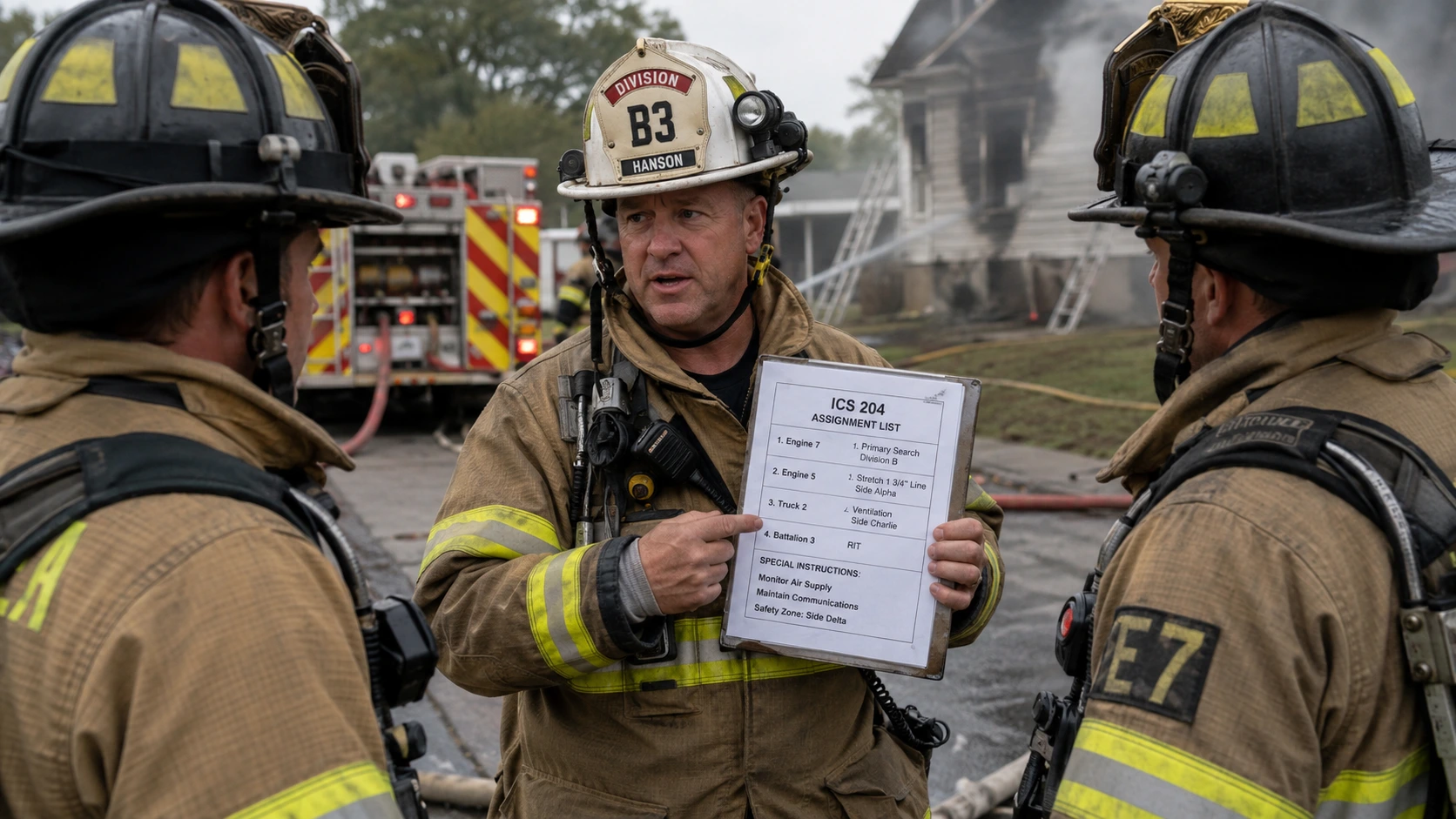
The ICS 204 is the most operationally critical form in the field. It is the document that a Division Supervisor holds in their hand when they check in resources and give assignments. Every engine, truck, rescue unit, crew, or specialist assigned to a division or group is listed on the ICS 204 by resource designator, leader name, and number of personnel. That personnel count is the accountability baseline — if everyone does not come back at the end of the operational period, the ICS 204 tells the incident commander exactly who is missing.
The work assignment section is where tactical direction becomes written instruction. “Division A — Conduct primary search and attack on floors 3 and 4, protect stairwell B egress” is the kind of assignment that belongs on the ICS 204. Vague assignments create freelancing. Written assignments create accountability.
The ICS 204 also captures the communications channels assigned to the division or group, which connects it directly to the ICS 205. A division supervisor who does not know what channel to use for tactical communications is a liability in any incident. The ICS 204 eliminates that ambiguity.
Special instructions at the bottom of the ICS 204 are where the supervisor records safety concerns specific to that division, coordination requirements with adjacent divisions, and any tactical notes that could not fit in the work assignment field. Division supervisors are expected to brief their assigned resources from the ICS 204 at the start of each operational period and to retain their copy throughout the period.
ICS 205 — Radio Communications Plan
Incident Radio Communications Plan
Who fills it: Communications Unit Leader • When: Each operational period • Purpose: Document all radio channels assigned to the incident, their functions, frequencies, tone squelch settings, and any special instructions
Radio communication failures are one of the most consistently identified contributing factors in firefighter line-of-duty deaths. The ICS 205 exists to eliminate ambiguity about who is talking on what channel and why. It assigns a named channel to every function on the incident: command, tactical divisions, air operations, medical, logistics, and any other function that needs dedicated radio coverage.
The form captures receive and transmit frequencies separately because simplex and repeater operations use different configurations. It records the mode (FM or AM), tone squelch requirements, and any access codes needed for trunked radio systems. A responder arriving from a mutual aid agency with different radio equipment needs to be able to look at the ICS 205 and program their radio to the correct channels before they go to work.
The ICS 205 is usually distributed as part of the IAP package and is also posted at the incident command post and staging area. On large incidents, it may be laminated and attached to each crew's assignment card. The Communications Unit Leader updates it each operational period to reflect any channel changes, additional frequencies added as the incident grows, or channels deactivated as sections demobilize.
A common failure on the ICS 205 is having channels assigned on paper that are not actually programmed into the radios on scene. Communications unit leaders should verify radio programming against the ICS 205 at the beginning of each operational period rather than assuming that units arriving from other jurisdictions have the channels loaded.
ICS 206 — Medical Plan
Medical Plan
Who fills it: Medical Unit Leader, Safety Officer • When: Each operational period • Purpose: Document medical aid station locations, hospital routing, ambulance availability, and emergency procedures for responder injuries
The ICS 206 is the medical plan for incident personnel — not for civilian patients, but for the responders working the incident. It identifies where medical aid stations are located on the incident, what level of care is available at each station (ALS or BLS), whether transport is available, which hospital will receive injured responders, and what the emergency procedures are if a responder is injured or becomes ill on scene.
The hospital section of the ICS 206 captures the primary receiving hospital's name, address, trauma designation, and direct phone number to their emergency department. An alternate hospital is also listed. On large incidents, a medical branch director may coordinate multiple ambulance providers and air medical resources whose availability is also documented on the ICS 206.
The emergency procedures section is the most critical part of the form for line-of-fire personnel. It describes what a division supervisor or crew leader should do if a responder is injured: who to notify, what radio channel to use, what the transport plan is, and what medical interventions might be expected on scene. These procedures should be briefed to all personnel at the start of each operational period, not just filed in the IAP binder.
The ICS 206 is signed by the Safety Officer, which reflects the integration of the medical plan into the incident safety program. On incidents involving significant health hazards — hazmat, high heat, heavy smoke, long operational periods — the ICS 206 may also reference rehabilitation protocols and medical monitoring requirements.
ICS 213 — General Message
General Message
Who fills it: Any ICS personnel • When: Any time a message needs to be transmitted in writing between positions • Purpose: Provide a written record of any message, request, or notification that should not be transmitted by radio or left verbal
The ICS 213 is the incident's paper-based messaging system. Any information that is too complex for radio, too sensitive for open-channel transmission, or too important to leave verbal belongs on an ICS 213. Resource requests, status updates, notifications to agency administrators, and situation reports sent between incident sections are all documented on the ICS 213.
The form is simple: a header block identifying sender, recipient, subject, date, and time, followed by a message body, and a reply section at the bottom. Originals are retained by the sender; copies go to the recipient and to the documentation unit. On large incidents, the ICS 213 log becomes an essential reconstruction tool for timeline analysis after the fact.
The ICS 213 is also the standard format for resource orders sent from a field incident to a dispatch center or emergency operations center. When a division supervisor needs to order additional units, that request goes on an ICS 213, is transmitted through the logistics section, and is tracked through fulfillment. That paper trail is what allows resource tracking to remain accurate on a large, fast-moving incident.
One practical use that many field firefighters overlook is the ICS 213 as a reply mechanism. The form has a “reply required” field and a reply section at the bottom. When the incident commander needs a written response to a specific request — not just a radio acknowledgment — the ICS 213 enforces that written response and creates a record of both the request and the answer.
ICS 214 — Unit Activity Log
Unit Activity Log
Who fills it: Unit leader or individual responder • When: Throughout the operational period • Purpose: Create a chronological record of a unit's activities, personnel roster, and notable events
The ICS 214 is the operational diary of a unit, section, or branch during an incident. It captures the unit's personnel roster, lists the individual activities in chronological order with time stamps, and records any notable events or safety issues that occurred during the operational period. Every unit operating at a significant incident should maintain an ICS 214.
The personnel roster section is where individual accountability lives at the unit level. Every person assigned to the unit is listed by name and ICS position. This information is what allows the accountability system to function if a mayday is transmitted — the unit leader knows exactly who they have and can confirm accountability without searching their memory.
The activity log section should be updated in real time, not reconstructed at the end of the shift. Time-stamped entries like “0715 — Deployed to Division A, began primary search floors 3 and 4” and “0742 — Primary search complete floors 3 and 4, no victims found” create the documentary record of what happened and when. That record is legally significant in any proceeding involving responder injury, civilian death, or property damage claims related to the incident.
The notable events section at the bottom of the ICS 214 is where safety issues, near-misses, equipment failures, accountability problems, and any other significant incidents within the unit's operational period are recorded. These entries are the raw data for after-action reviews and for the incident safety officer's post-incident analysis. A culture of thorough ICS 214 documentation is a culture that can actually learn from incidents.
📋 ICS Forms Generator — Fill and Print in Seconds
Enter your master incident information once and generate printable ICS 201, 202, 204, 205, 206, 213, 214, and 215 forms with standard NIMS layout. Built for training exercises, tabletop scenarios, and field reference. No login, no download required.
Open ICS Forms Generator →ICS 215 — Operational Planning Worksheet
Operational Planning Worksheet
Who fills it: Operations Section Chief, Planning Section Chief • When: Tactics Meeting / Planning Meeting before each operational period • Purpose: Document the Operations Section Chief's decisions on work assignments and resource needs for the next operational period
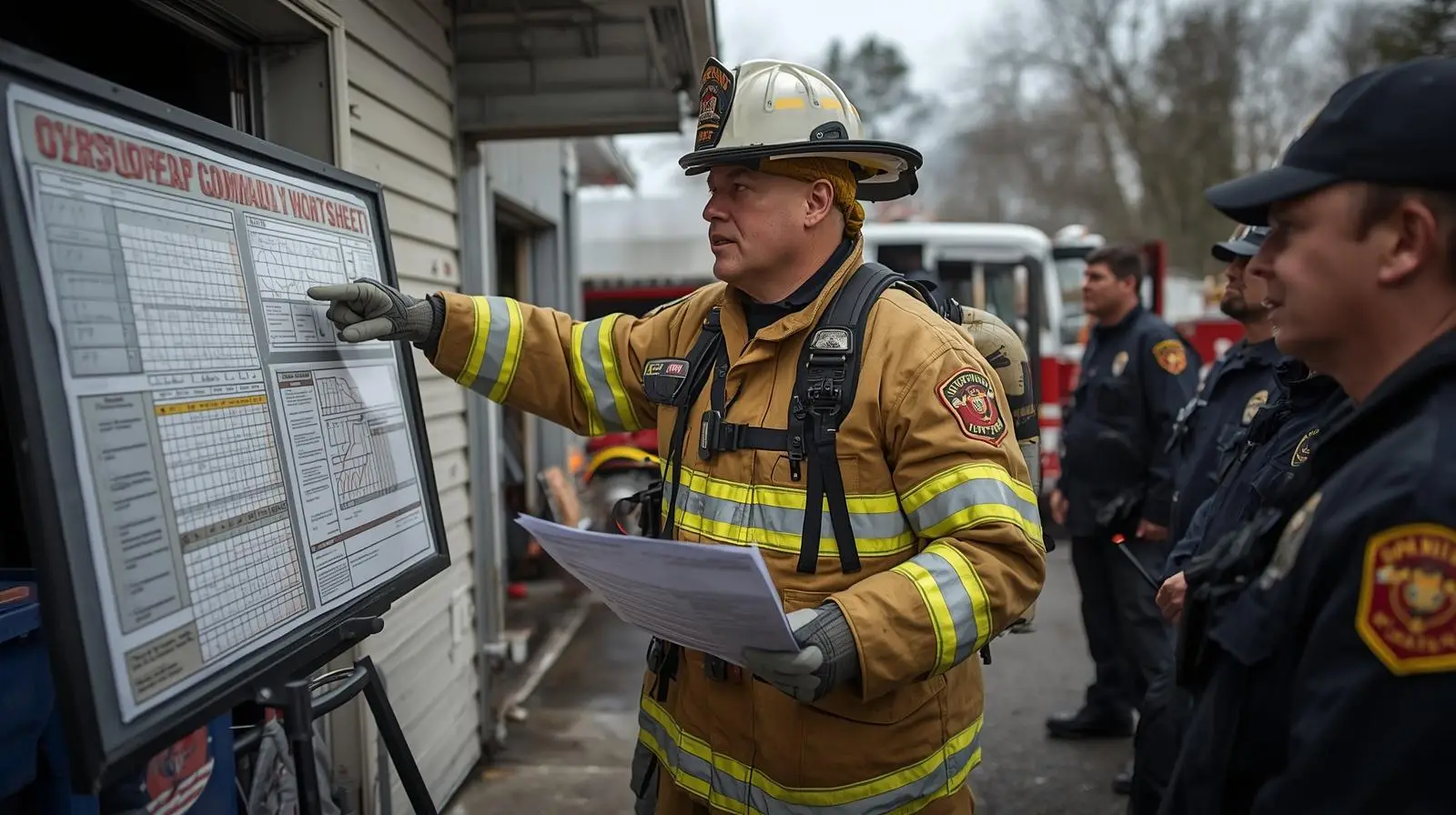
The ICS 215 is the bridge between the tactics meeting and the formal IAP. It is completed during or immediately after the tactics meeting — the session where the Operations Section Chief lays out the work assignments for each division and group in the next operational period and identifies what resources are needed to execute those assignments.
The form captures each division or group by name, the specific work assignment for that geographic or functional area, and the resources required to complete it. Resources are listed by type and quantity: three Type 1 engines, two water tenders, one aerial ladder. The ICS 215 is not a resource request form in itself, but the resource needs it identifies feed directly into the logistics section's ordering process.
The ICS 215 also captures the next operational period's timeframe and the Operations Section Chief's overall control objectives — the containment or suppression goals that the work assignments are designed to achieve. Those objectives then translate into the numbered objectives on the ICS 202 for the next operational period.
On complex incidents, the ICS 215 is completed in a formal tactics meeting attended by the Operations Section Chief, the Planning Section Chief, the Logistics Section Chief, and the Safety Officer. The Safety Officer uses the ICS 215 as the basis for completing the ICS 215A (Incident Action Plan Safety Analysis), which identifies the hazards associated with each work assignment and the controls that will be applied. Together, the ICS 215 and 215A ensure that operational planning and safety planning happen in the same meeting rather than in separate silos.
How ICS Forms Build the Incident Action Plan
The Incident Action Plan (IAP) is not a single document — it is a package of ICS forms assembled at the end of the planning cycle for each operational period and distributed to all supervisors before the period begins. For a well-run incident, the minimum IAP package contains the ICS 202, ICS 203 (Organization Assignment List), ICS 204 (one per division or group), ICS 205, and ICS 206. Large incidents may also include maps, weather forecasts, and agency-specific attachments.
| Form | Title | Section Responsible | In Minimum IAP? |
|---|---|---|---|
| ICS 201 | Incident Briefing | Command | Initial briefing only |
| ICS 202 | Incident Objectives | Planning | Yes |
| ICS 203 | Organization Assignment List | Planning / Resources Unit | Yes |
| ICS 204 | Assignment List | Planning / Resources Unit | Yes (one per Division/Group) |
| ICS 205 | Radio Communications Plan | Logistics / Communications Unit | Yes |
| ICS 206 | Medical Plan | Logistics / Medical Unit | Yes |
| ICS 213 | General Message | Any position | No (retained in documentation) |
| ICS 214 | Unit Activity Log | Unit leaders | No (retained by unit) |
| ICS 215 | Operational Planning Worksheet | Operations / Planning | No (internal planning tool) |
The planning cycle that produces each IAP follows a standard sequence. The situation status briefing establishes where the incident stands. The tactics meeting produces the ICS 215. The planning meeting assembles the ICS 202, 204, 205, and 206 from the decisions made in the tactics meeting. The Operations Section Chief and Incident Commander approve the IAP. The completed package is printed and distributed to all division supervisors, branch directors, and section chiefs before the operational period begins.
On incidents where an IAP cannot be completed before the operational period begins — a rapidly developing incident in its first hours, for example — an abbreviated IAP consisting of at minimum the ICS 202 and ICS 205 should be distributed as quickly as possible. A verbal briefing does not substitute for a written IAP on any incident that will last more than one operational period.
Common ICS Documentation Mistakes
Firefighters who are new to ICS documentation frequently make the same errors. Understanding these mistakes before they happen is one of the benefits of ICS 300 and 400 training, but field experience is where they most consistently appear.
Reconstructing forms after the fact. The ICS 214 in particular is often filled out at the end of a shift from memory rather than updated in real time. Memory is unreliable under operational stress. Time stamps recorded hours after the fact are not reliable documentation. The discipline of real-time logging must be practiced in training drills before it becomes automatic under incident conditions.
Vague objectives on the ICS 202. Objectives that cannot be measured cannot be evaluated. If the ICS 202 objective cannot be answered with “achieved” or “not achieved” at the end of the operational period, it was not written as an objective — it was written as a hope. Planning Section Chiefs should review every ICS 202 objective for measurability before the form is signed by the Incident Commander.
Assignment lists that do not match resources on scene. When units arrive or depart mid-operational period without the ICS 204 being updated, the accountability system breaks down. Resources Unit Leaders must maintain a live resource tracking system that stays synchronized with the ICS 204 copies held by division supervisors. This requires disciplined check-in and check-out procedures enforced by staging.
Radio plans that are not verified. An ICS 205 that lists channels not programmed into the radios on scene is worse than useless — it creates false confidence. Every time a new ICS 205 is issued, the Communications Unit Leader should verify with division supervisors that assigned units have the channels programmed and operational before the period begins.
Medical plans without current hospital information. Hospital trauma designations, bypass status, and phone numbers change. An ICS 206 pulled from a previous incident's IAP package and used without verification could send an injured firefighter to the wrong facility. Medical Unit Leaders should verify hospital availability and contact information at the beginning of every operational period rather than carrying forward information from prior periods.
Key Points
- The ICS 201 is the initial briefing document — the first form used on any incident that grows beyond a single-resource response. It feeds the formal planning process.
- The ICS 202 contains the incident objectives. Objectives must be SMART and must be signed by the Incident Commander before the operational period begins.
- The ICS 204 is the accountability document for each division or group. Personnel listed on it are the accountability baseline — everyone must return or be accounted for at the end of the period.
- The ICS 205 documents every radio channel on the incident. It must be verified against actual radio programming, not just distributed and filed.
- The ICS 206 is the medical plan for responders — distinct from EMS operations for civilian patients. It should be briefed to all personnel at the start of each operational period.
- The ICS 213 creates a written record of messages, requests, and notifications that should not be left verbal or transmitted over open radio channels.
- The ICS 214 is the unit activity log. It should be updated in real time, not reconstructed from memory at the end of the shift.
- The ICS 215 is the operations section's planning tool, completed during the tactics meeting. It feeds the ICS 202 objectives and the ICS 204 assignments for the next operational period.
- The minimum IAP package for any multi-period incident includes ICS 202, 203, 204 (per division), 205, and 206. Verbal briefings do not substitute for a written IAP.
References
- FEMA — ICS Forms, current edition (training.fema.gov)
- NIMS Integration Center — National Incident Management System, 2017 edition (fema.gov)
- NFPA 1561 — Standard on Emergency Services Incident Management System and Command Safety, current edition
- NWCG — Incident Command System Forms (nwcg.gov/ics-forms)
- U.S. Fire Administration — ICS-200: Basic ICS for Initial Response (usfa.fema.gov)
- IFSTA — Incident Command System for Emergency Medical Services, current edition
Comments 0
No comments yet. Be the first to share your thoughts!
Leave a Comment