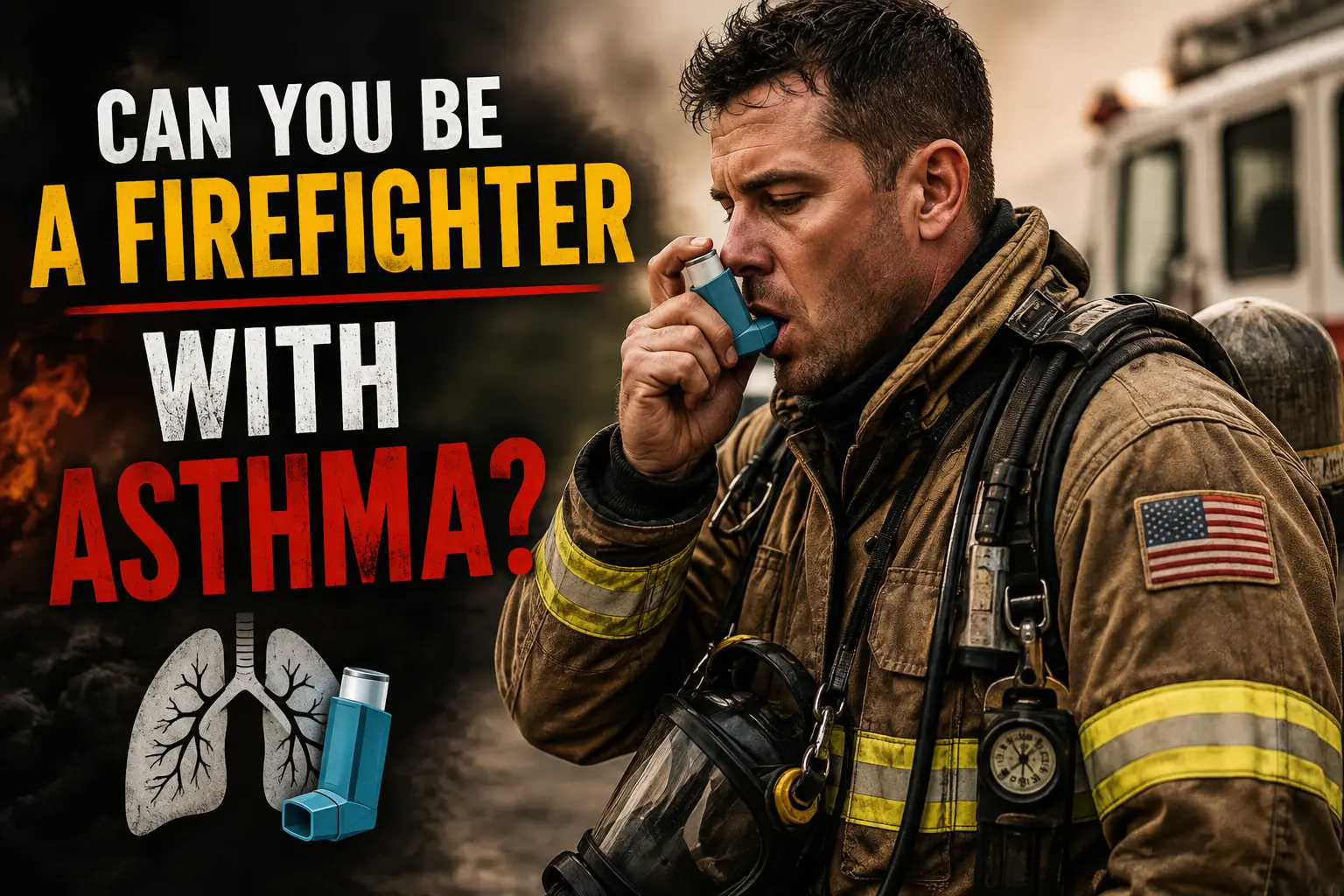
Short answer: Asthma is not an automatic disqualification, but it also isn't a non-issue. Under NFPA 1582 — the medical standard most U.S. fire departments use — a history of asthma that has required bronchodilator or corticosteroid treatment within the past two years is treated as a disqualifying condition by default. The way around that is a negative bronchoprovocation challenge test (methacholine, cold-air, or exercise challenge) combined with no recent bronchospasm off medication, which can demonstrate to a department's medical officer that you don't have clinically significant airway hyperreactivity. Mild, well-controlled, or childhood asthma that's fully resolved is generally much less of an obstacle than active, medicated asthma.
Important: NFPA 1582 is a voluntary standard, not federal law, and individual departments — especially smaller or volunteer ones — can and do set their own criteria. This article explains how the standard is typically applied; it isn't medical or legal advice, and your outcome depends on your own medical history and the specific department's occupational physician.
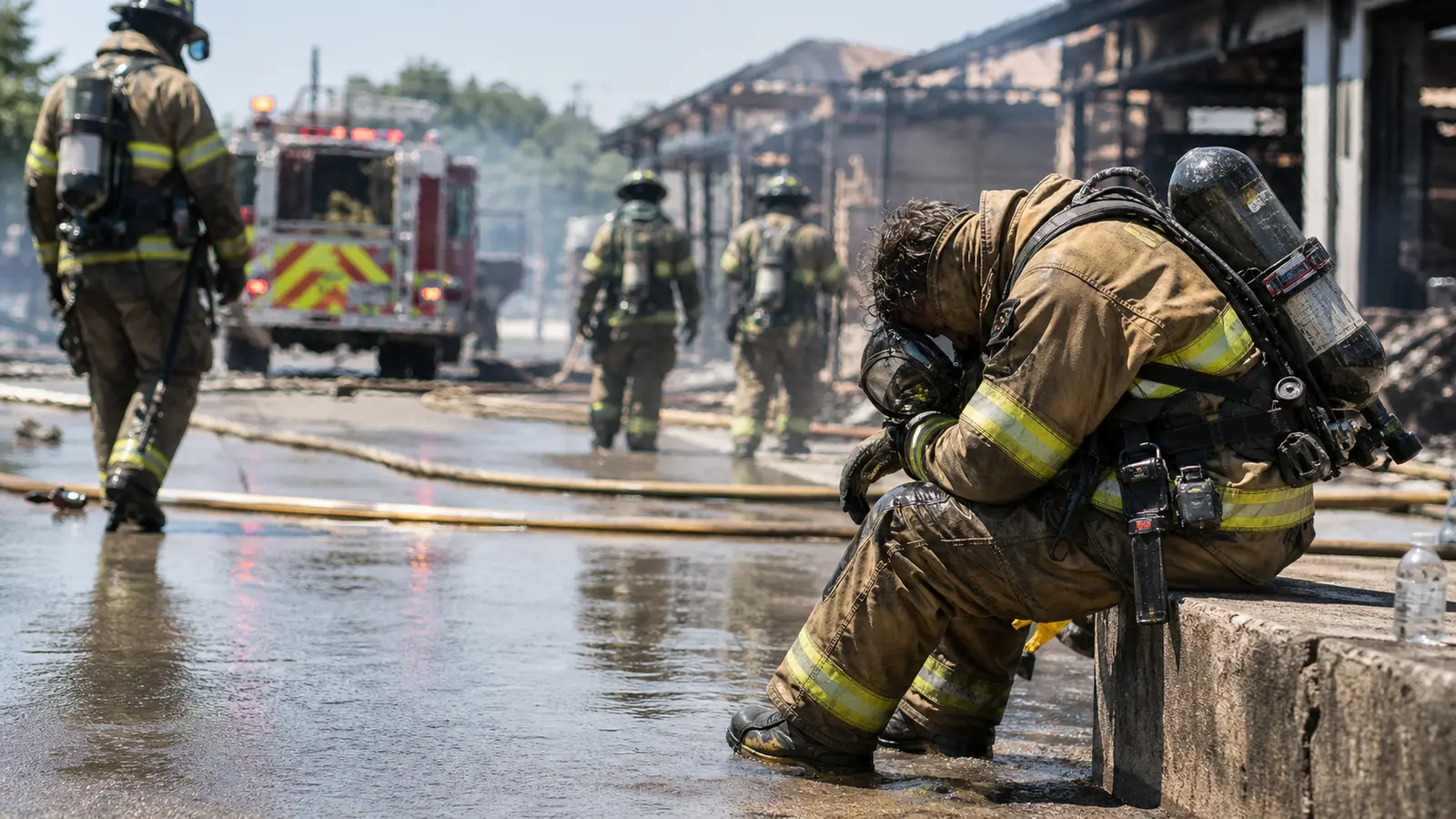
Firefighting puts extraordinary demands on the lungs: heavy exertion in full turnout gear, breathing cold, dry compressed air through an SCBA, and exposure to smoke, combustion byproducts, and other airborne irritants that can trigger bronchospasm even in people without a diagnosed respiratory condition. That's exactly why asthma gets so much scrutiny in the pre-employment medical evaluation — and why the honest answer to "can you be a firefighter with asthma" is "it depends on how well-documented and how well-controlled it is," not a flat yes or no.
What NFPA 1582 Actually Says About Asthma
NFPA 1582, Standard on Comprehensive Occupational Medical Program for Fire Departments, is the reference most U.S. fire departments use to structure their candidate and incumbent medical evaluations. It isn't enforced by any federal agency and departments aren't legally required to follow it — but it's widely adopted as the industry benchmark, and many state and local regulations point back to it. The standard sorts medical conditions into categories based on how directly they threaten a firefighter's or the public's safety if the condition causes sudden incapacitation on the job.
Asthma specifically is defined in the standard as "reactive airways disease requiring bronchodilator or corticosteroid therapy in the previous 2 years," and it's listed among the conditions a department's physician should treat as disqualifying by default. The standard also spells out an objective, obstructive-lung-disease threshold: an FEV1/FVC ratio under 0.75, with both FEV1 and FVC below 80% of predicted values, is treated as disqualifying regardless of diagnosis label. In plain terms, if your lung function testing shows meaningfully reduced airflow, that alone can be enough — you don't need a formal asthma diagnosis on your chart for it to matter.
The Escape Valve: Bronchoprovocation Challenge Testing
Here's the part most general career-advice articles skip: NFPA 1582 explicitly provides a path to clear the asthma disqualification even if you've been diagnosed and treated in the past. If a candidate has a history of asthmatic symptoms or bronchospasm, the standard allows a negative bronchoprovocation challenge test — using methacholine, cold-air, or exercise as the trigger — combined with no recent episode of bronchospasm while off medication, to serve as objective evidence that the person does not have clinically significant airway hyperreactivity.
In practice, this usually means: baseline spirometry (measuring FEV1 and FVC) is taken first, then the candidate is challenged — for example, by exercising to 70–85% of predicted maximum heart rate on a treadmill, or inhaling incrementally stronger doses of methacholine — while lung function is remeasured at intervals afterward. A drop in FEV1 of 20% or more from baseline is generally considered a positive (abnormal) result; a smaller drop, or none at all, supports a negative test. The standard also notes this testing should be performed off medication, should never be attempted in someone who already has moderate-to-severe pulmonary dysfunction (since it could trigger a dangerous bronchospasm), and shouldn't be repeated annually once cleared — only if clinically indicated.
| Your situation | Typical treatment under NFPA 1582 |
|---|---|
| Diagnosed with childhood asthma, no symptoms, no medication for years, normal spirometry | Generally low risk of disqualification; a normal exam and history are usually sufficient, though some physicians still request a challenge test. |
| Occasional rescue inhaler use (e.g., seasonal or exercise-triggered), no oral steroids, within the past 2 years | Presumed disqualifying by the letter of the standard, but commonly clearable with a negative bronchoprovocation challenge test and normal spirometry. |
| Daily controller inhaler (inhaled corticosteroid) or regular oral steroid use | Significant obstacle; both the underlying asthma and the medication itself (see below) will be scrutinized, and this is the profile least likely to pass. |
| Reduced FEV1/FVC ratio or below-normal spirometry, regardless of asthma label | Objectively disqualifying under the standard's obstructive lung disease threshold, independent of diagnosis or symptoms. |
Can Your Asthma Medication Itself Disqualify You?
Potentially, yes — separately from the underlying condition. NFPA 1582 also defines medications that can raise concerns on their own. Long-term or high-dose corticosteroid use (like prednisone), sometimes prescribed for more severe asthma, can weaken muscle, bone, and connective tissue over time, which matters for a physically demanding job. And carrying a rescue inhaler isn't itself disqualifying — many firefighters do — but the standard notes that bronchodilator medications aren't approved or intended as maintenance therapy to control symptoms in the irritant environment of a fireground or hazmat scene. If a candidate's reliance on a rescue inhaler suggests the underlying asthma isn't actually well-controlled, that becomes a red flag during the evaluation rather than a simple accommodation.
Wildland Firefighters and Smokejumpers Face an Even Higher Bar
If your goal is a federal wildland firefighting position — hotshot crews, smokejumpers, or other "arduous duty" roles with agencies like the U.S. Forest Service — expect pulmonary standards to be applied at least as strictly, if not more so, since these roles combine sustained heavy exertion at altitude with heavy smoke exposure over multi-day assignments, without the same access to SCBA that structural firefighters use. The medical clearance and work capacity testing (the well-known "pack test") for arduous wildland roles is separate from a structural department's NFPA 1582 exam, so if you're targeting a federal wildland position specifically, ask that agency directly about its own pulmonary and medical clearance requirements rather than assuming a structural department's standard applies.
What Happens If a Department Says No
A few practical realities worth knowing:
- ✓NFPA 1582 is a guideline, not a law. Departments set their own hiring criteria and aren't obligated to follow the standard exactly; some are stricter, some are more flexible, especially smaller volunteer departments.
- ✓Individualized assessment matters. A blanket "anyone who's ever used an inhaler is disqualified" policy, without an individualized medical evaluation, can run into problems under disability discrimination law in some jurisdictions — but this is a legal question specific to your situation and locality, not something a general guide can resolve for you.
- ✓Get your own records together before you apply. A clear timeline — diagnosis date, last time you used a rescue inhaler, last time you had a documented asthma attack, current spirometry — makes it much easier for an occupational physician to evaluate you fairly and quickly.
- ✓Ask about the challenge test up front. If you have a history of asthma but believe it's resolved or well-controlled, ask the hiring department's medical provider whether a bronchoprovocation challenge test is available as part of your evaluation — it's the specific mechanism NFPA 1582 provides for exactly this situation.
- ✗Don't hide your history and hope it doesn't come up. A candidate who has needed asthma medication but doesn't believe they truly have asthma is generally expected to demonstrate that through testing, not simply omit the history — and an incumbent firefighter who develops symptoms on the job is usually in a much stronger position if their medical history was accurate from day one.
The realistic takeaway: if your asthma was mild, childhood-onset, and you haven't needed medication in years, it's unlikely to be the thing that keeps you out of the academy. If you're currently using a daily controller inhaler or have needed oral steroids recently, it's a real obstacle worth discussing honestly with a physician and the hiring department before you invest time and money in the application process — not something to find out about after you've already completed the academy.
This article explains how NFPA 1582 is generally applied and is intended for general education, not as medical or legal advice. Every department's medical program, every candidate's history, and the applicable disability and employment law in your state can all change the outcome — talk to an occupational physician and the specific department you're applying to for guidance on your individual situation.

Comments 0
No comments yet. Be the first to share your thoughts!
Leave a Comment