Firefighter Turnout Gear Guide: Coat, Pants, Layers & How to Choose Structural PPE
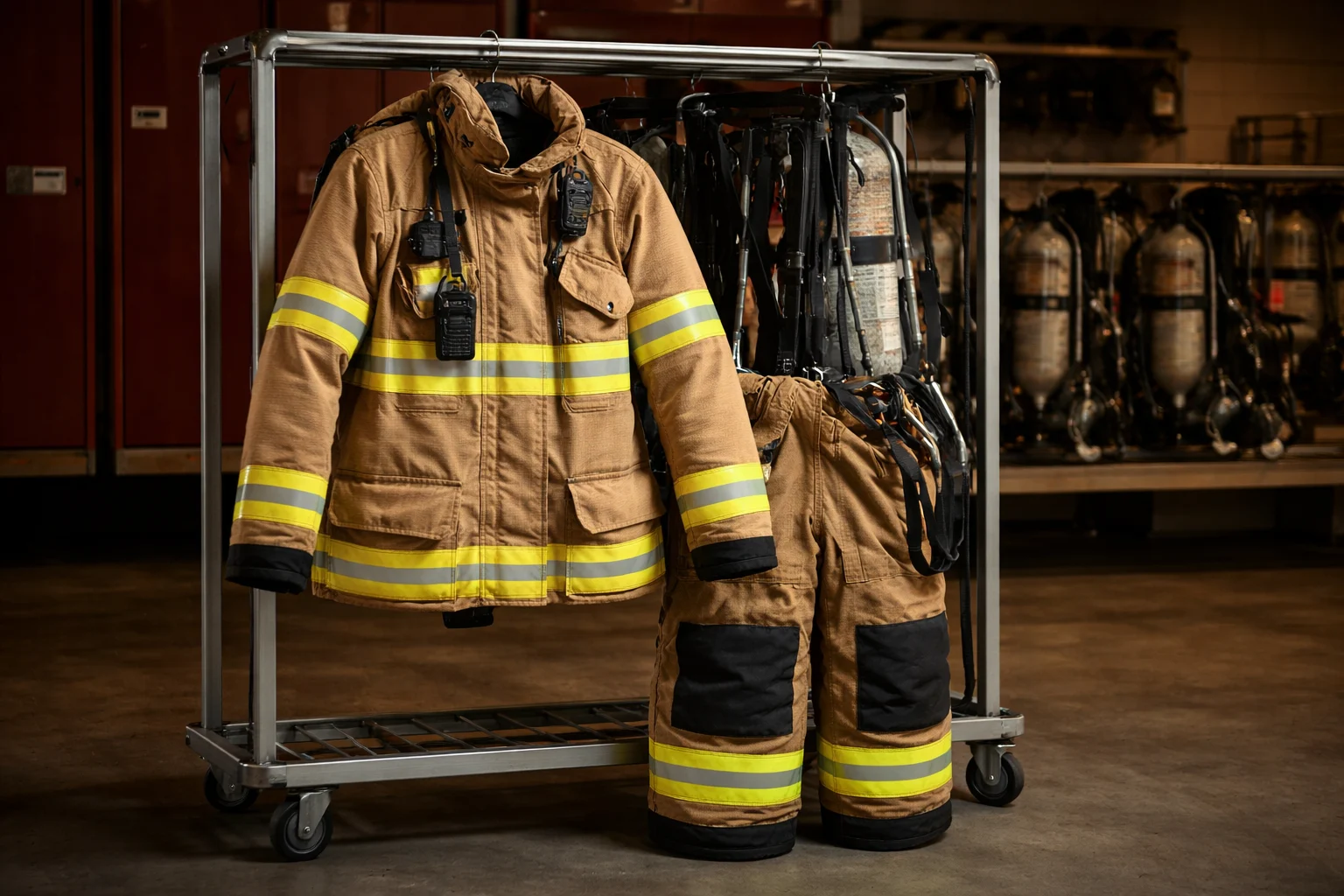
Structural firefighting protective clothing — commonly called turnout gear, bunker gear, or PPE — is your primary defense against heat, flame, steam, water, chemical contamination, and the carcinogens present in fire smoke. The right gear keeps you alive and working; the wrong gear or gear in poor condition can fail when you need it most. This guide covers what NFPA 1971 requires, how the three-layer system works, what to evaluate when selecting gear, and a comparison of the major manufacturers and systems in the U.S. fire service.
Jump to:NFPA 1971 requirements · The three-layer system · Outer shell · Moisture barrier · Thermal liner · Fit, sizing and mobility · Major manufacturers · Gear comparison · Contamination and decontamination · Inspection and retirement · FAQ
NFPA 1971: What the Standard Requires
NFPA 1971 (Standard on Protective Ensembles for Structural Fire Fighting and Proximity Fire Fighting) sets minimum performance requirements for all structural firefighting PPE sold in the U.S. Turnout gear that does not carry NFPA 1971 certification should not be worn in interior structural operations. Key performance tests under the standard:
- Thermal protective performance (TPP): Measures the total heat protection of the combined system (outer shell + moisture barrier + thermal liner). Minimum TPP rating of 35 cal/cm² under NFPA 1971. Higher TPP means more time before a firefighter sustains a second-degree burn from radiant and convective heat.
- Total heat loss (THL): Measures heat and moisture transfer through the system — essentially, how breathable the gear is. A higher THL means the gear allows body heat to escape more easily, reducing physiological heat strain. Minimum THL of 205 W/m² under NFPA 1971. TPP and THL exist in tension: thicker, more protective gear typically has lower THL (less breathable).
- Flame resistance: All fabric layers must resist sustained flame contact without igniting, melting, dripping, or propagating flame.
- Tear and puncture resistance: The outer shell must resist physical damage from tools, debris, and structural elements.
- Liquid penetration resistance: The moisture barrier must prevent liquid penetration including water, blood-borne pathogens, and certain chemicals.
- Retroreflective trim: Minimum 4.57 cm (1.8 in) wide retroreflective trim bands on the coat and pants for visibility.
The Three-Layer System
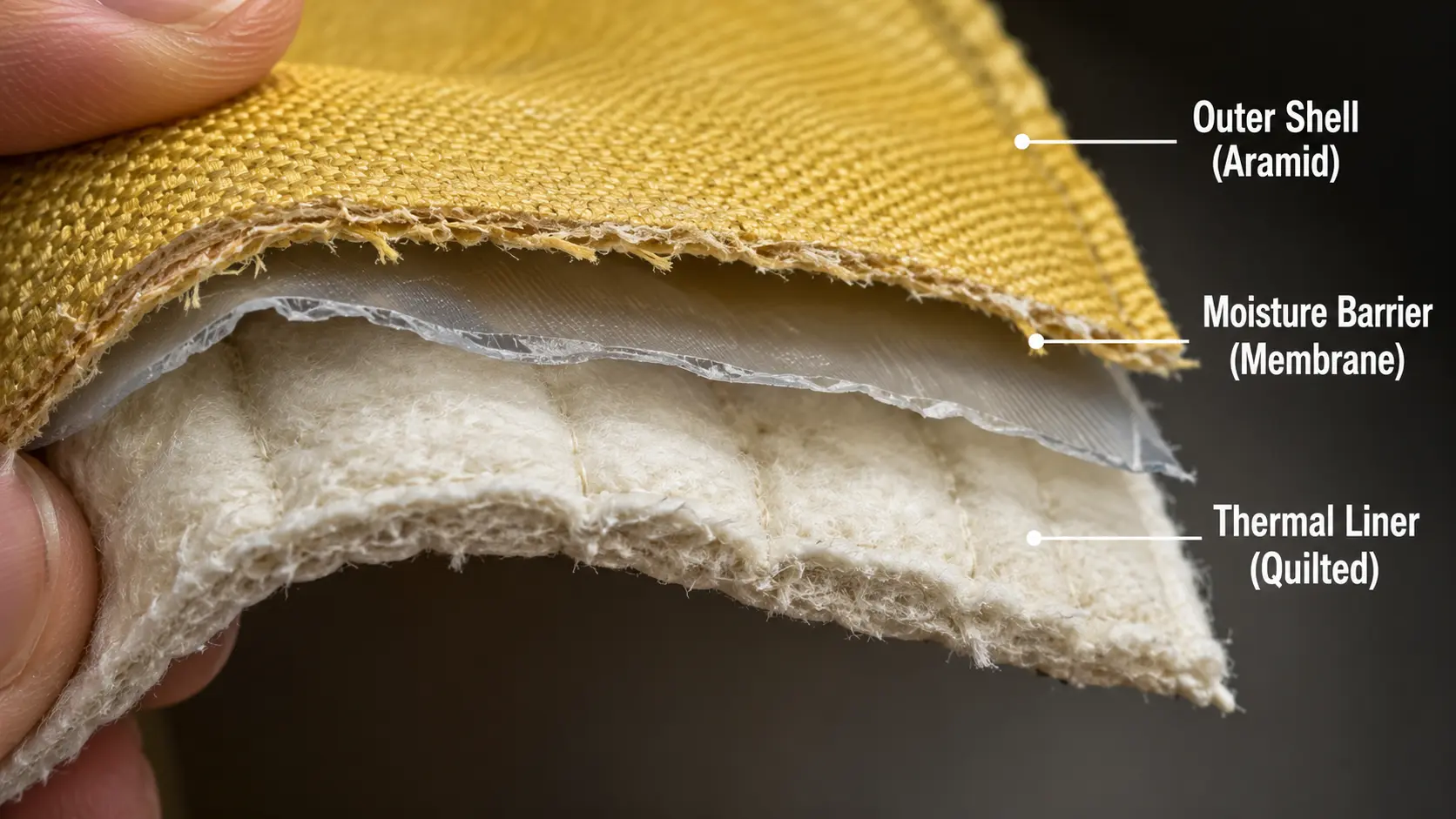
NFPA 1971 structural PPE uses a three-layer composite construction. Each layer serves a distinct protective function, and the system only achieves its rated performance when all three layers are worn together in proper orientation:
Layer 1: Outer Shell
The outer shell is the exterior fabric that contacts the fireground environment directly. It provides the first line of defense against flame, heat, abrasion, cuts, and liquid contamination.
Common outer shell fabrics
| Fabric | Manufacturer | Key properties | Trade-offs |
|---|---|---|---|
| Nomex® NXT | DuPont | Aramid fiber; excellent flame resistance; good abrasion resistance; lighter weight options available | Less tear resistance than some alternatives; can degrade with contamination over time |
| PBI® Gold | PBI Performance Products | PBI/Kevlar® blend; very high char resistance; does not melt or drip; excellent heat resistance | Heavier than Nomex; higher initial cost; slightly stiffer |
| Kevlar®/PBI blend | DuPont + PBI | Combines Kevlar tear strength with PBI thermal stability; very durable outer shell | Weight and cost premium over Nomex |
| Millenia® (TenCate) | TenCate Protective Fabrics | Lightweight aramid blend with improved THL; growing adoption for high-activity environments | Newer fabric with less long-term field data than established alternatives |
| Defender M® (DuPont) | DuPont | High-performance aramid blend; designed for improved breathability while maintaining NFPA 1971 TPP | Premium price point |
Outer shell color and contamination: Lighter-colored outer shells (tan, khaki) are increasingly popular because soot contamination is more visible — which prompts more frequent cleaning. Dark navy outer shells hide contamination, which can result in gear not being cleaned when it should be. From a cancer prevention standpoint, visible contamination on lighter gear may actually be a safety advantage.
Layer 2: Moisture Barrier
The moisture barrier (also called the vapor barrier or liquid barrier) is the middle layer that prevents liquid water, steam, and liquid-borne contaminants from reaching the firefighter's body while allowing water vapor (sweat) to escape outward. This combination — blocking liquid in while allowing vapor out — is what makes modern turnout gear both protective and physiologically manageable.
Common moisture barrier systems
- CROSSTECH® (DuPont): ePTFE membrane laminated to a substrate fabric. Excellent liquid penetration resistance; good vapor transmission. The most commonly specified moisture barrier in the U.S. fire service. Available in Black Label (blood-borne pathogen) and standard versions.
- Gore® Crosstech® Black: Enhanced version with improved chemical resistance and blood-borne pathogen protection. Specified for departments with significant EMS exposure.
- Stedair® (TenCate/Stedfast): ePTFE-based moisture barrier with competitive THL performance. Alternative to CROSSTECH in some manufacturer offerings.
Layer 3: Thermal Liner
The thermal liner is the innermost layer, providing the primary insulation against heat transfer to the firefighter's skin. It also wicks moisture away from the body and provides some comfort and tactile protection. The thermal liner contributes the most to the overall TPP rating of the system.
Common thermal liner systems
- Caldura® SL (Gentex): High loft aramid batting for excellent TPP with manageable weight. Among the most common thermal liner systems in U.S. turnout gear.
- Aralite® (Gentex): Lightweight alternative with good TPP; specified by manufacturers seeking higher THL (more breathable) systems.
- Kombat Flex (TenCate): Quilted liner design for improved mobility and reduced restriction. Growing specification in European-influenced gear systems.
- Breathe-Tex® Plus: Quilted liner with enhanced moisture management and improved THL performance.
Fit, Sizing, and Mobility
Turnout gear that does not fit correctly is dangerous in two directions: gear that is too large allows heat and flame to reach the body at gaps; gear that is too small restricts mobility, causes fatigue, and may leave gaps at wrists, collar, or cuffs when arms are raised. Key fit checkpoints:
- Raised arm test: With the coat fully fastened, raise both arms overhead fully. The coat should not pull up from the pants waist, the collar should not pull down from the neck, and the wrist cuffs should not expose skin at the wrist. If any of these occur, the coat is too short or too small.
- Coat-pants overlap: With both pieces donned, the coat hem should overlap the pants bib by at least 8 inches when the arms are raised. This ensures no gap at the waist during dynamic movement.
- Knee and hip mobility: With the pants on, walk, climb a step, and kneel. The pants should accommodate full range of motion without binding at the knee or hip. Insufficient pants length will restrict stride and kneel depth.
- Collar and throat protection: The collar should fully cover the throat and back of the neck when raised. A gap between the helmet earflap and the coat collar at the neck creates an unprotected zone for heat and debris entry.
- Wrist protection integration: The coat sleeve should extend to meet your glove cuff with the arm fully extended. The sleeve and glove must overlap sufficiently to prevent wrist exposure when reaching.
Custom vs. stock sizing: Most major manufacturers offer both stock (standard) sizing and custom-measured gear. Custom-measured gear fits better, performs better, and reduces fatigue. If your department provides a gear budget that allows custom sizing, take advantage of it — the performance and comfort difference over a career is significant.
Major Turnout Gear Manufacturers
Globe Manufacturing
Founded: 1887 | Made in: Pittsfield, New Hampshire, USA
Key systems: Globe G-Xtreme, Globe Athletix, Globe Guardian. Globe is one of the two dominant U.S. structural turnout manufacturers. Known for quality construction and extensive customization options. Strong dealer network for measuring and fitting.
Fabric combinations: Offers outer shell options including PBI Gold, Defender M, Nomex NXT, and proprietary blends with CROSSTECH and Stedair moisture barriers.
Price range: Complete coat and pants: $2,500–$4,500 depending on fabric selection and options.
Morning Pride (Honeywell)
Manufacturer: Honeywell Safety Products | Made in: Dayton, Ohio, USA
Key systems: BRT (Breakthrough), Viper (entry-level), and custom-built systems for large department contracts.
Fabric combinations: Nomex NXT, PBI Gold, and proprietary fabric combinations. CROSSTECH Black moisture barriers standard on most systems.
Price range: Complete coat and pants: $2,400–$4,200.
Lion Apparel (NFPA PPE)
Made in: Dayton, Ohio, USA
Key systems: Lion Stalker, Lion Nomex, Lion Quantum. Known for innovative design features including QuickDraw suspenders, anti-contaminant liner options, and integrated drag rescue device pockets.
Fabric combinations: Wide outer shell selection. Known for strong integration of anti-contaminant liner options as an additional fourth layer for carcinogen reduction.
Price range: Complete coat and pants: $2,600–$4,800.
Veridian (formerly Fire-Dex)
Made in: Medina, Ohio, USA
Key systems: HD Series, Tri-Cert, and station-to-structural transitions. Growing manufacturer with strong presence in Midwest departments. Known for competitive pricing at NFPA 1971 performance levels.
Price range: Complete coat and pants: $2,200–$3,800.
PGI / Securitex
Made in: Various; some domestic, some international
Key systems: Budget-focused NFPA 1971 compliant gear. Often specified by volunteer departments and smaller agencies with tighter gear budgets.
Price range: Complete coat and pants: $1,600–$2,800.
What to Compare When Evaluating Gear Systems
| Factor | What to look for | Why it matters |
|---|---|---|
| TPP rating | ≥35 cal/cm² (NFPA minimum); higher is more protective but less breathable | More TPP = more time before burn injury; critical for prolonged interior exposure |
| THL rating | ≥205 W/m² (NFPA minimum); higher = more breathable | Higher THL reduces physiological heat strain; critical for high-activity departments |
| Outer shell fabric | PBI for maximum thermal stability; Nomex/aramid blends for lighter weight | Shell determines abrasion resistance, durability, and heat resistance at contact |
| Moisture barrier | CROSSTECH Black for EMS-heavy departments; standard CROSSTECH otherwise | Determines chemical and biological liquid protection; also affects THL |
| Custom fit availability | Manufacturer's measure-and-fit process | Custom fit dramatically improves performance and reduces fatigue |
| Anti-contaminant liner | Optional 4th layer inside the thermal liner blocking particulate carcinogens | Reduces dermal absorption of carcinogens from smoke; cancer prevention feature |
| Drag rescue device (DRD) | Integrated strap allowing a downed firefighter to be dragged | NFPA 1971 2013+ requires DRD on all compliant coats |
Contamination and Decontamination
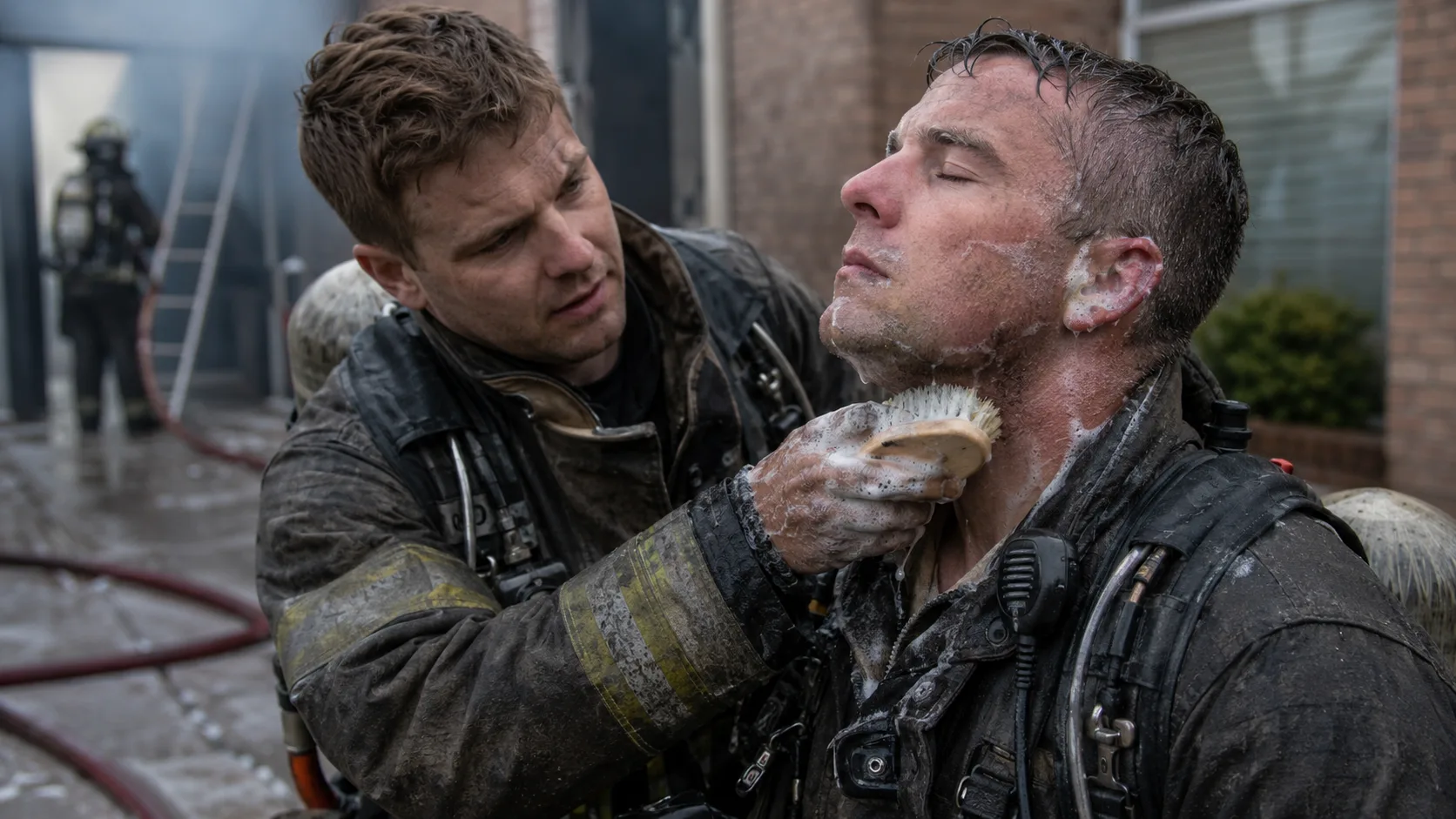
Turnout gear accumulates carcinogenic contamination from every structural fire response. Proper decontamination is one of the highest-impact cancer prevention practices available. See the Firefighter Cancer Risk guide for the full protocol. Key gear-specific practices:
- Wipe down the outer shell immediately after fire suppression at the scene (gross decon)
- Advanced cleaning per NFPA 1851 after every structural fire suppression assignment
- Never dry contaminated gear in occupied station areas
- Never wash turnout gear in home washing machines
- Annual inspection and cleaning by an ISP-certified Independent Service Provider
Inspection and Retirement
NFPA 1851 governs the inspection, retirement, and care of structural firefighting PPE. Key timelines:
- Element inspection: Each time gear is used and at least annually
- Advanced inspection: At least every 12 months by a qualified person
- Retirement: Gear must be retired when it fails inspection criteria including: outer shell has holes, tears, or burn damage that cannot be repaired; moisture barrier has failed the integrity test; gear is more than 10 years old from date of manufacture; gear has been involved in a serious incident that compromised its integrity
- Destroyed upon retirement: Retired gear must be rendered unusable (cut up, permanently marked) before disposal to prevent it from being used by civilians or transferred to unaware personnel
Frequently Asked Questions
What is TPP and THL in turnout gear?
TPP (Thermal Protective Performance) measures the total heat protection of the gear system — higher TPP means more time before a second-degree burn from radiant/convective heat. THL (Total Heat Loss) measures how well the gear allows body heat and moisture to escape — higher THL means more breathable gear with less heat strain. NFPA 1971 minimums are 35 cal/cm² TPP and 205 W/m² THL. TPP and THL trade off against each other: thicker, more protective gear typically has lower THL.
What is the three-layer system in structural firefighting gear?
Structural turnout gear uses three distinct layers: the outer shell (flame/abrasion protection), the moisture barrier (liquid blocking while allowing vapor out), and the thermal liner (heat insulation closest to the body). All three layers must be present and worn together for the gear to provide its rated NFPA 1971 performance.
How often should turnout gear be replaced?
NFPA 1851 provides the retirement criteria. Gear that passes inspection can be used up to 10 years from manufacture date. Gear that fails inspection criteria (damaged outer shell, failed moisture barrier, significant contamination that cannot be removed) must be retired regardless of age. Advanced cleaning and regular inspection significantly extend the service life of gear within these limits.
What is an anti-contaminant liner in turnout gear?
An anti-contaminant liner is an optional additional fourth layer, installed inside the thermal liner, designed to block carcinogenic particulates in fire smoke from reaching the firefighter's skin through the gear system. It addresses the dermal absorption pathway for occupational carcinogens. Several manufacturers offer this as an upgrade option on NFPA 1971-compliant gear systems.

Comments 0
No comments yet. Be the first to share your thoughts!
Leave a Comment