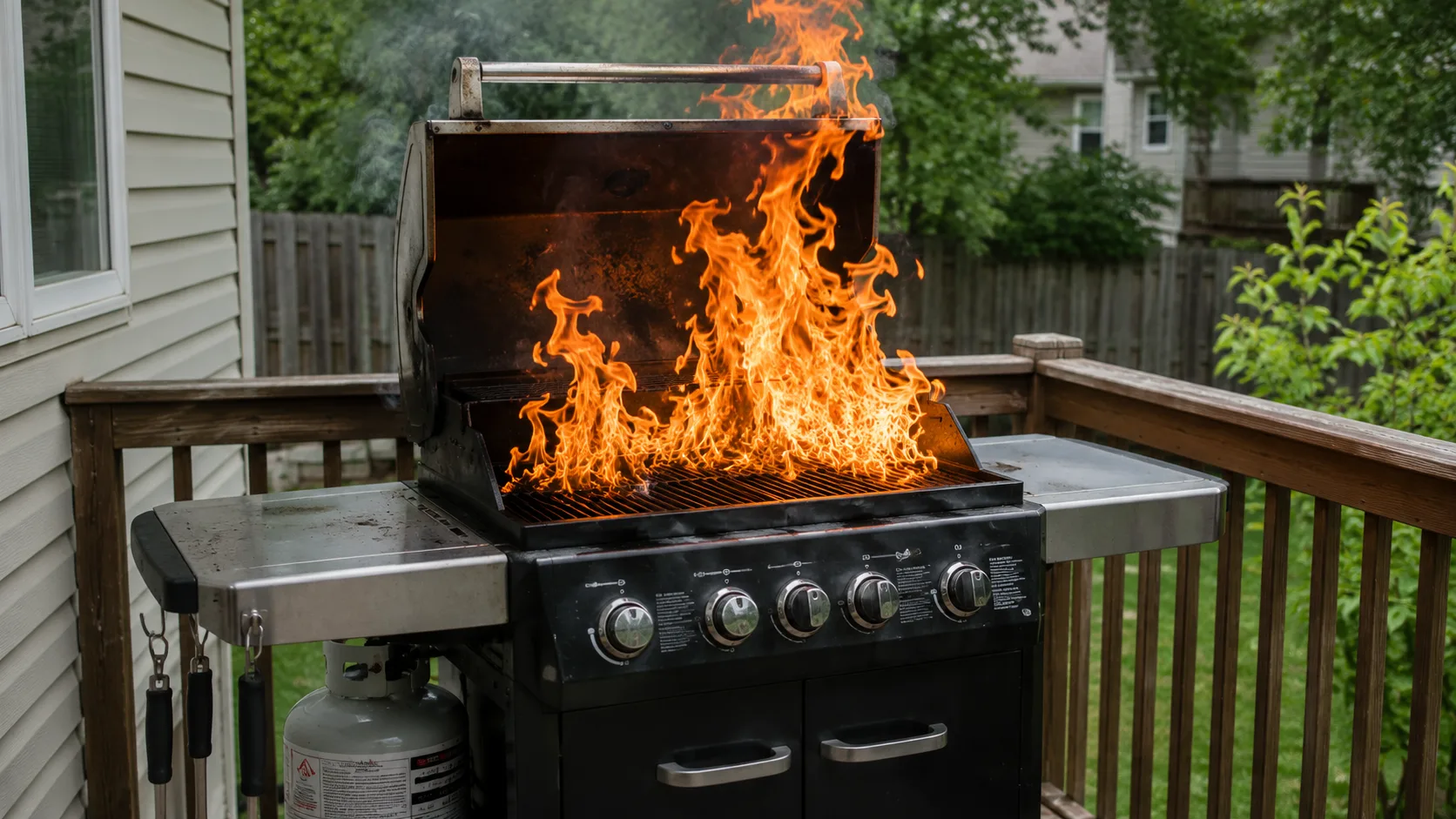

The Consumer Product Safety Commission tracks grill-related injuries every year. The numbers do not go down. Roughly 10,200 residential structure fires start from grills annually, and somewhere around 19,700 people end up in emergency rooms — burns, primarily, many of them to the face and hands. The injuries that come from grills are not random. They follow the same patterns every summer, caused by the same mistakes, on the same types of equipment. Most of them are entirely avoidable if you know what the actual failure points are.
This is not a list of generic grill safety tips. It covers the specific mechanisms behind the most common grill fires and injuries — what is physically happening when things go wrong, and what actually prevents it.
In this article:
- Propane grills: the three specific failure points
- Lighting a covered gas grill — the mistake with the worst outcomes
- Charcoal-specific risks: lighter fluid and ash disposal
- Where you put the grill matters more than most people think
- Grease fires: what actually happens and why water makes it worse
- When to let it burn vs. when to call 911
- BBQ fire safety checklist
Propane Grills: The Three Specific Failure Points
Propane grills account for the majority of residential grill structure fires. The three places they fail are predictable:
1. The hose and regulator
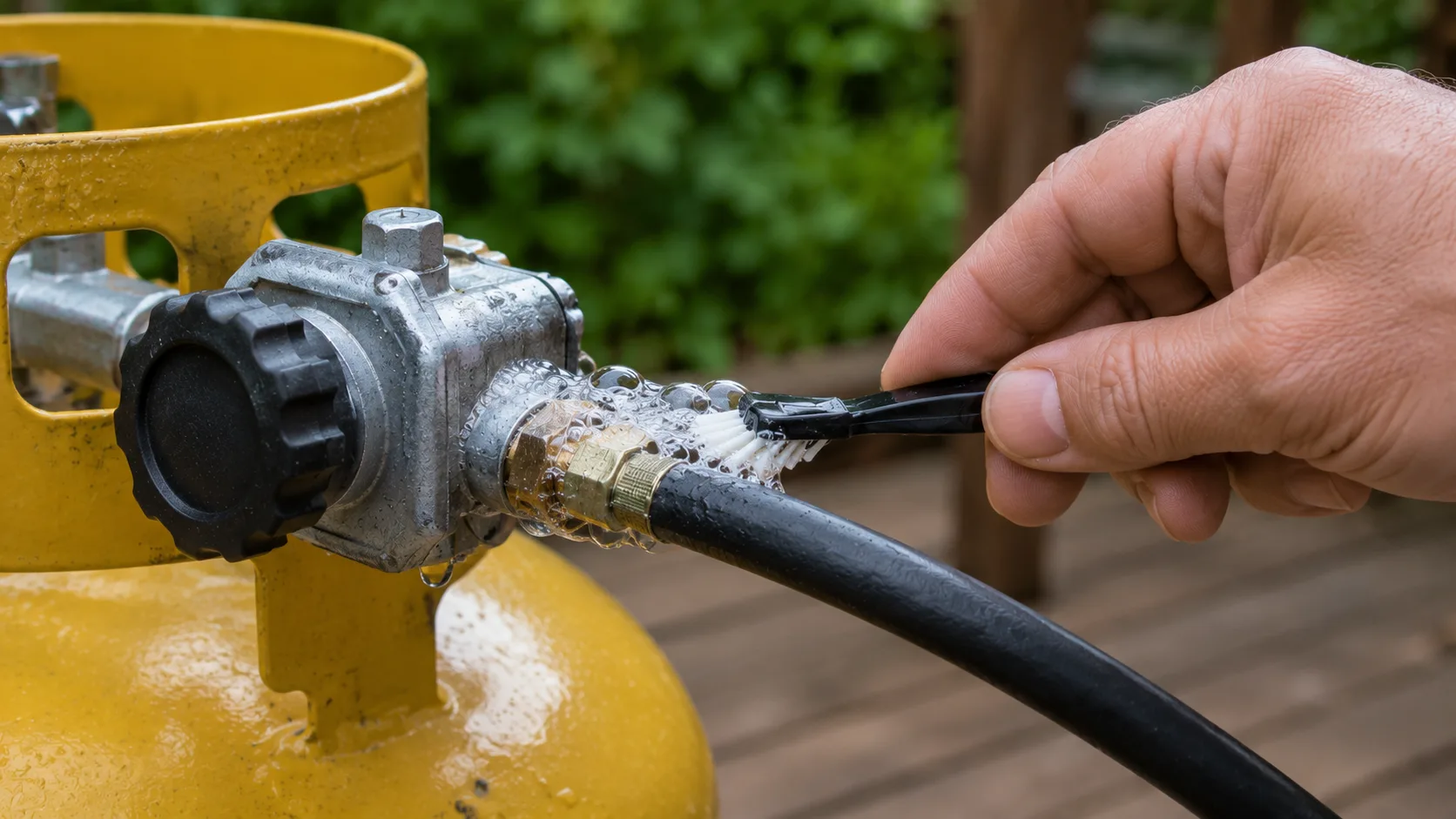
The rubber hose connecting the propane tank to the grill degrades over time — cracking from UV exposure, brittleness from cold winters, physical damage from storage. A hose with a hairline crack may pass a visual inspection and still leak enough gas to create a hazardous concentration near the burner. The correct test is the soapy water test: mix dish soap with water, brush it onto every connection (tank valve, regulator, both hose ends) with the tank valve open, and look for bubbling. Bubbles mean gas is escaping at that point. Do this at the start of every season and after any time the grill has been moved or the tank changed. A new hose costs $20 and takes five minutes to replace.
2. Blocked burner tubes
Spiders — specifically yellow sac spiders — build webs inside propane burner tubes during storage. This is documented frequently enough that propane grill manufacturers list it specifically in their maintenance guides. A web inside a burner tube blocks gas flow, which causes gas to back up and ignite at the connection point rather than at the burner ports. The symptom is a flame appearing underneath the grill rather than at the cooking surface. Check burner tubes at the start of the season by removing them and looking through them — you should see daylight at both ends. A straightened wire coat hanger clears a blocked tube in 30 seconds.
3. The tank itself
Propane tanks have an OPD (overfill prevention device) valve — a triangular handwheel on tanks made after 1998. If the handwheel is not triangular, or if the tank has visible rust on the collar or valve, the tank should not be used. Overfilled tanks — a risk when tanks are filled by unscrupulous operators — can leak through the pressure relief valve. An overfilled tank feels heavier than expected and may be frosted on the bottom even when warm. Return it to the supplier.
Lighting a Covered Gas Grill — The Mistake With the Worst Outcomes
This is the single grill mistake that produces the most severe injuries. Someone opens a gas valve — either intentionally to light the grill or accidentally — without lighting the burner immediately. They walk away, or they close the lid to "let it heat up," or they just wait too long before pressing the igniter. Gas accumulates inside the closed grill hood. Then they ignite it.
The result is a pressure wave and fireball. Eyebrows, eyelashes, and facial hair go first. Hand and forearm burns are common. The burn pattern in emergency rooms from grill flashback injuries is distinctive: the face, the leading hand, and sometimes the upper chest. These are not minor burns.
The prevention is simple and non-negotiable: always open the lid before turning on any gas valve, and ignite within a few seconds of turning on the gas. If the grill does not ignite within 5 seconds, turn off all burners, open the lid fully, and wait at least five minutes before trying again. Five minutes. Not 30 seconds. Five minutes for the gas to fully dissipate.
Never light a gas grill with the lid closed. Gas accumulates inside the hood within seconds of opening the valve. The flash from igniting that accumulated gas is the cause of the most serious grill burn injuries treated in emergency rooms every summer.
Charcoal-Specific Risks: Lighter Fluid and Ash Disposal
Lighter fluid on hot coals
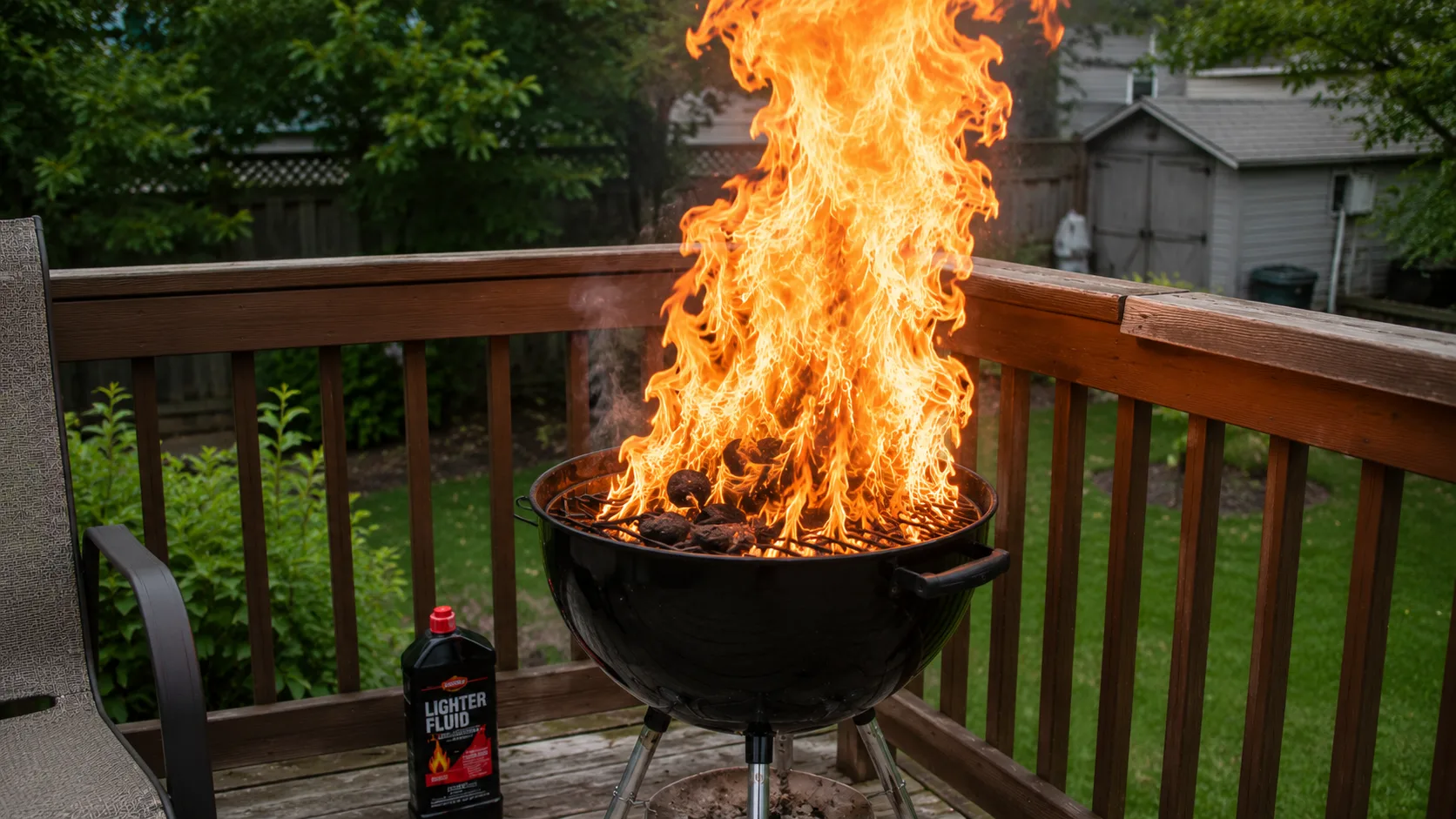
This is the charcoal equivalent of the covered gas grill problem. Someone's coals are dying down. They add more charcoal and want to restart the heat. They squeeze lighter fluid onto coals that look gray and cool. The coals are not cool — they are holding 600°F of residual heat underneath a gray ash layer. The lighter fluid hits that heat, vaporizes, and the vapor cloud ignites instantly with a fireball that extends well beyond the grill.
Lighter fluid should be applied only to cold charcoal before any ignition. Once the coals are lit — even if they appear to have gone out — lighter fluid is off the table. A chimney starter eliminates this entirely: newspaper in the bottom, charcoal loaded in the top, light the paper. Twenty minutes later you have evenly lit coals with no lighter fluid involved at any stage. They cost $15 and last for years.
Ash disposal
Charcoal ash holds heat for longer than almost anyone expects. Ash from a charcoal grill that was used the previous evening can still contain enough residual heat 24 hours later to ignite cardboard, paper, or dry grass. The documented disposal method: soak the ash with water in the grill, wait, then transfer it to a metal container with a metal lid. Not a trash bag. Not a cardboard box. Not a plastic bucket. A metal container, because the ash may not be as cool as it feels, and a metal container does not ignite.
Where You Put the Grill Matters More Than Most People Think
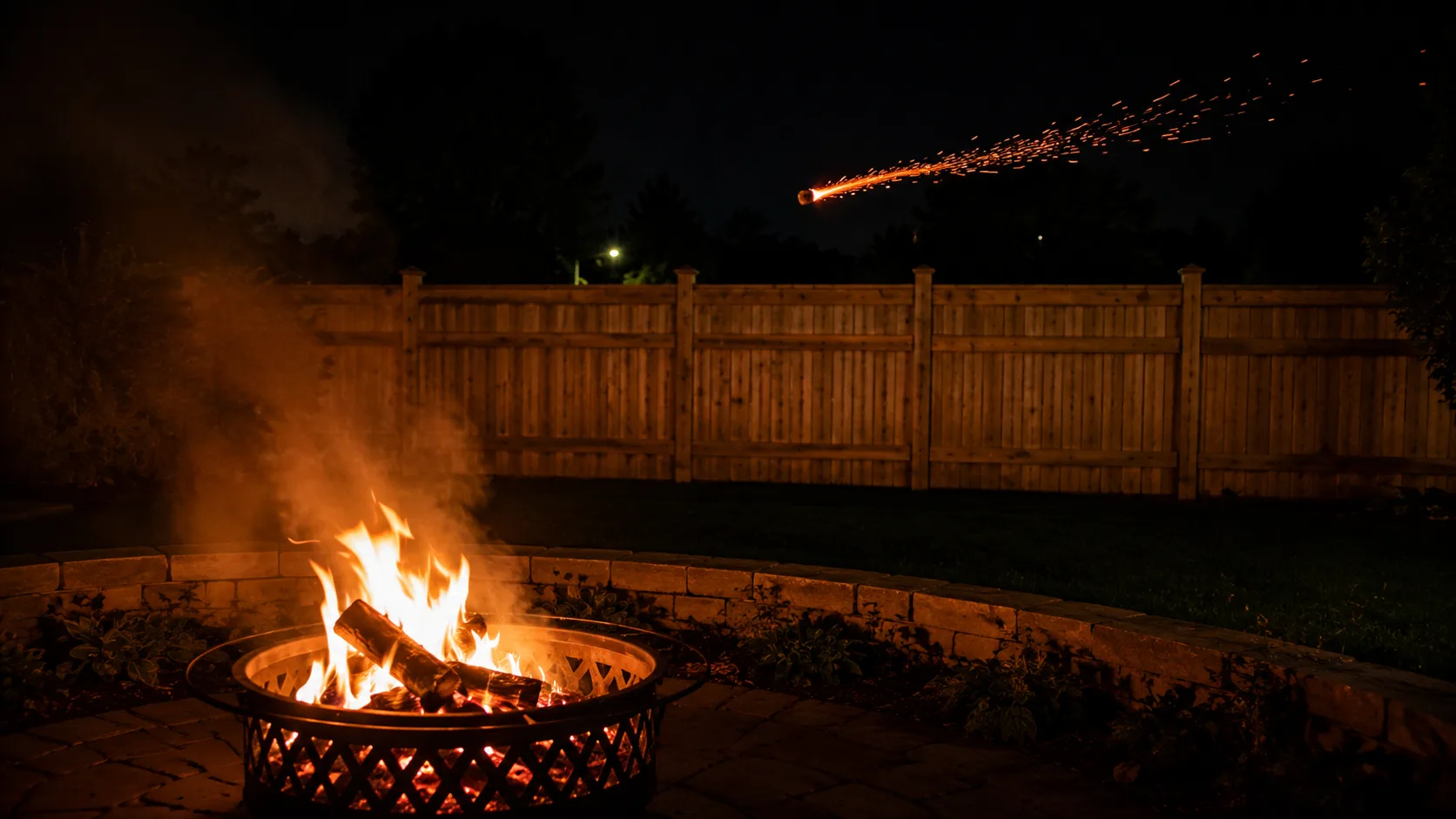
Fire codes and manufacturer specifications typically require grills to be placed at least 10 feet from any structure — the house, a fence, a shed, a deck railing. Surveys of where people actually place their grills tell a different story. Most residential grill fires that extend to the structure start because the grill was within a few feet of a wooden deck railing, a cedar fence, or a vinyl siding wall.
Wood decks are a specific concern. The decking material itself is combustible, grill grease drips accumulate on deck boards under the grill over time, and a grease fire that drips onto a grease-saturated wood deck can extend beyond the grill very quickly. If you use a charcoal or gas grill on a wood deck, use a grill mat — a non-combustible mat placed under the grill that catches drips. They cost $20 and they extend the life of your deck regardless of fire risk.
Grills on balconies are specifically prohibited by most fire codes and most lease agreements. The prohibition exists because balcony fires spread vertically in ways that ground-level fires do not — one burning balcony can reach the balcony above it within minutes. If you live in an apartment, a grill on the balcony is not a judgment call. It is a code violation with fire spread consequences for your neighbors.
Grease Fires: What Actually Happens and Why Water Makes It Worse
A grease fire on a grill is not the same as a charcoal fire or a gas burner flame. Grease fires are burning fat — a fuel source that behaves differently from wood or gas. When liquid water hits burning grease, it instantaneously vaporizes. That steam expansion is violent and immediate, and it carries burning grease droplets with it in all directions. The result is a fireball that extends well beyond the grill and coats the person throwing the water with burning fat. This is a known, documented injury mechanism. Do not use water on a grease fire. Ever.
What to do instead: close the grill lid if you can do so safely — cutting off oxygen is the correct response to a grease fire. Turn off the burners if it is a gas grill. If the fire is small enough to be contained within the grill, closing the lid and cutting the gas will typically extinguish it within 30 to 60 seconds. If the grease fire has spread beyond the grill — to the deck, to the table, to anything outside the grill body — the situation is no longer a grill problem. Move everyone away and call 911.
A Class K fire extinguisher is designed for cooking grease fires and is what commercial kitchens use. For a home grill, a standard ABC dry chemical extinguisher will work but will also destroy the grill and everything nearby with a fine powder that requires thorough cleanup. Use it if the alternative is the fire spreading — but closing the lid is the first response for a contained grill grease fire.
When to Let It Burn vs. When to Call 911
| Situation | Response |
|---|---|
| Flare-up from fat dripping on burners — contained inside the grill | Close lid, reduce heat, wait. Normal cooking event. |
| Grease fire inside grill that does not respond to closing the lid after 60 seconds | Close lid, turn off gas, move everyone back 15 feet. Call 911 if it continues or the grill is near a structure. |
| Fire extends to deck boards, fence, or any structure | Call 911 immediately. Move everyone away from the area. Do not attempt to fight a structure fire with a garden hose. |
| Gas grill with a visible flame at the hose or regulator (not the burners) | Do not attempt to extinguish — the flame is preventing a larger gas release. Call 911 and move everyone away. |
| Propane tank involved in fire (tank feels hot, hissing sound) | Evacuate immediately, at least 300 feet. Call 911. Do not attempt to cool the tank with water. |
The rule that covers most of this: a fire that is growing and has fuel available to it is not a fire to fight with a garden hose or a handheld extinguisher. The time to call 911 is before the fire reaches something it can spread to, not after.
BBQ Fire Safety Checklist
- ✓Soapy water leak test on all propane connections — at the start of every season and after every tank change.
- ✓Burner tubes checked and cleared — look through both ends, clear any blockage before first use of the season.
- ✓Grill placed at least 10 feet from any structure — house wall, deck railing, fence, shed.
- ✓Non-combustible grill mat under the grill if on a wood deck.
- ✓Lid open before turning on any gas valve — every single time, without exception.
- ✓Chimney starter used for charcoal instead of lighter fluid.
- ✓Charcoal ash disposed of in a metal container with a metal lid — after soaking with water in the grill.
- ✓ABC or Class K extinguisher accessible within 10 feet of the grill.
- ✗Never add lighter fluid to coals that have already been lit — even if they look dead.
- ✗Never use water on a grease fire.
- ✗Never light a gas grill with the lid closed.
- ✗Never use a grill on an apartment balcony.
Most grill fires and injuries happen to people who have used grills for years without incident. Familiarity is the actual risk factor — the habits that form after nothing goes wrong for ten summers are the habits that eventually produce a trip to the emergency room. The specific mistakes in this article are not beginners' mistakes. They are the mistakes of experienced grillers who stopped paying attention to the steps that matter.
Comments 0
No comments yet. Be the first to share your thoughts!
Leave a Comment