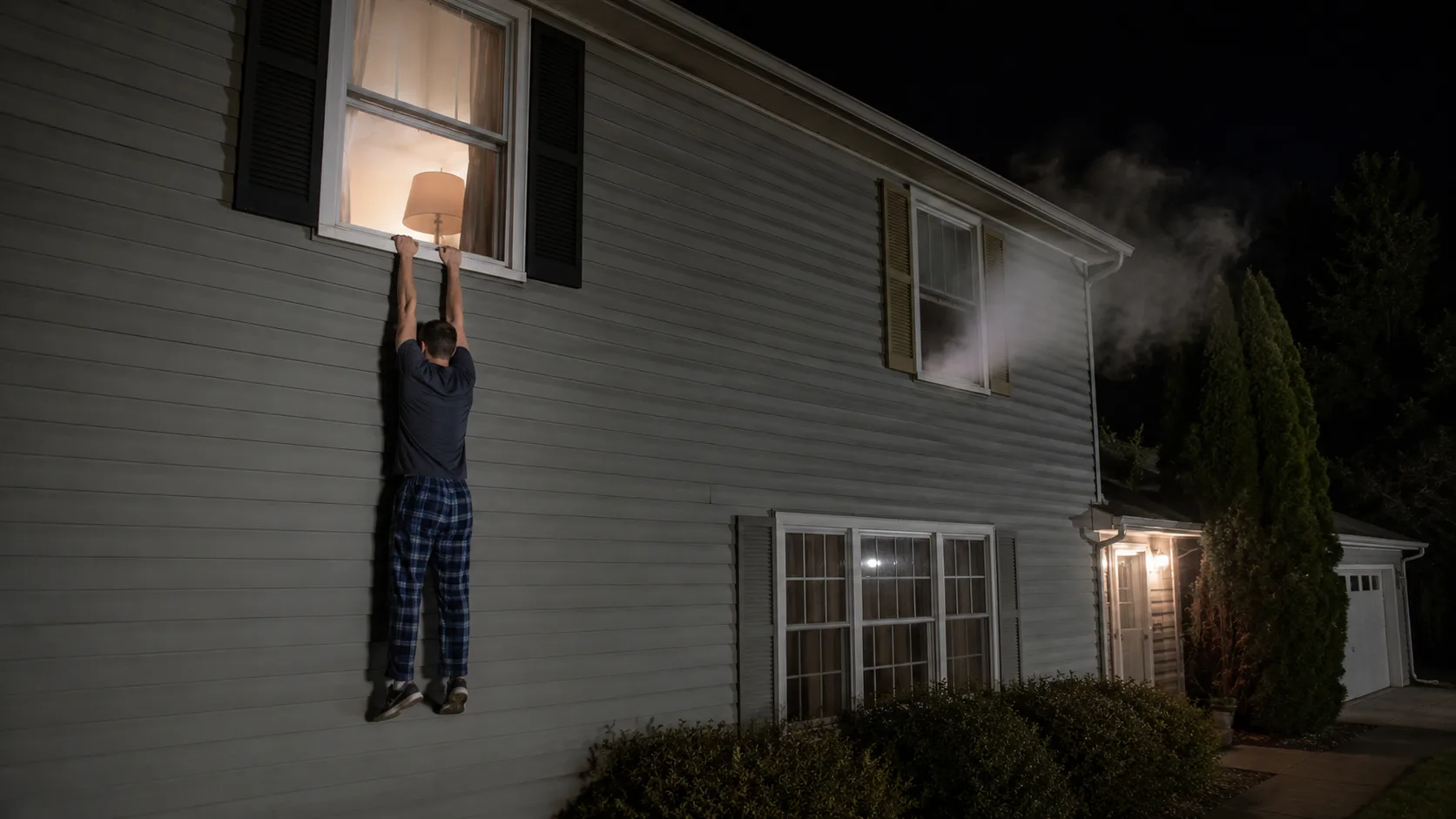

The second floor bedroom escape is one of those scenarios that feels theoretical until it is not. The hallway has smoke. The stairs are on fire or blocked by smoke so dense you cannot breathe through it. The only exit from the room is the window. The ground is 12 to 15 feet below you. What happens next is determined by whether you have thought about this before, whether there is anything in the room to help, and whether you know the specific techniques that reduce the fall height and the injury risk to something survivable.
The uncontrolled jump from a second-floor window to the ground is approximately a 12-foot fall. At that height, the impact velocity is around 19 mph — comparable to a moderate car accident absorbed entirely by the legs, hips, and spine. Serious injuries are common, and fatalities occur. But the distance between "uncontrolled 12-foot jump" and "controlled 6-foot drop with a hang" is the distance between serious injury risk and a manageable outcome. That technique takes 30 seconds to execute and requires knowing it before the emergency.
In this article:
- When window escape becomes the right decision
- The hang-and-drop technique
- Escape ladders: types, selection, and storage
- Knotted sheets: does this actually work?
- Window assessment: which windows you can actually use
- Children first or adults first?
- What to do about what you land on
- The pre-plan: doing this before you need it
When Window Escape Becomes the Right Decision
Window escape from a second floor is not the first option. It is the option when the first option — the door — has been assessed and found to be blocked by fire or untenable smoke conditions.
The door assessment comes first, every time. Feel the door with the back of your hand. If the door is cool and there is no smoke visible at the gap, the primary escape route through the door may still be viable. Open the door slowly, staying behind the frame. If the hallway is clear or has only light smoke above head height, the stairs are a better exit than a second-floor window. The window becomes the primary option when the door is hot, smoke is visible at the base, or the hallway assessment on opening reveals untenable conditions.
The other trigger for window escape: fire has entered the room — either through the ceiling, through a wall, or through the door frame — and conditions in the room are deteriorating faster than fire department arrival can address. In that scenario, the window is not a fallback. It is the only exit. The decision needs to be made before the room becomes untenable, not after, because the margin for error at that point has disappeared.
Signal before you exit. If you have 30 to 60 seconds before you need to go through the window, use them to call 911, give your location (address, floor, room), and hang a white or light-colored item from the window. Arriving firefighters who see a signal know exactly where to go. Firefighters arriving to a house fire with no signal have to search — and the search takes time that may be critical.
The Hang-and-Drop Technique
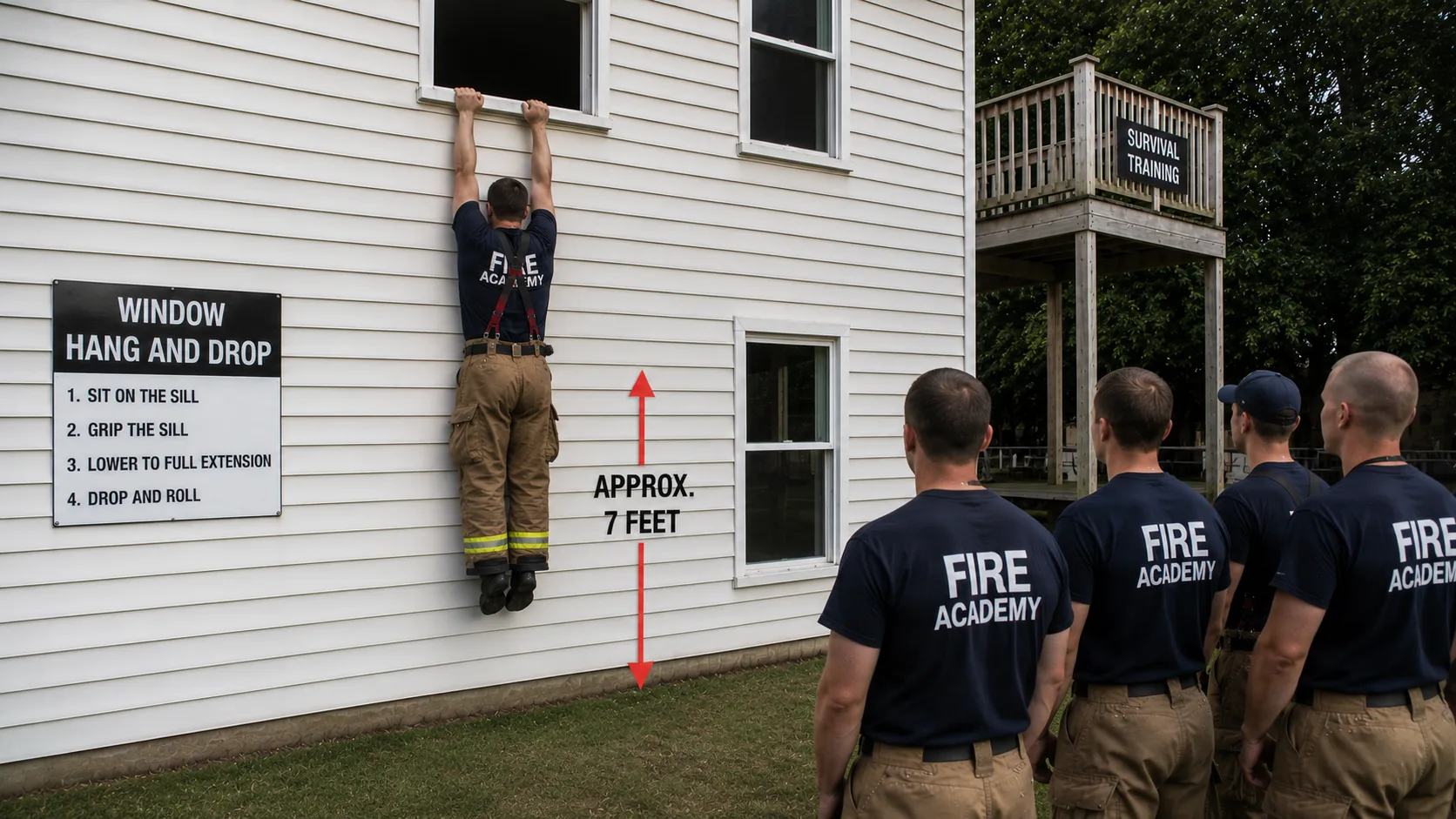
The technique that most significantly reduces injury risk in a second-floor window escape requires no equipment and can be executed in under 30 seconds if you know it:
- Open the window fully — both the window and any screen. A screen does not stop a fall, but it complicates the exit and can cause cuts or entanglement. Remove it or push it out.
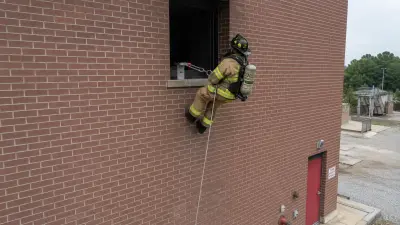
- Get out feet-first. Sit on the sill, swing your legs out, and rotate so you are facing the building exterior with your chest against the wall and your feet dangling outside.
- Lower yourself to a hanging position. Grip the window sill with both hands, fingers hooked over the edge, and lower your body until you are hanging at full extension below the window opening. Your feet should now be 6 to 7 feet from the ground — half the original fall distance.
- Look down and assess the landing zone before releasing. If there is a bush, a hard object, or a sloped surface directly below, shift your position along the wall if possible.
- Release and land with slightly bent knees. Do not lock your legs straight. As you land, let your knees bend and roll to one side — distributing the impact force over a larger surface area rather than absorbing it entirely through your legs.
At full extension from a standard second-floor window, an adult of average height will have their feet approximately 6 to 7 feet from the ground. This is a survivable drop without significant injury risk for most adults in reasonable physical condition — equivalent to jumping from a high counter. The difference from a 12-foot uncontrolled jump is the difference between a likely-survivable and a likely-injurious event.
Escape Ladders: Types, Selection, and Storage
A commercial fire escape ladder eliminates the drop entirely — and costs between $30 and $80. This is the most straightforward solution to the second-floor escape problem and the one most households with children on a second floor should implement rather than relying on a technique that requires coolness under pressure.
Chain ladders
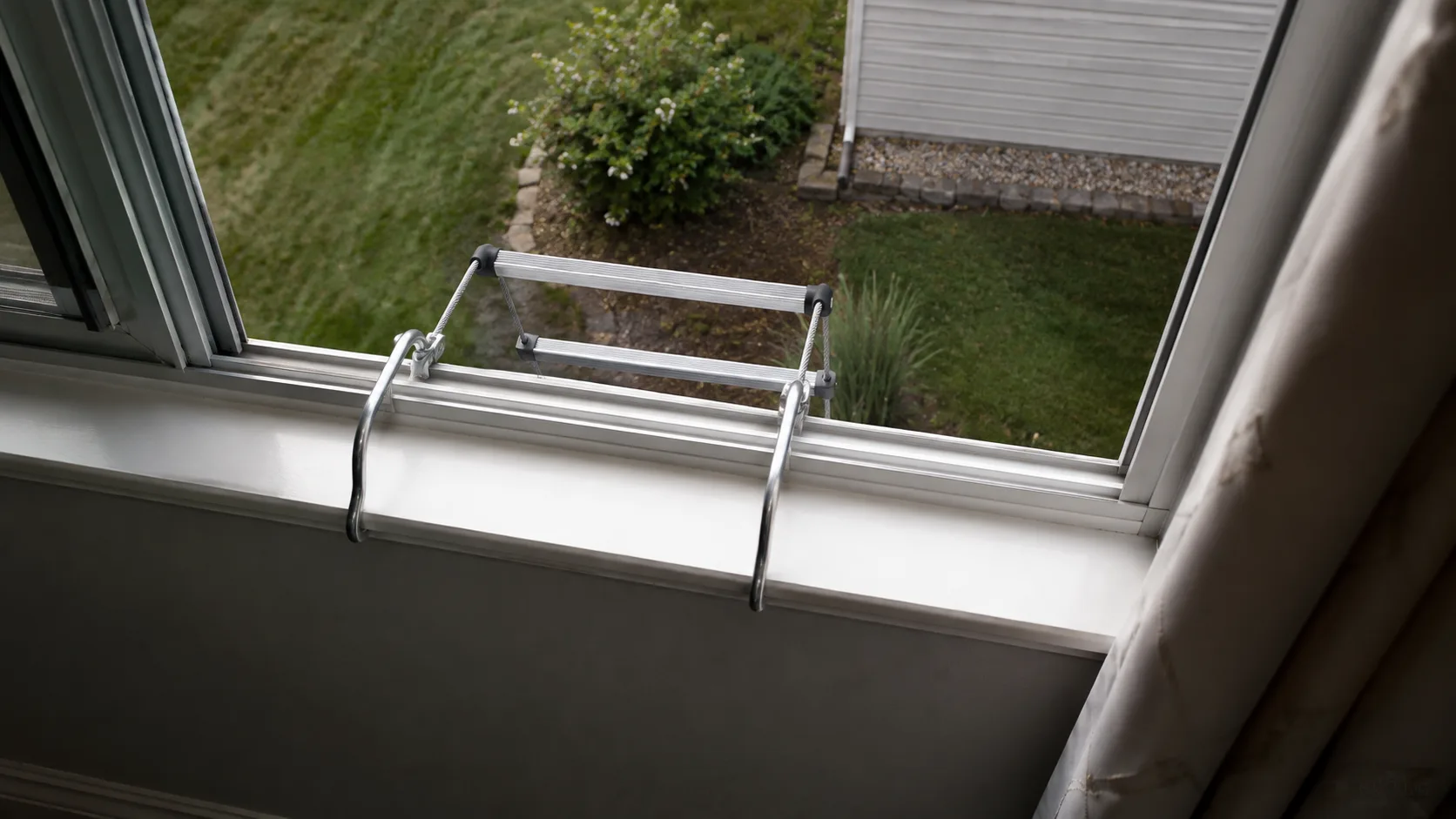
The most common type: two chains with cross-rungs, hooks that attach to the window sill. Deploy by throwing the ladder out the window and hooking it. They are compact, lightweight, and inexpensive. The drawbacks: the hooks require a standard window sill width to seat properly, the ladder swings against the wall making footing somewhat unstable, and they require practice to deploy quickly. Deploying a chain ladder for the first time during a fire emergency is significantly harder than deploying one you have practiced with.
Permanent escape ladders
Mounting brackets installed inside the window frame that hold a permanently attached ladder in a housing. To deploy, the housing is opened and the ladder drops. More expensive ($150 to $300), but faster and more reliable under stress because the installation point is fixed and the deployment requires only one action.
Storage and accessibility
An escape ladder stored in a closet on the opposite side of the house from the bedroom it is intended for is not accessible in an emergency. The ladder should be stored in the room it is intended to be used from — under the bed, in a bedside drawer, or on a shelf within immediate reach of the window. Everyone who sleeps in that room should know where it is and how to deploy it. Children who are old enough to use it should practice the deployment at least once per year — in daylight, calmly, so the action is familiar.
Knotted Sheets: Does This Actually Work?
The knotted bedsheet rope is a staple of movie escapes and a topic that comes up regularly in fire safety discussions. The honest answer: it can work, but the conditions required for it to work are much more demanding than the movies suggest, and in a real fire emergency, most of those conditions will not be met.
For a sheet rope to be usable: the sheets must be actual cotton sheets with reasonable tear strength (not worn, not synthetic blends that have lower tensile strength), the knots must be tied correctly and under the load of the person's weight rather than the fire-emergency version of quickly, and there must be something inside the room to anchor the top — a bed frame leg, a radiator, a desk bolted to the floor — that can withstand approximately 200 to 400 pounds of dynamic load.
A queen-size flat sheet tied to a bed frame, with two additional sheets knotted together, gives you approximately 12 to 14 feet of rope — roughly sufficient to reduce the drop to a manageable distance from a second-floor window. But tying reliable knots quickly under stress, while smoke may be in the room, while managing children or other people, is not a simple task. The same $30 to $80 that buys a commercial escape ladder avoids all of this entirely.
If a sheet rope is your only option — no ladder, no other choice — use it. Any reduction in fall height reduces injury risk. But it should be the option of last resort rather than the planned approach.
Window Assessment: Which Windows You Can Actually Use
Not all bedroom windows are equally usable for emergency escape. Before you need to use one, know which windows in your bedroom actually open, how wide they open, and whether they can be opened quickly from inside — ideally with one hand, in the dark.
Window types that present problems:
- Casement windows (hinged on the side, cranked open) open wide but the crank mechanism can be slow and may be painted shut on older windows. The opening, when fully open, is typically adequate.
- Double-hung windows (slide up and down) open to half the total window area. A standard double-hung window opened fully on the top or bottom provides adequate escape width for adults but may be tight for larger adults with anything in their hands.
- Sliding windows similarly open to half the window area and may have security pins that limit opening width.
- Fixed windows do not open at all. If your bedroom has only fixed windows, a rescue hammer or window breaker tool — available for under $15 — should be in the bedside drawer. Breaking a standard residential window from the inside takes one firm strike at a corner with a pointed tool.
Security bars on bedroom windows are a documented cause of fire death. If your bedroom windows have security bars, they must have quick-release mechanisms that can be operated from inside without a key. Test that you can operate yours in the dark, one-handed, in under 10 seconds. If you cannot, the security bars need to be addressed before there is a fire.
Children First or Adults First?
The answer depends on the escape method. With a ladder: younger children should go first, with an adult holding the top of the ladder for stability and going last. Children who are old enough to descend the ladder independently can go in any order. An adult who goes last can assist children from below if needed and can receive a younger child handed out the window before descending themselves.
With the hang-and-drop method: adults go first so they can be on the ground to receive a child lowered from the window. Lowering a young child by their arms from a window — an adult inside gripping the child's wrists and lowering them to their full extension before releasing — reduces the child's effective fall height to approximately 3 to 4 feet at an adult's arm extension. This is the method for children too young to climb down independently and too heavy to safely hold for a full hang. The adult goes last because once you lower a child and release, you cannot get back through the window to retrieve another — plan the sequence before anyone goes out.
What to Do About What You Land On
The landing zone assessment before releasing from the window sill is not optional. The ground directly below a second-floor bedroom window may have an air conditioning unit, a concrete walkway, a garden with stone edging, a rose bush, or a sloped grade that changes the effective fall height. Shifting your position along the wall by 2 to 3 feet before dropping — to land on softer ground rather than concrete — can be the difference between a minor injury and a serious one.
After landing, move away from the house immediately regardless of your pain level. A person who has fallen and landed 10 feet from the burning structure has reduced their exposure to heat, falling debris, and window failures on upper floors. Adrenaline will mask injury severity temporarily — do not trust your assessment of whether you are hurt. Get away from the structure and get medical attention. The ambulance that responds to a house fire will evaluate you at the scene.
The Pre-Plan: Doing This Before You Need It
- ✓Walk to your bedroom window now — open it fully, look at the ground below, assess the landing zone and the effective drop height.
- ✓Buy and store an escape ladder in every second-floor bedroom — under the bed or on the window sill shelf.
- ✓Practice ladder deployment once per year — everyone in the household who might need to use it, including children who are old enough.
- ✓Test that every bedroom window opens fully and without a tool from inside.
- ✓If you have security bars — test the quick-release in the dark, one-handed. If you cannot do it in 10 seconds, fix it.
- ✓Keep a flashlight or charged phone within arm's reach of the bed — navigation to the window in a dark smoke-filled room is significantly harder without light.
- ✗Do not jump feet-first from a standing position on the window sill — lower yourself to a hang before releasing.
- ✗Do not go back inside for any reason after exiting.
A second-floor bedroom escape is survivable with preparation and manageable without it — but the gap between those two outcomes is large enough that preparation is clearly worth the 30 minutes and $30 to $80 it costs. The ladder under the bed costs less than a copay and weighs less than a textbook. The pre-plan costs nothing. Both are available right now.




Comments 0
No comments yet. Be the first to share your thoughts!
Leave a Comment