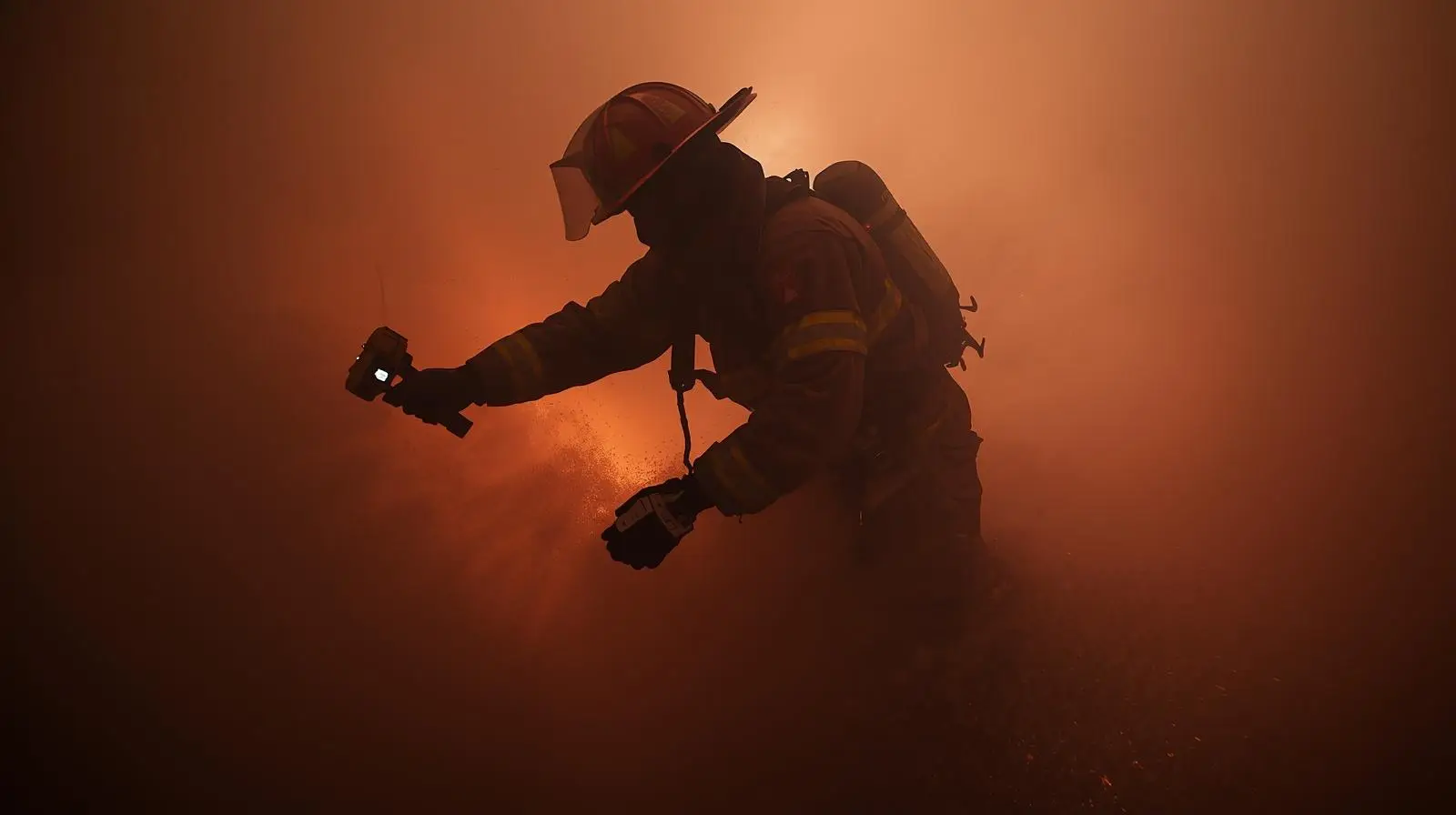

Firefighter Search and Rescue: Primary Search, Oriented Search, and Victim Removal Techniques
Search and rescue is the highest-stakes function in structural firefighting. Every minute inside a burning structure without water on the fire narrows the survival window for both the victim and the search team. This guide covers the systematic methods used to conduct primary and secondary search, the techniques for locating and packaging victims in zero visibility, and the physical methods for removing victims from a structure alive.
Jump to:Primary vs secondary search · Before you enter · Oriented search · TIC-assisted search · Search techniques · Victim location priorities · Victim care during search · Victim removal · MAYDAY and self-rescue · FAQ
Primary vs. Secondary Search
The fire service distinguishes between two types of structural search based on conditions, thoroughness, and timing:
| Primary search | Secondary search | |
|---|---|---|
| When | During active fire conditions; simultaneous with suppression | After fire is knocked down and conditions improve |
| Conditions | Smoke, heat, poor visibility; hostile environment | Improving conditions; smoke clearing or cleared |
| Speed | Fast, systematic, thorough but rapid | Slower, more methodical; every space checked |
| Purpose | Rapid life safety intervention; locate victims before conditions deteriorate | Confirm all victims have been found; locate those missed in primary |
| Team | Minimum 2 firefighters; with hoseline or on search line | Can be conducted with improved conditions; may be 1 or 2 firefighters |
| Documentation | Verbal report: "Primary search floor 2 complete, all clear" or "victims located at..." | Written documentation; formal "all clear" confirmation to command |
Both searches must be completed at every structure fire. A "primary all clear" does not mean no victims are in the structure. It means no victims were found during the rapid primary sweep under hostile conditions. Secondary search is required to confirm all areas have been checked in improved conditions.
Before You Enter: Size-Up for Search
Rushing into a structure without a search plan wastes time and creates accountability problems. Before search begins:
- Get a victim count from bystanders. How many people in the building? Where were they last seen? What floor? This directs your search priority. One credible report of a victim on the second floor near the bathroom is more valuable than a systematic floor-by-floor sweep with no information.
- Identify the highest-probability victim locations. Victims are found most frequently: in sleeping areas (fire at night), near the exit they tried to use (which may be near the fire), in rooms where they sought refuge (bathroom or room with window), and under furniture or in closets (where children hide).
- Know your egress before you enter. The door you entered, an alternate window or door, the layout of the structure from your size-up. You must be able to exit even if conditions deteriorate and you cannot see.
- Establish accountability. Command must know you entered, where you are going, and how long your air will last. Check in at regular intervals or when you clear each floor.
Oriented Search: Staying Found While Looking
The most dangerous aspect of primary search is disorientation. A firefighter who loses their orientation inside a burning structure with zero visibility is at immediate risk of running out of air before finding egress. Oriented search keeps the firefighter connected to a known reference point.
Wall-following (right-hand or left-hand rule)
The simplest oriented search technique: maintain physical contact with one wall throughout the search. Keep one hand on the wall at all times while sweeping the floor and mid-level ahead with the other arm and legs. When you complete the room perimeter, you return to your entry point.
The limitation: wall-following only covers the perimeter of each room. An island victim in the center of a large room may be missed. In rooms where the search radius is larger than the firefighter's arm reach, centerline sweeps must supplement wall-following.
Search rope technique
A search rope anchored at the entry point allows firefighters to venture into large open spaces without losing orientation. Technique:
- Anchor the search rope bag to the door frame, bottom of stairwell, or other fixed point
- Advance into the space paying out rope; maintain tension on the rope so you can follow it back
- Sweep the area within arm's reach on each side as you advance
- When you reach the end of your rope, follow it back to the anchor and reposition before extending further
- Personal escape devices (carabiner, quick link) on the rope at intervals allow additional crew members to follow your path
Hose line as orientation reference
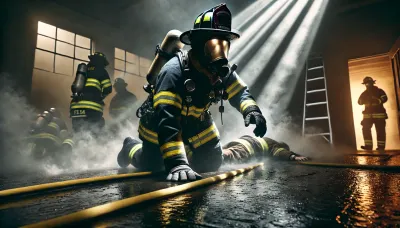
If an attack line has been advanced into the structure, the hose itself is an orientation reference. Search teams can advance alongside the hose, knowing that following it back leads to egress. The male coupling (ribbed end) points toward the nozzle; the female coupling (smooth end) points toward the door.
Couplings tell you which way is out. If you are disoriented on a hose line, feel the coupling. Smooth (female) = toward the pump and egress. Ribbed (male) = toward the nozzle and deeper into the fire. This is a critical survival skill that every firefighter must know without thinking.
TIC-Assisted Search
The thermal imaging camera dramatically improves search efficiency in smoke-filled environments. See the TIC guide for full details, but the key search applications:
- Sweep the TIC at floor level in a systematic grid pattern — victims appear as warm shapes against cooler floor surfaces
- Check under beds and behind furniture systematically; children hide in these locations
- In post-flashover environments where all surfaces are hot, the victim's heat contrast is reduced; physical search supplements TIC
- Use TIC to identify windows and doors in zero visibility for navigation and egress identification
Search Techniques by Space Type
Residential bedroom search (most common victim location at night fires)
Large open floor plan search
Commercial spaces, warehouses, and open floor plan residential areas cannot be adequately searched by wall-following alone. Use a search rope and grid pattern:
- Anchor rope at entry; advance to the far wall
- Walk parallel sweeps back and forth, moving laterally 6–8 feet between each pass
- This creates a systematic grid coverage of the floor
- Mark each pass with a snap link or directional indicator so you know which areas have been covered
Multi-story building search
- Search from top down in a fully involved multi-story building (occupants above the fire are in immediate danger)
- Search the fire floor last (most dangerous; most likely to already have been evacuated or to be untenable)
- Clear each floor before moving to the next; report each floor status to command
- Assign a dedicated search team to each floor when resources allow
Victim Location Priorities by Fire Scenario
| Scenario | Highest-probability victim location |
|---|---|
| Residential fire, nighttime | Bedrooms; hallway between bedroom and exit; bathroom (refuge seeking) |
| Residential fire, daytime | Room of origin (most common daytime victim: person in room where fire started); kitchen |
| Apartment/multi-unit, early morning | Sleeping areas in all units on fire floor; stairwells (evacuation attempt); elevator lobbies |
| Commercial/office, business hours | Stairwells; near exits; restrooms (refuge); areas where smoke forced retreat |
| Commercial, after hours | Security office; overnight maintenance areas; sleeping areas if any exist |
| Pediatric victims | Under beds; in closets; in hiding places (bathtub, behind furniture); near parents' location |
| Elderly or mobility-impaired | Bedroom; areas near assistive devices (wheelchair, walker); bathrooms |
Victim Care During Search
When a victim is located, your initial actions determine whether they survive:
- Announce immediately. "Victim located, second floor bedroom, north side." Give command the location so additional resources can be directed.
- Move the victim toward fresh air first. If removal to the exterior is not immediately possible, move the victim to the lowest-smoke area available — a window, a stairwell, a corridor with less involvement.
- Do not stop to provide extended medical care in the fire environment. The goal is extraction. Begin CPR only if you can maintain it while moving toward egress, or once the victim is in a safe location. Moving a victim who is not breathing out of the fire building gives them a chance; starting CPR in a smoke-filled room while you run out of air does not.
- Use the victim's airway as your guide. If the victim is unconscious, position them to maintain airway patency during removal. Prone removal (face down, head-forward drag) can compromise the airway — consider positioning.
Victim Removal Techniques
Drag techniques for unconscious victims
- Webbing drag: Loop 1-inch tubular webbing under the victim's armpits and across the chest. Drag toward egress from the head end. Keeps the airway somewhat maintained, allows one firefighter to drag while moving backward.
- Coat drag: Grab the victim's coat or shirt collar and drag from the head. Effective for short distances on smooth floors.
- Two-firefighter carry: One firefighter supports the upper body and arms (from behind, arms under the victim's armpits); one supports the legs. Move toward egress together. Faster than a drag for conscious or semi-conscious victims.
- Stokes basket (when available): For suspected spinal injury or stairwell removal, a Stokes basket or similar device provides full-body support and a rigid carry surface.
Stairwell removal
Removing an unconscious victim down a stairwell requires at least two firefighters and a coordinated approach:
- Position victim at the top of the stairs, feet first toward the bottom
- One firefighter at the head (top) controls the descent; one or two at the feet control the pace
- Lower the victim one step at a time; do not slide rapidly (increases injury risk)
- In narrow stairwells, a single firefighter can descend while facing up and dragging the victim across their lap/thighs one step at a time
Window removal
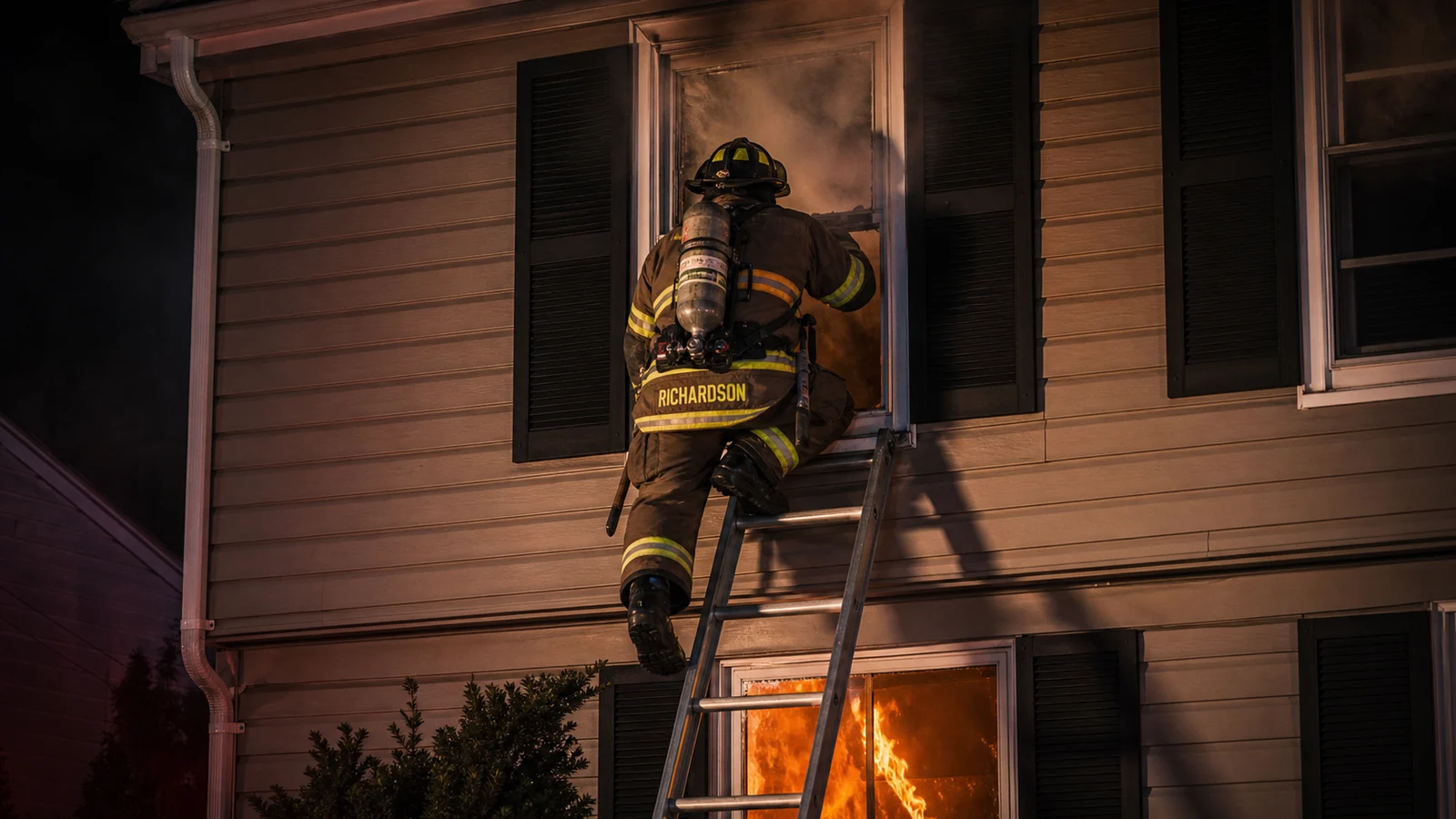
Victim removal through a window is used when stairwells are compromised or the victim is on the upper floors with aerial ladder access:
- Clear all glass from the window frame before moving the victim through it
- Feet-first for conscious or semi-conscious victims who can assist
- Head-first for unconscious victims being passed to ladder crew (allows crew to support head and shoulders first)
- Aerial ladder crews should be positioned and ready before the victim reaches the window
MAYDAY and Self-Rescue
If a search team member becomes lost, trapped, or runs out of air, declare MAYDAY immediately. See the SCBA Emergency Procedures guide for the full protocol. For search specifically:
- Activate PASS device immediately upon recognizing an emergency — not after you have exhausted self-rescue attempts
- Transmit MAYDAY using LUNAR: Location (as specific as possible), Unit, Name, Air level, Resources needed
- If entangled, stop moving and systematically free the entanglement; do not thrash
- If disoriented on a hoseline, feel the couplings to determine direction to egress
- If there is no hoseline, activate PASS, transmit MAYDAY, and move toward any exterior light source or cooler air
Use the MAYDAY LUNAR Generator to practice building complete MAYDAY messages before you need them.
Frequently Asked Questions
What is the difference between primary and secondary search in firefighting?
Primary search is a rapid, systematic sweep conducted during active fire conditions to locate victims as quickly as possible. Secondary search is a slower, more methodical search conducted after the fire is knocked down to confirm all areas have been checked. Both are required at every structure fire. A primary all clear does not mean no victims are present — it means none were found during the rapid sweep.
Where are victims most commonly found in residential fires?
In nighttime fires: bedrooms, the hallway between the bedroom and exit, and bathrooms where occupants sought refuge. Children are frequently found under beds and in closets. Elderly or mobility-impaired victims are most often found in their bedroom or near their assistive devices. Occupants who attempted to reach windows are found near windows.
What is oriented search?
Oriented search is any search technique that maintains the firefighter's connection to a known reference point, enabling return to egress even in zero visibility. Methods include wall-following (maintaining hand contact with one wall throughout), search rope (attached to a fixed point at entry), and hose line orientation (following the hose toward the female couplings to exit).
How do you drag an unconscious victim out of a fire?
The most common methods: webbing drag (loop webbing under the armpits and drag from the head end), coat drag (grip the collar and drag backward), and two-firefighter carry (one at the head, one at the feet). The technique depends on victim size, space constraints, and available crew. Move the victim toward egress first; provide extended medical care only once they are in a safe location.

Comments 0
No comments yet. Be the first to share your thoughts!
Leave a Comment