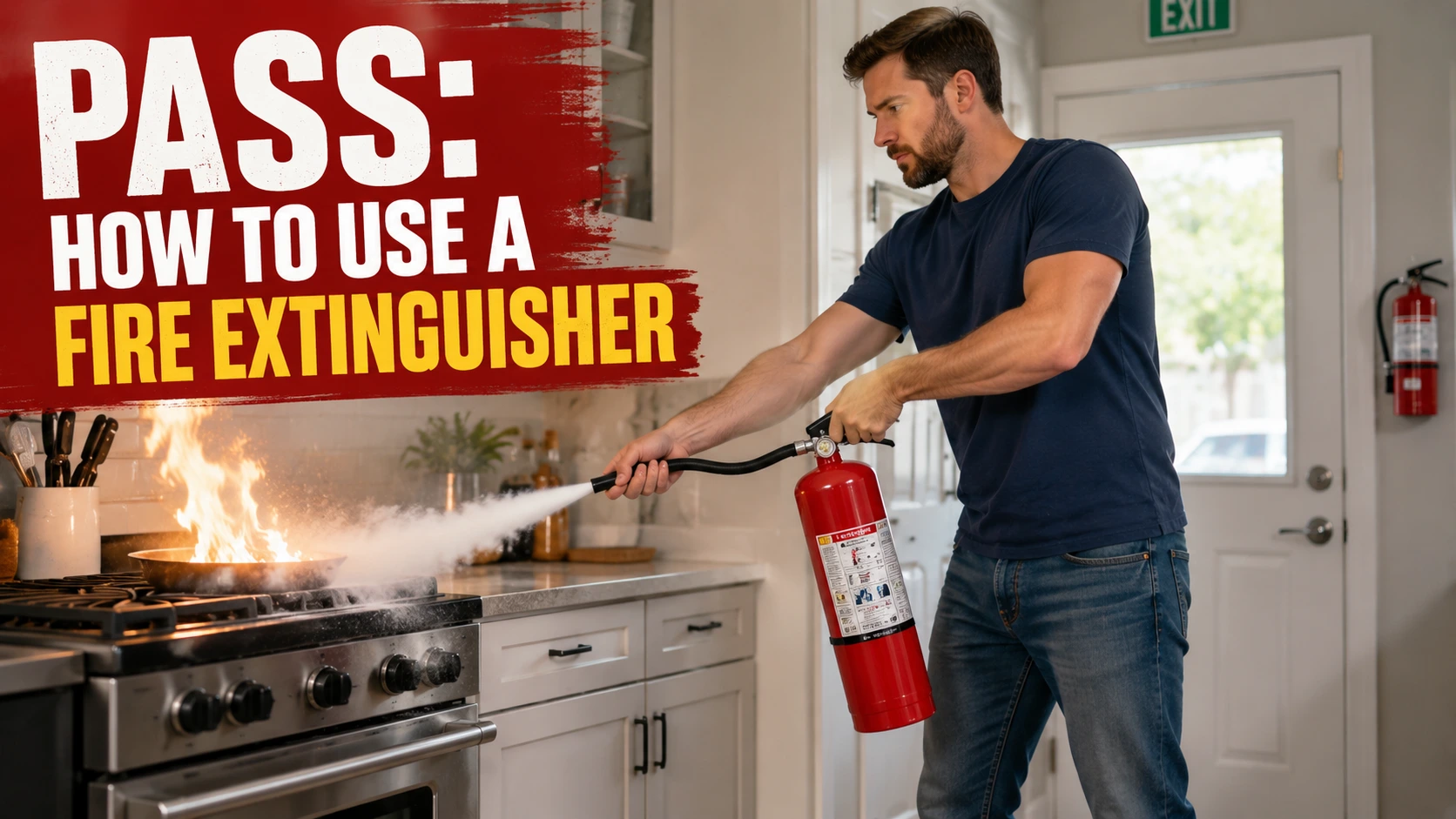

A residential fire extinguisher has about 8 to 12 seconds of discharge time. That is the entire window you have to pull the pin, aim, and apply the agent effectively. In those 8 to 12 seconds, there is no time to read the label, think through the steps, or figure out which end to aim. Either you know how to use it before you need it, or you will find out what happens when you do not.
This covers everything you need to know before an extinguisher sits unused in your kitchen: the PASS technique in full detail, what the class ratings (A, B, C, K) actually mean about what the extinguisher can and cannot do, how to check whether your extinguisher is still serviceable, and the specific situations where picking one up will make the fire worse instead of better.
In this article:
The PASS Technique — Full Breakdown

Four words that look simple on paper and require practice to execute correctly under adrenaline and smoke. Here is what each step actually involves when you are standing in front of a real fire:
The pin is a small metal ring or strip running through the handle assembly. It blocks the handle from being squeezed. Pull it straight out — do not twist it. Some pins have a plastic seal as well. Both come out with a firm straight pull. The pin stays in your hand or drops — it does not need to go anywhere specific. Once the pin is out, the extinguisher is live.
This is the step most people get wrong under pressure. The instinct is to aim at the visible fire — the flames, the smoke, the most alarming-looking part. The agent needs to go to the fuel that is burning, not the combustion products above it. For a trash can fire: aim at the burning material at the bottom of the can, not the flames rising above it. For a pan fire: aim at the burning liquid surface. For a burning curtain: aim at the fabric where it is burning, starting at the lowest point. Stand 6 to 8 feet back — close enough to be effective, far enough that the discharge does not scatter the burning material.
Squeeze the upper and lower handle together firmly. The discharge is immediate and forceful — most people are surprised by the pressure and the volume of agent. Hold the handle assembly firmly. A partial squeeze gives a partial, ineffective discharge. Squeeze fully and maintain it. You can release to pause — the pin is already pulled so re-squeezing continues the discharge without any additional steps.
Move the nozzle in a slow, controlled side-to-side arc across the base of the fire. Slow is correct — rushing the sweep means the agent covers each spot for less time and the fire may survive behind the sweep as it passes. Work from the nearest edge of the fire toward the far edge. Continue sweeping until the agent is exhausted or the fire is out — whichever comes first. If the agent runs out before the fire is out: the fire is too large, you need to leave.
Your exit route must be behind you before you start. Never position yourself between the fire and the only exit. If the extinguisher does not work, or the fire grows around you, you need to be able to turn and leave immediately. If you have to step past the fire to reach the exit — do not fight the fire. Leave.
Fire Extinguisher Classes: What A, B, C, and K Actually Mean
The letter rating on a fire extinguisher tells you what types of fire the agent is effective against. Using the wrong class on the wrong fire can be useless at best and dangerous at worst.
| Class | Fire Type | Examples | What the Agent Does |
|---|---|---|---|
| A | Ordinary combustibles | Wood, paper, cloth, most plastics, furniture, structural materials | Water-based or dry chemical agents cool the fuel and interrupt combustion. Effective on solid fuel fires where cooling and coating the fuel is the suppression mechanism. |
| B | Flammable liquids and gases | Gasoline, diesel, oil, grease, propane, paint, solvents | Dry chemical or foam agents smother the fuel surface and interrupt the chain reaction. Water is not used on Class B — it spreads the burning liquid. |
| C | Energized electrical equipment | Electrical panels, wiring, motors, computers, appliances while plugged in | Non-conductive agent that can be safely applied to energized equipment. This does not mean the agent fights "electrical fires" — it means it won't conduct electricity back to you during application. |
| K | Cooking oils and fats | Deep fryer oil, cooking grease, animal and vegetable fats at cooking temperatures | Wet chemical agent that reacts with hot cooking oil through saponification — creating a soapy foam that seals the fuel surface and prevents re-ignition. The correct agent for kitchen grease fires. |
The C rating is often misunderstood
Class C does not mean the extinguisher fights fires in electrical systems — it means the agent is safe to apply near live electrical equipment without the agent conducting electricity back to the user. Most fires that involve electrical equipment are actually Class A or B fires (burning insulation, burning wood near a panel, burning fuel) that happen to be near live electrical equipment. An ABC dry chemical extinguisher handles this scenario: the C rating ensures it is safe to use near the electrical equipment while the A and B ratings address the actual burning material.
The one situation where Class C matters specifically: a fire inside a live appliance or inside electrical equipment that is still energized. The agent must be non-conductive. ABC dry chemical and CO2 extinguishers meet this requirement. Water extinguishers do not.
Which Extinguisher to Have at Home
For most residential kitchens: a Class K wet chemical extinguisher mounted near (but not directly next to) the stove. Class K is specifically designed for the cooking oil temperatures at which kitchen grease fires occur and is significantly more effective than ABC dry chemical on these fires.
For the rest of the home: a 2.5 lb or 5 lb ABC dry chemical extinguisher in accessible locations — garage, each floor. ABC covers the widest range of common home fire scenarios: wood, paper, flammable liquids, and use near electrical equipment.
The number rating in front of the class letter (2A:10B:C, for example) indicates the relative effectiveness within that class: higher numbers mean more fire-fighting capability. A 2.5 lb ABC extinguisher rated 1A:10B:C is adequate for most residential small-fire scenarios. A 5 lb unit rated 3A:40B:C gives you more agent and more suppression capability — worth having in the garage or workshop where larger fires are more likely.
What not to get: a kitchen extinguisher rated only for ABC without a K rating. An ABC dry chemical on a hot grease fire will knock it down initially but does not prevent re-ignition the way a K-rated wet chemical agent does.
When NOT to Use a Fire Extinguisher
This is the part of fire extinguisher training that gets skipped most often, and it is the part that matters most for staying alive. An extinguisher is a tool for a specific, narrow scenario. Using it outside that scenario is how people get trapped, get burned, and die in fires they could have walked away from.
Do not use a fire extinguisher when:
- The fire has grown beyond the very early stage. If the fire is larger than a small trash can, if it has spread to a wall or ceiling, if it involves more than one object — a standard residential extinguisher will not stop it. You will exhaust your agent without extinguishing the fire, while having moved closer to it and spent time you needed to use for evacuation.
- There is smoke filling the room. Smoke means the fire has been burning long enough to produce significant combustion products. The room is already compromised. Fighting a fire in a smoke-filled room without breathing protection is a medical emergency waiting to happen — carbon monoxide alone can incapacitate you in minutes.
- You do not have a clear exit route behind you. You cannot fight a fire effectively while also managing your own escape route. If reaching the fire means passing through the only exit, do not engage — leave.
- The fire involves the building structure — walls, ceiling, floor. Structure fires require professional suppression. A residential extinguisher is for incipient (just-started) fires in contents, not structure.
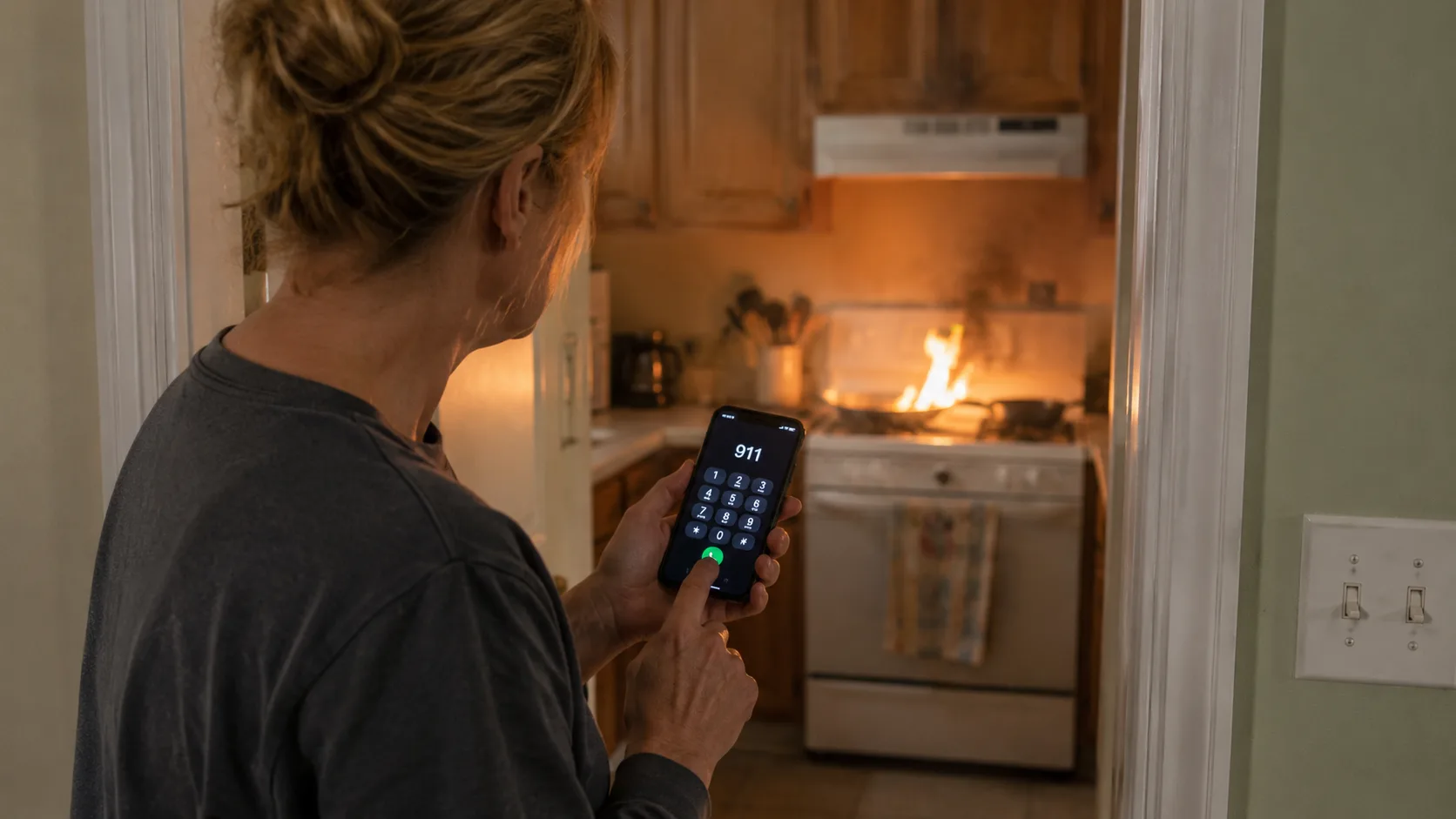
- You are using the wrong class extinguisher for the fire. An ABC extinguisher on a large grease fire can cause violent re-ignition as the pressure disperses burning oil. No extinguisher at all on a gas-fed fire — shut off the gas supply first.
- Anyone is still in the building who has not evacuated. Getting everyone out is always the first priority. No extinguisher attempt is worth staying in a building with fire while others are still inside.
The decision to fight or flee must be made before you pick up the extinguisher. If any of the above conditions are present, the decision is already made: leave. Do not pick up the extinguisher, attempt one squeeze, reassess, and then decide. Make the assessment before reaching for it. One condition on the list above means you walk to the exit, not to the extinguisher.
How to Inspect Yours Right Now
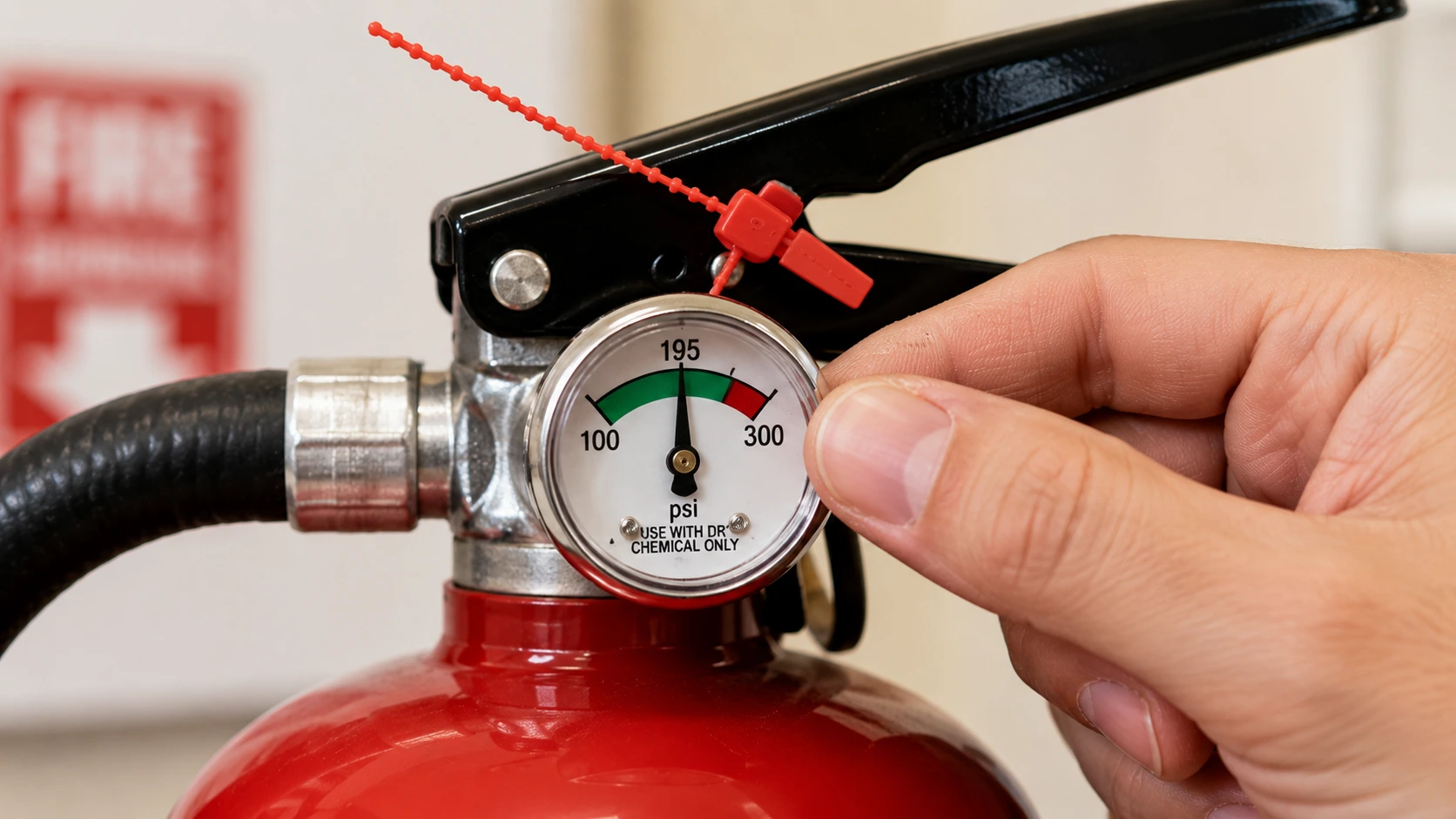
A fire extinguisher that is not inspected is an extinguisher you cannot trust when you need it. Monthly inspection takes 60 seconds:
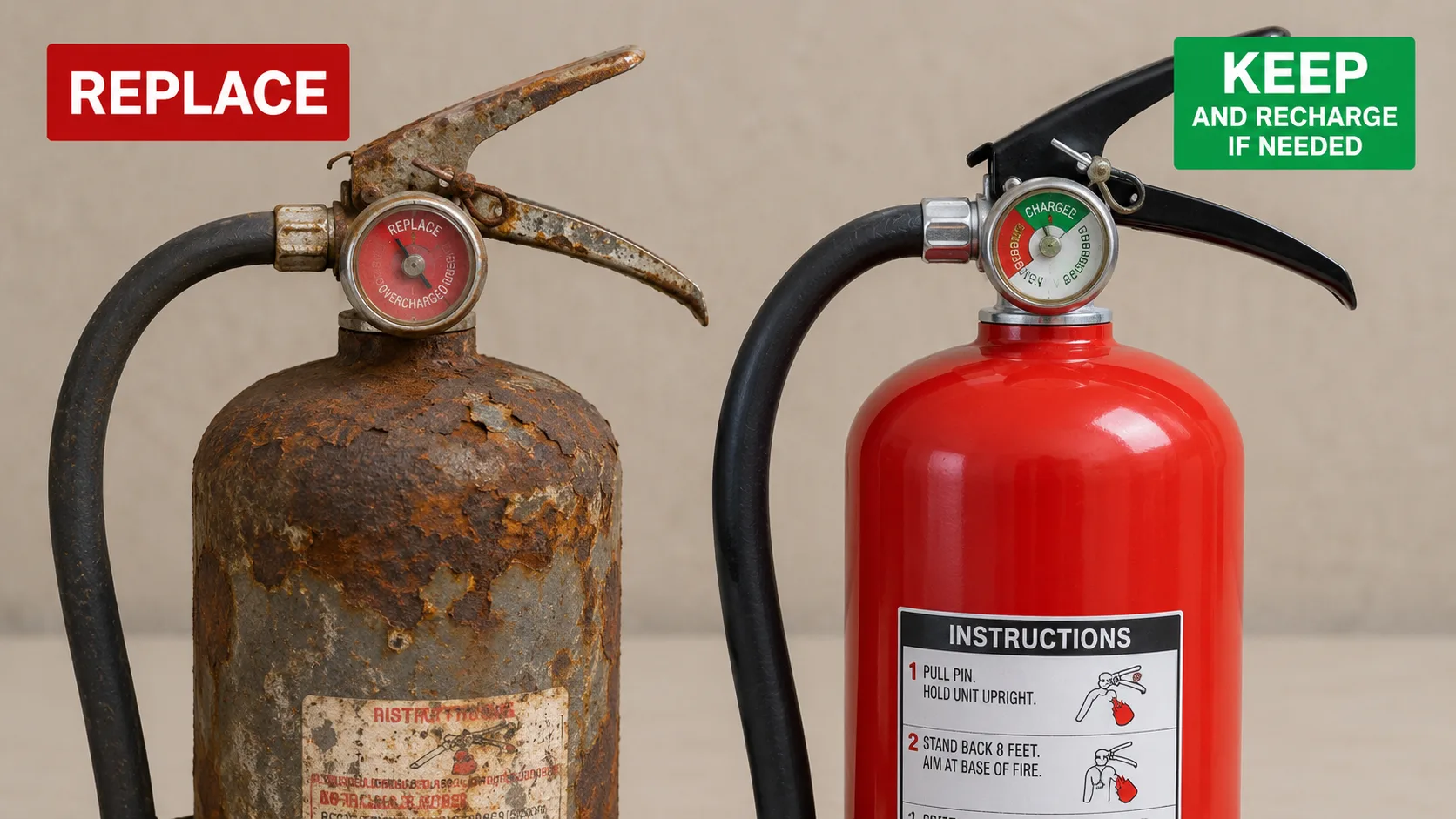
- ✓Pressure gauge needle in the green zone. Most extinguishers have a pressure gauge with a green zone (adequate pressure), red on the left (undercharged), and red on the right (overcharged). The needle should be solidly in the green. If it is in the red — the extinguisher needs recharging or replacement before it will work reliably.
- ✓Safety pin intact with tamper seal. The pin should be in place with an unbroken plastic or wire tamper seal. If the pin has been pulled and re-inserted, or if the seal is broken, the extinguisher may have been partially discharged — have it inspected.
- ✓No visible damage. No dents, corrosion, leaking, or cracked hose. A physically damaged extinguisher may not perform as rated.
- ✓Accessible and visible. Not behind things, not stored in a cabinet that takes two steps to open, not covered with kitchen equipment. The extinguisher has to be reachable in five seconds.
- ✓Label readable. The operating instructions on the label must be legible. If the label has worn off or is unreadable, replace the unit.
Annual and long-term service
NFPA 10 (Standard for Portable Fire Extinguishers) recommends annual professional inspection for all fire extinguishers. Most residential owners do not do this — at minimum, inspect it yourself monthly and replace or recharge every 6 years for dry chemical units. Hydrostatic testing (pressure testing the cylinder) is required every 12 years for most types. Check the label for the specific service interval for your extinguisher type.
An extinguisher that has been used — even partially discharged — must be recharged or replaced before being returned to service. A partially discharged extinguisher will not perform as expected the next time it is needed. Either take it to a fire equipment service company for recharging or replace it with a new unit.
Where to Put It So You Can Actually Get to It
The extinguisher that matters is the one you can reach in five seconds, from the direction of your exit, without moving toward the fire. That sounds obvious but it eliminates most of the places people actually store them.
- Kitchen extinguisher: On the wall near the kitchen exit — not next to the stove. If the fire is on the stove, reaching an extinguisher that is next to the stove means walking toward the fire. Mount it on the wall 10 to 15 feet from the stove, near the door out of the kitchen.
- Garage extinguisher: Near the garage entrance to the house — not on the far wall near the work area. You want to be able to grab it as you assess the situation from the doorway, not after you have walked into the garage past the problem.
- Multi-story home: One per floor, in an accessible location on each level.
- Mounting height: Handle no higher than 5 feet for large units (10 lbs and above), no higher than 3.5 feet for smaller units. Low enough that anyone in the household can reach it.
After You Use One
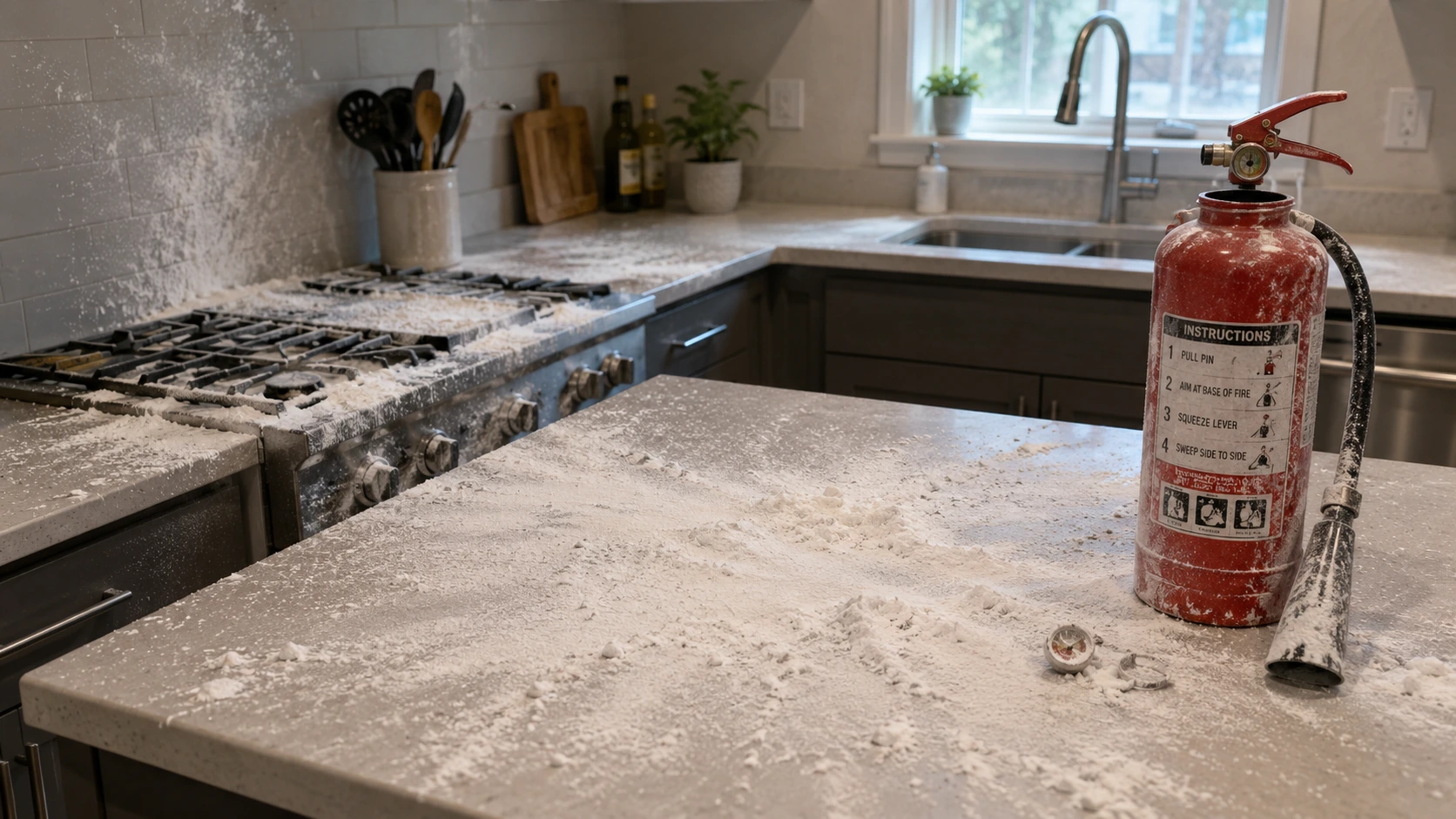
- Replace or recharge immediately. A used extinguisher — even one that was only briefly discharged — goes to a fire equipment service company for recharge or gets replaced with a new unit. It does not go back on the wall.
- Dry chemical residue is corrosive. The dry chemical agent from an ABC extinguisher is mildly corrosive to metal surfaces, electronics, and food. Clean it up promptly from all surfaces it contacted. For kitchens: anything the agent contacted should be cleaned before using — the agent is not food-safe.
- Ventilate the area. Dry chemical and CO2 both displace oxygen. Open windows and doors after extinguisher use and do not re-enter a heavily discharged area without ventilation.
- Even if the fire appeared completely out — call 911 anyway. Fire in a home can re-ignite from residual heat, from embers inside walls, or from material that was heated without reaching ignition temperature initially. Let firefighters confirm the fire is out and inspect for any extension before you close the situation.
Fire Prevention Week 2026: Fire extinguisher knowledge works best as part of a larger home-safety plan. See the 2026 Fire Prevention Week guide for this year’s lithium-ion battery and safe-charging focus.
Comments 0
No comments yet. Be the first to share your thoughts!
Leave a Comment