
Trench collapse is one of the deadliest construction hazards in the United States. OSHA reports that trench collapses kill more than 100 workers per year, and the fatality rate for trench rescue rescuers who enter without proper protection is extremely high. An unstable trench that collapsed once will collapse again — and the second collapse is often triggered by the vibration and weight of rescuers entering the excavation. This guide covers the awareness and Operations-level framework for trench rescue: soil classification, collapse hazards, protective systems, and the initial response actions that protect rescuers while awaiting technical rescue teams.
Never enter an unprotected trench. An unprotected trench that has already collapsed is at extreme risk of secondary collapse. Entry by an untrained rescuer without protective systems kills rescuers. Establish the perimeter, remove bystanders, request technical rescue, and protect the victim from above until a protected entry is established by trained Technicians.
Why Trenches Collapse: The Physics
A trench is dangerous because of the lateral pressure that soil exerts on the trench walls. Soil is heavy — a cubic foot of moist soil weighs approximately 100 pounds. A section of trench wall 4 feet high by 10 feet long contains roughly 4,000 pounds of lateral load bearing against the open face of the trench. When that load exceeds the shear strength of the soil, the wall fails.
Key factors that accelerate collapse:
Depth: Lateral pressure increases with depth. A 5-foot trench with stable soil may be temporary without shoring; a 10-foot trench in the same soil requires protective systems by law.
Surcharge loads: Any weight at the top edge of the trench (excavated soil pile, equipment, vehicles) adds to the lateral pressure on the wall. Surcharge loads are a primary cause of trench collapse at construction sites.
Water: Water saturates soil, dramatically reduces its cohesion (stickiness), and can trigger sudden collapse. After rain or in high-water-table areas, even previously stable trenches can fail suddenly.
Vibration: Construction equipment, traffic, and even foot traffic near the trench edge can trigger collapse in marginal soil conditions. A running pump, a passing truck, or rescuers walking on the trench edge can be the trigger for a secondary collapse.
Previous disturbance: Soil that has been previously excavated and backfilled (utility corridors, road cuts) has less strength than undisturbed native soil. Trenches in previously excavated areas are at higher collapse risk.
Soil Classification: What Type A, B, and C Mean
OSHA classifies soil in four categories based on cohesive strength and stability. This classification determines what protective system is required:
Class
Description
Examples
Max safe slope (simple)
Stable Rock
Natural solid mineral matter; can be excavated with vertical sides; does not change when exposed to moisture
Solid granite, limestone, sandstone
Vertical — 90°
Type A
Cohesive soil with unconfined compressive strength ≥1.5 tsf; undisturbed; not fissured, not subject to cracking or vibration
Clay, silty clay, sandy clay in good condition
3/4:1 (53°)
Type B
Cohesive soil with unconfined strength 0.5–1.5 tsf; OR previously disturbed soil; OR subject to vibration; OR fissured or seeping water
Cohesive soil with strength <0.5 tsf; OR granular soil; OR flowing conditions; OR submerged soil
Sand, gravel, loamy sand; soil with visible water seepage; soil in a state of flow
1.5:1 (34°)
When in doubt, classify as Type C. On a rescue scene, rescuers rarely have time for formal soil testing. Any soil that does not clearly meet the requirements of Type A should be treated as Type C (most restrictive, requiring the most protective slope or shoring). Err toward safety.
Simple field tests for soil classification
Thumb penetration test: Press your thumb firmly into the soil. Cannot penetrate at all = likely Type A. Penetrates with effort = likely Type B. Penetrates easily = likely Type C.
Visual indicators of Type C: Visible water seeping into the trench; cracking or sloughing of trench walls; granular, loose, flowing soil; soil from a previously excavated utility corridor.
Visual indicators of Type B: Fissures (cracks) running parallel to the trench edge; angular or uneven trench wall face; some seepage but not flowing.
Common Trench Collapse Patterns
Collapse type
Description
Victim situation
Spoil pile slide
Excavated soil piled too close to the trench edge slides into the trench
Victim buried under loose soil; may be partially accessible
Wall shear
One or both walls fail and shear down into the trench floor
Victim crushed between wall and opposite face or trench floor
Cave-in (progressive)
Initial wall failure causes progressive collapse of additional soil from above
Victim buried progressively deeper as secondary collapse continues
Kickout
Bottom of the trench wall kicks outward; top of the wall falls inward
Victim caught between rotating wall face and trench floor
Active flow
Granular soil (sand, gravel) flows continuously into the trench like water
Victim buried rapidly in flowing soil; extremely difficult rescue
OSHA Excavation Standards (29 CFR 1926 Subpart P)
OSHA's excavation standards apply to any excavation more than 5 feet deep in which a person may enter. Key requirements:
Any excavation 5 feet or deeper that a person will enter requires a protective system unless the excavation is in solid rock
Any excavation 20 feet or deeper requires a protective system designed by a Registered Professional Engineer
A competent person must classify the soil before any worker enters the excavation
Excavated material (spoil) must be kept at least 2 feet from the trench edge
An access/egress ladder must be within 25 feet of any worker in the trench
When you arrive at a trench rescue and find no protective systems and workers who entered without training, you are looking at a workplace that violated OSHA standards. This means the trench was treated as safe when it was not. Do not replicate that mistake by entering without protection.
Cutting the trench wall back at an angle that matches the soil's natural angle of repose. No physical support system is required — the geometry of the cut prevents collapse. The required slope angle depends on soil classification (Type A: 3/4:1, Type B: 1:1, Type C: 1.5:1). Sloping is the simplest protective system but requires significant space and moves substantial additional soil.
Benching
Cutting a series of horizontal steps (benches) into the trench wall, reducing the effective wall height at any given level. Only permitted in Type A or B soils; not permitted in Type C or layered soils.
Shoring
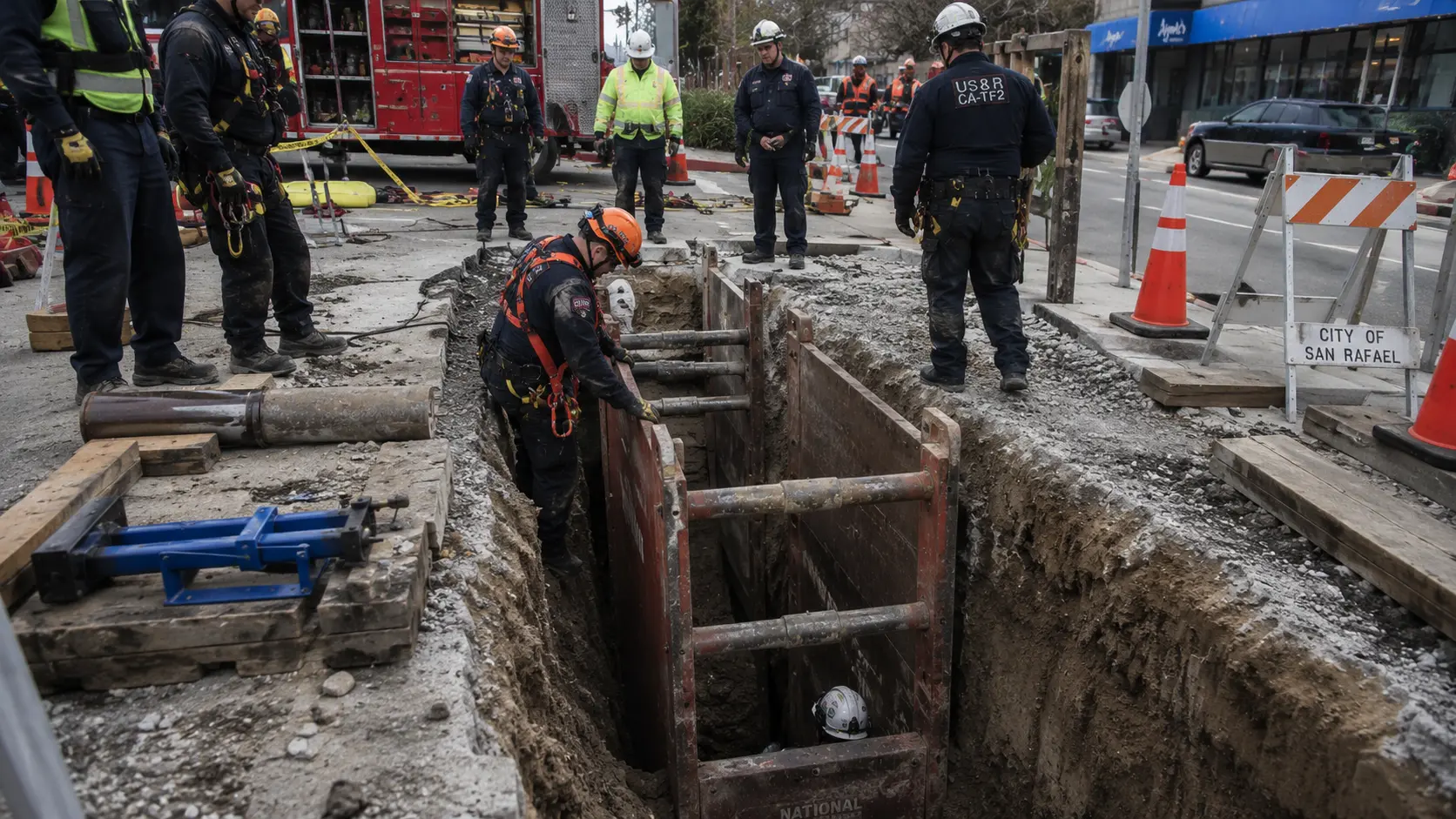
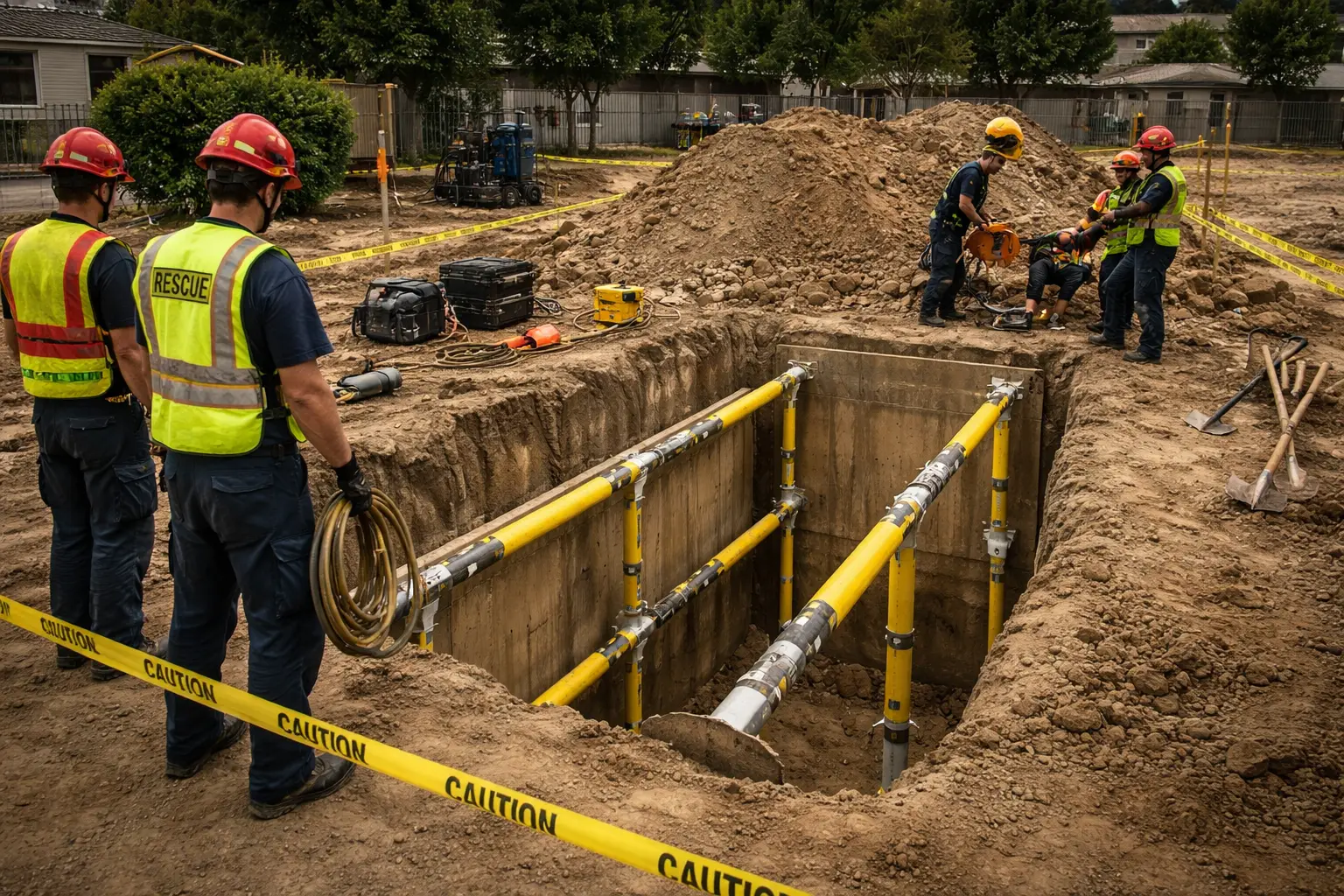
Installing a structural support system (timber, hydraulic, pneumatic, or screw-type shores) against the trench wall to prevent lateral movement. Shoring transfers the lateral soil load to the support structure rather than relying on soil strength. The most versatile protective system for rescue operations because it can be installed incrementally as rescue progresses.
Types used in rescue:
Pneumatic shores (air shores): Aluminum cylinders inflated with air to span the trench and press against opposing walls. Fast to install, adjustable, and the most common technical rescue shoring system.
Hydraulic shores: Similar to air shores but use hydraulic pressure. Heavier but higher load capacity.
Timber shoring: Traditional dimensional lumber cross-bracing. Slower to install but available with standard materials.
Shielding (trench box)
A prefabricated steel or aluminum box lowered into the trench that protects workers within its boundaries. Does not prevent collapse — it protects workers inside from a collapse. Trench boxes are widely used in construction but are typically too large and slow to deploy for rescue operations where the victim's location may be difficult to access.
Initial Response Actions
1
Establish a perimeter and remove everyone from the trench edge. Bystanders and coworkers standing at the edge add surcharge load and vibration. Clear all non-essential personnel at least 50 feet from the trench edge. Foot traffic near the edge is a secondary collapse trigger.
2
Shut down all heavy equipment and vehicles near the excavation. Vibration from running equipment is a documented secondary collapse trigger. Turn off everything within 50–100 feet of the excavation.
3
Request technical rescue immediately. Do not wait to see if you can rescue the victim without technical resources. Trench rescue requires Technician-level training and equipment. Get the resource request out early.
4
Assess victim status from the edge if possible. Can you see or hear the victim? Are they responsive? What portion of the body is buried? This information helps plan the rescue approach without entering the trench.
5
Atmospheric monitoring. Trenches may have hazardous atmospheres from decomposing organic material, natural gas lines, or oxygen displacement. Test the atmosphere at the trench level before any entry.
6
Shore the spoil pile if accessible. Excavated soil piled at the trench edge is one of the most common secondary collapse triggers. If it can be moved away from the edge or stabilized without anyone approaching the trench wall, do so.
Secondary Collapse Prevention
Secondary collapse is the primary cause of rescuer death in trench operations. Every action on scene must be evaluated for its effect on collapse risk:
Keep all personnel (including firefighters and rescue team members) at least 50 feet from the edge until protective systems are in place
Conduct all communications and briefings away from the edge
Do not use pneumatic or power tools near the trench without a technical rescue supervisor directing their use
Establish a designated vibration-control zone and enforce it
Assign a dedicated safety officer who monitors only the trench walls and edge conditions throughout the operation
Establish an evacuation signal (air horn, code word) and brief all personnel on its meaning before operations begin
Victim Care Approaches
While awaiting technical rescue, limited care may be provided from above the trench or from a protected position:
Verbal reassurance: Maintain voice contact with the victim. Keep them calm and still. Movement by the victim can trigger additional soil movement.
Airway protection: If loose soil is near the victim's face, passing a small tool or tube to the victim to clear an airway space may be possible without entry.
Do not attempt to pull the victim free. A victim buried in soil may be under compressive load — pulling without removing the soil load can cause traumatic injury (degloving, vascular injury, traumatic asphyxia release).
Hypothermia prevention: Soil contact over time causes significant heat loss. If the rescue will be extended and the victim is accessible, passing a blanket over their upper body reduces heat loss without disturbing the soil.
Frequently Asked Questions
What is the most dangerous thing to do in a trench rescue?
Entering the trench without a protective shoring system in place. A trench that has already collapsed is at extreme risk of secondary collapse triggered by vibration, weight, or time. An untrained rescuer who enters to reach the victim becomes a second victim in the majority of cases where secondary collapse occurs during unprotected entry.
What is soil Type C in trench rescue?
Type C is the least stable soil classification in the OSHA system: unconfined compressive strength below 0.5 tsf; granular, sandy, or gravelly soils; soil with visible water seepage or active flow; previously disturbed soil. Type C requires the most protective slope (1.5:1 ratio) or shoring. When soil type is uncertain on a rescue scene, treat it as Type C.
How fast can a trench collapse?
A trench wall failure can occur in less than a second. The collapse itself is nearly instantaneous — there is no warning sound that allows time to react. A worker who is in the trench when a wall fails typically has no opportunity to escape. This is why no one should be in a trench without a protective system in place, regardless of how stable the walls appear.
What is an air shore in trench rescue?
An air shore is a pneumatic shoring device — an aluminum cylinder that is inflated with compressed air to span the width of the trench and press against opposing walls. Air shores are the most commonly used shoring system in technical trench rescue because they are fast to install, lightweight, and adjustable to trench width. They require Technician-level training to install correctly and safely.