Building Construction Types I–V: Complete Firefighter Guide to Collapse Risk, Fire Spread & Tactical Decisions
Building construction is the foundation of every size-up decision you make. Knowing whether you are inside a Type I concrete high-rise or a Type V lightweight wood frame changes everything: how long you have before structural failure, how fire will travel, where collapse is most likely, and whether offensive operations are defensible. This guide covers all five NFPA 220 construction types from a firefighter's operational perspective.
Jump to:Why it matters · Type I — Fire Resistive · Type II — Non-Combustible · Type III — Ordinary · Type IV — Heavy Timber · Type V — Wood Frame · Side-by-side comparison · Lightweight construction warning · How to ID construction type on arrival · FAQ
Why Building Construction Matters on the Fireground
As Francis Brannigan put it: "The building is your enemy." Every structural element that supports a building under normal load behaves differently under fire conditions. Heat degrades steel, burns wood, and can cause catastrophic failure at times no one can precisely predict. Your construction type knowledge tells you:
- How long you have before structural failure becomes probable
- Where fire will travel — through void spaces, concealed cavities, open floor plans
- What collapse mode is most likely — pancake, lean-to, V-shape, wall separation
- Whether offensive interior attack is defensible at a given stage of the fire
- Where to position exposures and establish collapse zones
The modern construction hazard: Engineered lumber (LVL beams, I-joists, OSB), truss systems, and synthetic adhesives fail far faster than dimensional solid lumber under fire conditions. A building labeled "wood frame" (Type V) built in 1960 behaves very differently from one built in 2015 using the same classification.
Type I — Fire Resistive Construction
Also called: "Fireproof" construction (a misnomer — nothing is truly fireproof)
Structural materials: Reinforced concrete, protected steel. Structural members coated with spray-applied fireproofing, gypsum, or encased in concrete.
Fire resistance ratings: Highest of all five types. Structural frame rated 3–4 hours. Floor/roof assemblies 2–3+ hours depending on subtype (IA vs. IB).
Where you find it: High-rise office buildings, hospitals, hotels, modern apartment towers, parking structures.
Firefighter tactical considerations
- Contents drive the fire, not the structure. In a true Type I building, the fire load is the furniture, ceiling tiles, HVAC equipment, and stored materials — not the structure itself. Fire spread is compartment-to-compartment via openings, HVAC systems, and utility penetrations.
- Time is on your side early. Structural failure is unlikely in the early stages of a working fire. This supports offensive interior operations with standpipe systems where applicable.
- Steel loses strength at 1,000°F. Even in Type I buildings, unprotected steel elements (added during renovation, or where fireproofing has been damaged) can fail. Never assume complete protection throughout an older Type I structure.
- High-rise concerns: Smoke movement via stack effect, HVAC systems, and elevator shafts. Evacuation, stair pressurization, and floor-by-floor attack operations require specific protocols. Use the PDP Calculator for standpipe pressure calculations.
- Renovation risk: Many Type I buildings have been renovated with lightweight wood interior elements. The exterior rating doesn't tell you what's inside.
Type II — Non-Combustible Construction
Also called: Non-combustible, protected or unprotected steel
Structural materials: Steel framing, metal deck roofs, concrete masonry unit (CMU) walls. Structural members may be unprotected (IIB) or have limited protection (IIA).
Fire resistance ratings: Less than Type I. Type IIB has zero fire resistance rating for structural members — unprotected steel is directly exposed.
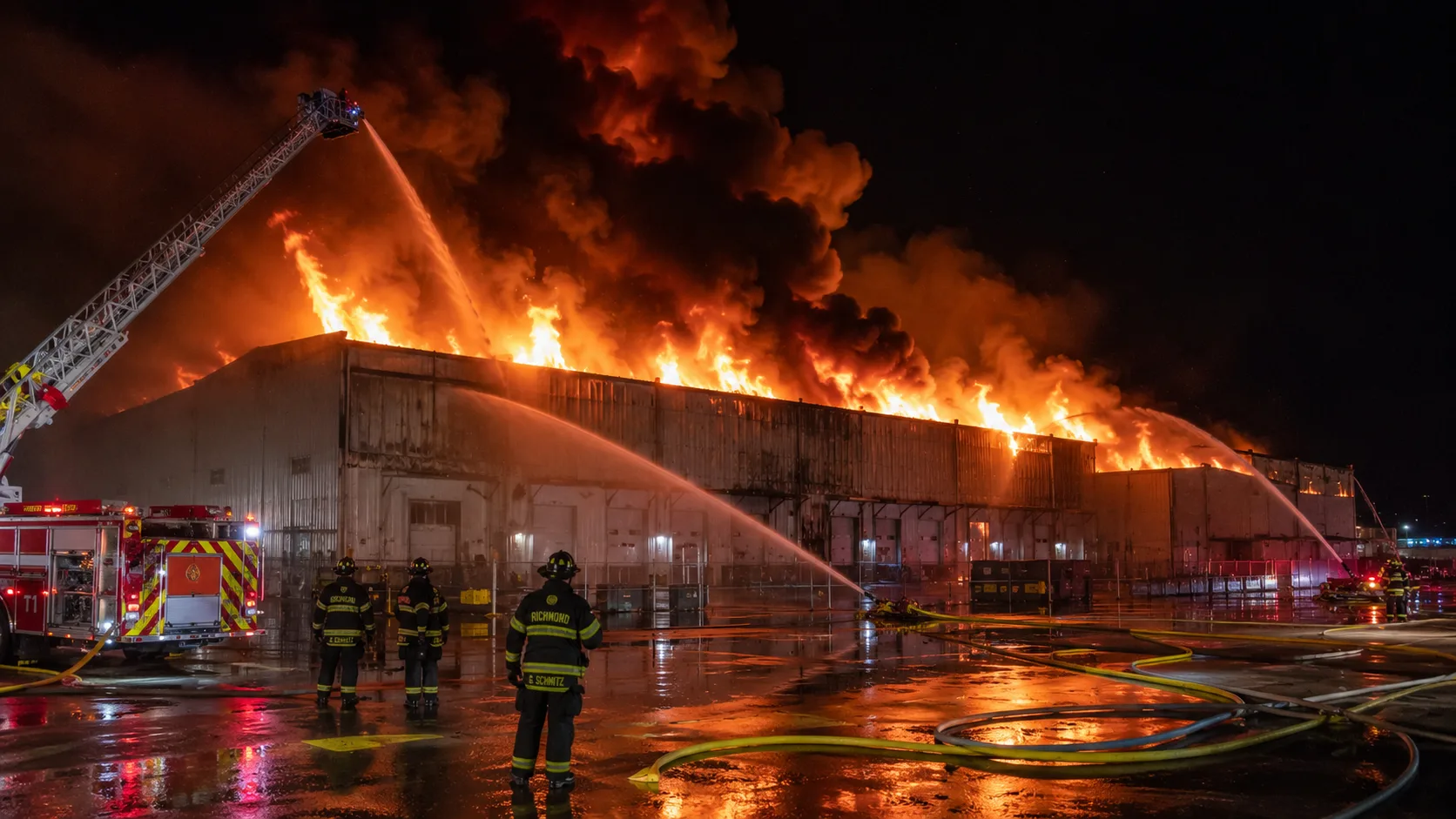
Where you find it: Strip malls, big-box retail stores, warehouses, schools, newer commercial buildings, churches.
Firefighter tactical considerations
- Unprotected steel fails fast and unpredictably. Steel expands and loses load-bearing capacity rapidly above 1,000°F. A Type IIB building with an established working fire can collapse with very little warning.
- Roof collapse is the primary kill zone. Metal deck roofs on open-web bar joists are one of the most dangerous assemblies in the fire service. Bar joist roofs can fail catastrophically when the joist welds soften. This is the construction type responsible for numerous firefighter LODDs.
- Built-up roofing materials ignite. Foam insulation, asphalt, and felt paper on metal deck roofs can create a separate fire above and below the roof deck, trapping and killing firefighters who are ventilating.
- Recognize it from the exterior: Metal cladding panels, CMU walls, unadorned commercial construction. From inside: visible steel at ceiling level, no fire-resistive wrap on structural members.
- Defensive posture threshold: Any established fire in a Type IIB occupancy with a metal deck roof warrants serious consideration of a defensive posture before committing personnel to the roof.
LODD pattern: Bar joist collapse in big-box retail and strip mall fires has killed dozens of firefighters. If the fire has been burning for any duration in a Type II occupancy with a metal deck roof, treat the roof as potentially compromised before personnel go up.
Type III — Ordinary Construction
Also called: Ordinary, brick-and-joist, mill construction
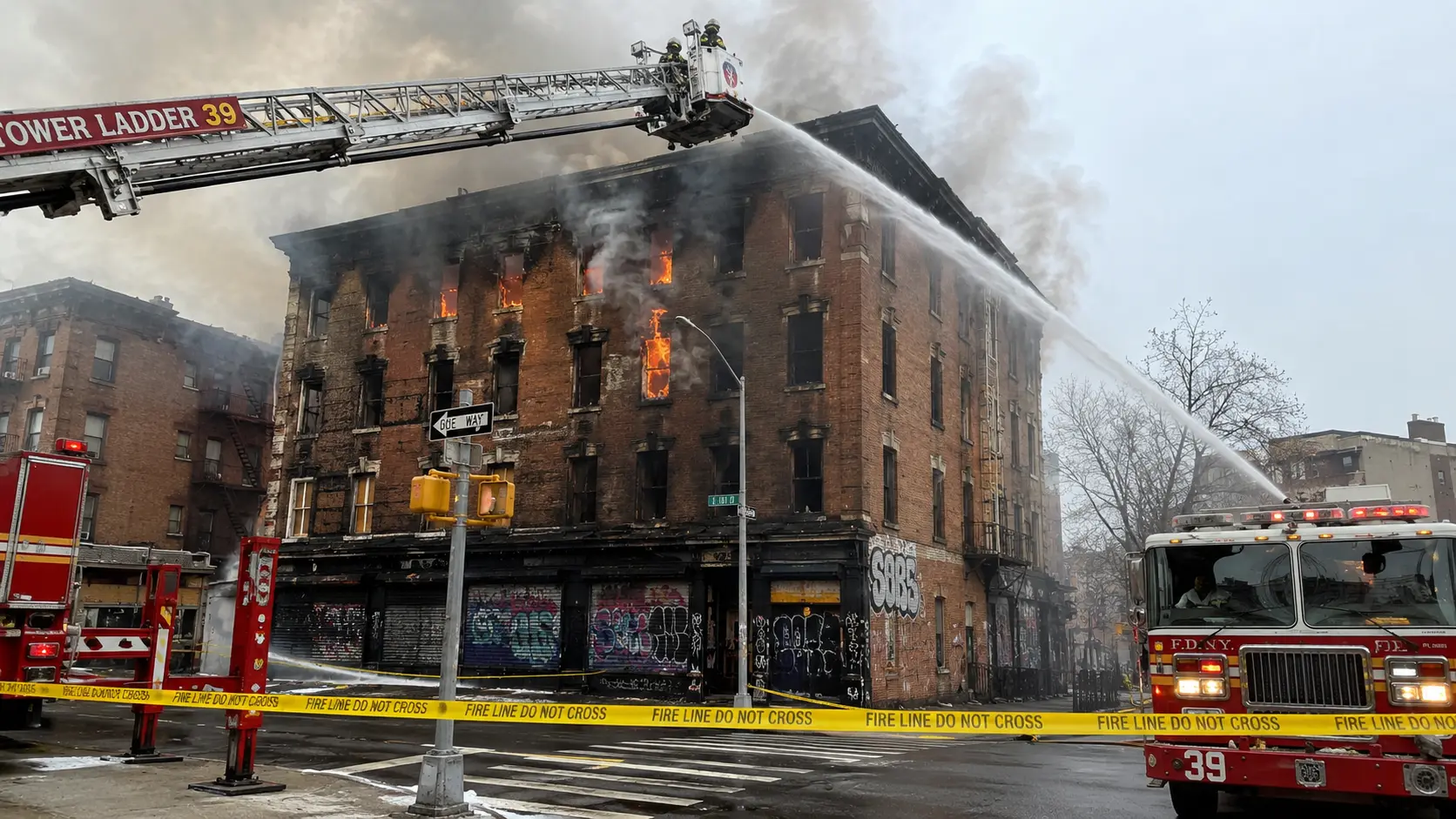
Structural materials: Masonry exterior walls (brick, block, stone). Wood interior structural members — beams, joists, floors, roof systems. Interior may be entirely combustible.
Fire resistance ratings: Exterior walls non-combustible; interior elements have little to no fire resistance rating in Type IIIB (unprotected).
Where you find it: Downtown commercial districts, older storefronts, row houses, 2–6 story older commercial buildings, renovated warehouses.
Firefighter tactical considerations
- The walls stay up; the inside comes down. Masonry exterior walls are designed to outlast interior fire. Fire-cut joists (joists notched to fall inward without taking the wall) allow interior collapse while the shell remains standing — trapping firefighters inside.
- Concealed spaces are major fire travel paths. Void spaces between old plaster ceilings and roof decking, inside balloon-frame party walls, and between floors allow fire to travel unseen through the building. Fire that appears contained at one floor may already be in the attic or adjacent unit.
- Collapse zones extend beyond the building footprint. In a Type III building, falling masonry walls and parapets create collapse zones that can extend 1.5× the building height from the wall. Position apparatus accordingly.
- Standpipe and exposure protection priority. In commercial strips with party walls, fire can spread building-to-building through shared wall voids. Exposure protection is often as important as direct attack.
- Renovation hazard: Many Type III buildings have been renovated with Type V interior components (lightweight trusses replacing solid wood joists). You cannot tell from the exterior. Pre-incident planning is essential.
Type IV — Heavy Timber Construction
Also called: Heavy timber, mill construction (older usage)
Structural materials: Large dimension solid or laminated wood members. Columns and beams must be at least 8×8 inches; floors 6+ inches thick. No concealed spaces — all structural members are exposed.
Fire resistance ratings: Large mass means slow ignition and long burn time before failure. No concealed spaces limits fire spread pathways.
Where you find it: Old factory and mill buildings, some churches, renovated loft spaces, some modern mass timber (CLT) buildings.
Firefighter tactical considerations
- Large mass = long collapse time. Heavy timber burns slowly and loses strength gradually. An early-stage fire in a true Type IV building gives firefighters more time for offensive operations than Types II, III, or V — but do not overestimate this window.
- Modern mass timber (CLT) changes the equation. Cross-Laminated Timber uses adhesive-laminated layers. The adhesive can degrade under heat, causing CLT panels to delaminate and fail faster than solid timber. New Type IV buildings with CLT require updated tactical assumptions.
- Massive heat release during advanced fire. Once heavy timber is fully involved, it produces enormous amounts of heat and poses serious exposure problems. Defensive operations require significant water supply.
- No concealed spaces is an advantage. Fire cannot travel through hidden voids in true heavy timber construction. What you see is what you get — fire is visible and can be tracked.
- Water demand is very high. Once heavy timber is burning, volume is everything. Use the Fire Flow Calculator to estimate needed fire flow early in your pre-incident planning.
Type V — Wood Frame Construction
Also called: Wood frame, combustible construction
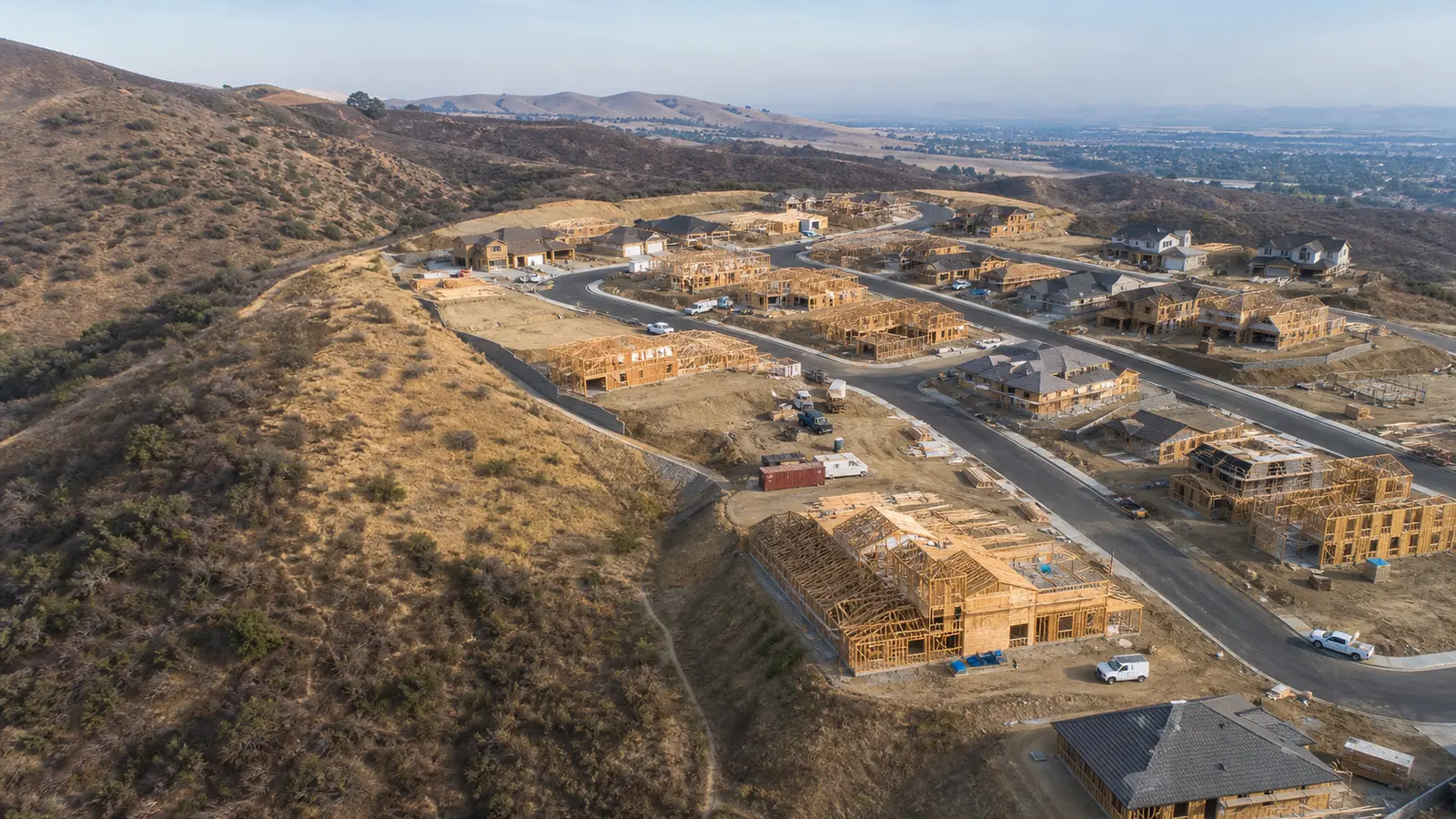
Structural materials: All exterior walls, interior walls, floors, roofs, and structural supports may be wood or other approved combustible materials. Most common in residential construction.
Fire resistance ratings: Lowest of all five types. No inherent fire resistance in structural members without added protection (gypsum, sprinklers).
Where you find it: Single-family homes, apartments up to 7 stories, townhouses, older commercial buildings, most of the residential building stock in the U.S.
Firefighter tactical considerations
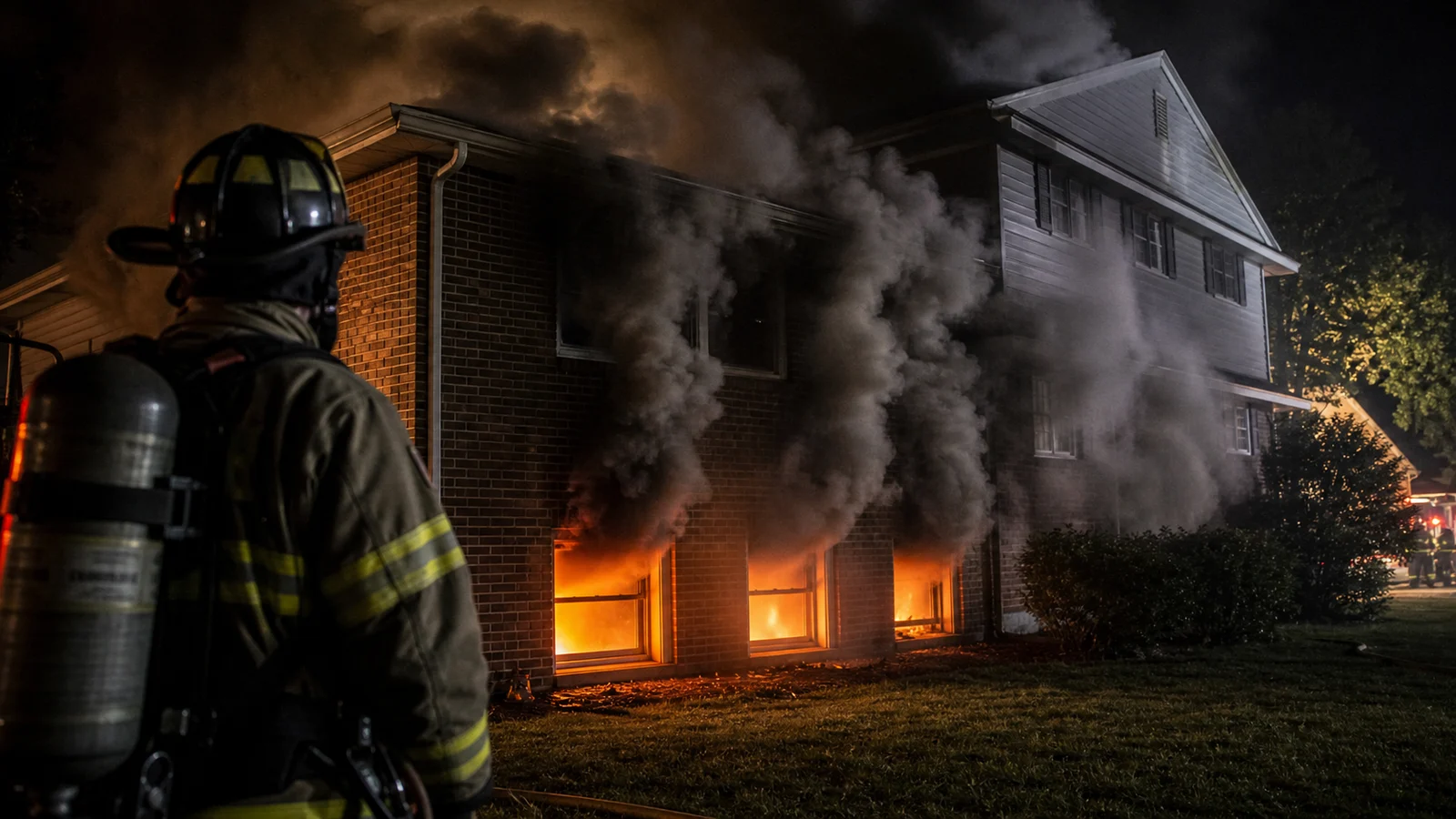
- Most of your residential fires are Type V. This is the construction type you will encounter most often. It is also the most forgiving to work in early — and the most dangerous once fire is established in the structure.
- Lightweight construction is the critical variable. Older Type V buildings used 2×10 dimensional lumber floor joists. Modern Type V uses engineered I-joists, OSB, and lightweight trusses. Lightweight floor assemblies can fail in under 5 minutes of direct fire exposure. A floor that looks solid can give way without warning.
- Balloon frame vs. platform frame: Balloon frame (pre-1940s) has continuous wall studs from foundation to roof with no fire stops — fire travels vertically from basement to attic through wall cavities instantly. Platform frame (modern) has horizontal fire stops at each floor level, slowing vertical travel.
- Truss roof systems are common and dangerous. Lightweight wood trusses used in modern roof construction rely on metal connector plates at the joints. These plates can pull free under heat load before the wood members themselves ignite. Roof collapse can occur with fire still in early stages.
- Thermal imaging is essential. In a Type V building, fire can be traveling through multiple void spaces simultaneously without visible flames. TIC use during size-up, search, and overhaul is not optional.
Lightweight construction rule: If you cannot confirm that a building uses dimensional solid lumber (not engineered wood), treat floors and roofs as potentially lightweight construction. The consequences of being wrong are fatal.
Side-by-Side Comparison: All Five Types
| Type | Common name | Exterior walls | Interior structure | Collapse risk (established fire) | Typical structures |
|---|---|---|---|---|---|
| I | Fire Resistive | Concrete / protected steel | Reinforced concrete, protected steel | Low (early) — renovation risk | High-rise, hospitals, modern towers |
| II | Non-Combustible | Metal, CMU, masonry | Unprotected steel, metal deck roofs | HIGH — fast, catastrophic | Big-box retail, strip malls, warehouses |
| III | Ordinary | Masonry (brick/block) | Wood joists, beams, floors | High (interior) — wall separation risk | Downtown commercial, row buildings |
| IV | Heavy Timber | Masonry or heavy timber | Large dimensional solid wood (≥8×8) | Moderate — slow failure, high heat | Old factories, mills, churches |
| V | Wood Frame | Any combustible material | Wood — dimensional or lightweight | HIGHEST (lightweight) — rapid failure | Single-family homes, apartments |
The Lightweight Construction Warning Every Firefighter Needs to Know
The single most important construction-related development in the modern fire service is the shift from dimensional solid lumber to engineered lightweight construction. This affects Types III, IV, and V buildings and has fundamentally changed collapse timelines.
Why lightweight construction is more dangerous
- Reduced mass = faster ignition and failure. An engineered wood I-joist has far less material than a solid 2×10 joist. It reaches ignition temperature faster and loses structural integrity sooner.
- Adhesive failure. Engineered lumber uses adhesives that can vaporize or degrade at lower temperatures than the wood itself burns. This causes delamination and connection failure without visible flame involvement.
- Metal connector plates in trusses. When the metal plate heats up, it acts as a heat sink, charring the wood at the connection point faster than the member itself. The truss can pull apart at the joint while the individual members appear only lightly charred.
- UL research data: Studies by Underwriters Laboratories found that lightweight wood assemblies can fail in as little as 5–6 minutes of direct fire exposure — compared to 18–20 minutes for comparable dimensional lumber assemblies.
Practical rule: Treat any floor or roof you cannot verify as solid dimensional lumber as potentially lightweight. If you see engineered lumber at any point (I-joist flanges, OSB sheathing, gang-nail truss plates), assume the entire assembly may behave as lightweight under fire conditions.
How to Identify Construction Type on Arrival
You will not always know the construction type before arrival. Here is a rapid field identification approach:
| What you see | Likely type | Key tactical implication |
|---|---|---|
| Concrete high-rise, glass curtain walls, no visible structural steel | Type I | Contents fire — standpipe operations; check for renovation work |
| Metal panel walls, metal deck visible at parapet, big-box format | Type II | Bar joist roof — treat as collapse risk early; no roof operations in established fire |
| Brick exterior, wood cornices, downtown commercial building pre-1970 | Type III | Void space fire travel; collapse zone 1.5× building height from walls |
| Exposed heavy timbers visible through windows, old mill or factory building | Type IV | Long collapse window but massive heat; CLT = reassess |
| Single-family home, apartment, siding exterior, residential scale | Type V | Check age: pre-1980 = likely dimensional; post-1995 = likely lightweight |
Frequently Asked Questions
What are the 5 types of building construction in firefighting?
Type I (Fire Resistive), Type II (Non-Combustible), Type III (Ordinary), Type IV (Heavy Timber), and Type V (Wood Frame). These classifications come from NFPA 220 and are used across the U.S. fire service to predict fire spread and collapse risk.
Which building construction type is most dangerous for firefighters?
Type II (Non-Combustible) with unprotected steel and metal deck roofs produces the most sudden catastrophic collapses. Type V with lightweight construction is responsible for the most residential firefighter deaths due to rapid floor and roof failure. Both represent significant threats for different reasons.
What is the difference between Type I and Type II construction?
Both use non-combustible materials, but Type I has higher fire resistance ratings (3–4 hours on structural members) because the steel and concrete are protected with spray-applied fireproofing or encasement. Type II, particularly Type IIB, has unprotected steel — which means structural members can fail rapidly when exposed to fire without any protective coating.
What is balloon frame construction and why is it dangerous?
Balloon frame is a pre-1940s wood framing method where wall studs run continuously from foundation to roof with no horizontal fire stops between floors. Fire entering the wall cavity at the basement level can travel to the attic in seconds through this continuous void space. It is one of the most dangerous void space fire travel conditions in residential firefighting.
How do you identify lightweight construction on scene?
Look for I-joist flanges visible in crawl spaces or basements, OSB sheathing (rather than solid plywood or boards), gang-nail truss plates, and the building's age. Most residential construction after the mid-1990s uses engineered lightweight components. Pre-incident planning, size-up, and TIC use help identify it before firefighters commit to interior operations.
Comments 0
No comments yet. Be the first to share your thoughts!
Leave a Comment