

Fire Sprinkler Systems: How They Work, Types, and What Firefighters Need to Know
Automatic fire sprinklers are the most effective structural fire suppression technology ever deployed. In buildings with working sprinkler systems, fire death rates drop by approximately 80–88% compared to unprotected buildings of the same type. Despite this, many firefighters do not fully understand how sprinklers work, what types exist, or how to support a sprinkler system during fireground operations. This guide covers sprinkler fundamentals, system types, activation mechanics, and the firefighter's role in a sprinklered building fire.
Jump to:How sprinklers work · Individual sprinkler activation · System types · Wet pipe systems · Dry pipe systems · Deluge and pre-action · Fire company response to sprinkler systems · Fire department connection (FDC) · Impaired systems · FAQ
How Automatic Fire Sprinklers Work
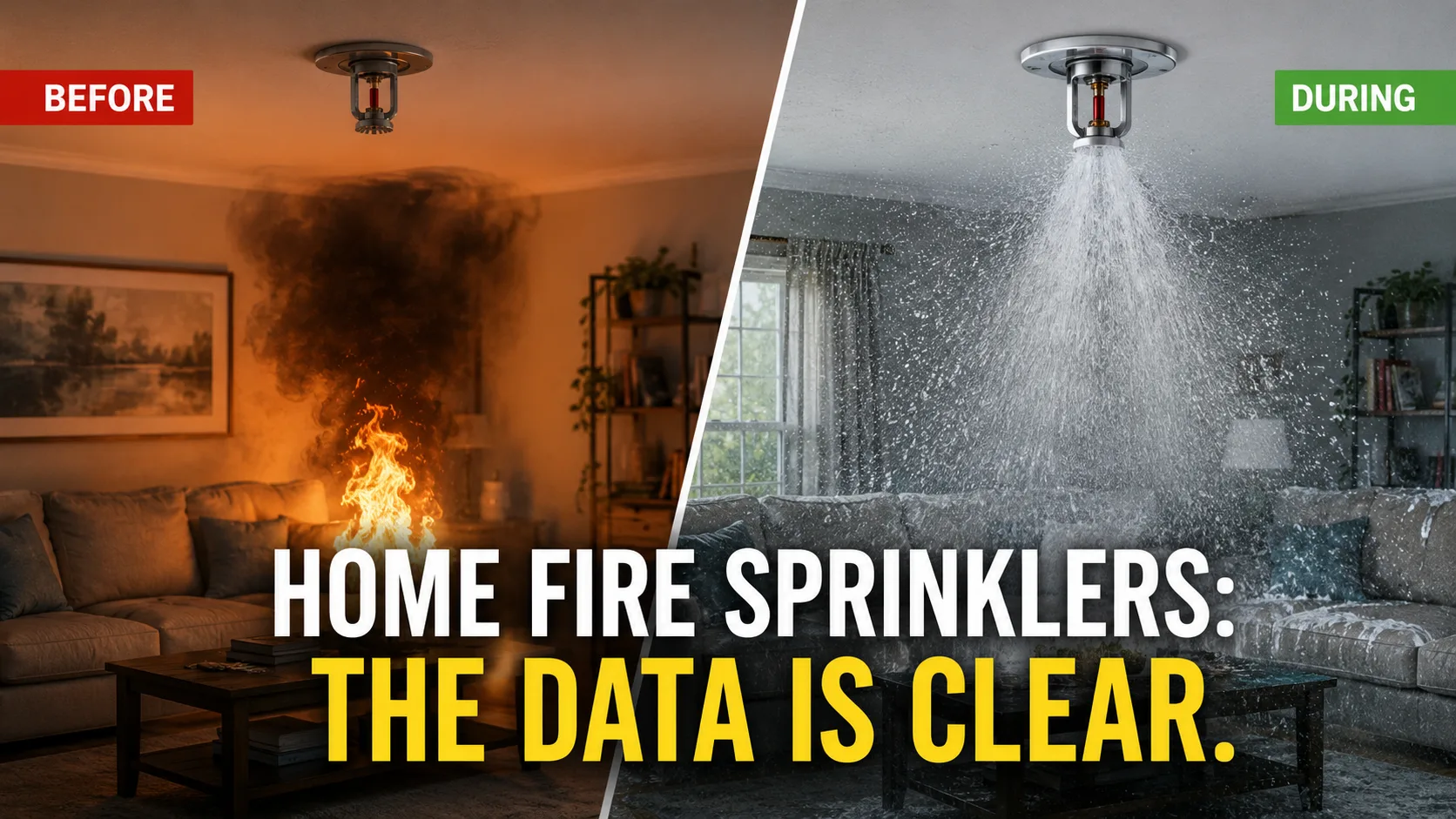
A common misconception is that smoke activates sprinklers. It does not. Sprinklers are heat-activated devices. Each sprinkler head contains a thermal element — either a fusible link (a low-melting-point alloy) or a glass bulb filled with heat-sensitive liquid — that holds a cap over the water orifice. When the air temperature at the sprinkler head reaches the activation temperature, the fusible link melts or the glass bulb breaks, the cap falls away, and water flows through the deflector to create a spray pattern.
Because activation requires heat at the specific sprinkler head location, sprinklers activate individually, one at a time, only in the immediate area of the fire. This is profoundly important: in a typical residential or office fire, only one or two sprinklers activate. This is enough to control or suppress the fire while simultaneously limiting water damage to the smallest possible area.
Myth busted: Sprinklers do not all activate simultaneously when one is triggered. Each head is an independent heat-detection device. In the vast majority of sprinkler-controlled fires, only 1–2 heads activate. Hollywood depictions of every sprinkler flooding a building are fictional.
Individual Sprinkler Head Activation
Fusible link heads
The fusible element is an alloy (typically a tin-bismuth or tin-lead compound) that melts at a specific temperature, releasing the two-piece link that holds the cap in place. When the link separates, water pressure pushes the cap free and water flows. Fusible links are durable, resistant to accidental activation from physical damage, and have been the standard for over a century.
Glass bulb heads
The glass bulb contains a liquid that expands when heated. When the temperature reaches the activation point, the liquid expands enough to shatter the bulb, releasing the cap. Glass bulb heads are color-coded by activation temperature:
| Bulb color | Activation temperature | Typical application |
|---|---|---|
| Orange | 135°F (57°C) | Residential, office, standard occupancies |
| Red | 155°F (68°C) | Standard commercial occupancies |
| Yellow | 175°F (79°C) | Higher ambient temperature areas (boiler rooms) |
| Green | 200°F (93°C) | High-temperature environments |
| Blue | 286°F (141°C) | Very high temperature areas |
| Purple | 360°F (182°C) | Extra high temperature |
| Black | 440°F+ (227°C+) | Special high-temperature applications |
Sprinkler System Types Overview
| System type | Pipe contents | Activation mechanism | Common application |
|---|---|---|---|
| Wet pipe | Water under pressure | Individual heat-activated head | Offices, residential, most commercial |
| Dry pipe | Pressurized air or nitrogen | Head activation releases air; water floods pipes | Unheated spaces (parking garages, attics, freezer warehouses) |
| Pre-action | Air (no water until two conditions met) | Detection system + head activation required | Data centers, archives, museums |
| Deluge | None (open heads, no water) | Detection system opens valve; all heads flow simultaneously | Aircraft hangars, chemical storage, high-hazard areas |
| Residential NFPA 13D | Water under pressure | Individual heat-activated head | Single-family and two-family residences |
Wet Pipe Systems: The Most Common
Wet pipe systems are filled with water under pressure at all times. When a sprinkler head activates, water flows immediately through the open head. Wet pipe systems are the simplest, most reliable, and fastest-responding sprinkler system type. They account for the majority of installed sprinkler systems in the United States.
Components of a wet pipe system
- Water supply: Municipal main, gravity tank, or fire pump supplying adequate pressure and flow
- Main control valve: The OS&Y (outside screw and yoke) gate valve or PIV (post indicator valve) at the system entrance — must be open for the system to function
- Alarm check valve: Allows water to flow to sprinklers when a head activates; triggers waterflow alarm
- Waterflow alarm: Electronic or mechanical alarm that activates when water moves through the system (indicates a head has opened)
- Inspector's test valve: A valve that simulates the flow of one sprinkler head for testing the alarm system without opening an actual head
- Fire department connection (FDC): Allows engine companies to boost system pressure during a fire
Dry Pipe Systems
Dry pipe systems fill the piping with pressurized air or nitrogen instead of water. A dry pipe valve holds back the water supply until a sprinkler head activates. When a head opens, the air pressure drops, the dry pipe valve trips, water fills the pipes, and flows through the open head.
Key characteristics for firefighters
- Delayed water application. After a head activates, there is a delay of 30 seconds to over a minute while water fills the pipes. This is the system's primary operational disadvantage compared to wet pipe.
- Used where wet pipe would freeze. Any unheated space where wet pipe water would freeze uses a dry pipe system: loading docks, parking structures, attic spaces in cold climates, refrigerated warehouses.
- Larger pipe sizes required. To compensate for the delay, NFPA 13 limits dry pipe systems to 500 gallons of volume and requires accelerators or exhausters in larger systems to reduce trip time.
- Trip notification. The dry pipe valve tripping sounds the alarm. This is an indicator that a head has opened — but water has not yet reached the fire.
Deluge and Pre-Action Systems
Deluge systems
Deluge systems have open sprinkler heads (no thermal element) and an empty pipe. A separate detection system (heat, flame, or smoke detectors) opens the deluge valve when a fire is detected, flooding the entire piping system and flowing water through all heads simultaneously. Used in very high hazard occupancies where rapid flooding of an entire area is required: aircraft hangars, ammunition storage, chemical processing areas, and certain industrial applications.
Pre-action systems
Pre-action systems require two conditions to be met before water flows: the detection system must activate AND a sprinkler head must open. This double-interlock design prevents accidental water discharge, which makes it the system of choice for water-sensitive occupancies: data centers, libraries, art storage, museums. The operational tradeoff is increased complexity and slower activation than wet pipe.
Fire Company Response in Sprinklered Buildings
When an engine company arrives at a fire in a building with a sprinkler system, operations change significantly from a non-sprinklered building response:
Do not shut off the system
The most critical rule: do not shut off a functioning sprinkler system without a compelling reason. An operating sprinkler is providing suppression, cooling the structure, and protecting both victims and firefighters. Shutting it off removes the one system that has been actively fighting the fire since it activated. Only shut down the system after the fire is confirmed fully extinguished and the IC makes a deliberate decision to do so.
Support the system first
Before stretching attack lines, connect to the FDC to boost system pressure. A sprinkler system operating from municipal supply alone may not maintain adequate pressure for simultaneous supply to multiple heads or for water delivery to upper floors. Engine company water supply to the FDC is the highest-priority task in a sprinklered building fire.
Find and confirm the operating head
The waterflow alarm and flow indicators (or simply following the wet ceiling and floor) locate the operating head. The fire is in the area directly below or near the operating head. If the fire is already controlled by the sprinkler, a small attack line to extinguish the residual fire may be all that is needed.
Attack with the system, not against it
Direct the attack line at the fire in coordination with the operating sprinkler. Avoid directing hose streams at the operating sprinkler head in a way that cools it below activation temperature — this will cause the head to close before extinguishment is complete.
Fire Department Connection (FDC)
The FDC is the Siamese connection on the exterior of the building that allows engine companies to pump water into the sprinkler system to boost pressure and supplement supply.
- Connect early, before stretching attack lines. FDC connection is the highest-priority task in a sprinklered building fire. In a large commercial fire, the system may need 250–500 GPM or more sustained.
- Use correct pressure. The FDC connection pressure should be sufficient to maintain system pressure at the flowing heads. A typical target is 150 PSI at the FDC connection. Consult your pre-incident plan or local fire sprinkler coordinator for system-specific requirements.
- Locate the FDC before you need it. Pre-incident planning identifies FDC location, required pressure, and the system it serves. In a large complex building, multiple FDC connections may serve different system zones.
- Verify the FDC check valve is functional. The FDC has a check valve that prevents building supply water from back-flowing out through the FDC. Occasionally these fail, resulting in water spraying from the FDC instead of entering the system.
Impaired Sprinkler Systems
An impaired sprinkler system is one that is not capable of functioning normally due to a closed control valve, a depleted water supply, a damaged component, or any other condition. Impaired systems require specific management:
- NFPA 25 requires notification of the authority having jurisdiction (AHJ) and the building owner when a system is impaired for more than 10 hours.
- Hot work permits may require a fire watch when the system is impaired during construction or maintenance. See the Fire Watch guide for NFPA 25 requirements.
- Closed control valves are the most common impairment. A PIV or OS&Y valve that has been partially or fully closed (intentionally or not) eliminates or reduces system function. Check valve position status during pre-incident planning and on arrival at a building fire.
- Treat an impaired building like an unsprinklered building. Adjust your tactical expectations. The life safety and property protection benefits of sprinklers are absent.
Frequently Asked Questions
Do all sprinklers go off at once when one activates?
No. Each sprinkler head is an independent heat-detection device. Only heads that reach their individual activation temperature will open. In the typical residential or commercial fire, only 1–2 sprinkler heads activate, which is sufficient to control or suppress the fire. The simultaneous activation of all heads shown in movies is fictional and only occurs in deluge systems, which are specialized high-hazard systems.
How much water does a fire sprinkler use?
A residential sprinkler head (NFPA 13D) typically flows 8–24 gallons per minute. A standard commercial sprinkler head (NFPA 13) flows 13–25 GPM or more depending on hazard classification. Because only 1–2 heads typically activate, the total water used by a sprinkler-controlled fire is dramatically less than the water applied by fire department hose streams, significantly reducing water damage.
What is the fire department connection (FDC) on a building?
The FDC is a Siamese connection on the building exterior that allows engine companies to pump water into the sprinkler or standpipe system to boost pressure and supplement the building water supply. Connecting to the FDC is typically the first action engine companies take at a fire in a sprinklered building, before stretching attack lines.
What should firefighters do when a sprinkler system is operating at a fire?
Do not shut off the system. Connect an engine to the FDC immediately to boost system pressure. Locate the operating head to find the fire. Attack the fire in coordination with the operating sprinkler. Shut down the system only after the fire is confirmed fully extinguished and the IC makes a deliberate decision to do so.


Comments 0
No comments yet. Be the first to share your thoughts!
Leave a Comment