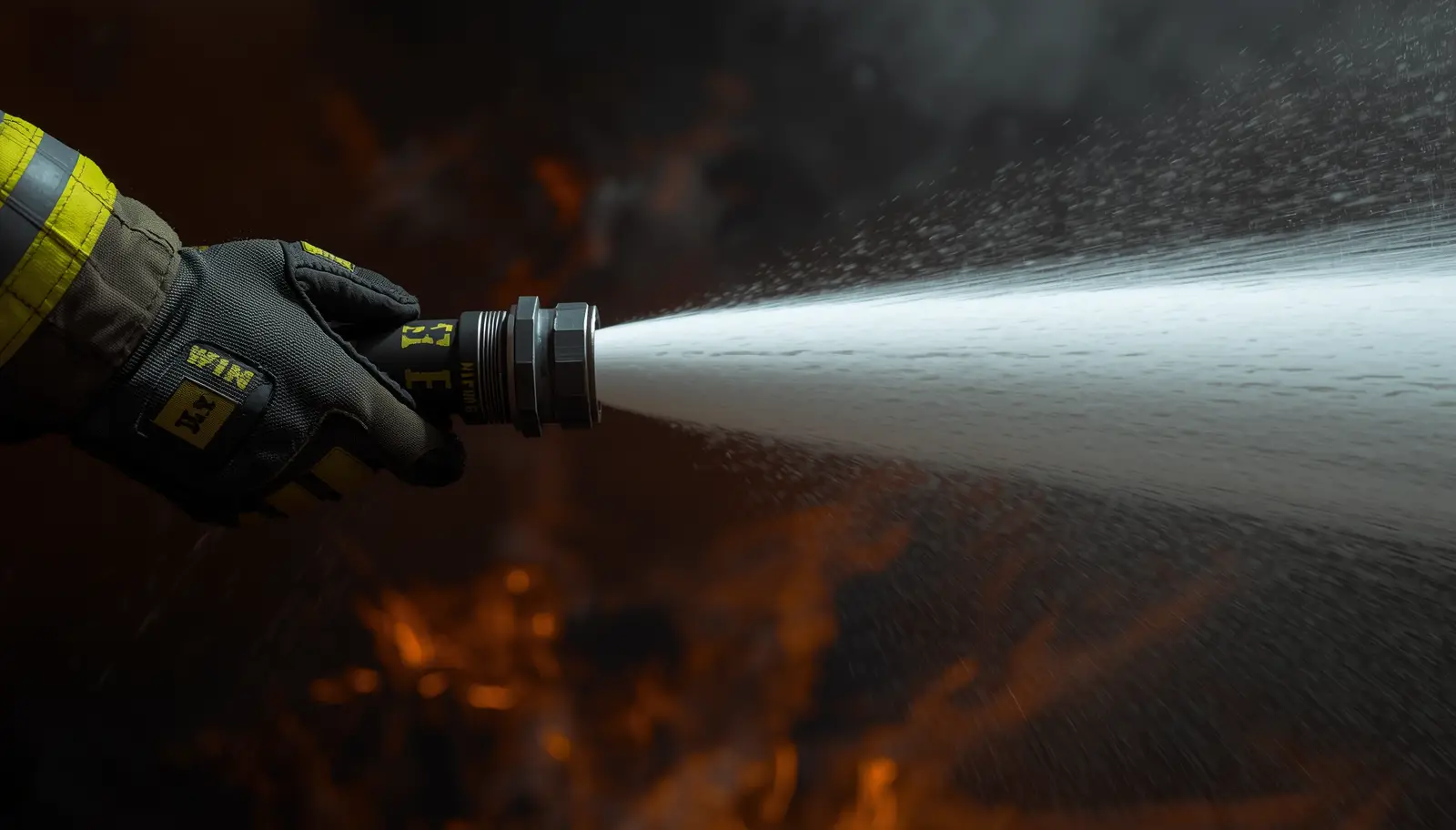

Fire Nozzle Types, GPM, and Operations: Smooth Bore, Combination & Automatic Explained
The nozzle is where hydraulic theory meets the fire. Every pressure calculation, every pump operation, and every hose lay decision ultimately delivers water through a nozzle at a specific flow rate and pattern. Understanding the differences between smooth bore, combination (fog), and automatic nozzles — and knowing when each is the right tool — makes you a better firefighter and a better engineer. This guide covers nozzle types, GPM and pressure requirements, nozzle reaction, and when to use which nozzle on the fireground.
Jump to:Why nozzle selection matters · Smooth bore nozzles · Combination (fog) nozzles · Automatic (constant pressure) nozzles · Side-by-side comparison · Nozzle reaction · Master stream devices · Nozzle maintenance · FAQ
Why Nozzle Selection Matters
Nozzle selection directly affects three fireground outcomes:
- Flow rate (GPM): More water on the fire faster means faster knockdown and less structural damage. But more GPM also means more water damage if the fire is small, and more pump demand from the engineer.
- Reach and penetration: A smooth bore stream reaches farther and penetrates fire-heated air better than a fog pattern. This matters for large or deep-seated fires where reach is needed.
- Nozzle reaction: Higher GPM and pressure = more pushback on the nozzle operator. A firefighter advancing into a doorway alone with a high-flow nozzle at high pressure may not be able to control it. Nozzle reaction is a safety consideration, not just a hydraulic one.
Smooth Bore Nozzles
Smooth bore (solid stream / straight tip)
How it works: A smooth, tapered opening (the tip) with no moving parts. Water exits as a solid cylindrical stream. GPM is determined by tip diameter and nozzle pressure. Operating pressure: 50 PSI at the nozzle for hand lines; 80 PSI for master streams.
Common tip sizes (hand line): ¾-inch, 1-inch, 1⅛-inch, 1¼-inch, 1½-inch
Advantages: Maximum reach and penetration; consistent GPM at a given pressure; no moving parts to fail; less affected by kinks or pressure fluctuation; low nozzle reaction relative to flow; performs well through heat and steam
Disadvantages: No pattern adjustment; cannot produce fog or wide-angle spray; only two options: stream or shutoff
Smooth bore GPM formula
GPM = 29.72 × D² × √NP
Where D = tip diameter in inches, NP = nozzle pressure in PSI (50 PSI for hand lines).
| Tip diameter | GPM at 50 PSI | Typical use |
|---|---|---|
| ¾ inch | ~119 GPM | Booster line; small fires |
| 1 inch | ~210 GPM | 1¾-inch hand line, light commercial |
| 1⅛ inch | ~266 GPM | Standard 2½-inch hand line, most common attack tip |
| 1¼ inch | ~328 GPM | Heavy commercial, high-flow attack |
| 1½ inch | ~473 GPM | Large-diameter hand line or master stream |
Use the smooth-bore GPM formula and table above to calculate flow for a given tip size and pressure. The nozzle-reaction section below explains how to calculate the push-back force on the nozzle operator.
Combination (Fog) Nozzles
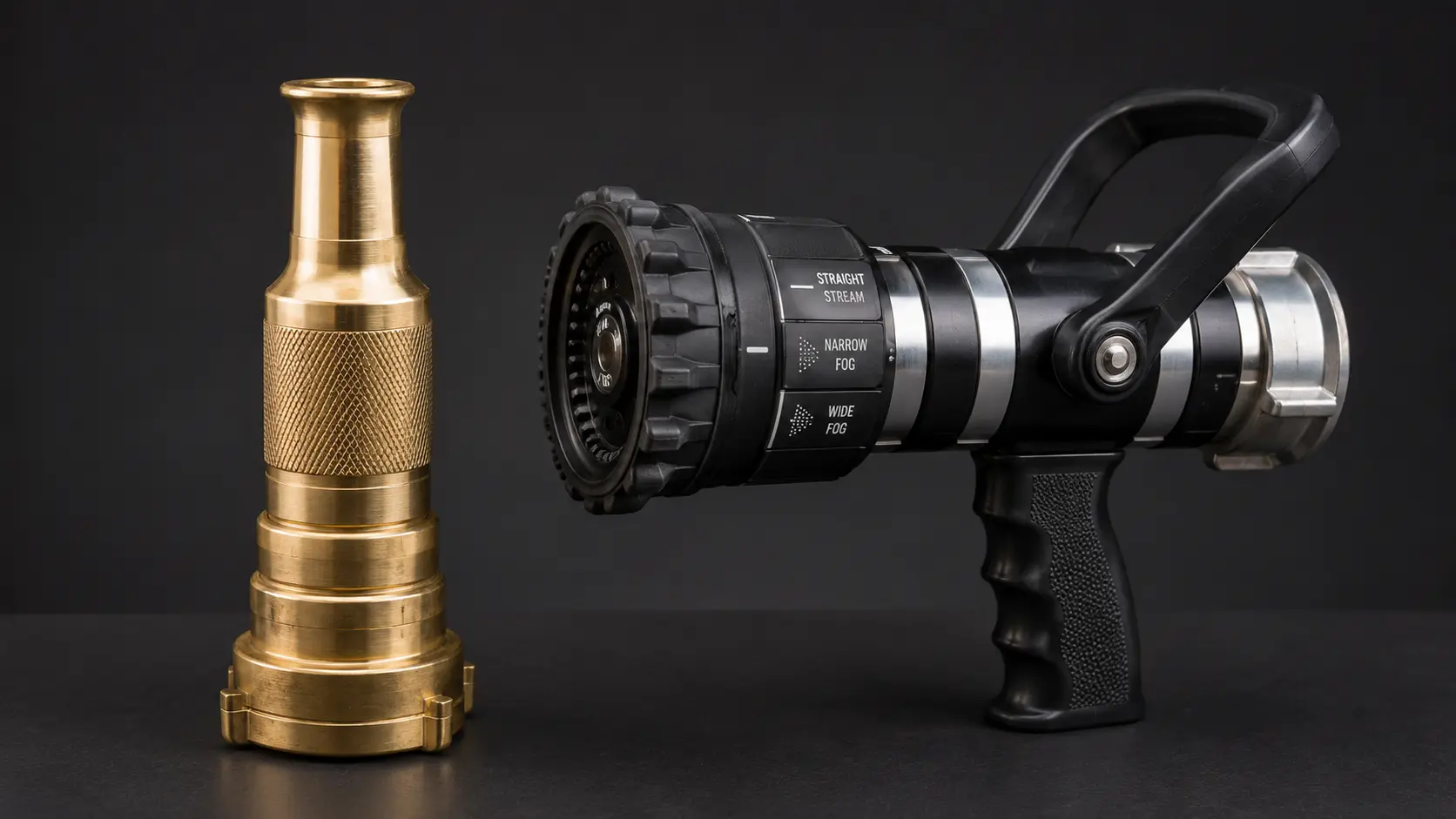
Combination nozzle (adjustable fog)
How it works: An adjustable deflector breaks the stream into a spray pattern ranging from a straight (solid) stream to a wide-angle fog (up to 60° or wider). The pattern is adjusted by rotating the outer barrel. Standard operating pressure: 100 PSI at the nozzle.
GPM: Fixed-gallonage versions flow a preset GPM at 100 PSI (e.g., 95 GPM, 125 GPM, 150 GPM, 200 GPM). Selectable-gallonage versions allow the operator to set a flow rate from a range.
Advantages: Pattern flexibility (straight stream to wide fog); can apply water at various angles; fog pattern useful for vapor suppression and exposure protection
Disadvantages: Operates at 100 PSI NP (higher than smooth bore's 50 PSI), meaning more friction loss and higher PDP required; fog pattern loses reach and penetration compared to smooth bore; moving parts can fail or clog; reduced effectiveness in high heat (fog droplets vaporize before reaching the fire)
When to use fog vs straight stream from a combination nozzle
- Straight stream setting: Offensive interior attack; reaching deep-seated fire; most structural firefighting situations
- Narrow fog (30°): Ventilation-aided attack; cooling hot gas layer from a doorway before entry; exposure protection in exterior operations
- Wide fog (60°+): Vapor suppression in chemical emergencies; exterior exposure protection; never used for offensive interior attack (reduces reach to near zero, pushes steam into the structure)
Wide-angle fog inside a structure kills firefighters. A wide fog pattern produces massive steam conversion in a hot environment. That steam superheats and burns the crew advancing the line. Wide fog is an exterior tool. On an interior attack, use straight stream or narrow fog only.
Automatic (Constant Pressure) Nozzles
Automatic nozzle (constant pressure / variable flow)
How it works: An internal spring-loaded mechanism automatically adjusts the orifice opening to maintain a near-constant nozzle pressure (typically 100 PSI) across a wide flow range. As flow increases or decreases, the nozzle compensates to maintain the target pressure.
Flow range: Typically 40–350 GPM (varies by model) at the designed pressure, automatically
Advantages: Adjusts automatically to changes in pump pressure, hose length changes, or multiple lines being opened/closed; operator does not need to notify engineer of flow changes; maintains effective stream quality across a wide range
Disadvantages: The engineer cannot know what flow rate is actually being delivered — it varies automatically. This makes hydraulic calculations imprecise. Requires specific training; the "automatic" adjustment can mask pump problems that need attention.
The automatic nozzle debate: Automatic nozzles are popular for their simplicity but generate significant controversy. The core issue: when flow rate is unknown, the engineer cannot confirm adequate fire flow is being delivered. A nozzle that is automatically adjusting to compensate for a pump problem may look like it is working while delivering significantly less water than the fire requires. Know your nozzle and your system.
Nozzle Comparison: When to Choose What
| Situation | Best nozzle | Why |
|---|---|---|
| Offensive interior residential attack | Smooth bore 1⅛-inch or combination on straight stream | Maximum reach and penetration; consistent GPM; manageable nozzle reaction |
| Offensive interior commercial/large area | Smooth bore 1¼-inch or 2½-inch hand line with smooth bore | Higher GPM required for larger spaces; reach is critical |
| Defensive exterior operations | Master stream with smooth bore or combination | Range and volume; pattern flexibility for exposure protection |
| Exterior vapor suppression (hazmat) | Combination nozzle in wide fog | Wide pattern dilutes and disperses vapor cloud |
| Variable pressure supply (rural/tanker) | Automatic nozzle | Compensates for pressure fluctuations in shuttle operations |
| Standpipe operations (high-rise) | Smooth bore 1⅛-inch | Predictable GPM and pressure; operates at 50 PSI NP (lower standpipe demand) |
Nozzle Reaction: The Force Pushing Back
Every flowing nozzle produces a reaction force pushing back on the nozzle operator. This force must be controlled by the nozzle team. Nozzle reaction (NR) is calculated differently for smooth bore and fog nozzles:
Smooth bore nozzle reaction
NR = 1.57 × D² × NP
Where D = tip diameter in inches, NP = nozzle pressure in PSI.
Example: 1⅛-inch tip at 50 PSI → NR = 1.57 × 1.265625 × 50 = 99 lbs
Fog / combination nozzle reaction
NR = 0.0505 × GPM × √NP
Example: 150 GPM combination nozzle at 100 PSI → NR = 0.0505 × 150 × 10 = 75.75 lbs
Use the formulas above to determine reaction force for the nozzle configuration you are evaluating. A firefighter working alone with a 100+ lb reaction force on a nozzle in a difficult position can lose control of the line. Nozzle reaction is a crew safety consideration on every deployment.
Master Stream Devices
Master streams (deck guns, portable monitors, and ladder pipes) deliver 350–2,000+ GPM for defensive operations, large commercial fires, and exposure protection. They are always operated from the exterior or from a safe position due to their flow rate and stream energy.
| Device | Flow range | Nozzle NP | Use |
|---|---|---|---|
| Deck gun (mounted on apparatus) | 250–2,000 GPM | 80 PSI (smooth bore) / 100 PSI (fog) | Defensive attack; large volume exposure; tanker fires |
| Portable monitor | 350–1,000 GPM | Same as deck gun | Defensive attack when apparatus cannot position; collapse perimeter |
| Ladder pipe / aerial device | 1,000–2,000 GPM | 80 PSI smooth bore | High-angle defensive attack; roof fire; large structure collapse zone |
Nozzle Maintenance and Inspection
- Inspect nozzle every shift: check for debris in the orifice, smooth operation of the bail (shutoff), and pattern adjustment mechanism
- Flush all nozzles with clean water after any use with foam or debris-laden water
- Test flow and pattern at least monthly during company training
- Replace o-rings and gaskets when any leakage is observed at the connection or bail
- Do not use nozzles with damaged or deformed tips — tip damage changes the stream quality and GPM in ways that are not visible but affect fireground performance
Frequently Asked Questions
What is the difference between a smooth bore and a fog nozzle?
A smooth bore nozzle has a fixed opening with no moving parts and delivers a solid cylindrical stream at 50 PSI nozzle pressure. A fog (combination) nozzle has an adjustable deflector that breaks the stream into patterns from straight stream to wide-angle fog, operating at 100 PSI. Smooth bore delivers more GPM at lower pressure with better reach; fog nozzles offer pattern flexibility at the cost of higher pressure requirements and less stream reach.
What is an automatic nozzle?
An automatic nozzle uses an internal spring mechanism to automatically adjust its orifice opening and maintain a near-constant nozzle pressure across a range of flow rates. It compensates for changes in pump pressure and flow without operator adjustment. The tradeoff is that the engineer cannot determine exact flow rate, making precise hydraulic calculations difficult.
Why is wide-angle fog dangerous inside a structure?
Wide-angle fog converts water to steam rapidly in a hot fire environment. That steam is superheated and causes thermal burns to firefighters inside the structure. Wide fog also has virtually no reach, pushing heat and steam back toward the crew instead of delivering water to the fire. Wide fog is restricted to exterior vapor suppression and exposure protection — never used for interior structural firefighting.
What nozzle pressure does a smooth bore nozzle use?
50 PSI at the nozzle for hand line operations. Master stream smooth bore devices use 80 PSI. These lower operating pressures (compared to 100 PSI for fog nozzles) mean less friction loss in the hose and lower pump discharge pressure required from the engineer.



Comments 0
No comments yet. Be the first to share your thoughts!
Leave a Comment