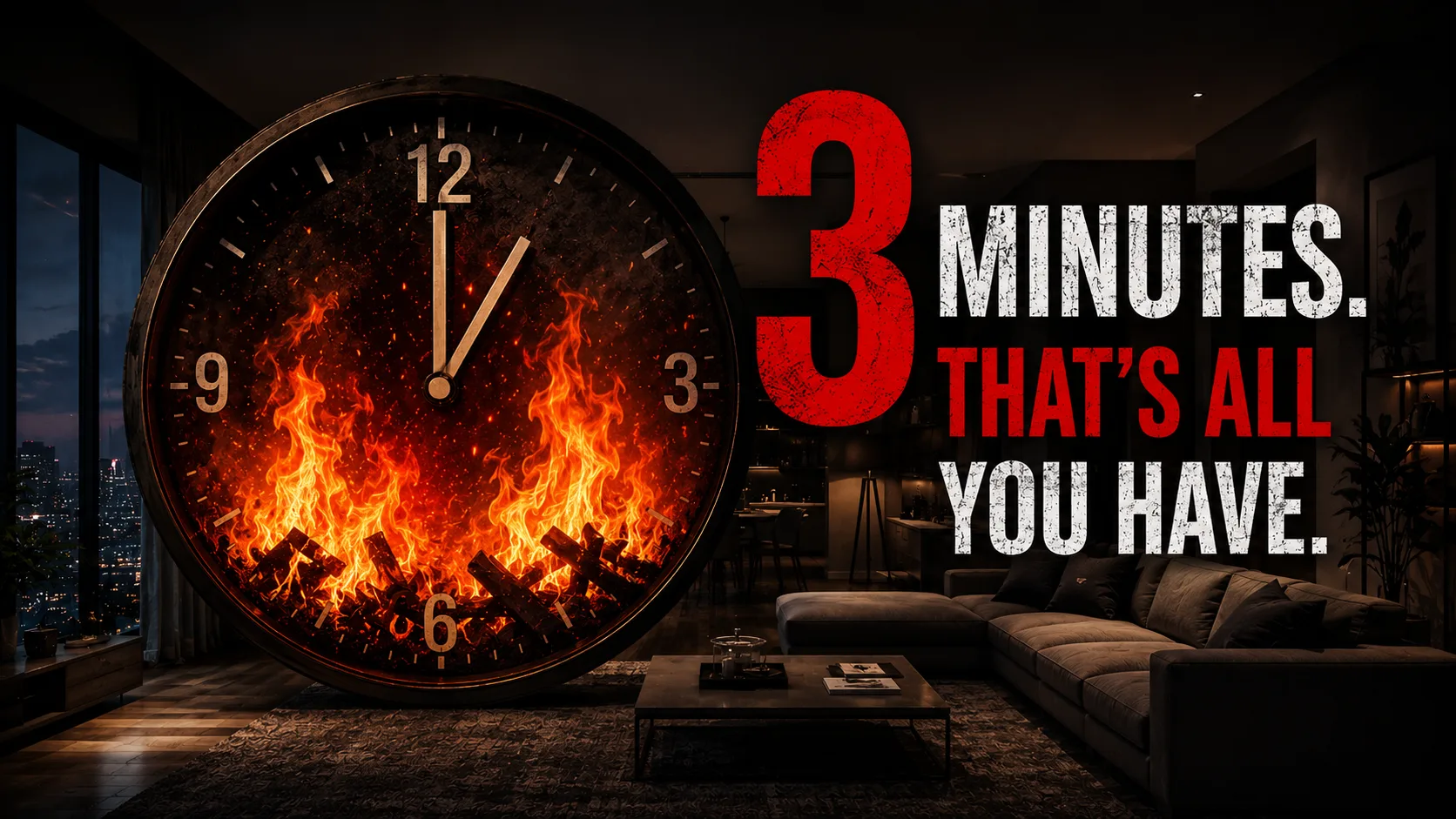
In 1975, research by the National Bureau of Standards found that occupants of a burning home had approximately 17 minutes from ignition to escape safely before conditions became unsurvivable. Researchers and fire departments used this number for decades to set response time standards and public education timelines.
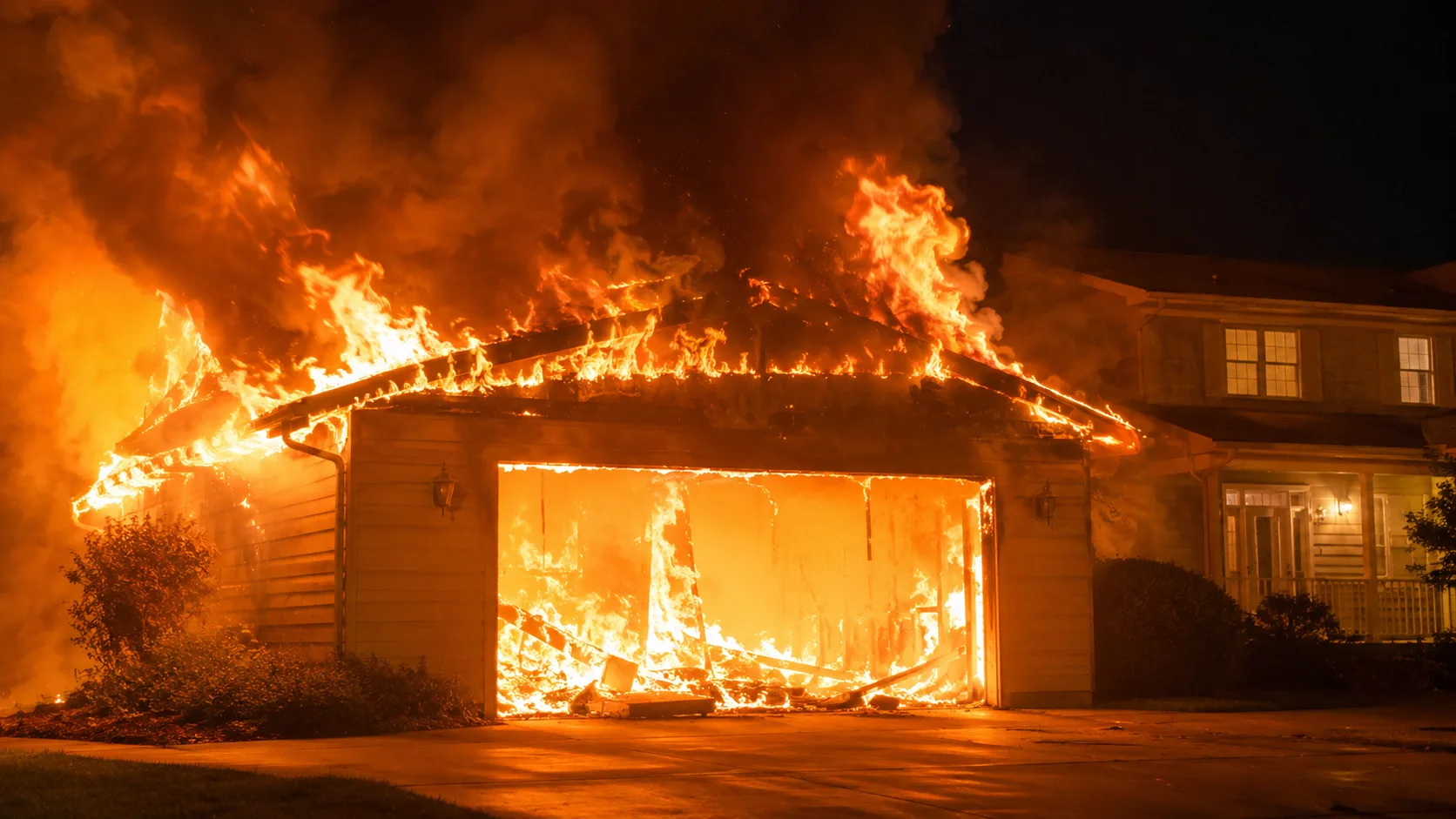
That 17-minute window no longer exists. UL (Underwriters Laboratories) conducted burn tests in 2012 comparing a furnished room from the 1970s to an identically sized furnished room from the 2010s. The modern room reached flashover — the point at which everything in the room ignites simultaneously — in approximately 3 minutes and 40 seconds. The 1970s room took approximately 29 minutes. The same research found that from the time a residential smoke alarm activates, occupants of a modern home may have as little as 2 to 3 minutes to escape before conditions in the structure become unsurvivable.
In this article:
- Why modern homes burn so much faster
- The minute-by-minute timeline inside a burning home
- What flashover is and why it matters
- Carbon monoxide kills before the flames reach you
- What actually buys you more time
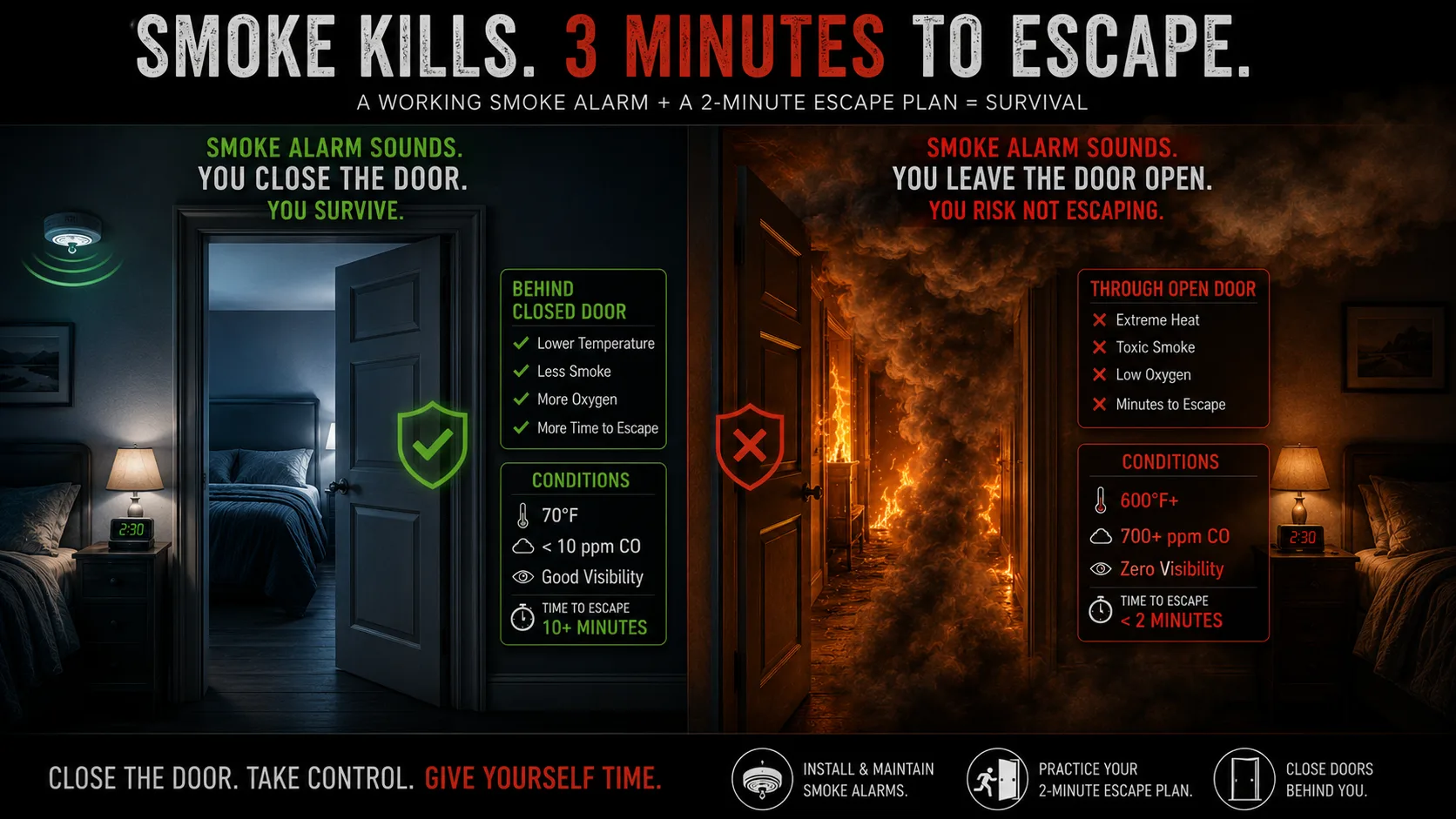
- The closed door: the most underused safety measure
- Why nighttime fires are so much more dangerous
Why Modern Homes Burn So Much Faster
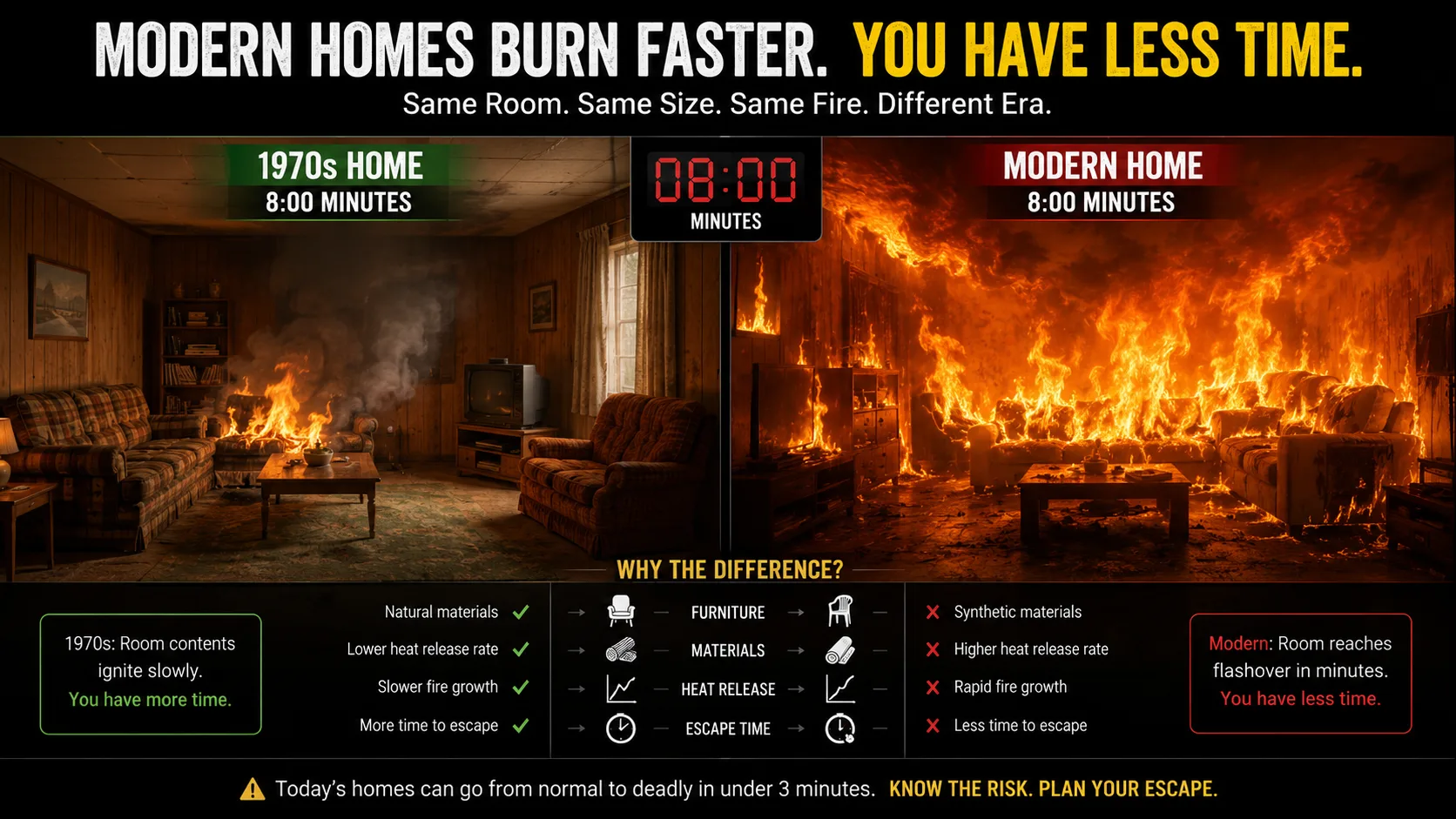
The structure of a house has not changed as dramatically as how it is furnished. The walls, the framing, the insulation — these are different in modern construction but are not the primary driver of the speed difference. The primary driver is the furniture and contents, and the chemistry of what those contents are made from.
Natural vs. synthetic materials
Furniture in the 1970s was predominantly made from natural materials: solid wood frames, cotton or wool upholstery, natural latex foam. These materials burn, but they burn relatively slowly. They are essentially the same material as wood — which has a slow, predictable combustion rate that firefighters and engineers have understood for a long time.
Modern furniture is predominantly made from petroleum-derived synthetic materials: polyurethane foam in cushions and mattresses, polypropylene and nylon in fabric, ABS plastic in frames and trim. These materials are not simply flammable — they are effectively solid fuel with the combustion characteristics of refined petroleum products. Polyurethane foam burns intensely, rapidly, and produces dramatically more energy per unit of mass than natural materials. It also produces much larger quantities of black smoke and toxic gases.
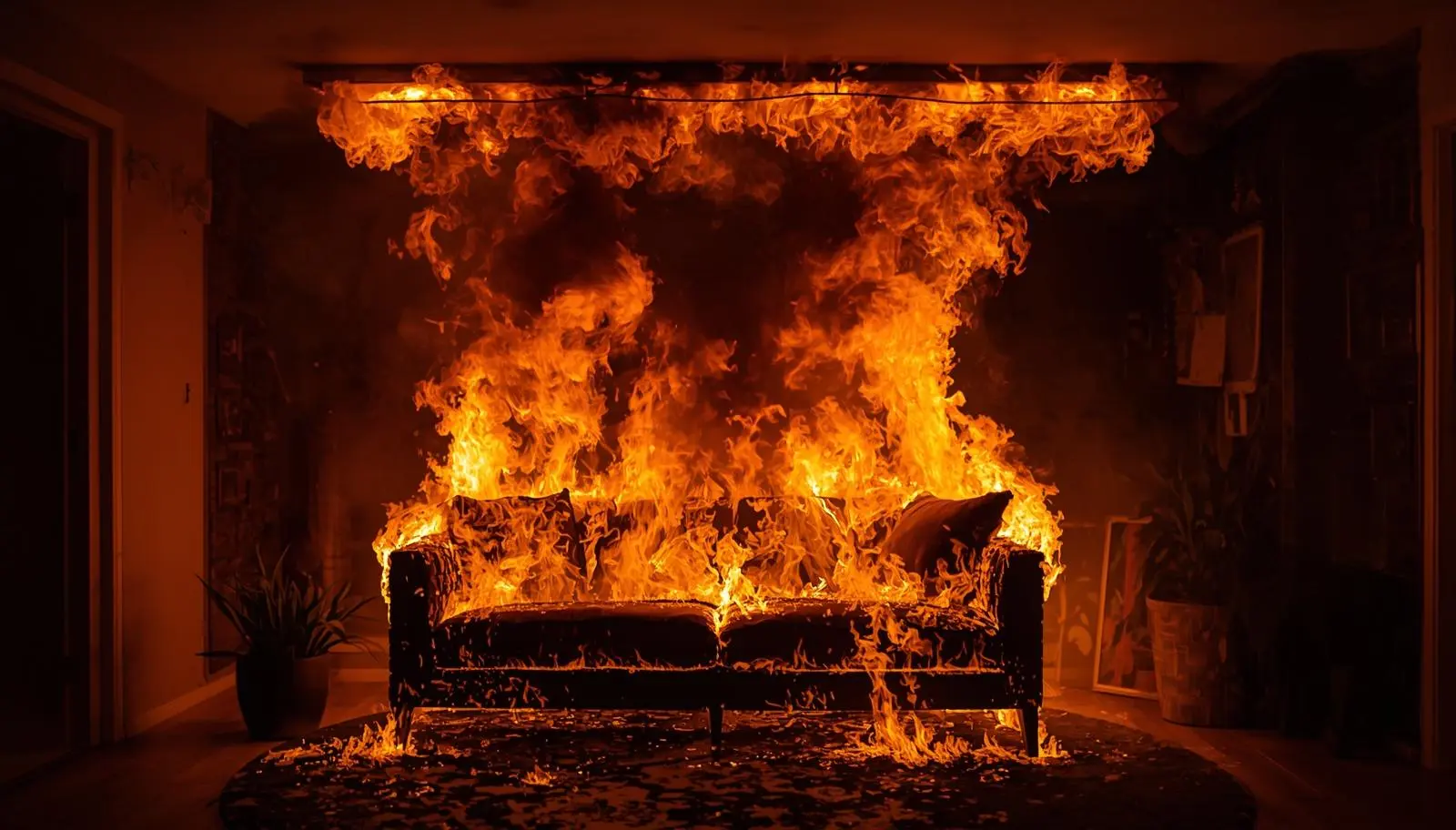
When a modern couch catches fire, the polyurethane foam core ignites and burns with the intensity of a petroleum fire. It releases enormous amounts of heat quickly — enough to raise the surrounding air temperature to the ignition point of everything else in the room in minutes. That is flashover.
Open floor plans
Modern home design favors open floor plans — large connected spaces without the compartmentalization of traditional room-by-room construction. In a fire, compartmentalization slows spread. Each wall and closed door the fire must pass through adds time. An open plan kitchen-living room-dining room is a single large fuel-and-oxygen environment that allows fire to spread freely without the resistance of door frames and walls. The same fire that might take 10 minutes to breach a wall and spread to an adjacent room in a traditionally compartmentalized home can move across an open plan in seconds.
The Minute-by-Minute Timeline
This timeline is based on UL research data for a fire starting in a modern furnished living room. Actual timing varies with room size, fuel load, ventilation, and fire location — but the order of events and the general timeframe are consistent with documented fire behavior in modern construction.
A cigarette ignites upholstery. A candle contacts curtain fabric. An electrical fault ignites insulation. At ignition, the fire is small. A person in the room could extinguish it with a fire extinguisher or a glass of water at this moment. This window is measured in seconds, not minutes.
A working photoelectric alarm in the room may activate within the first minute. An ionization alarm may take slightly longer. Bedrooms with alarms on the other side of a closed door will take longer still — sound travels slowly and is attenuated by the door. This is the moment the survival clock starts for sleeping occupants.
Smoke has stratified. The upper portion of the room may be completely smoke-filled. Near the floor, conditions are still breathable. This is the window for low-crawl escape — the person who gets low and moves quickly toward the exit has a viable path out. A person who stands up in this room breathes toxic smoke at the ceiling layer.
The survivable air layer near the floor is shrinking. Carbon monoxide concentration in the room is approaching incapacitating levels. The fire has grown significantly. A person who delayed response by one to two minutes is now attempting escape in conditions that are deteriorating faster than they can move through them.
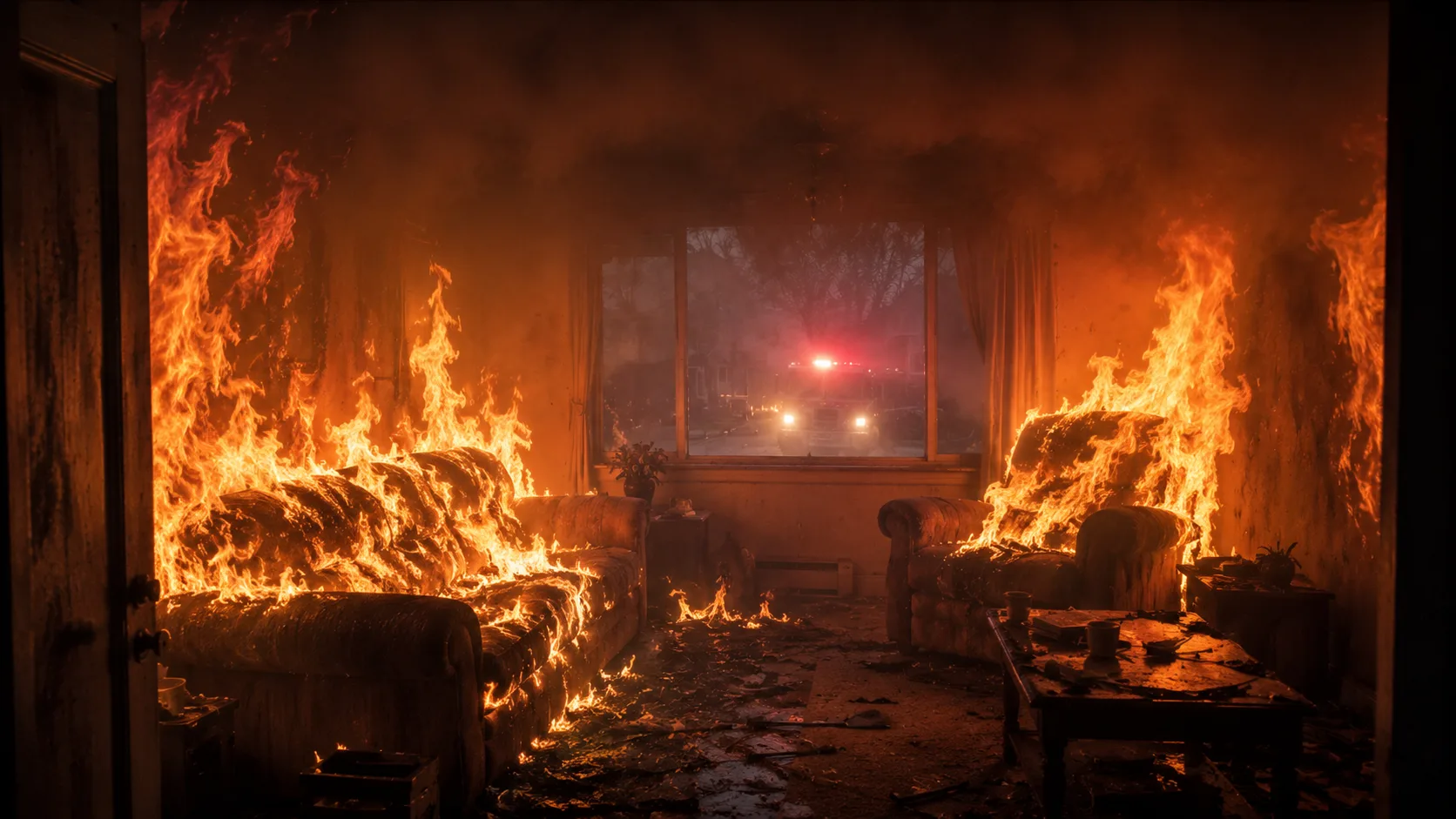
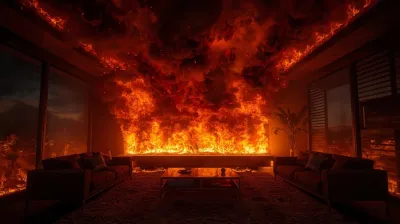
The radiant heat from the burning contents raises every combustible surface in the room to its ignition temperature simultaneously. Everything in the room ignites. Temperatures exceed 1,000°F. No unprotected person survives flashover in the room of origin. Anyone still in the room at flashover is not escaping.
Post-flashover, the fire moves rapidly into adjacent spaces through doorways, ventilation paths, and structural gaps. Hallways fill with smoke and heat. Exit paths through the structure become compromised. The survivable zone is rapidly shrinking to rooms with closed doors and external windows.
Flashover: The Point of No Return
Flashover is the most critical concept in understanding house fire survival timelines. It is not the moment the fire starts — it is the moment the fire becomes total. Before flashover, the fire occupies a fraction of the room. After flashover, the entire room is on fire. Before flashover, an exit through the room may still be viable. After flashover, the room is unsurvivable.
The temperature at which flashover occurs is approximately 1,100°F at ceiling level. The radiant heat from surfaces at this temperature ignites everything below them simultaneously. Structural elements, the floor, clothing on a person in the room — all ignite at essentially the same moment. A person in a room at the moment of flashover has no meaningful survival options without full fire protective equipment.
The reason flashover has moved from 29 minutes (1970s room) to under 4 minutes (modern room) is entirely the change in fuel load — specifically the polyurethane foam in modern upholstered furniture. The same fire dynamics, the same physics, the same building — different result entirely because of what is inside the room.
Carbon Monoxide Kills Before the Flames Reach You
Most people picture fire death as a person trapped by flames. The reality is that the majority of fire fatalities are caused by smoke inhalation — specifically by carbon monoxide — before the fire itself reaches the victim. CO is produced in large quantities by the incomplete combustion of synthetic materials. Polyurethane foam fire produces CO at concentrations that can incapacitate a person in minutes and kill in under ten.
Carbon monoxide is not detectable by smell. You do not know it is there. The first symptom may be confusion or disorientation — the very cognitive impairment that prevents a person from executing a practiced escape route. By the time the headache begins, the CO level may be high enough that coordinated movement is compromised. By the time a person loses consciousness, the CO level is typically in the range that causes death within minutes of continued exposure.
This is why the timeline is more brutal than most people expect. It is not just that the flames spread fast — it is that the toxic environment becomes incapacitating before the flames arrive. A person asleep in a bedroom with a fire in the adjacent living room may never be aware the fire started. The CO migrates under and around the door, reaches incapacitating concentration in the bedroom before the smoke alarm wakes them effectively, and they are unconscious before they get up.
This is why smoke alarms must be inside bedrooms — not just in the hallway. A hallway alarm and a closed bedroom door create a system where the alarm activates but the sound may not be loud enough to wake a sleeping person in time. An alarm inside the bedroom activates at a lower smoke concentration — when CO is lower and the escape window is still viable. A bedroom door buys time; an alarm inside the bedroom uses that time to wake you earlier.
What Actually Buys You More Time
| Factor | Effect on Escape Window | Practical Action |
|---|---|---|
| Working smoke alarm inside bedroom | Adds 1–3 minutes vs. hallway alarm through closed door | Install alarm inside every sleeping room. Test monthly. |
| Closed bedroom door | Adds 10–15 minutes of survivable conditions inside the closed room | Sleep with bedroom door closed every night. |
| Practiced escape route | Reduces response time by 30–60 seconds — critical in a 3-minute window | Practice the escape drill at night, from bedrooms, twice yearly. |
| Fire starting in distant room vs. adjacent room | Each room of separation adds approximately 1–3 minutes | Close all interior doors at night — each one is a fire barrier. |
| Single-story vs. multi-story home | Upper floors have more time before fire arrives but require window escape if stairs are compromised | Fire escape ladder for upper floor bedrooms. |
| Fire starting while occupants are awake | Response begins immediately — adds 1–2 minutes vs. needing to wake up | Only relevant for daytime fires; nighttime fires are the dangerous scenario. |
The Closed Door: 10–15 Extra Minutes
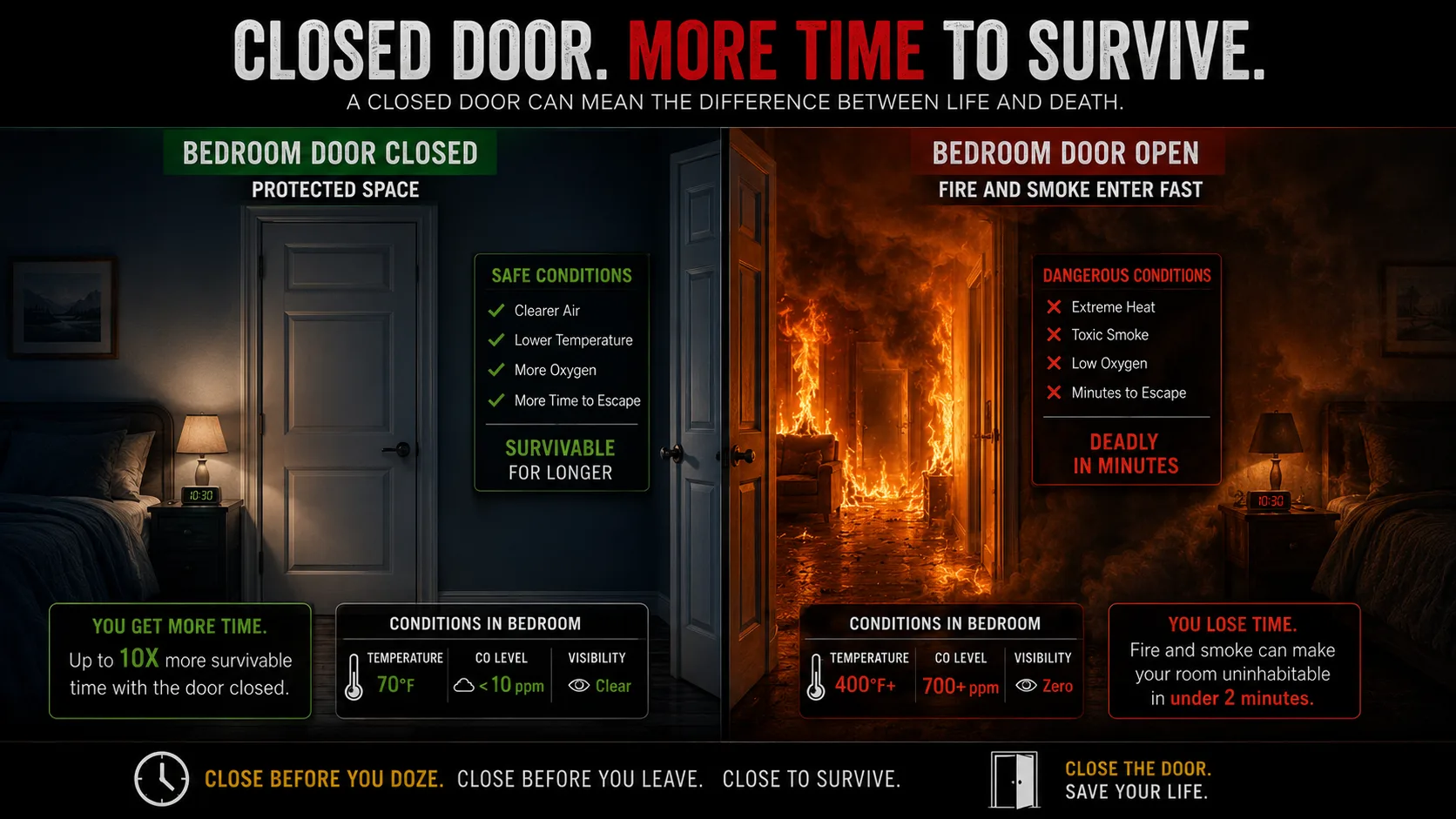
Of all the things that affect how much time you have to escape a house fire, a closed bedroom door is the most accessible and most consistently overlooked. It costs nothing. It requires no installation. It is reversible. And its effect on survival time is documented and significant.
UL's testing shows that a closed standard interior door — not a fire door, just a regular hollow-core residential door — maintains survivable temperatures and oxygen levels on the protected side for approximately 10 to 15 minutes after the room on the other side has gone to flashover. The door warps, smoke seeps around it, and heat transfers through it — but the barrier effect slows all of these enough to give the person inside the room time that an open doorway does not.
In a modern home fire with a 3-minute window to flashover in the room of origin, a closed door between you and the fire is not a minor convenience. It is the difference between being awoken by the alarm with time to escape and being awoken into conditions where escape may no longer be possible.
The Close Before You Doze campaign (from the UL Firefighter Safety Research Institute) is based specifically on this data. Sleep with your bedroom door closed. It is the single highest-value habit change available to any household in a modern home, and it costs nothing.
Why Nighttime Fires Are So Much More Dangerous
The 3-minute escape window assumes the occupant is awake and alert when the alarm sounds. A sleeping person typically takes 30 to 60 seconds to reach full wakefulness after an alarm activates — and during that time they are not moving toward an exit. For children and for adults who have consumed alcohol or sleep medication, the response time is longer.
Subtract the wake-up time from the 3-minute window and the effective escape window — the time from alarm activation to when a fully alert person exits the building — may be as little as 90 seconds to 2 minutes. In that window, a person must:
- Wake up and understand what the alarm means
- Check the bedroom door before opening it
- Choose the correct exit route based on conditions
- Get low and navigate to the exit
- Exit the building
That sequence, executed for the first time in the dark, while disoriented from sleep, in a potentially smoke-filled environment — is where the practice-versus-no-practice gap becomes a survival gap. Families who have drilled this sequence, who know the door check, who have practiced the low crawl, who know where the meeting place is — execute it in 60 to 90 seconds. Families who have not drilled it improvise under the worst possible conditions.
The math is uncomfortable but clear: in a modern home fire at night, the margin between adequate preparation and no preparation is measured in seconds, not minutes. Build the escape plan, run the drill, sleep with the bedroom door closed, and keep the smoke alarms working. That combination does not extend the 3-minute window — nothing does. But it compresses the time spent on the wrong side of that window.

Comments 0
No comments yet. Be the first to share your thoughts!
Leave a Comment