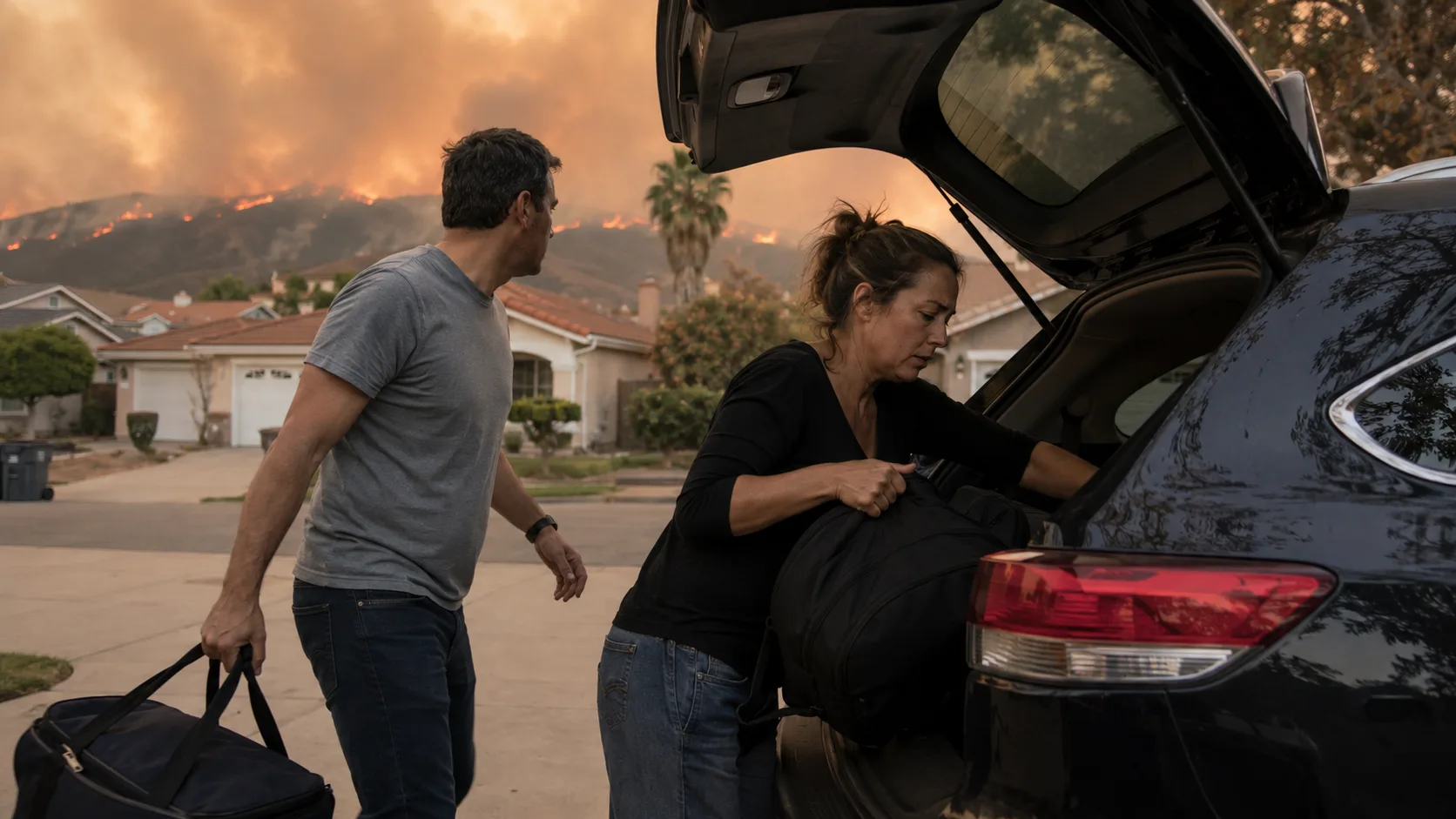

A wildfire evacuation order gives you somewhere between 15 minutes and a few hours to leave. The lower end of that range is documented — communities in the path of fast-moving fires in high-wind conditions have received and lost that margin. The go-bag concept exists precisely because 15 minutes is not enough time to think about what to take. It is only enough time to grab something that has already been thought about and is ready to go.
The problem is that most go-bags that exist are not actually ready. They were assembled once, stored in a closet, and have not been checked since. The medications expired. The water leaked. The phone charger in the bag does not fit anyone's current phone. The documents are a three-year-old set that does not include the insurance policy you switched. A go-bag that has not been maintained is not a go-bag — it is a bag.
In this article:
- What a go-bag is — and what it is not
- Documents: what you need and how to store them
- Medications: the most commonly forgotten category
- Water and food for 72 hours
- N95 masks and why a regular mask fails for wildfire smoke
- Power, communication, and charging
- Pets: the leading reason people don't leave
- The bag itself and how to organize it
- Maintenance: the part everyone skips
What a Go-Bag Is — and What It Is Not
A go-bag is not a camping kit, a survival kit, or a general emergency preparedness box. It is a specific thing: a pre-packed bag containing what you need to leave your home in under 90 seconds and be self-sufficient for 72 hours without returning. The 72-hour window is the standard used by FEMA and emergency management agencies as the typical period before government or community resources become reliably accessible after a major disaster event.
For wildfire specifically, the go-bag serves an evacuation scenario — not a shelter-in-place scenario. You are leaving. You may not know where you are going yet. You may be driving through smoke. You may end up in a shelter, a hotel, or at a family member's home you have not called yet. The bag needs to support all of those outcomes without requiring you to stop and shop or return home.
The distinction from a general emergency kit: a wildfire go-bag is optimized for mobility and speed. It is not the same as a home emergency kit that contains a week's worth of supplies and weighs 60 pounds. The go-bag should be carriable by one adult in one trip to the car, packed in a container that fits in a vehicle trunk without taking up the entire space, and organized so that the most frequently needed items are accessible without unpacking everything.
Documents: What You Need and How to Store Them
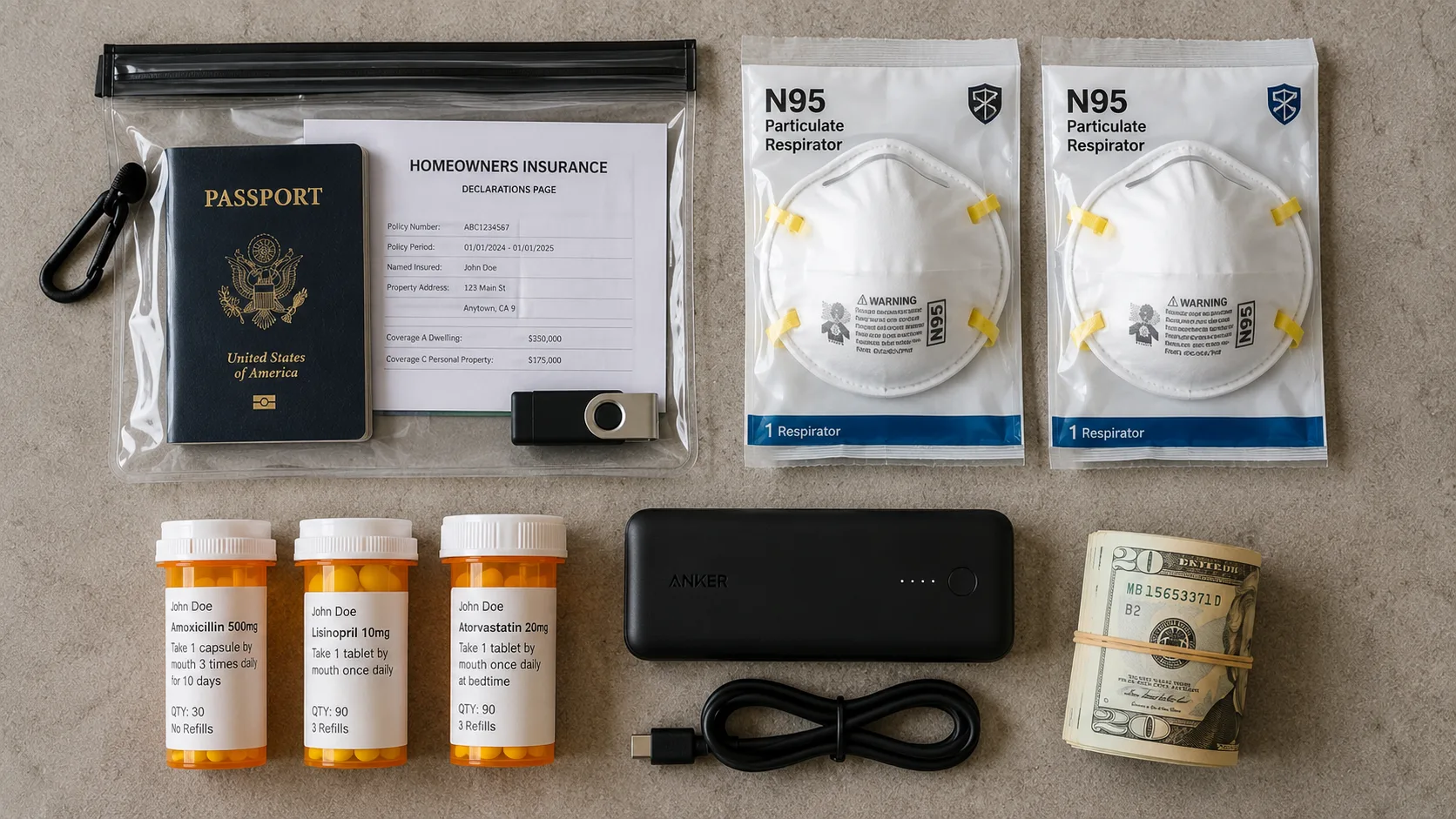
Documents are the category most people underpack. After an evacuation, the documents you need immediately are: photo ID for every household member, insurance policies (homeowners and vehicle), property deed or mortgage information, vehicle titles, financial account information (account numbers, bank contact — not passwords), passports, birth certificates, Social Security cards for all household members, and any professional licenses or credentials that would be difficult to replace quickly.
Original documents are preferable when possible. For documents you cannot safely remove from a safe or secure storage (birth certificates, Social Security cards), high-quality photocopies and a scanned digital copy on a USB drive are acceptable alternatives. The USB drive should be encrypted if it contains sensitive information.
Store physical documents in a waterproof, sealable pouch inside the bag. Documents that have been through a vehicle trunk for six months with temperature cycling, humidity, and the occasional spill need waterproofing. A dry document after an evacuation is infinitely more useful than a water-damaged one.
Medications: The Most Commonly Forgotten Category
Prescription medications are the item that causes the most serious problems when missing from a go-bag. A person with insulin-dependent diabetes who evacuates without insulin faces a medical emergency within hours. A person with a seizure disorder who evacuates without seizure medication faces a similar timeline. These are not hypotheticals — medication access is a documented critical issue in wildfire evacuation scenarios.
The go-bag should contain a minimum 7-day supply of every prescription medication for every household member. Not a travel-size amount — seven days, which accounts for evacuation periods that extend beyond initial expectations. Medications should be in their original labeled pharmacy bottles, because a prescription label identifies the medication, the dose, the prescribing physician, and the pharmacy — all information needed if a refill is required at an unfamiliar pharmacy during evacuation.
The practical challenge is that insurance typically will not cover a fill before the normal refill date. Two approaches: request an early fill citing evacuation preparedness (many insurers accommodate this for a 30-day supply once per year), or ask your physician for a written emergency supply prescription that can be filled separately and rotated into the go-bag. The latter is more reliable and does not depend on insurer accommodation.
Include a written list of all medications, doses, and prescribing physicians as a backup to the physical medications. If the medications are lost or damaged, the list enables an emergency prescription request at any pharmacy or urgent care clinic.
Water and Food for 72 Hours
The standard water recommendation for emergency preparedness is one gallon per person per day — three gallons per person for a 72-hour kit. For a family of four, that is 12 gallons. Twelve gallons of water weighs 100 pounds. This is where the go-bag approach requires a practical compromise.
A realistic approach: carry a 3-liter water supply per person in the go-bag (about 25 percent of the 72-hour recommendation), sufficient for drinking and minimal hygiene for the first day. Supplement this by filling every reusable container in the house — water bottles, thermoses — immediately upon receiving an evacuation warning, before you leave. Hotel rooms, shelters, and convenience stores along evacuation routes will supply water for the remaining days.
Water purification backup: a small water filter (such as a LifeStraw-type personal filter) or purification tablets add minimal weight and provide the ability to purify water from any source if commercial supply is unavailable. This is a low-cost, low-weight addition with significant coverage for extended scenarios.
Food for 72 hours should be calorie-dense, non-perishable, and require no cooking or minimal preparation. Protein bars, dried fruit, nuts, crackers, peanut butter in single-serve packets, and jerky all meet this profile. Avoid items that require the specific food preferences or dietary restrictions of household members to be set aside — this is not the time to discover that the emergency granola bars are the kind nobody likes. Pack food that everyone will actually eat.
N95 Masks and Why a Regular Mask Fails for Wildfire Smoke
Wildfire smoke contains fine particulate matter — PM2.5, particles 2.5 microns or smaller — that penetrates deep into the lungs and cannot be filtered by a cloth mask or a standard surgical mask. Both of those mask types filter large particles and droplets. Neither filters fine particulate at the concentration present in wildfire smoke.
An N95 respirator — the designation means it filters 95 percent of airborne particles at 0.3 microns and larger — is the minimum effective respiratory protection for wildfire smoke. N95 masks must be fit properly: the nose wire bent to the face, the mask tested for seal by covering the vents and breathing in to feel whether air leaks around the edges. A poorly fitted N95 provides substantially less than 95 percent filtration.
Include two N95 masks per person in the go-bag. They are small, lightweight, and inexpensive. Do not store surgical masks or cloth masks as wildfire smoke protection — they are not equivalent and their inclusion may create false confidence that air quality protection is adequate when it is not.
Power, Communication, and Charging
During a wildfire evacuation, your phone is your primary communication tool, your map, your payment system, and your connection to evacuation status updates. It is also the device most likely to be at 40 percent battery when the evacuation order comes. The go-bag should contain a fully charged portable power bank of at least 10,000 mAh — enough to charge a smartphone two to three times — with charging cables for every device type used by household members. USB-C, Lightning, and USB-A are all potentially relevant depending on what devices the household uses.
Keep the power bank charged. A power bank stored in a closet and not plugged in for a year loses a significant portion of its charge capacity. Put the power bank on a quarterly charging rotation — add it to a calendar reminder, charge it fully, put it back. A dead power bank in the go-bag is equivalent to no power bank.
A battery-operated or hand-crank weather radio provides information when cell and internet service is disrupted — which happens in major wildfire events when towers are in the evacuation zone or have lost power. Emergency alert radio frequencies provide official evacuation status, road closures, and air quality information independent of cellular infrastructure. A small hand-crank radio costs $20 to $40 and weighs almost nothing.
Pets: The Leading Reason People Don't Leave
Studies of wildfire evacuation behavior consistently find that inability or unwillingness to evacuate with pets is among the leading reasons people delay evacuation or refuse to leave. This is not irrational — for many people, leaving a pet behind is not an acceptable option. The problem is that the planning required to evacuate with pets takes time that is not available during a 15-minute evacuation window.
Pet evacuation pre-planning should include: a carrier or crate immediately accessible (not in a shed or garage that requires unpacking to reach), a 7-day supply of pet food and any pet medications in the go-bag, pet identification tags current with your phone number, vaccination records in the go-bag (many emergency shelters require proof of vaccination for animals), and identification of pet-friendly hotels and shelters along your most likely evacuation routes. Looking up "pet-friendly hotels near [evacuation destination]" at 2am during an active evacuation is less effective than having done it in advance.
If your evacuation route requires going through a shelter that does not accept animals, know where the nearest pet-accepting shelter is before you need it. Many counties in fire-prone regions now operate dedicated large-animal evacuation facilities for livestock — know whether one exists in your area and what the process is to use it.
The Bag Itself and How to Organize It
The container matters. A go-bag that requires significant unpacking to find what you need at 2am under stress defeats its own purpose. The organizing principle: most-needed items most accessible, least-needed items deepest.
Layer the bag: top and most accessible pocket — medications, phone charger, N95 masks, car keys, cash, and the document pouch. These are what you grab in the first 60 seconds. Main compartment — water, food, first aid kit, change of clothing, weather radio. External pockets or clips — items you may need to add at departure (phone, wallet, items from the nightstand).
Cash is an underrated go-bag essential. ATMs in evacuation zones lose power. Card processing systems at gas stations and stores along evacuation routes go down when cellular and internet infrastructure is disrupted. Having $200 to $300 in mixed bills (small bills are more useful than large) provides payment capability when electronic systems fail. The cash should be in the bag, not in your wallet — your wallet will come with you anyway.
Maintenance: The Part Everyone Skips
- ✓Twice-yearly review — pull the bag out, check every item. Replace expired food and medications, charge the power bank, verify document currency.
- ✓Update documents when they change — new insurance policy, renewed passport, added household member. The document pouch reflects the household's current situation, not the one from three years ago.
- ✓Check medication supplies quarterly — prescriptions change; the bag should reflect current medications, not previous ones.
- ✓Charge the power bank every three to four months — add to a calendar reminder.
- ✓Update pet records annually — vaccination records expire; update them when the vet visit happens.
- ✗Do not store the go-bag somewhere that adds steps to reaching it — in a storage unit, in the back of a deep closet, or in an area that requires moving other things to access it.
- ✗Do not assume a go-bag assembled in one year is still current three years later.




Comments 0
No comments yet. Be the first to share your thoughts!
Leave a Comment