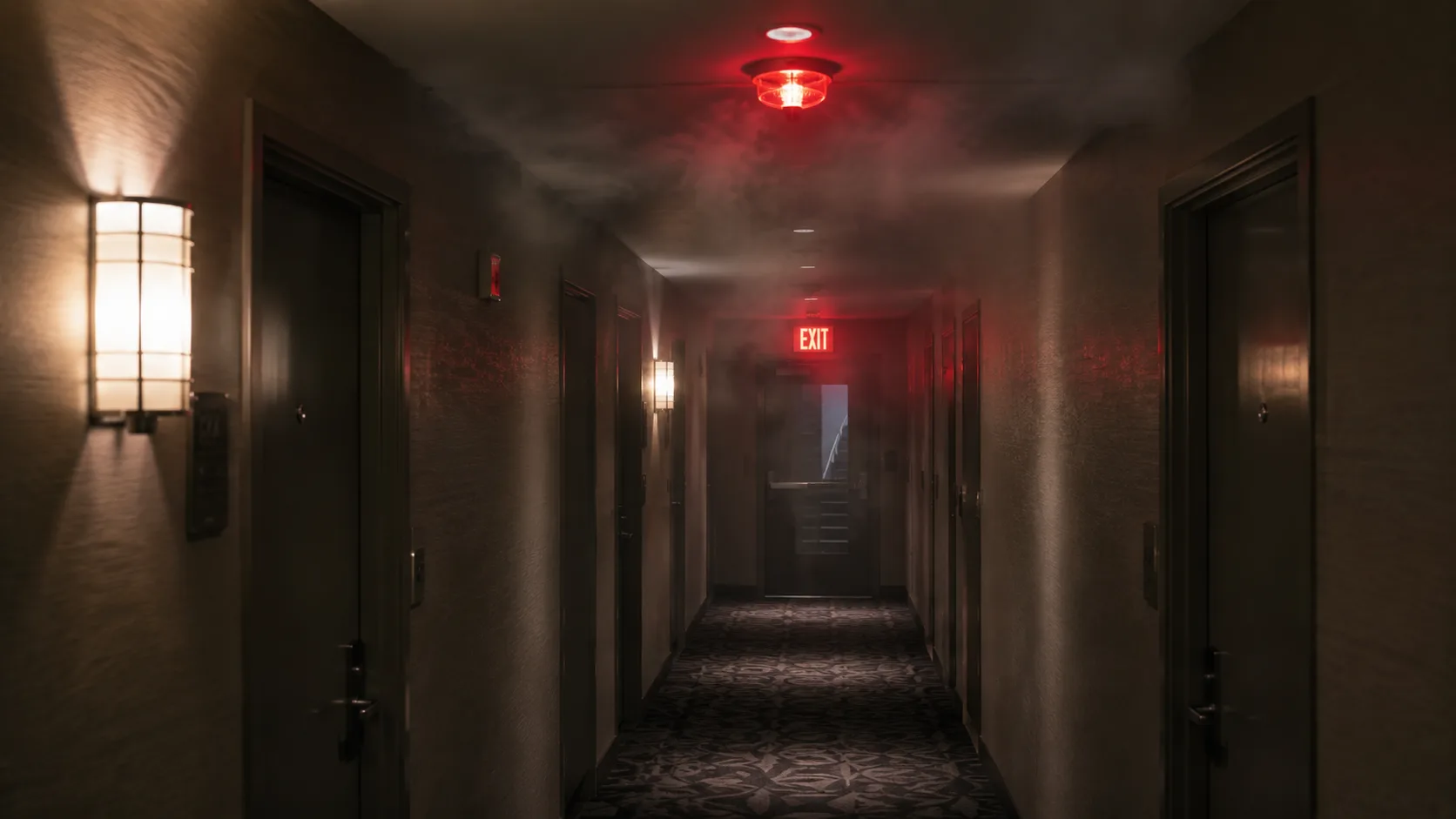
Hotel fire alarms go off in the middle of the night, in a building you have never been in before, in a room you checked into eight hours ago. You are disoriented. You do not know which direction the stairs are. You do not know if the alarm is real. You have 60 to 90 seconds to make a decision that determines whether you are walking out of the building or waiting for a rescue team on the 14th floor.
The data on hotel fires is grim in a specific way: the majority of people who die in hotel fires are not killed by the fire. They are killed by smoke — usually because they left their room when they should not have, or because they did not know their exit route and were overcome in a smoke-filled hallway before they found the stairs. Both of those outcomes are entirely preventable.
In this article:
- The 90-second check-in habit most guests skip
- When the alarm goes off at 3am: step by step
- The door-feel test and what it tells you
- Shelter-in-place in a hotel room
- High-floor hotel fires: different rules
- Propped fire doors: the hazard nobody talks about
- What to take, what to leave
- Hotel fire safety checklist
The 90-Second Check-In Habit Most Guests Skip
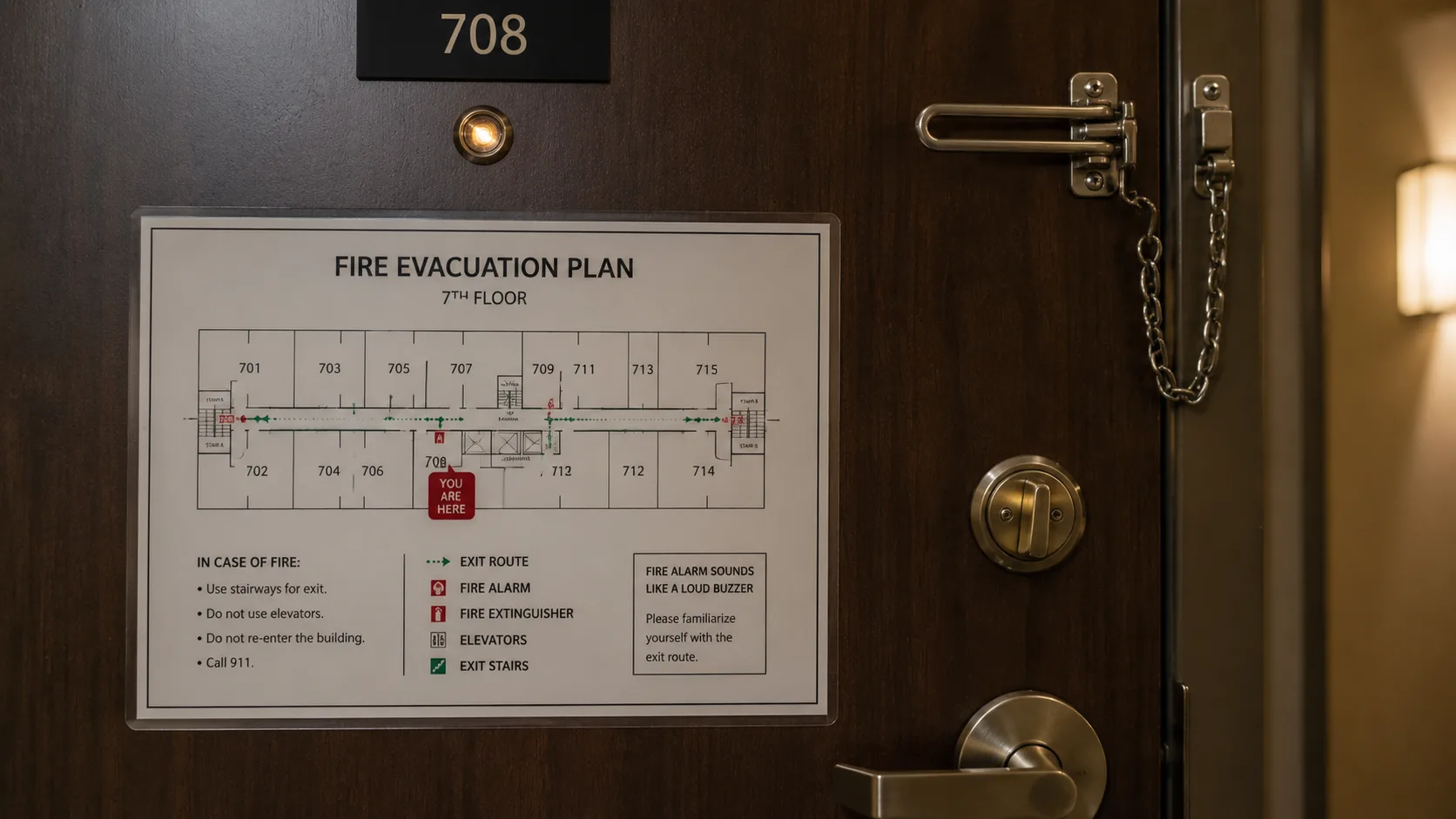
Every hotel room has a fire evacuation map on the back of or next to the door. Before you put your bag down or check your phone, do three things with that map:
- Find your room on the map. Identify the two nearest stairwell exits — there are always two. Note which direction each is from your room.
- Walk to the nearest stairwell. Not look at it from the doorway — actually walk there, open the stairwell door, and count the doors from your room. This takes 90 seconds and will be the most valuable 90 seconds of the trip if you ever need it.
- Identify the alternate stairwell. If the primary stairwell is blocked by smoke or fire, you need to know where the second one is without having to think about it.
This habit comes from flight crews, military personnel, and professional travelers who have studied fire survival. The reason it works is specific: in a smoke-filled hallway at 3am, your ability to navigate by memory of a route you have physically walked beats your ability to read a sign or recall a map you glanced at once. The neurological difference between "I remember the map said left" and "I walked left earlier and touched the door" is significant under stress.
One additional step: count the doors between your room and the stairwell. In zero-visibility smoke conditions, you can navigate by feel and count — run your hand along the wall, count doorframes, reach the stairwell door.
When the Alarm Goes Off at 3am: Step by Step
The alarm sounds. Here is the sequence, in order:
- Do not ignore it or assume it is a false alarm. Most hotel fire alarms are false alarms — but treating it as real costs you 3 minutes of inconvenience. Treating a real one as false can cost you your life. Get up.
- Put on shoes and take your room key. Shoes because evacuated guests frequently end up standing on hot asphalt, broken glass, or in the parking structure. Key because if you evacuate and the hallway is clear, you may need to return to your room — and because a locked door slows fire spread.
- Feel your door before opening it. Back of the hand on the door, then the frame, then look at the bottom gap for smoke. This is the single most important step.
- If the door is cool and no smoke is visible: open it slowly, staying low. If the hallway is clear or has only light smoke near the ceiling, move immediately toward your memorized stairwell, staying low. Do not wait for others. Do not use the elevator.
- In the stairwell: go down. If the stairwell fills with smoke as you descend, reverse and go up to the roof or the highest floor with a door that opens. Stairwells are typically pressurized and relatively smoke-free, but this varies by building age and construction.
- Once out: move away from the building and do not re-enter for any reason. Report your room number and floor to the fire incident commander.
The Door-Feel Test and What It Tells You
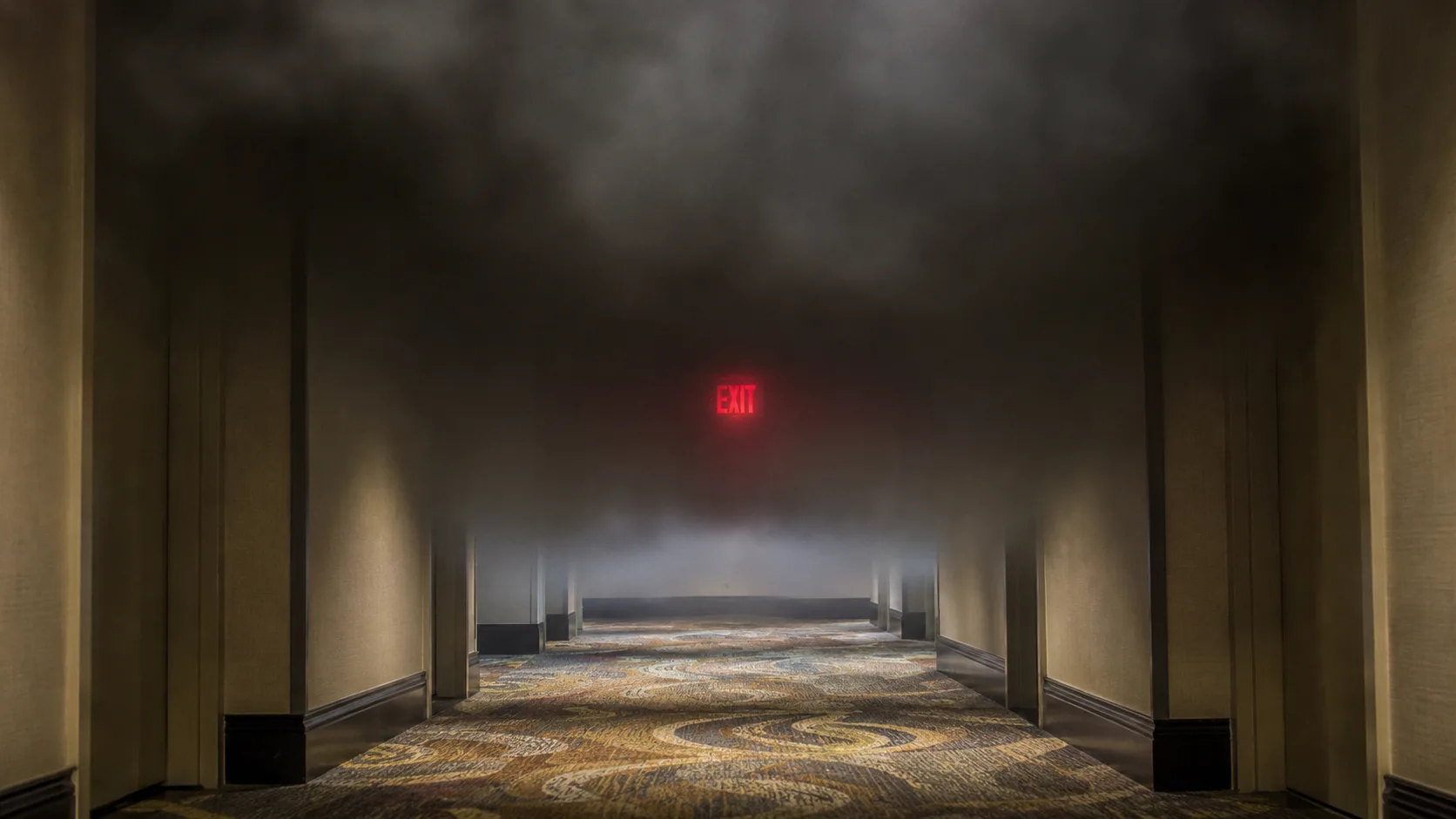
The door-feel test is not an old wives' tale. It is a direct assessment of what is on the other side of your door, and the result changes everything that happens next.
What a hot door means
A door that is warm or hot to the back of your hand indicates heat on the other side — either the fire is in the hallway or the fire is close enough to have heated the corridor air significantly. Opening this door will introduce superheated air and potentially flames into your room. Do not open it. This is a shelter-in-place situation.
What smoke at the door gap means
Visible smoke seeping under the door indicates the hallway is compromised. Even if the door itself is cool, smoke-filled hallways are rapidly unsurvivable — smoke at the gap means the hallway concentration may already be above the threshold for loss of consciousness within 60 to 90 seconds of exposure. Do not open the door. Shelter in place.
What a cool door with no smoke means
Open it slowly, stay behind the door as it opens, and assess the hallway. Light smoke near the ceiling — you can still move low. Dense smoke at eye level or below — reconsider. Clear hallway — proceed to the stairwell immediately without delay. Every second spent evaluating in the doorway is a second that conditions may be changing.
Shelter-in-Place in a Hotel Room
If you cannot safely evacuate, shelter-in-place is not giving up — it is the correct survival strategy. Hotel rooms are designed with fire resistance in mind; a closed, sealed door can hold back smoke and heat for 20 to 30 minutes or longer in a modern hotel, which is typically enough time for firefighters to reach you.
Shelter-in-place procedure in a hotel room:
- Call 911 immediately. Give them the hotel name, your floor, and your room number. Stay on the line.
- Seal the door gap. Wet towels, clothing, or bedding pushed against the gap at the bottom and sides of the door. This is not a perfect seal but it significantly slows smoke infiltration.
- Turn off the HVAC unit in your room — hotel HVAC systems can draw smoke from hallways into the room.
- Open the window slightly if you can do so without drawing smoke in from outside. Do not break the window unless you must — a broken window can create draft that draws fire toward the room.
- Signal from the window. A white sheet or towel hung from the window tells responding firefighters exactly where you are.
- Stay low. Even with a sealed door, some smoke infiltration may occur. The air within 18 inches of the floor is last to be compromised.
Do not attempt to re-enter the stairwell once you have gone back to your room. Conditions in the hallway can deteriorate rapidly. Once you have assessed that the route is unsafe and returned to your room, your shelter is your room. Stay there, stay on the line with 911, and wait for the fire department.
High-Floor Hotel Fires: Different Rules
Above the 7th or 8th floor of a hotel, aerial ladders cannot reach you. This is a known constraint — modern high-rise hotels are designed around it, with enhanced compartmentalization, sprinkler systems in every room, and pressurized stairwells. But it means the calculus of evacuation vs. shelter-in-place shifts for high-floor guests.
On a high floor, the general guidance is more conservative about evacuating. A 15-story stairwell descent through a stairwell that may fill with smoke partway down — and that may be filled with panicking guests — presents more risk than a well-sealed room with a 911 call in progress. If the fire is below you, smoke rising in the stairwell may cut off your descent before you reach a clear floor. Know where the roof access is. Many high-rise fires result in guests and firefighters staging on the roof while interior conditions are addressed.
Propped Fire Doors: The Hazard Nobody Talks About
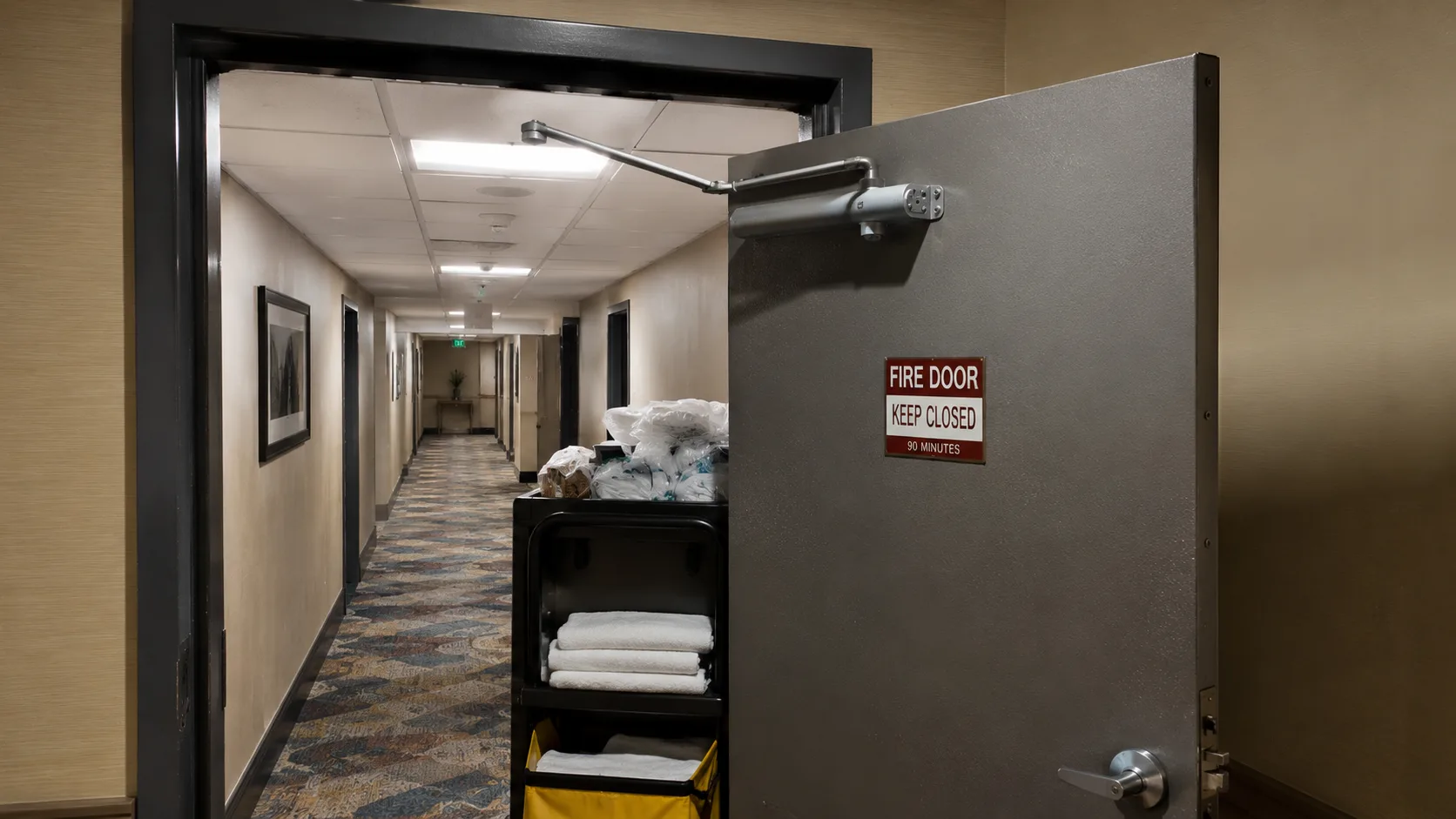
Hotel corridors have fire doors at intervals — the heavy, self-closing doors that divide the corridor into sections. Their purpose is compartmentalization: in a fire, they close automatically and prevent smoke from traveling the full length of the floor, giving guests on the far end more time and a clearer evacuation route.
Guests and housekeeping staff prop these doors open constantly. A luggage cart. A trash can. A doorstop brought from home. This is not a minor nuisance — a propped corridor fire door eliminates the smoke protection for everyone in that section of the building. If you see a corridor fire door propped open, remove the obstruction. If you see a door that does not close on its own and has no obvious prop, report it to the front desk.
Your own room door is also a fire door. The instruction "close your door behind you when evacuating" is not about security — it is about fire compartmentalization. A closed door between the fire and the hallway, or between the hallway and you, adds minutes. Those minutes matter.
What to Take, What to Leave
| Take | Why |
|---|---|
| Room key | Needed to return to room if evacuation route is blocked; keeps the door locked behind you |
| Shoes | Parking lots, exterior surfaces, and debris are hazardous barefoot; you may stand outside for hours |
| Phone | To call 911 and to signal your location; leave it charging within reach at night |
| Prescription medication | Only if on the nightstand and takes 5 seconds — not worth opening luggage for |
| Leave | Why |
|---|---|
| Luggage, laptop, valuables | Every second spent packing is a second the hallway conditions deteriorate |
| Wallet and documents | Replaceable — your phone can do most of what a wallet does for 24 hours |
| Clothing beyond what you are wearing | Get out first; the Red Cross will address clothing needs at the scene if necessary |
Hotel Fire Safety Checklist
- ✓Read the evacuation map on the door — find your room, locate both stairwells.
- ✓Walk to the nearest stairwell — physically walk there and count the doors.
- ✓Sleep with your room key within reach — nightstand or the same place every night.
- ✓Keep your shoes accessible — beside the bed, not packed in a suitcase.
- ✓Always feel the door before opening — back of hand, frame, then bottom gap.
- ✓Know the shelter-in-place procedure — seal, call, signal, stay low.
- ✓Remove any prop from corridor fire doors — it takes 3 seconds and protects your floor.
- ✗Never use the elevator during a fire alarm — not even to go one floor.
- ✗Never go back for luggage or valuables once you are evacuating.
- ✗Never assume it is a false alarm — treat every alarm as real until you know otherwise.
The 90-second walk to the stairwell after check-in costs nothing and requires no equipment. It is the single most effective thing a hotel guest can do to improve their odds in a fire. Do it every time, every hotel, without exception.
Comments 0
No comments yet. Be the first to share your thoughts!
Leave a Comment