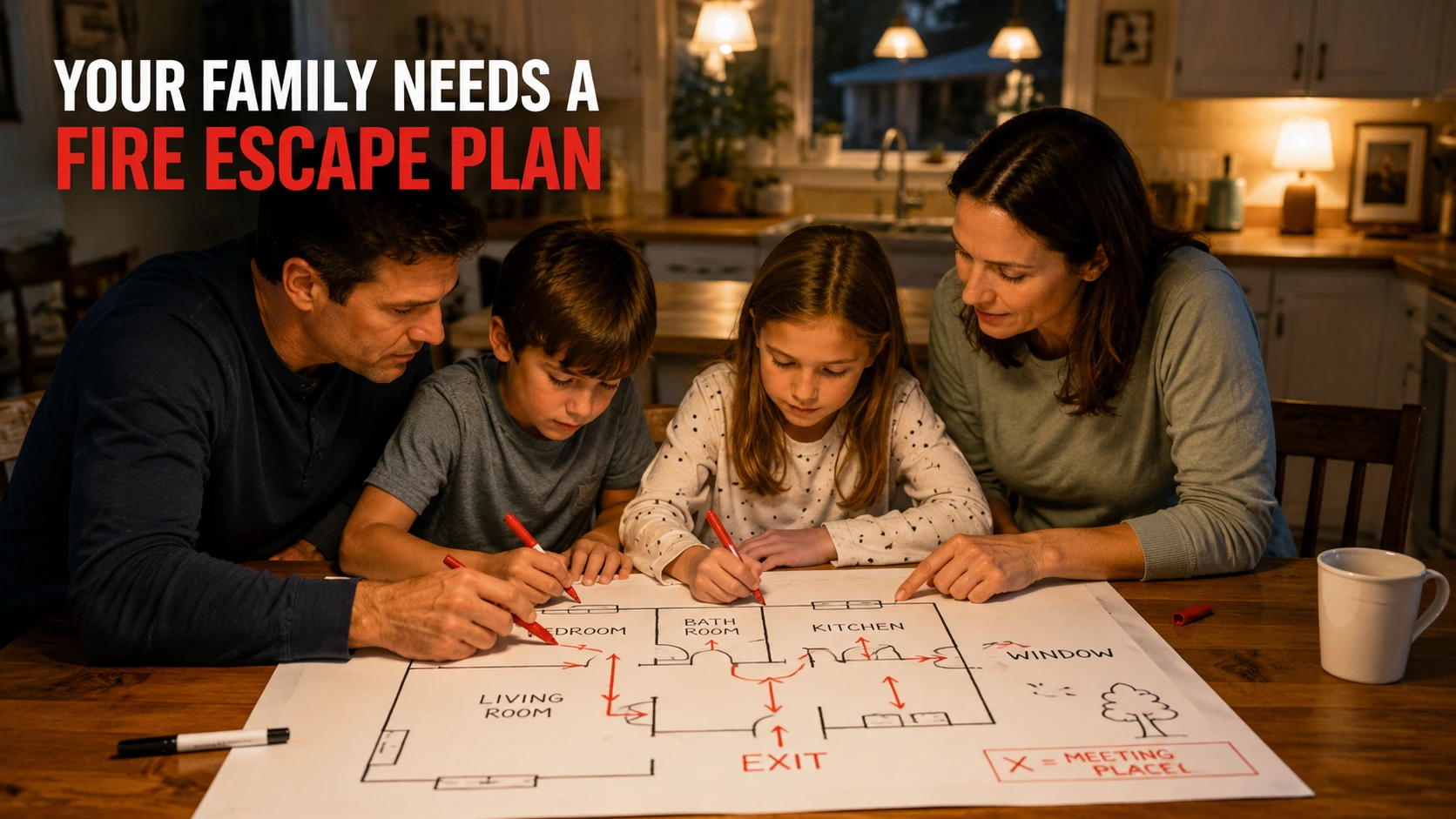

Most house fires that kill people happen between midnight and 6am. The smoke alarm goes off. Everyone wakes up disoriented, in the dark, in a room that may already have smoke in it. What happens in the next 90 seconds is almost entirely determined by what the family practiced before that moment — not by what they figure out on the spot.
I have responded to house fires where families escaped because they had a plan and had practiced it. I have also responded to fires where people died making decisions in real time that they should have worked out weeks earlier. The difference between those two outcomes is almost never luck. It is preparation.
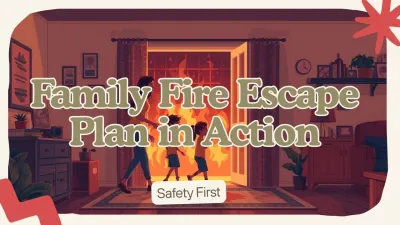
This is how to build a fire escape plan that actually functions under pressure — not the kind you talk about once at the dinner table and forget, but the kind that works at 3am when the alarm is screaming and your kids are calling for you from down the hall.
What we cover:
- Why most family fire escape plans fail
- Drawing your escape routes — how to do it right
- Two ways out of every room
- Two-story homes and upper floor escapes
- The door check — the most important habit in a house fire
- Teaching kids — by age
- The meeting place
- Running a real drill
- Pets, elderly family members, and mobility considerations
- Complete plan checklist
Why Most Family Fire Escape Plans Fail
You have roughly 2 minutes.
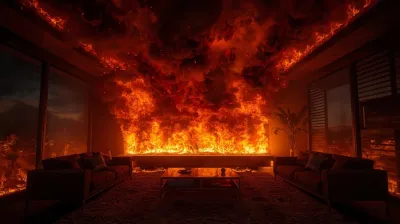
Modern homes burn faster than homes built decades ago — synthetic materials in furniture and construction ignite quickly and produce toxic smoke rapidly. Once a room reaches flashover, everything in it burns. The time between a smoke alarm sounding and a bedroom becoming unsurvivable can be under 3 minutes. Your plan needs to work in that window, not in 10.
Most families have a version of a fire escape plan that goes something like this: “We'll go out the front door, or the back door if the front is blocked, and we'll meet in the driveway.” That is not a plan. That is a general idea, and it has several things that will fail in a real fire.
The plan is in one adult's head, not everyone's. If the adult who knows the plan is the one separated from the children by the fire, the children do not have a plan. They have terror and instinct.
Nobody knows which door is “blocked.” Smoke makes it impossible to see. Heat makes it impossible to approach certain areas. Without a practiced primary and secondary route from each room, people stand in hallways trying to figure out which way to go while the fire makes the decision for them.
The meeting place is vague. “The driveway” is an area where firefighters will be running hose, where neighbors will be gathering, and where it is impossible to confirm everyone got out. “The oak tree at the corner of the driveway by the mailbox” is a meeting place.
Nobody has practiced it at night, from their bedroom, with a simulated alarm. Navigating a familiar hallway in daytime is a completely different experience from doing it at night with adrenaline, disorientation, and possibly smoke. Practice changes the outcome. A plan without practice is aspirational, not operational.
Drawing Your Escape Routes
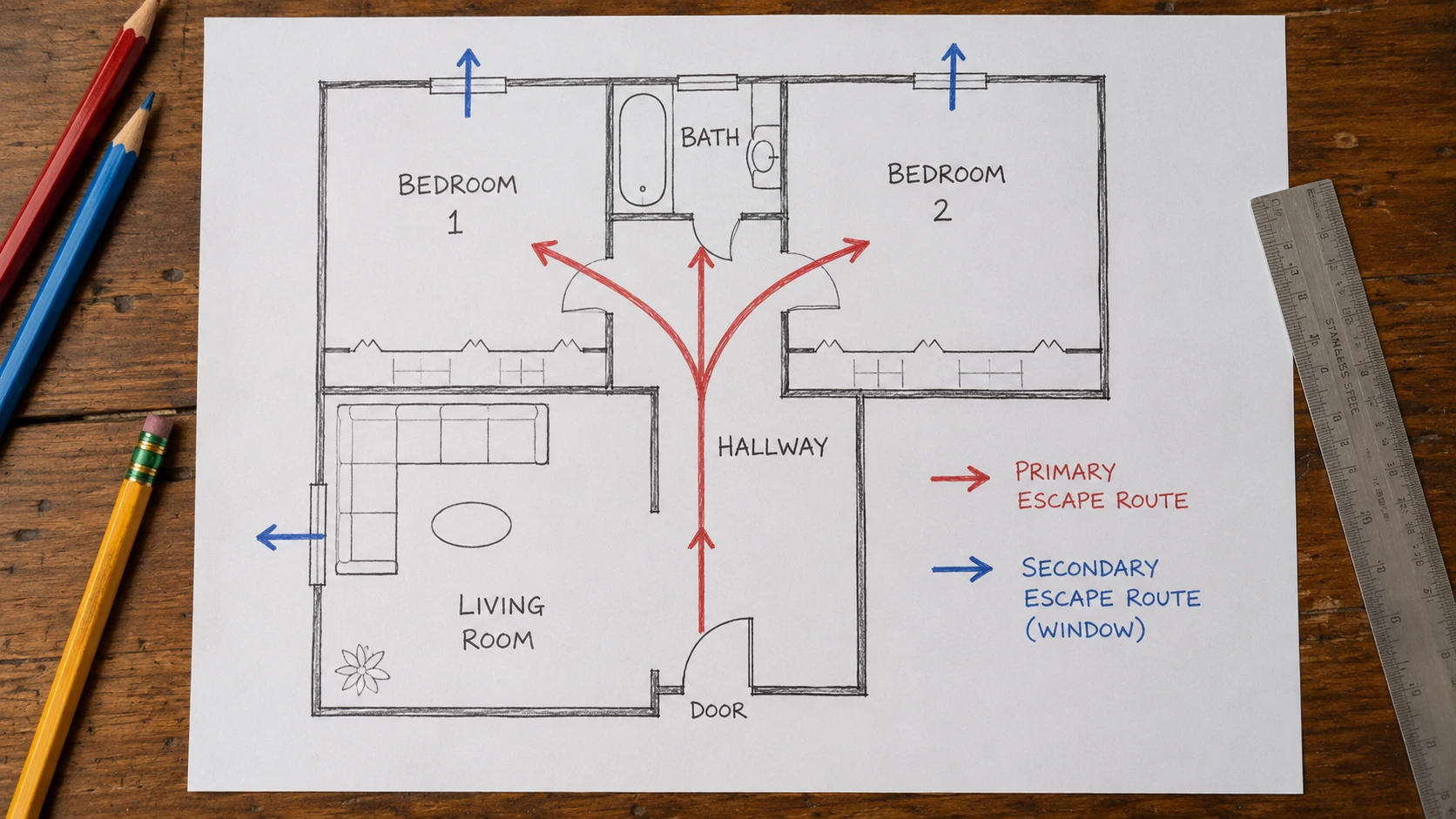
Get a piece of paper and draw your home. It does not need to be architectural quality — a rough sketch showing each room, every door, and every window is enough. Do this for every floor.
For each room, draw two arrows:
- Primary exit: The fastest way out under normal conditions — usually the bedroom door to the hallway, then to the nearest exit.
- Secondary exit: The alternate route if the primary is blocked by fire or smoke — almost always a window.
Walk each route physically as you draw it. Do the windows in secondary exit rooms actually open? Open them now, while you are calm. A window that has been painted shut, or that has a storm window that requires two hands and a latch, is not a reliable emergency exit. Fix it now.
Note on the drawing where the smoke alarms are located. Note the meeting place outside. Post the completed drawing somewhere in the home where everyone can see it — inside a kitchen cabinet door, on a bulletin board, wherever your family actually looks. A plan in a drawer is not a plan.
Two Ways Out of Every Room — What This Actually Means
Every room that someone sleeps in needs two viable exit paths. For most bedrooms, the primary path is the door to the hallway. The secondary path is the window. But “the window” as a secondary exit only counts if:
- The window can be opened from inside without tools, while panicked, with one hand if necessary
- The window opening is large enough for a person to fit through — including adults, not just children
- The drop to the ground from the window is survivable, or there is a plan for a safe drop (escape ladder, roof overhang, porch roof)
- Everyone who sleeps in that room knows how to open that window and has practiced doing it
Check every bedroom window in your home right now. Open each one. If any window requires effort to open — paint seal, stiff mechanism, locking hardware that is not obvious — practice opening it until everyone who sleeps in that room can open it quickly in the dark.
For rooms where the window drop is too high to be safe — upper floors, above a hard surface — you need either a fire escape ladder or a plan that accounts for the fact that that window is not a viable secondary exit. We will cover upper floor escapes next.
Two-Story Homes: Upper Floor Escapes
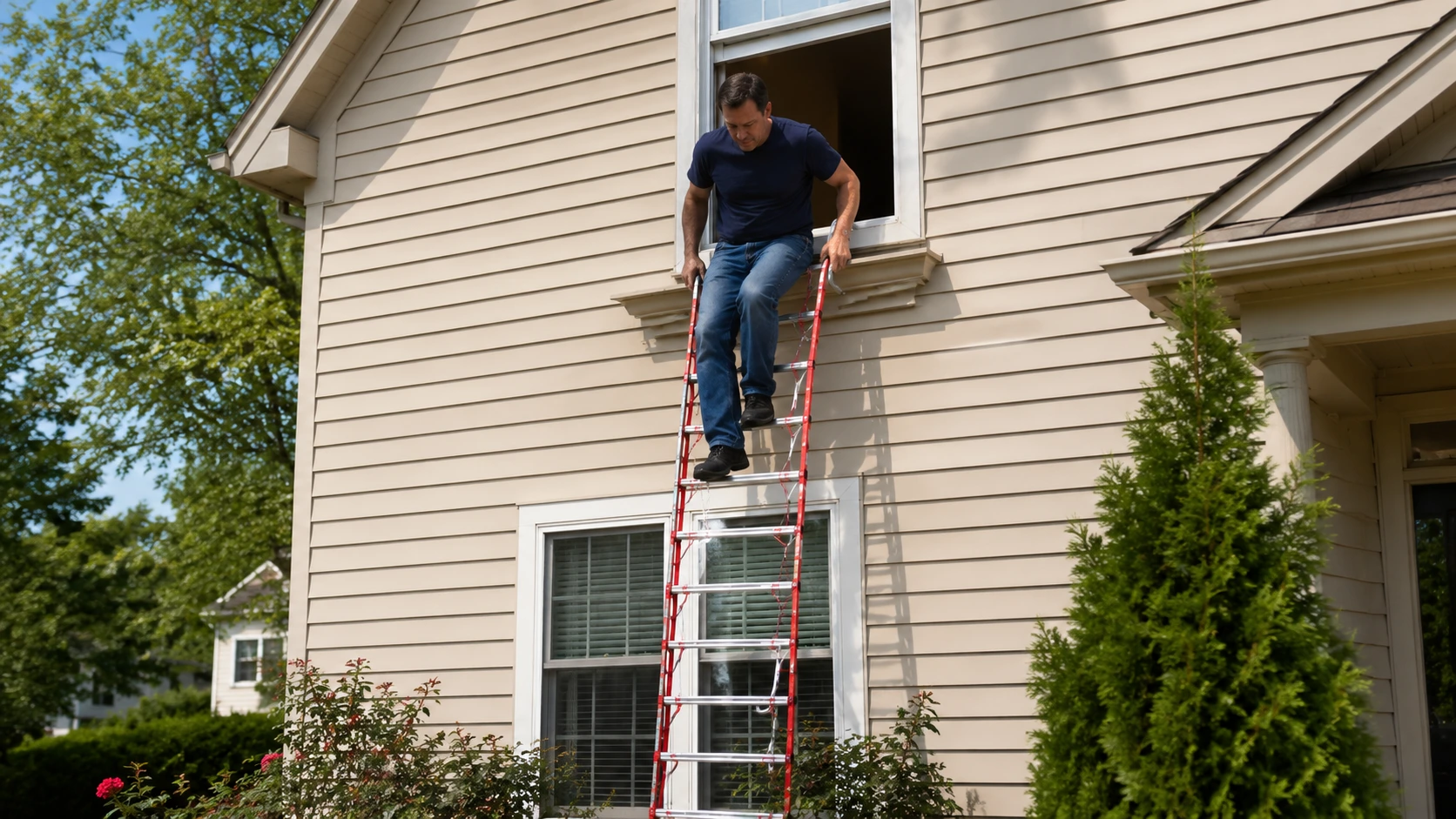
Upper floors create the hardest escape problem in residential fire. The staircase — the obvious exit — is often the first part of the house to fill with smoke, because smoke rises. A bedroom at the end of a second-floor hallway with a fire in the living room below may have its primary exit cut off within the first minute.
Fire escape ladders
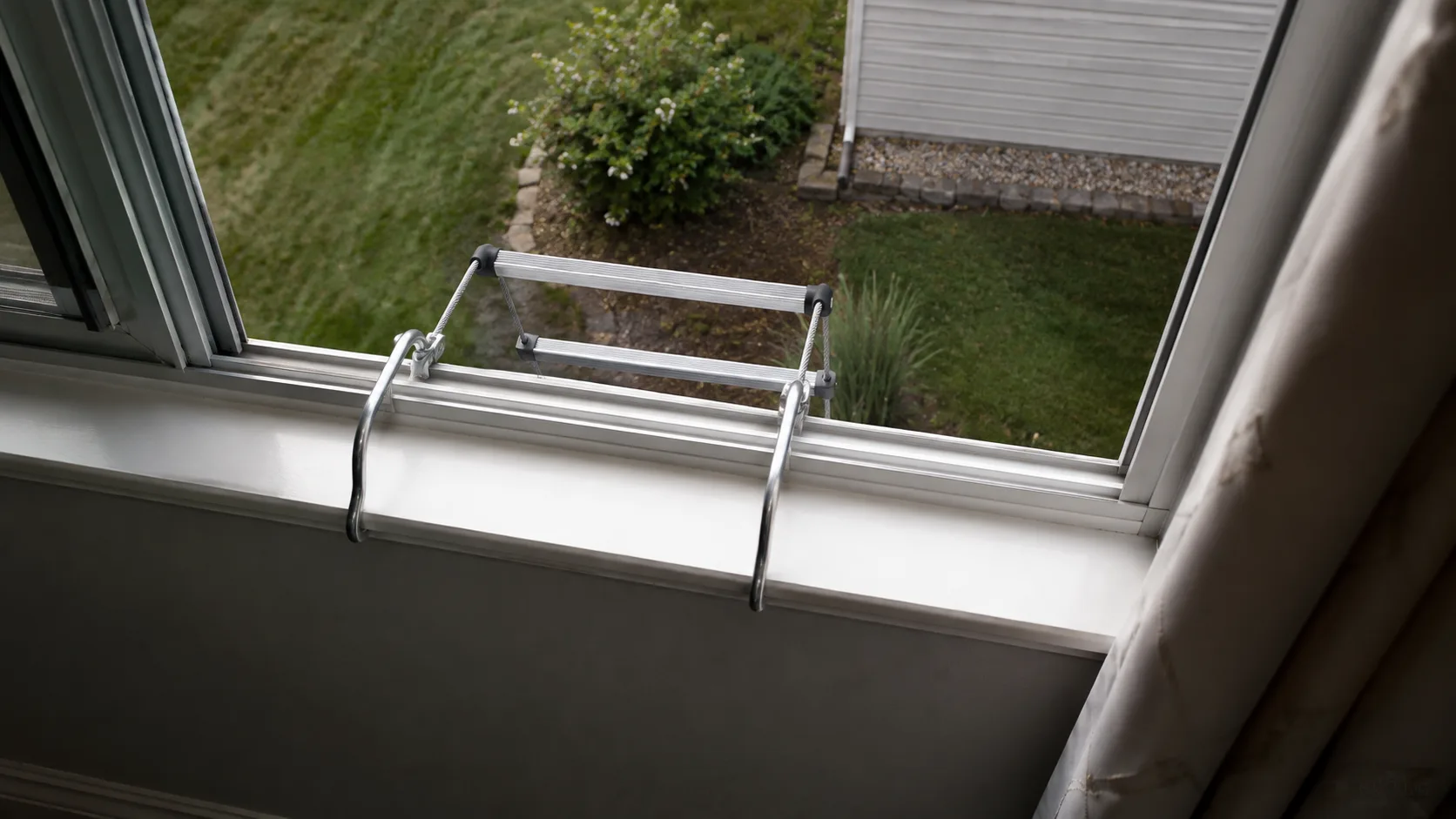
Collapsible fire escape ladders are the practical solution for upper-floor bedrooms. They hook over the window sill and deploy to the ground, allowing a person to climb down from a second or third floor window. They cost $30–80, fold to the size of a small bag, and store under a bed or in a closet. Every upper-floor bedroom where someone sleeps should have one.
The critical detail: practice deploying and using your escape ladder before you need it. The first time you try to unfold and hook a fire escape ladder is a bad time for it to be during a real fire. Do a practice deployment in daylight — hook it over the window sill, let it drop, and climb out at least once. Adults should practice this. Older children should practice this. Knowing how the ladder deploys and feeling what it is like to climb out a window and down the side of your house removes the uncertainty that freezes people during real emergencies.
Shelter in place when the hallway is blocked
If you open your bedroom door and encounter heavy smoke or heat — close the door immediately. Do not try to push through. Close the door, seal the gap at the bottom with a towel, blanket, or clothing, and signal from the window. Call 911 if you have a phone. Make noise — yell, wave something from the window. A closed interior door can slow fire spread for 10–20 minutes. That is enough time for firefighters to reach you if you have called and they know where you are.
This is the part of fire survival that goes against every instinct. Everything in you will want to get out. If getting out means running through heavy smoke, staying in a closed room and signaling for help is the better choice. We will find you faster if you are at the window than if you are in the hallway.
The Door Check: The Habit That Saves Lives
Before opening any door during a fire, check it. Every door. Every time. This is the single most important physical habit in a house fire, and it takes two seconds.
Place the back of your hand on the door surface, starting at the bottom and moving up. The back of the hand is more sensitive to heat than the palm. If the door is hot, there is fire on the other side. Do not open it.
Look at the gap under the door. Smoke visible coming under the door means there is smoke in the space beyond. If the door is cool but smoke is coming under — open slowly, stay low, and be ready to close it immediately if conditions on the other side are worse than expected.
This is your secondary exit situation. Use your secondary route. If no secondary route is viable, seal the door gap and signal from the window.
Teach this to everyone in your household, including children old enough to understand it. Practice it during your fire drill — have children walk to their bedroom door and practice the check motion. It is a simple motor habit that is easy to learn and very hard to remember to do for the first time in a real fire.
Close your bedroom door at night. A closed door between you and a fire in another part of the home is the most underused piece of fire safety equipment in residential settings. In testing, a closed hollow-core interior door can hold back lethal smoke and heat for 10–15 minutes. That is the difference between being asleep and unreachable and being awake and at your window before we arrive. Sleep with your bedroom door closed.
Teaching Kids: What Works at Each Age
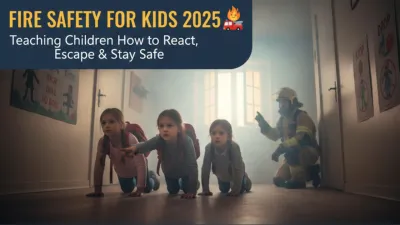
Children are not small adults when it comes to fire behavior. They hide during fires — under beds, in closets, in familiar spaces that feel safe but make them impossible to find. They are also more susceptible to smoke incapacitation than adults. Teaching fire escape to children requires age-appropriate framing and repeated practice, not a single conversation.
Focus on the alarm sound and one response: get up, get to the door, come find a parent. Practice the alarm sound so they know what it means — play it during your drill so it is not terrifying the first time they hear it for real. Teach “get low and go.” Do not expect independent escape — this age needs an adult.
These children can learn and practice the full escape route from their room. Teach the door check. Teach the meeting place. Practice walking the route with lights off. Teach them to never hide and to go outside even if they are scared. A child who has walked their escape route in the dark is a child who can use it.
Old enough to be responsible for a younger sibling in the escape plan if routes allow it. Teach them to close doors behind them as they leave. Teach them how to deploy the escape ladder if they have one. Practice calling 911 — know your address, say it clearly, stay on the line.
The hiding problem
Children hiding in fires is a documented pattern that kills children who had viable escape routes. They go to familiar hiding places — under the bed, in the closet, in the corner of the room — when they are frightened. This is instinct, and instinct wins over instruction that was only given once. The antidote is practice. A child who has physically walked out of the house in a drill multiple times has a practiced motor routine to compete with the hiding instinct. Practice enough times and the routine becomes the stronger impulse.
Tell children directly: do not hide during a fire. Ever. Get out. We will find your toys. We cannot find you in a closet when the house is full of smoke.
The Meeting Place
The meeting place exists for one reason: so that when firefighters arrive, you can tell us whether everyone is out of the house. That information determines what we do in the first 60 seconds. If you can say with certainty that everyone is at the meeting place, we search and suppress differently than if you tell us there may be a child still inside.
The meeting place needs to be:
- Specific. Not “the front yard” — a specific identifiable point. The mailbox. The neighbor's driveway. The oak tree. Something everyone can find independently and that will not be occupied by fire trucks.
- Far enough from the house. At minimum, across the street or to the neighbor's property. The driveway in front of a burning house is not far enough — it is in the path of fire apparatus and potentially in the path of falling debris.
- Agreed upon by everyone. Including children. The meeting place only works if everyone goes to the same place without coordinating — because in a real fire, coordination may not be possible.
- A place from which to call 911. If you have a phone, call from the meeting place. If you do not, go to the neighbor's and call from there. Give the dispatcher your address first.
Establish a secondary meeting place as well — in case the fire or emergency conditions make the primary meeting place unreachable. A neighbor's house two doors down, a nearby corner. If family members arrive at the primary meeting place and some are not there, they go to the secondary.
Do not go back inside for any reason once you are out. Not for pets. Not for phones. Not for medications. Not for anything. Tell the firefighters what is inside and let us handle it. The number of people who have died going back into burning homes for retrievable items is not small. Once you are out, you stay out.
Running a Real Fire Drill
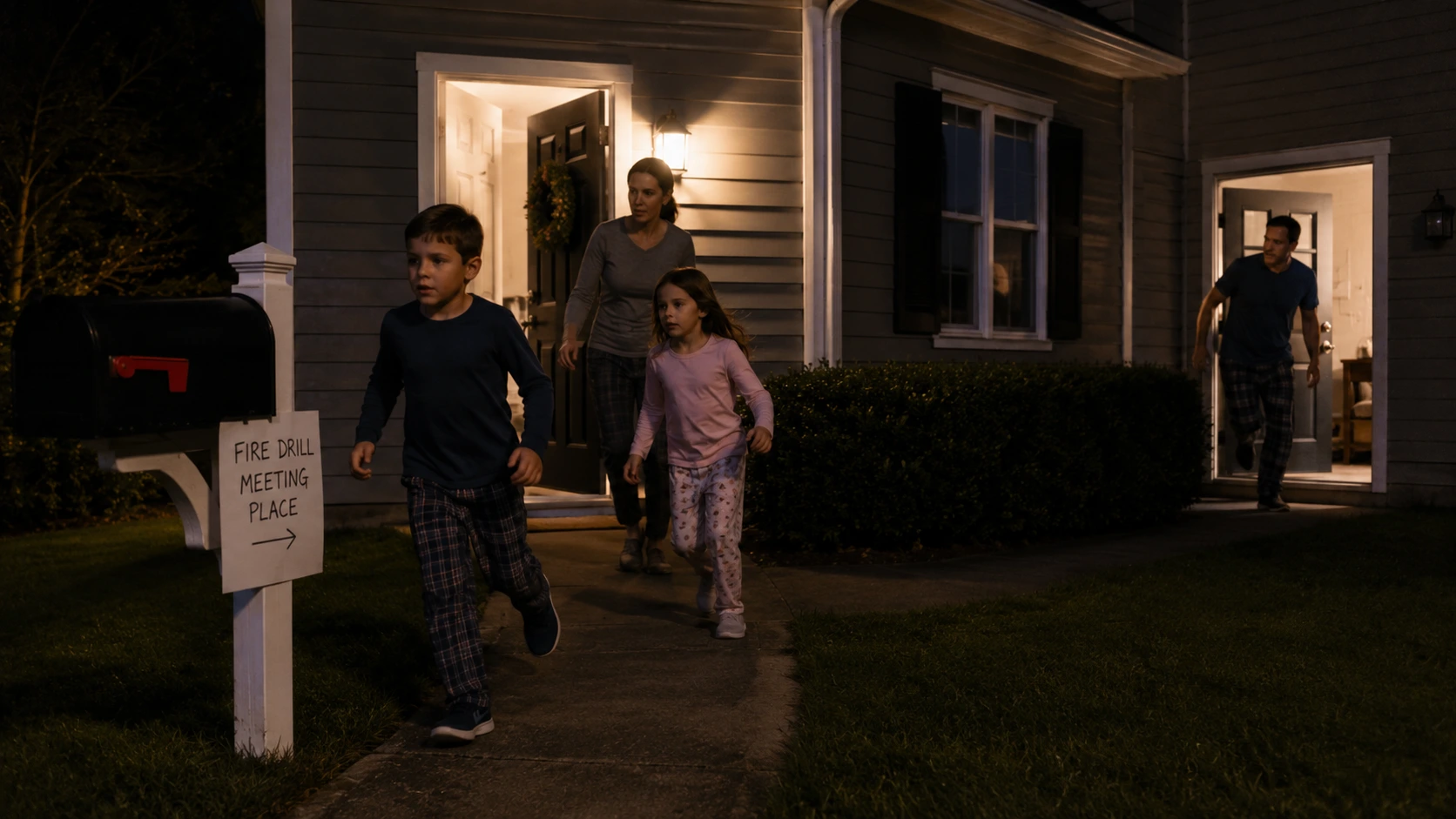
A plan that has never been practiced is just a drawing on paper. Here is how to run a drill that actually prepares your family:
Do it at night
The vast majority of fatal house fires occur when people are asleep. A drill run in the middle of a Saturday afternoon teaches your family the route when they are alert and oriented. A drill run after everyone has gone to bed tests whether they can execute the plan when they wake up disoriented, which is when they actually need to. Run at least one nighttime drill per year. Tell them it is coming, but not exactly when.
Start with the alarm
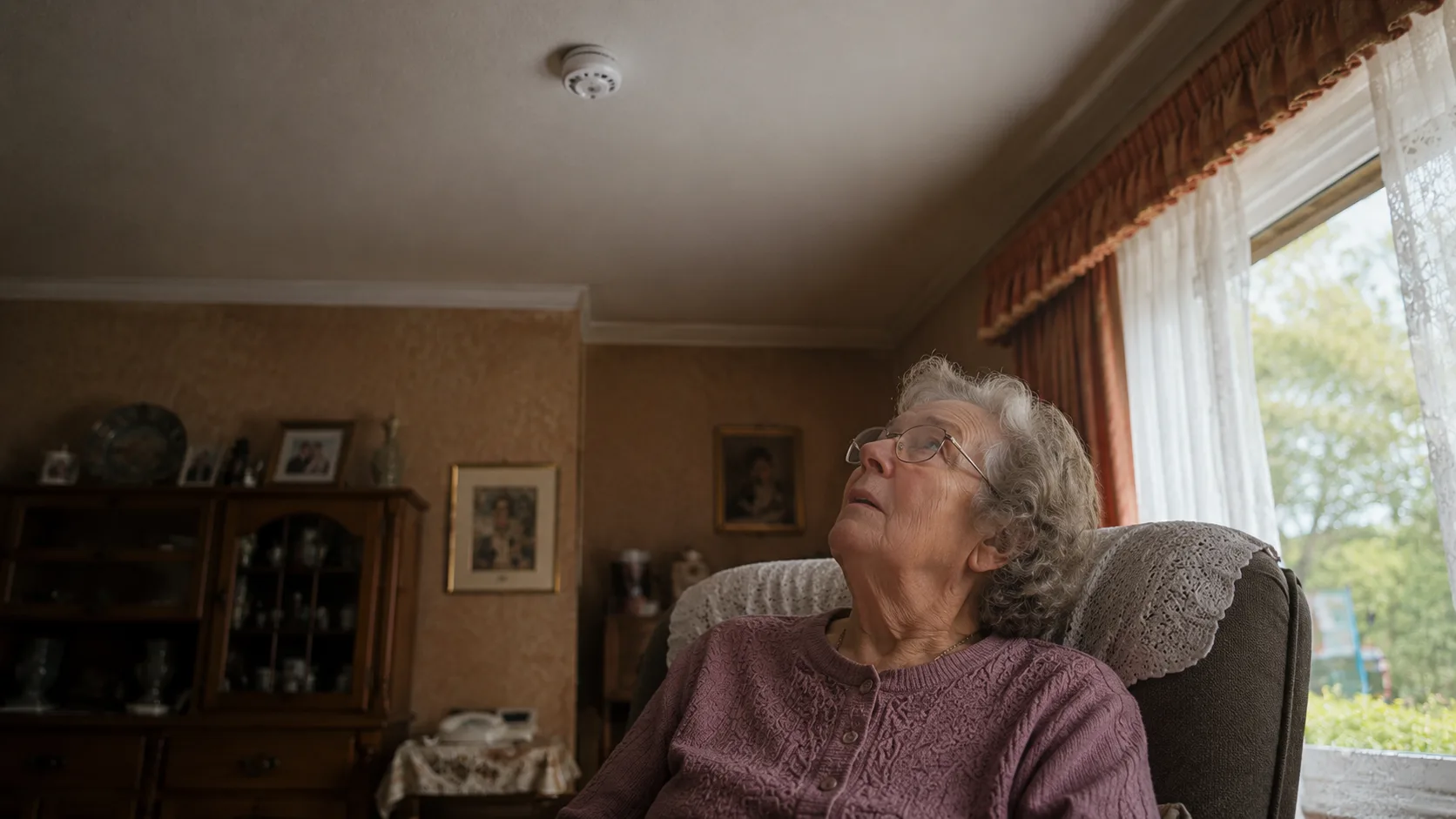
Press the test button on your smoke alarm to start the drill. This does two things: it familiarizes children with the actual sound of the alarm (not a verbal “pretend the alarm is going off”) and it tests that the alarm is working. If the alarm does not sound when you press the button, you have discovered a maintenance problem that needed to be found.
Use the actual routes
Everyone exits through their actual planned routes, not the most convenient door. The point of the drill is to practice the paths that will be used in the actual emergency — not to get outside as fast as possible by any means available.
Close doors
During the drill, close bedroom doors and interior doors as you leave, just as you would in a real fire. This habit needs to be automatic — it will not be automatic in a real fire unless it was practiced in the drill.
Meet at the meeting place
Everyone goes to the meeting place. Count heads. Confirm everyone is accounted for before ending the drill. This practices the accountability step that matters most when firefighters arrive and ask you “is everyone out?”
Debrief
After the drill, ask everyone what was difficult or confusing. Did a window not open easily? Was a route unclear? Was the meeting place hard to find in the dark? Fix the problems you discover in the drill. That is what the drill is for.
How often: NFPA recommends practicing your home escape plan twice a year. Once at night and once during the day covers both conditions. For families with young children, quarterly practice until the plan is automatic is worth the ten minutes it takes.
Pets, Elderly Family Members, and Mobility Considerations
Pets
This is a hard thing to write but an important one: do not put your life at risk for a pet. If your pet is in your path as you exit, take them. If they are not, get out. Many pets survive house fires on their own — they move to low areas, find exits, or shelter in place. Many people have been seriously injured or killed attempting pet rescues after they were already out. Tell the firefighters a pet may be inside and where it sleeps. That is what we need from you.
Practically: if you want to maximize the chance of getting pets out, keep them in a room near an exit at night. A cat who sleeps in the bedroom can be scooped up during the bedroom exit. A dog in a crate in the living room is much harder to reach if the fire is between you and the crate.
Elderly or mobility-limited family members
Every family with an elderly parent, a person with limited mobility, or a person who uses a wheelchair or walker needs a specifically assigned person whose role in the escape plan is assisting that person. This is not a general “we'll figure it out” — it is a named person with a named responsibility: “In a fire, Dad goes to Mom's room and they exit through the back door together.”
If a family member cannot safely exit without assistance and there is no other person who can reliably provide that assistance, contact your local fire department non-emergency line and ask about the process for registering high-risk residents. Many departments maintain lists of addresses with mobility-limited residents so that incoming crews know to expect this on an alarm call. This is not an unusual request. We want to know.
Infants and very young children
Assign a specific adult to be responsible for the infant or toddler in every fire scenario. This should not be left to whoever happens to be closest. In a two-parent household: one parent is assigned to each young child. The assignments are discussed, agreed upon, and practiced. In single-parent households: the parent always gets the young child before exiting, which affects which routes are viable (a parent carrying a young child cannot use an escape ladder from a second floor, for example). Plan around this reality.
Complete Plan Checklist
- ✓Floor plan drawn with all rooms, doors, and windows marked for each floor
- ✓Primary exit route marked from every sleeping room
- ✓Secondary exit route marked from every sleeping room — viable window or alternate path
- ✓All windows tested — open freely, opening large enough, drop safe or escape ladder present
- ✓Escape ladder purchased and stored in every upper-floor bedroom with a non-viable window drop
- ✓Escape ladder practiced — deployed and climbed at least once by every person who would use it
- ✓Plan posted somewhere visible in the home
- ✓Meeting place identified — specific location, known to everyone including children
- ✓Secondary meeting place identified
- ✓Door check taught and practiced by all family members
- ✓Children know not to hide and have practiced walking the route in the dark
- ✓Responsibility assigned for each person needing assistance (infants, elderly, mobility-limited)
- ✓Pet plan established — realistic, not aspirational
- ✓Nighttime drill completed — from bedrooms, starting with the alarm, using actual routes
- ✓911 address known by all family members old enough to call
- ✓Drill scheduled on the calendar for 6 months from now
This is not a complicated process. It takes a few hours spread over a couple of evenings — drawing the plan, checking the windows, buying the escape ladder if needed, and running one drill. The families who do it are the ones who are standing at the meeting place when we arrive. The families who do not are the ones trying to figure it out in the dark with smoke in the air.
Make the time. Do it this weekend, not eventually.
For related reading: the Smoke Alarm Beeping article covers how to make sure your alarms are working correctly, and the House Fire Spread article explains exactly why the 2-minute window matters.


Comments 0
No comments yet. Be the first to share your thoughts!
Leave a Comment