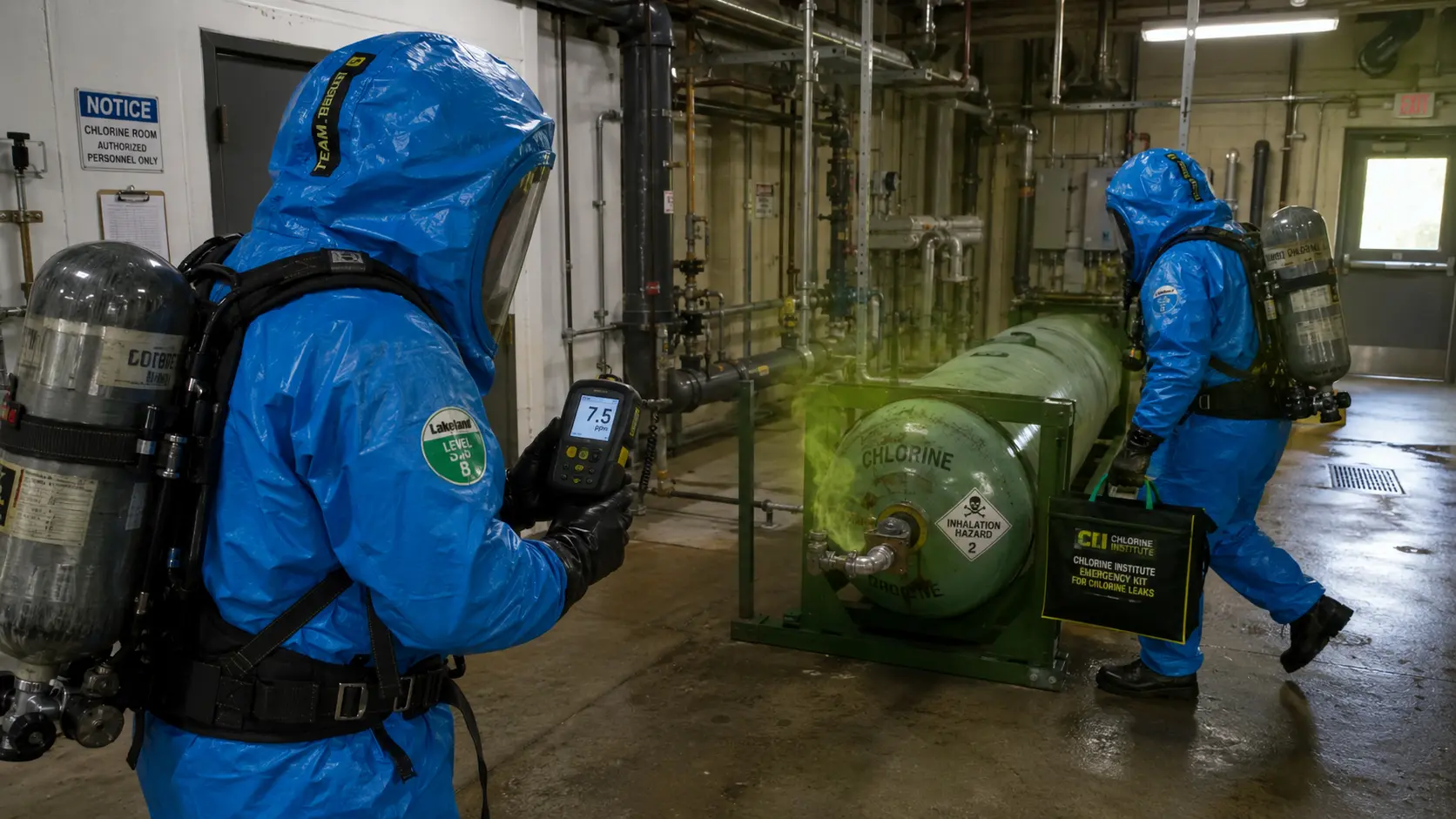

Chlorine kills faster than almost any common industrial chemical at concentrations that are achievable from a relatively modest release. The chemistry is straightforward: chlorine reacts with the moisture in lung tissue to form hydrochloric acid, producing chemical burns to the respiratory tract that cause pulmonary edema — fluid accumulation in the lungs — that can develop over hours after a brief exposure and kill a person who initially walked away from the scene feeling relatively well.
It is also one of the most commonly released hazardous materials in the United States: present at virtually every municipal water treatment facility, at swimming pools and recreational facilities, at pulp and paper mills, at chemical manufacturing plants, and moving through the transportation system in pressurized rail tank cars that carry up to 90 tons of liquid chlorine. Most hazmat teams respond to a chlorine incident within the first year of their formation. Many respond to one every few months.
In this article:
Physical and Chemical Properties
Chlorine (Cl₂) is a diatomic halogen gas at standard temperature and pressure — one of the elemental halogens, along with fluorine, bromine, and iodine. In the industrial context it is typically stored and transported as a liquid under pressure, converting to gas when released at atmospheric pressure. Key physical properties:
- Color: Yellow-green at moderate concentrations — the color is visible at concentrations that are already significantly toxic. Colorless at very low concentrations.
- Odor: Pungent, bleach-like — detectable by most people at concentrations as low as 0.5 to 1 ppm. The odor threshold is above the permissible exposure limit, meaning that by the time you smell it, you have already exceeded the safe exposure level.
- Density: 2.5 times heavier than air — chlorine released at grade level sinks and accumulates in low areas: basements, trenches, ditches, storm drains, sub-grade mechanical rooms, and any enclosed space below the release point.
- Reactivity with water: Highly soluble in water, forming hypochlorous acid (HOCl) and hydrochloric acid (HCl) in aqueous solution. This reaction is the basis for both its use in water purification and its toxicity to lung tissue.
- Flammability: Chlorine is not flammable — it is an oxidizer. It does not burn, but it supports combustion of other materials and reacts violently with many organic compounds.
Why Chlorine Pools in Low Areas
The 2.5× air density means chlorine released at grade level moves downward and horizontally in a layer close to the ground rather than rising and dispersing like many lighter gases. It flows like a liquid, following terrain, draining into low points, and accumulating there until it disperses by wind or is diluted by mixing.
The operational implication: the area immediately at grade level around a chlorine release is the highest concentration zone. A person standing upright in a chlorine release may be inhaling air that is at lower concentration than the air at ankle height. First responders who are not aware of the pooling behavior and who kneel or crouch near a suspected chlorine release to check on a victim are placing themselves in the highest-concentration zone.
Storm drains, maintenance tunnels, elevator pits, basements, and any sub-grade spaces within the chlorine's flow path accumulate dangerous concentrations even when the surface concentration appears manageable. SCBA is required for any entry into sub-grade spaces in the vicinity of a chlorine release, regardless of surface atmospheric readings.
Physiological Effects by Concentration
| Concentration (ppm) | Exposure duration | Effects |
|---|---|---|
| 0.5–1 ppm | Any | Odor detectable; mild mucous membrane irritation; OSHA ceiling limit (1 ppm) |
| 1–3 ppm | Short-term | Mild eye, nose, and throat irritation; coughing; tear production |
| 3–6 ppm | Minutes | Significant respiratory irritation; lacrimation; increasing cough; headache |
| 10 ppm | Any | IDLH — lung damage begins; severe coughing and choking; potential pulmonary edema |
| 25 ppm | 30–60 min | Pulmonary edema; life-threatening respiratory compromise |
| 50 ppm | Minutes | Severe pulmonary edema; potentially fatal; incapacitation within minutes |
| 430+ ppm | 30 min | Lethal concentration for 50% of exposed population (LC50) |
The delayed pulmonary edema pattern is among the most clinically significant aspects of chlorine exposure. A person who was briefly exposed to a moderate chlorine concentration and evacuated may feel only mild throat irritation at the time. Over the following 4 to 24 hours, the chemical burns to the respiratory epithelium produce an inflammatory response and fluid transudation that fills the alveoli — pulmonary edema — and progressively impairs oxygenation. This person requires hospital observation and may deteriorate to respiratory failure while apparently recovering.
The Olfactory Fatigue Trap
Chlorine's odor threshold (the concentration at which it can be smelled) is lower than its IDLH. This produces a specific hazard: a person entering a moderate chlorine concentration smells the chemical and registers its presence. After 2 to 3 minutes of exposure, olfactory adaptation occurs — the sense of smell becomes desensitized to the specific odor. The person may conclude that the concentration has decreased or that conditions have improved, when in fact nothing has changed except their olfactory sensitivity.
This olfactory fatigue pattern has produced serious injuries in workers and first responders who used their nose as a concentration monitor — concluding that conditions were safe based on reduced perceived odor and remaining in the hazard zone. Air monitoring equipment is the only reliable concentration measurement. Personal odor perception of chlorine is an entry warning indicator only, not a concentration monitoring tool.
Approach and Positioning
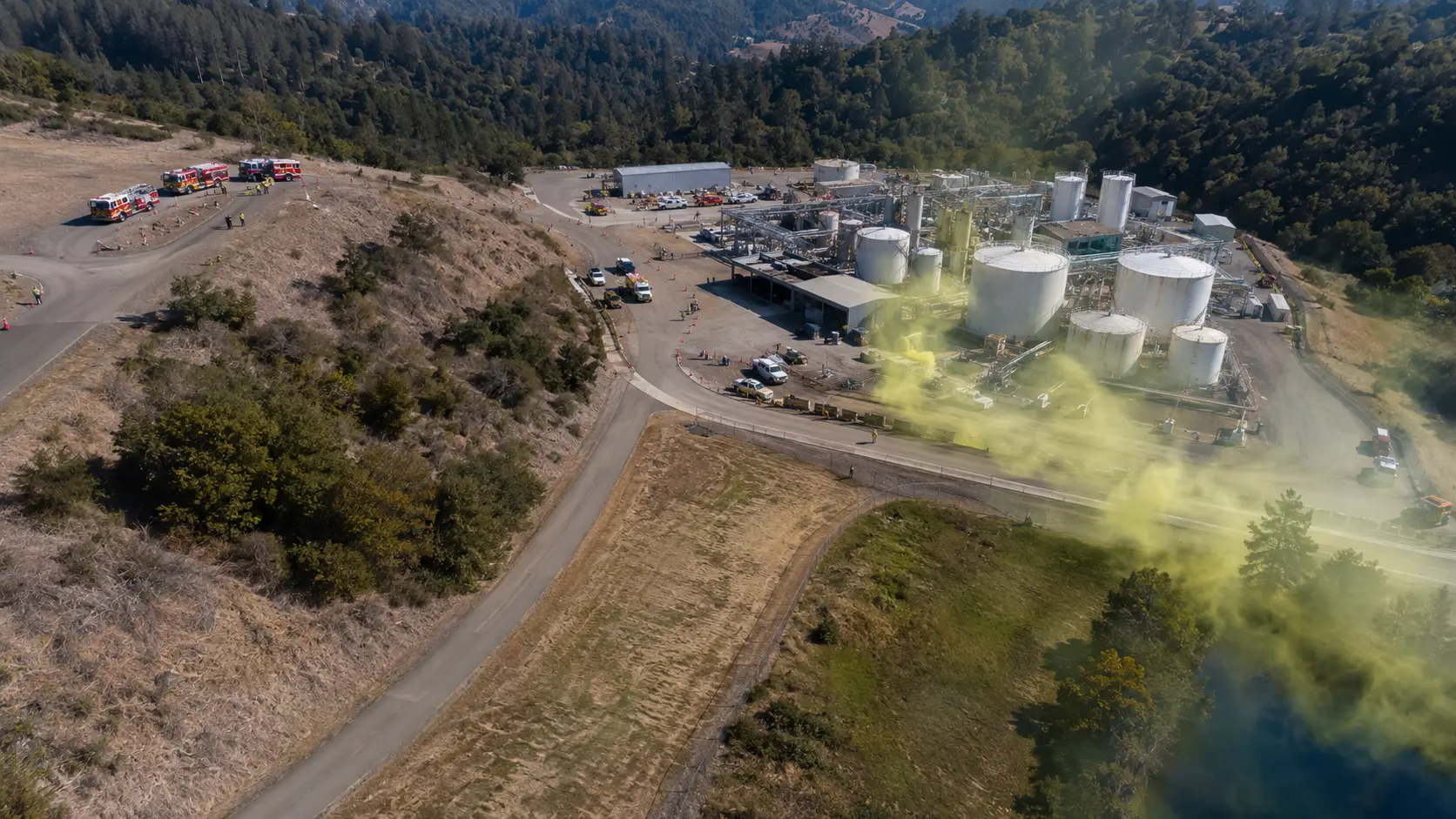
The two positioning rules for chlorine incidents are upwind and uphill. Both serve the same purpose: keeping responders outside the flow path of the heavier-than-air gas plume that is flowing downwind at grade level and pooling in low areas.
The DOT Emergency Response Guidebook (Guide 124 for chlorine) specifies initial isolation distances of at least 100 meters (330 feet) in all directions for a small release and substantially larger distances for large releases. These are starting points — actual distances depend on wind speed and direction, quantity released, temperature, and terrain. The CAMEO/ALOHA dispersion modeling software can provide more precise downwind hazard distances when the release quantity and atmospheric conditions are known.
First-arriving units that approach a chlorine incident from a downwind or downhill position — either because they did not know the incident type before arrival or because the wind shifted after positioning — must reposition before any further operations. Positioning upwind is not optional for a hazmat incident involving a dense toxic gas.
Product Control Options
The primary objective at a chlorine release is stopping the release — product control. The three approaches, in order of preference:
Source shutoff: If the release is from a valve, a fitting, or a controlled supply point, closing the source valve stops the release immediately. This is the fastest and most complete intervention. It requires either remote valve access or entry by trained personnel in appropriate PPE (Level A for large releases, Level B at minimum for contained valve access with monitoring).
Plugging and patching: For releases from damaged cylinders, tanks, or pipelines where valve control is not possible, specialized plugging kits allow hazmat technicians to stop or slow the release by inserting plugs, applying patches, or applying chlorine emergency kits (CEKs) that are specifically designed for standard chlorine cylinder valve and body configurations. Chlorine Institute Emergency Kit A (150-pound cylinders), Kit B (ton containers), and Kit C (tank cars) are the standard kits maintained by hazmat teams operating in areas with chlorine transportation or storage.
Containment: If the source cannot be controlled, containing the release area — diking, berming, or covering the release point — limits the spread. For liquid chlorine releases that are converting to gas, containment prevents the liquid from spreading to new surface area and increasing the gas generation rate.
Water as a Mitigation Tool
Water absorbs chlorine gas rapidly — the high solubility means that a water fog or water curtain between a chlorine release and a populated area will absorb a significant fraction of the chlorine before it reaches the downwind population. Fog nozzles or water curtain systems can create a dilution and absorption barrier that reduces downwind concentrations.
The limitation: the chlorine-containing water runoff is acidic and corrosive and must be contained rather than allowed to enter storm drains. The water that absorbs chlorine becomes contaminated wastewater requiring disposal. A fog curtain that reduces airborne chlorine concentration by routing the chlorine into drainage water that then enters a municipal storm system has moved the hazard rather than eliminated it. Runoff containment is required whenever water is used as a chlorine mitigation agent.
Shelter-in-Place vs. Evacuation Decision
For chlorine releases, the shelter-in-place decision depends heavily on the release duration, quantity, wind conditions, and the building type available for sheltering. Modern buildings with HVAC systems that can be shut off provide better shelter from external gas hazards than older buildings with significant air infiltration. Short-duration releases — a chlorine cylinder leak that will be controlled within 15 minutes — may be best addressed by sheltering residents in upper floors of buildings with HVAC isolated, since chlorine sinks and indoor upper floors may see lower concentrations than the outdoor ground level.
For large, ongoing releases where the source cannot be controlled quickly — a breached rail tank car, a major storage tank failure — evacuation is the appropriate response. Shelter-in-place provides finite protection as indoor air quality eventually equilibrates with outdoor concentrations. A 90-ton chlorine rail car release producing a plume of IDLH concentration for hours will eventually penetrate shelter-in-place protection. Early evacuation before the plume reaches the population is better than late evacuation through a developing gas cloud.
What Civilians Should Do
- ✓If you smell chlorine outdoors, move upwind and uphill immediately. Do not investigate the source. Do not attempt to assist anyone already incapacitated — you may be incapacitated before reaching them.
- ✓If indoors and told to shelter in place: Close all windows and doors, turn off HVAC and bathroom exhaust fans, go to the highest floor available (chlorine sinks), and await official all-clear.
- ✓If you were exposed and feel respiratory irritation: Get to fresh air and call 911 even if symptoms are mild — pulmonary edema can develop hours later with no worsening of immediate symptoms as a warning.
- ✗Do not re-enter a building or area where you smelled chlorine without official clearance from hazmat personnel with atmospheric monitoring.
- ✗Do not use a wet cloth over the face as chlorine protection — it is not a substitute for SCBA. Wet cloth will absorb some chlorine but not at concentrations above 3 to 5 ppm for more than a few seconds.
- ✗Do not assume you are safe because you can no longer smell chlorine — olfactory fatigue is real and life-threatening in chlorine exposure.
Notable Historical Incidents
Chlorine's history as a mass casualty hazard precedes industrial accidents — it was the first chemical weapon deployed in modern warfare, released at Ypres in 1915 and killing thousands of soldiers before adequate respiratory protection could be developed and distributed. This historical context is relevant to hazmat responders because it establishes the casualty profile that even moderate-scale releases can produce in unprotected populations.
The 2005 Graniteville, South Carolina train derailment — where a collision caused a 90-ton chlorine tank car to rupture — killed 9 people, sent 554 to the hospital, and required evacuation of over 5,000 residents. The release produced IDLH concentrations over a wide area for hours before the tank was controlled. The incident drove significant updates to railroad chlorine transportation regulations and community emergency planning for rail corridors carrying hazardous materials.
Industrial chlorine releases at water treatment facilities — typically involving smaller quantities than rail incidents — occur regularly across the country. Most involve failures of valve seals, flexible connections, or operator error during cylinder exchange. Most are controlled within 30 to 60 minutes by trained plant personnel or the first hazmat response. The incidents that escalate to significant casualties typically involve delayed detection, delayed notification, or responders arriving without appropriate PPE.

Comments 0
No comments yet. Be the first to share your thoughts!
Leave a Comment