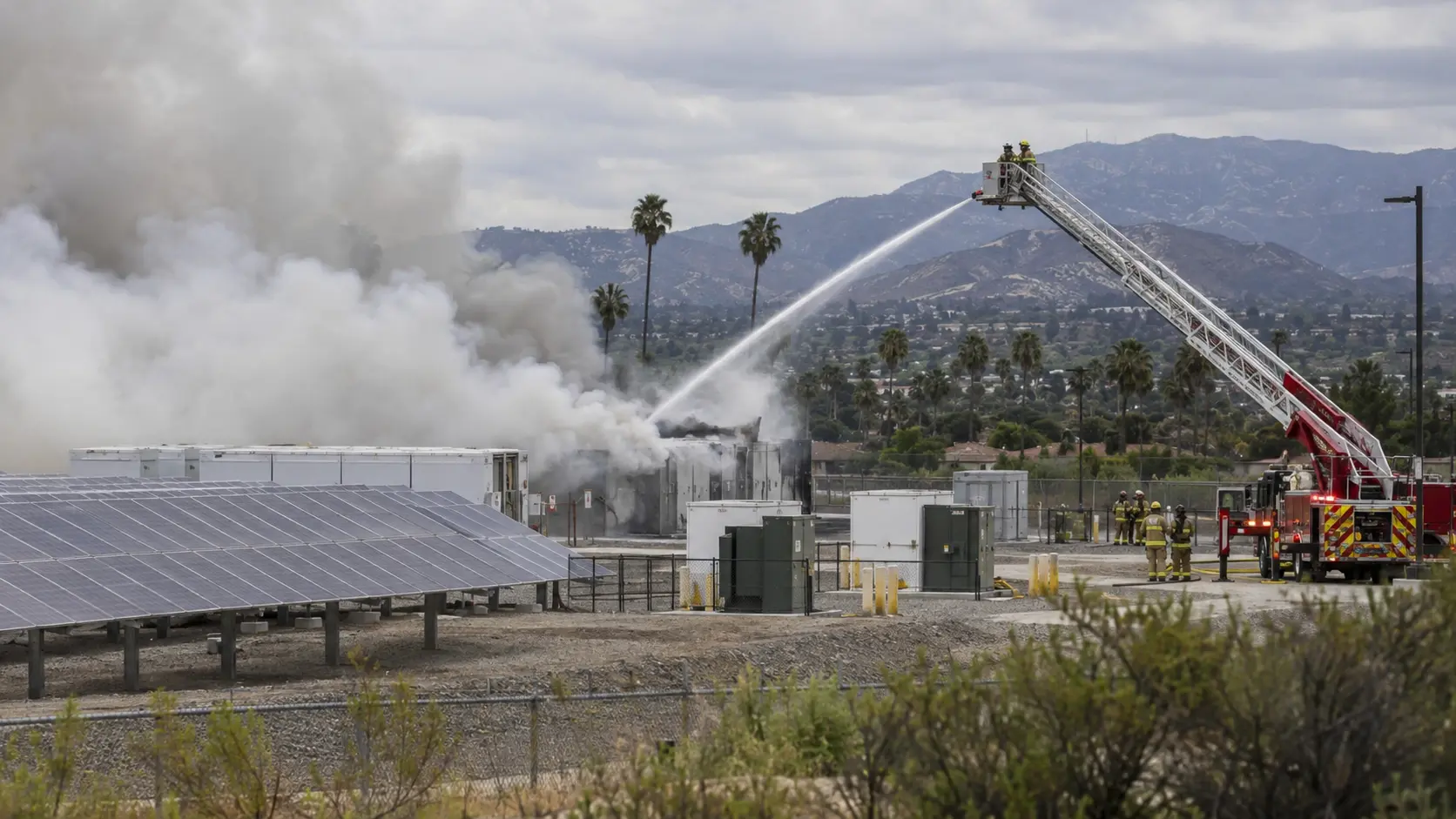

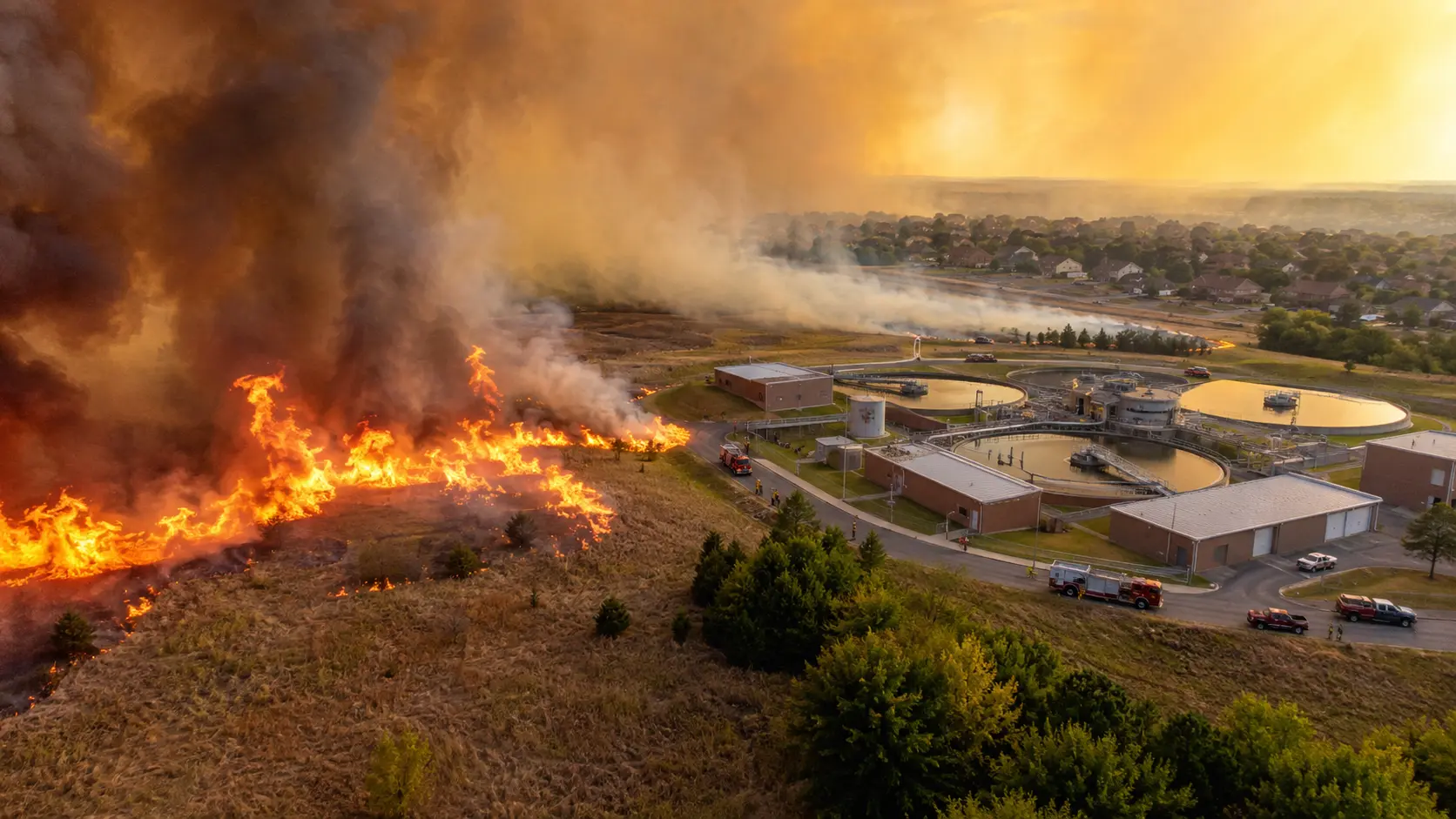
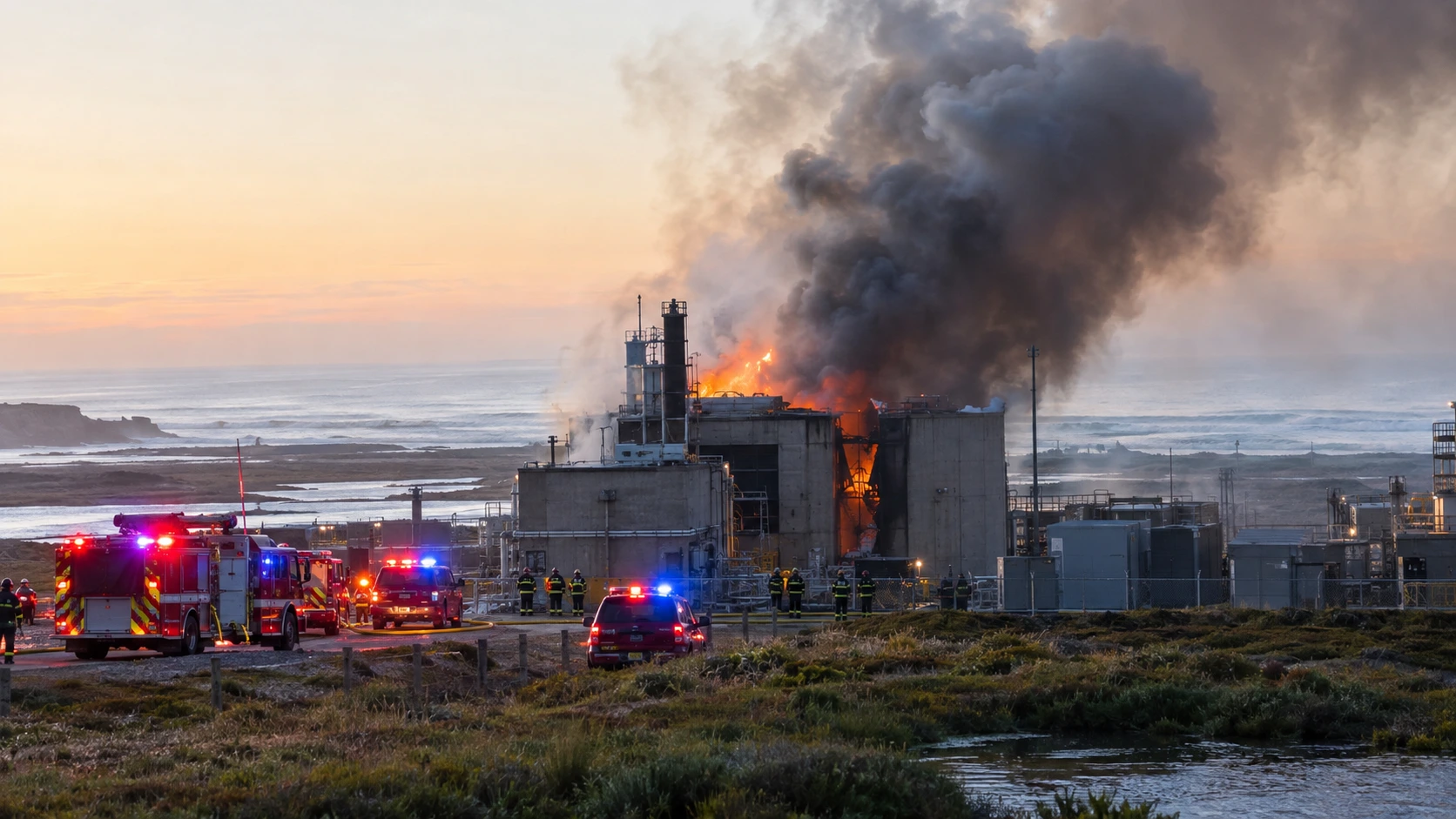
What happened: An outdoor battery energy storage unit ignited Tuesday just before noon at the Metropolitan Water District's Weymouth Water Treatment Plant on Wheeler Avenue in La Verne, California. Firefighters arriving on scene reported a small explosion inside the battery enclosure. One civilian was taken to a hospital. La Verne Fire and Los Angeles County Fire crews took up a defensive position — spraying water on the burning batteries from the outside rather than attempting to extinguish them directly — while a hazmat response covered the surrounding blocks. A mandatory evacuation order went out for the area around Wheeler and Bonita avenues, two nearby schools sheltered in place, and the University of La Verne canceled classes for the rest of the day. By evening, fire officials said they believed the fire was under control, though crews planned to stay through the night because damaged lithium batteries "can have a mind of their own."
This is the second time in less than a week that a battery energy storage fire has forced evacuations in California — the Vistra facility at Moss Landing had its own flare-up on September 18 — and it's a reminder of how quickly a fire inside a battery storage array can outgrow the footprint of the building or enclosure it started in.
In this article:
How the Fire Started
The fire broke out in an outdoor lithium battery storage unit positioned near a solar panel field on the northeast side of the Weymouth plant, in the 3200 block of Wheeler Avenue. La Verne Fire Department Battalion Chief Mark Savage told reporters that when crews first arrived, they witnessed a small explosion inside the battery unit itself — consistent with a cell or module going into thermal runaway. Several residents in the surrounding neighborhood reported hearing what sounded like a loud blast just before smoke became visible. No firefighters were reported injured; the one confirmed injury was a civilian, taken to a hospital for treatment, though details on that person's condition haven't been released.
Los Angeles County Fire Department units backed up La Verne Fire on scene, and by early afternoon the incident had been upgraded to a hazardous materials response given the smoke and off-gassing risk associated with burning lithium cells. Fire officials said the flames stayed confined to the one structure/enclosure and did not extend to the surrounding solar array or the treatment plant's main operations.
Evacuation Zones, Schools, and Road Closures
At around 12:50 p.m., roughly an hour after the initial call, the Los Angeles County Fire Department formally declared the incident a hazmat event and La Verne Police issued a mandatory evacuation order covering everyone near Wheeler and Bonita avenues. The order spread quickly through the surrounding blocks as the scope of the response became clear:
- ✓Mandatory evacuation: Residents near Wheeler and Bonita avenues, ordered out around 12:30–12:50 p.m.
- ✓Schools: Grace Miller Elementary and Bonita High School were placed under shelter-in-place orders, with Holly Oak Street closed near Grace Miller.
- ✓University of La Verne: Classes were canceled for the remainder of the day; students, faculty, and staff were told to leave campus.
- ✓Businesses: Shopping centers along Wheeler Avenue north of Foothill Boulevard were evacuated as a precaution, along with a senior mobile home community on Moreno Avenue.
- ✓Roads: Foothill Boulevard between Moreno and B streets was closed to through traffic while crews worked the scene.
- ✓Shelter: The city opened an evacuation center at the La Verne Community Center, 3680 D Street, for displaced residents.
Some of the evacuation warnings began easing by around 2:30 p.m. as crews gained ground on the fire, and most of the surrounding neighborhood evacuations were lifted by roughly 4 p.m. As of Tuesday evening, orders remained in place closest to the plant itself while officials continued monitoring air quality and the condition of the remaining batteries.
What the Water District Is Saying
The Metropolitan Water District of Southern California — which supplies drinking water to parts of Los Angeles, Orange, Riverside, San Bernardino, San Diego, and Ventura counties through the Weymouth plant and other facilities — confirmed the fire involved a battery energy storage system next to the site's solar array, not the treatment plant's water infrastructure itself. In a statement, the district said it was "supporting our first responders as they take the appropriate steps to help ensure the health and safety of residents, employees and others in the affected area," and stressed that the safety of the region's drinking water supply was not affected by the fire.
Why Crews Fought This Fire From the Outside
Anyone who's worked a battery energy storage fire knows the drill isn't the same as a structure fire. Once a lithium-ion cell is damaged enough to enter thermal runaway, it's generating its own heat and oxygen from a chemical reaction inside the cell — which means it doesn't need outside air to keep burning, and pouring water directly onto a cell already in runaway does very little to stop it. What water can do is cool the modules sitting next to the one that's failing, buying time and slowing the fire from spreading cell to cell to the rest of the array.
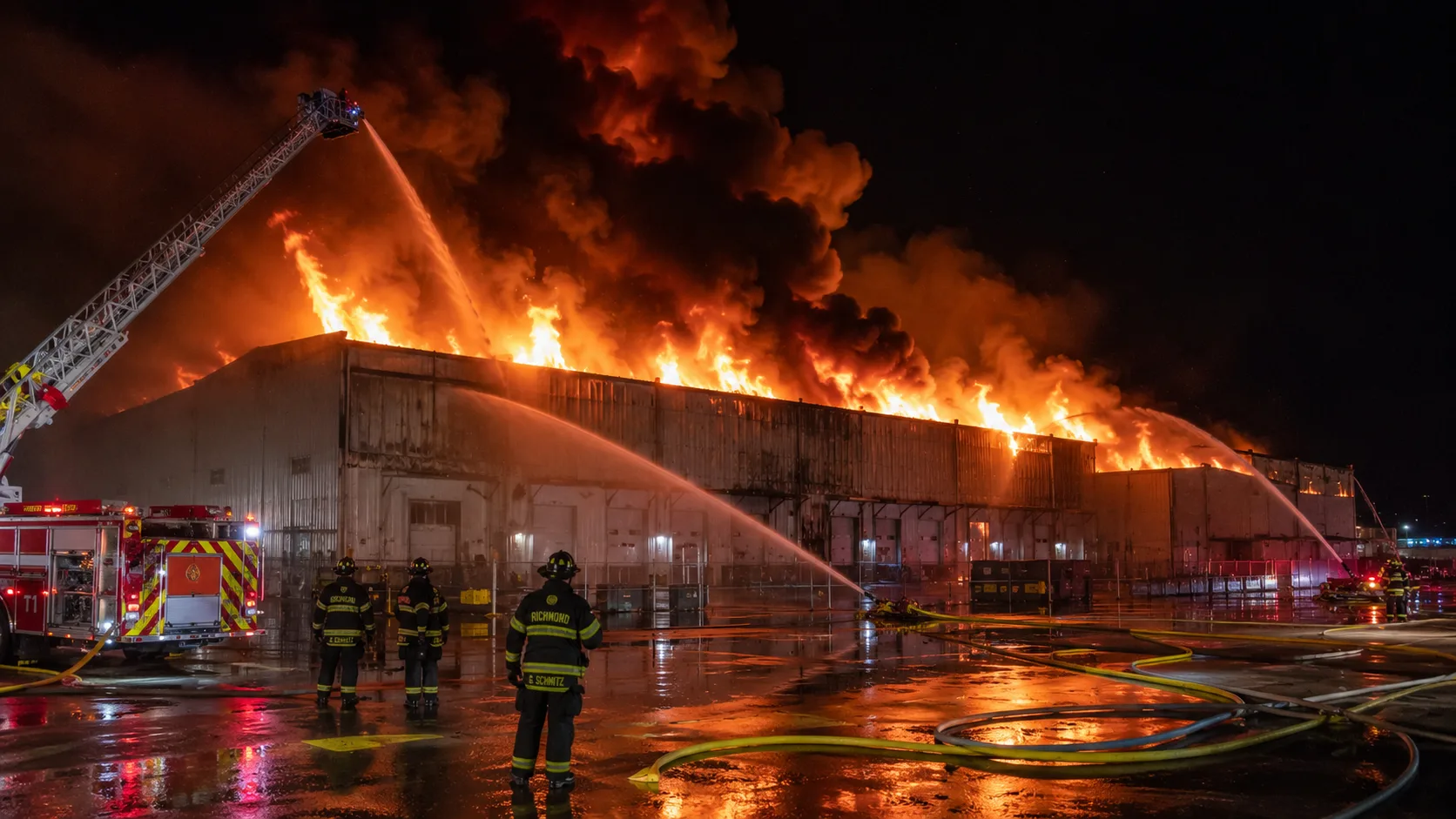
That's exactly the posture La Verne and County crews took Tuesday: ladder trucks and water tenders applying water from a distance to keep the fire from spreading, rather than making an interior attack on the battery enclosure itself. It's also why Battalion Chief Savage was blunt with reporters about staying on scene overnight even after the fire looked knocked down — damaged lithium cells can smolder for hours and reignite well after the visible flame is gone, and the only way to be confident it's truly out is to keep eyes and thermal cameras on it until temperatures stay down on their own.
A Pattern Worth Watching in California
La Verne is the second battery energy storage fire in California to force evacuations in less than a week. Just four days earlier, on September 18, a fire broke out in a section of Vistra's Moss Landing Power Plant in Monterey County — the same building damaged in a much larger fire back in January 2025 — triggering a shelter-in-place order and road closures of its own. The two incidents are unrelated and involve different operators, different equipment, and different causes under investigation, but together they point to a real operational reality as California continues to build out grid-scale and site-level battery storage: departments across the state are going to keep encountering these fires, at facilities both large and small, and the playbook — isolate, cool from a distance, monitor air quality, and give the batteries time to burn themselves out safely — is becoming as routine a call as a vehicle fire or a vegetation fire for crews working anywhere near solar and storage infrastructure.
What Happens Next
La Verne Fire crews are expected to remain on scene through the night monitoring the battery unit for reignition before fully clearing the incident. The cause of the initial fire hasn't been released and is under investigation. The Metropolitan Water District will likely face questions in the coming days about the design and placement of the battery storage system relative to the surrounding neighborhood, schools, and university — questions that tend to follow any battery storage fire that reaches a hazmat evacuation, regardless of how quickly it's brought under control.
Where to Get Live Updates
- City of La Verne (cityoflaverne.org) — official city alerts and evacuation center information.
- Los Angeles County Fire Department — incident updates and hazmat status.
- Metropolitan Water District of Southern California (mwdh2o.com) — statements on the Weymouth plant and water supply safety.
- Bonita Unified School District — reopening status for Grace Miller Elementary and Bonita High School.
This is a developing story. We'll update this article as La Verne Fire, Los Angeles County Fire, and the Metropolitan Water District release further information.


Comments 0
No comments yet. Be the first to share your thoughts!
Leave a Comment