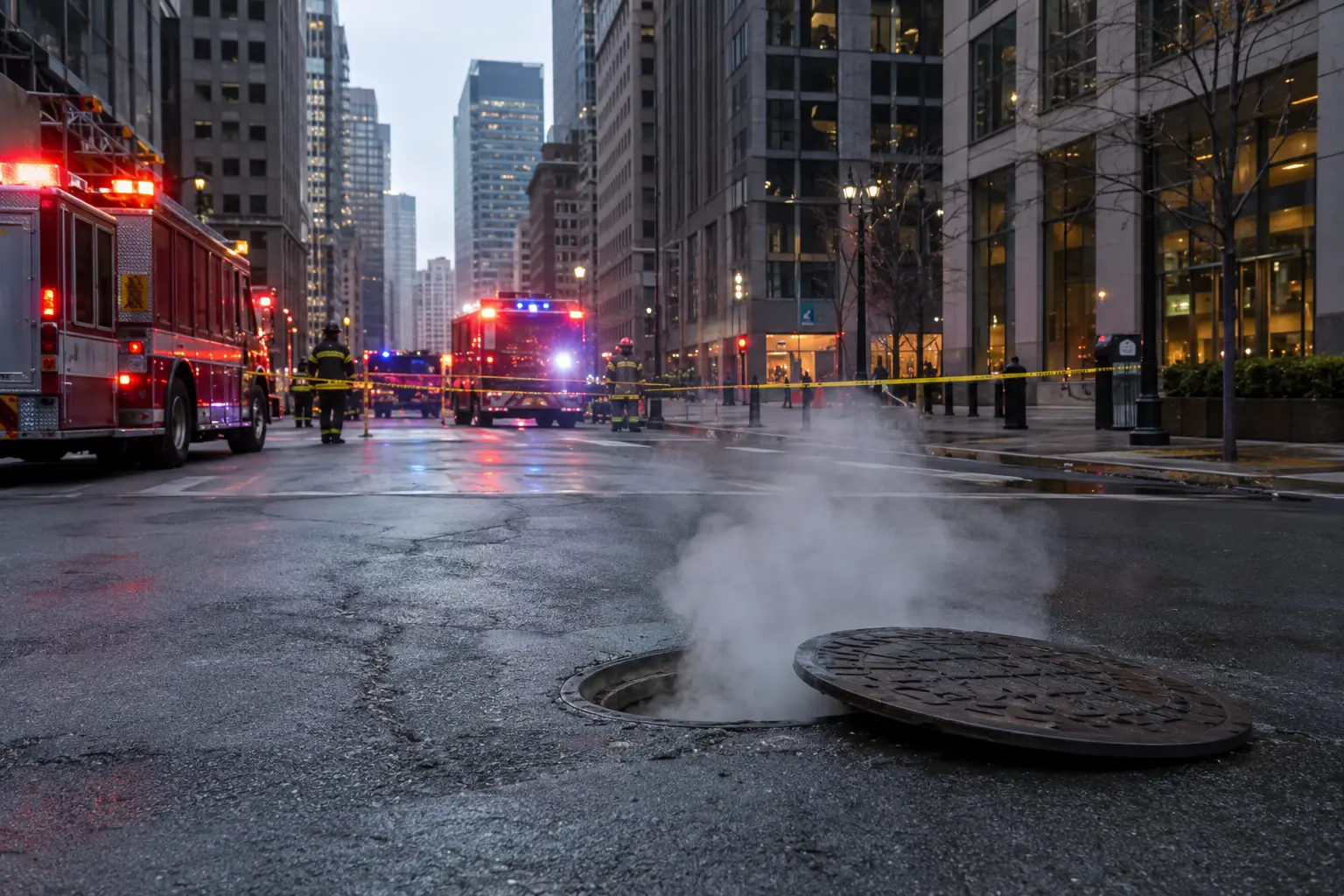

Resolved as of Thursday morning. The San Francisco Fire Department responded at approximately 6:04 a.m. Thursday, October 1, to reports of smoke coming from an underground PG&E electrical vault near 150 California Street in the Financial District. Over the next two hours, four separate vaults in the area experienced what fire officials called "eruptions" — manhole covers forced up by pressure inside the vaults — though all activity stayed contained to the vaults themselves. A shelter-in-place order covering the 100–300 blocks of California and Front streets was issued and later lifted by 11 a.m. PG&E cut power to a limited number of customers as a safety measure and told fire officials the cause was an issue with an underground cable. No injuries were reported.
If you weren't downtown Thursday morning, you probably heard about this one through the search bar instead — "vault fire," "what is a vault fire," and "SF vault fire" all spiked as people tried to figure out what they were looking at on the news: manhole covers popping off a quiet financial district street with no flames in sight. It's a fair question. A vault fire doesn't look like most fires, and it isn't fought like most fires either.
In this article:
What Happened on California Street
SFFD crews were first dispatched for reports of smoke coming from a basement near 150 California Street, which fire officials quickly traced to an underground PG&E vault beneath the street. By 6:55 a.m., SFFD had issued a shelter-in-place order covering the 100–200 blocks of California and Front streets. As crews and PG&E worked the scene, three more vaults in the surrounding area experienced the same pressure-driven "eruptions" — forcing manhole covers up — by around 8:30 a.m., and the shelter-in-place footprint was expanded to the 300 blocks of both streets to account for it. PG&E shut off power to a limited number of downtown customers as a precaution and told emergency management officials to prepare for the outage area to grow further before the utility fully resolved the incident, which PG&E estimated would happen by around 9:30 a.m. By late morning, SFFD confirmed there was no remaining smoke or life-safety hazard on California Street, lifted the shelter-in-place order, and reopened the roads that had been cordoned off. The ripple effects reached well past the Financial District itself — morning commute traffic on the Bay Bridge backed up for hours as drivers worked around the closures.
What a Vault Fire Actually Is
A utility vault is a concrete or steel enclosure built under the street — usually accessed through a manhole — that houses underground electrical cable, splices, transformers, or gas connections, giving technicians a way to service that infrastructure without digging up the road every time. In dense cities like San Francisco, running power lines underground this way keeps overhead wires off the street, but it also means that when something inside a vault fails, it fails in an enclosed, buried space with nowhere obvious for the resulting heat, gas, and smoke to go — until it finds the manhole cover above it.
That's the short answer to "what is a vault fire": it's an electrical fire that starts underground, in a sealed utility chamber, rather than in open air. From street level, the first sign is almost always smoke pushing up through a manhole or grate, sometimes with a visible glow, long before anyone sees actual flame.
Why Vaults "Erupt" Instead of Just Burning
The word fire officials used Thursday — "eruption" — is doing real work, not just dramatic framing. When insulation or cable material burns or arcs inside a sealed vault, it doesn't just produce flame; it produces gas and heat with nowhere to expand. Pressure builds inside the enclosed chamber until it has enough force to lift a cast-iron manhole cover that can weigh well over 100 pounds, sometimes launching it a short distance into the air. That's the "eruption" — a pressure release, not a traditional fireball — and it's also exactly why crews responding to a reported vault fire treat the street itself as a hazard zone before they ever get close enough to see what's burning below.
It's also why four vaults "erupting" in sequence over a couple of hours, as happened Thursday, isn't necessarily four separate ignition events. Underground vaults in a city grid are frequently interconnected by cable runs and ductbanks, so heat, arcing, or gas from one failed vault can travel through that shared infrastructure and trigger a cascading failure in a neighboring vault some distance away — part of why the shelter-in-place footprint on California Street kept expanding rather than staying fixed to the original address.
How Crews Actually Handle One
A working vault fire is a unified-command call by default — fire department, police, and the utility all have a job to do before anyone can call it resolved. SFFD's first priority is evacuating and cordoning off the surface area around the affected vaults, since the immediate danger to the public is from a manhole cover lifting unpredictably or from toxic smoke venting at street level, not from direct fire exposure. Entry into an active vault is close to the last option on the list; the standard approach is to let the utility de-energize the circuit first; PG&E crews work to isolate and shut down power to the specific vault and any connected infrastructure, cutting off the fuel for further arcing. Only once a vault is confirmed de-energized and cooled does anyone attempt to open it and assess the damage inside. That sequencing — contain the surface, de-energize, then inspect — is why a vault fire response can stretch on for hours even when nothing is visibly burning for most of that time; crews aren't idle, they're waiting out a process that can't safely be rushed.
Why This Keeps Happening in San Francisco
Thursday's incident wasn't an isolated event for the city. In late August, a separate underground vault fire along Geary Boulevard in the Western Addition neighborhood knocked out power overnight near Japantown, disrupting the start of the school day for two nearby schools before PG&E attributed that fire to equipment failure. San Francisco's downtown core sits on some of the oldest underground electrical infrastructure in the state, built up over decades as the city densified — aging cable insulation, moisture intrusion, and heavy, constant electrical load are the usual suspects when a given vault fails, and none of those risk factors are unique to one block of California Street. For residents and business owners downtown, the practical takeaway is that a vault-related outage or shelter-in-place advisory is a recurring, if infrequent, feature of life in a dense, electrically aging city core — not a one-off anomaly.
What Happens Next
PG&E is expected to lead the follow-up investigation into exactly what failed inside the original vault and why it spread to three others nearby, consistent with how the utility handled the cause determination after the August Geary Boulevard incident. Power has been restored to the affected downtown customers, and normal street access has resumed on California and Front. Expect PG&E to inspect the broader ductbank and cable network connecting the four vaults before fully closing out the incident, since confirming the rest of that shared infrastructure is stable is the only way to rule out a repeat failure in the same stretch of street.
Where to Get Live Updates
- San Francisco Fire Department Media (@SFFDPIO) — real-time incident updates during active responses.
- PG&E Outage Center (pge.com/outages) — current outage maps and restoration estimates.
- SF Department of Emergency Management — shelter-in-place and evacuation advisories for the city.
- 511.org / Bay Bridge traffic updates — for commute impacts tied to downtown incidents like this one.
We'll update this article if PG&E or San Francisco Fire release further findings on what caused the original vault failure.

Comments 0
No comments yet. Be the first to share your thoughts!
Leave a Comment