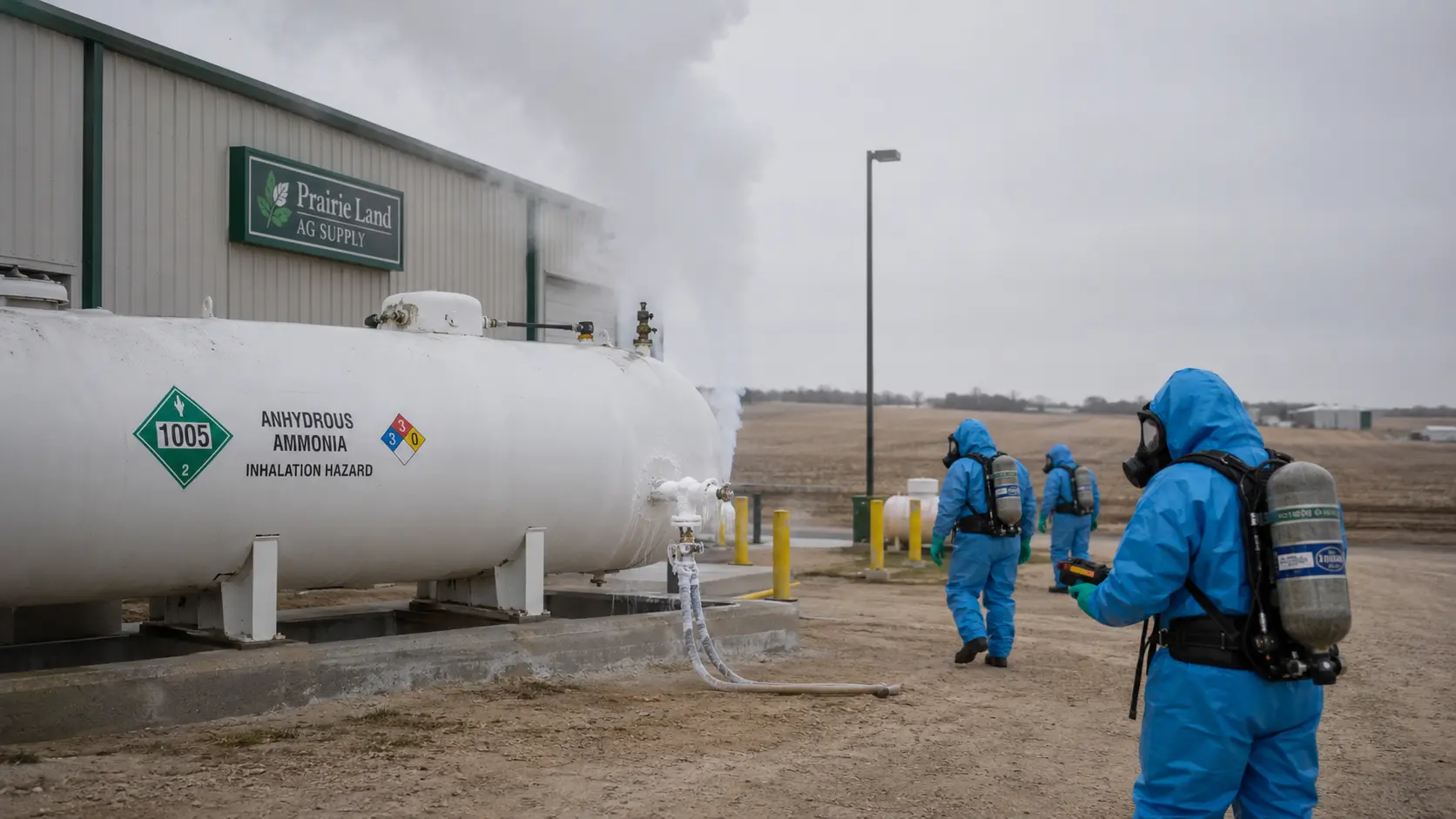

Anhydrous ammonia is the second most produced chemical in the world by volume — more of it is manufactured each year than almost any other industrial chemical. Most of it becomes fertilizer. Large quantities move through the agricultural transportation system in pressurized railcars and highway tank trailers, pass through rural ammonia distribution points, and are stored in nurse tanks at farms across the American Midwest and Great Plains — typically without the safety infrastructure that would surround equivalent quantities of a more widely recognized hazardous material.
The rural agricultural context means that many anhydrous ammonia releases occur in jurisdictions with limited hazmat capability — volunteer departments that may not have hazmat-level training, limited monitoring equipment, and response times that allow the release to develop significantly before resources arrive. Understanding anhydrous ammonia's specific properties, its physiological hazard profile, and the correct response approach is not optional knowledge for any department operating in agricultural territory.
In this article:
- Physical and chemical properties
- Lighter than air: the behavior difference from chlorine
- Physiological effects by concentration
- Skin and eye contact hazards
- Approach and positioning
- Water as the primary mitigation tool
- Protective equipment selection
- Agricultural release scenarios
- Refrigeration system releases
- PSM and RMP regulatory requirements
Physical and Chemical Properties
Anhydrous ammonia (NH₃) is a colorless gas at standard temperature and pressure, with a distinctive pungent odor detectable at concentrations as low as 1 to 5 ppm. "Anhydrous" means without water — the industrial chemical contains no water, which distinguishes it from aqueous ammonia solutions (household cleaners) that are significantly less hazardous at equivalent concentrations.
Key physical properties:
- Boiling point: -28°F (-33°C) at atmospheric pressure — anhydrous ammonia must be stored under pressure (or at very low temperature) to remain liquid at ambient temperature. Storage tanks maintain internal pressures of 50 to 200 psi depending on ambient temperature, keeping the ammonia liquid.
- Vapor density: 0.6 relative to air — ammonia gas is lighter than air and rises. This is the critical difference from chlorine (density 2.5) — ammonia released at grade level disperses upward and does not pool in low areas. It does accumulate in enclosed upper spaces and under roof structures.
- Flammability: Ammonia has an LEL of 15% and UEL of 28% by volume. This is a much higher ignition concentration than most flammable gases — ammonia will not ignite at atmospheric concentrations that are toxic. However, in confined spaces at high concentration with an ignition source, ammonia can ignite and detonate.
- Water solubility: Extremely high — ammonia dissolves readily in water, forming ammonium hydroxide (aqueous ammonia). This solubility is both a hazard (moisture in the lungs dissolves inhaled ammonia into a corrosive solution) and a mitigation tool (water spray absorbs airborne ammonia efficiently).
Lighter Than Air: The Behavior Difference From Chlorine
The positioning rules for ammonia releases differ from those for chlorine specifically because of the vapor density difference. Chlorine is 2.5 times heavier than air — it sinks, flows into low areas, and is found at ground level at the highest concentrations. Ammonia is 0.6 times the density of air — it rises. A release at grade level will initially form a ground-level cloud (because the release may be cold and dense initially), but as the ammonia warms to ambient temperature it rises and disperses upward.
The upwind rule still applies — being downwind of an ammonia release places the responder in the plume path. But the specific concern about low areas, basements, and sub-grade spaces that governs chlorine response does not apply to ammonia. Ammonia accumulates in the upper portions of enclosed spaces — rafters, roof peaks, upper floors — not in basements and trenches.
For outdoor releases in open air, ammonia's lighter-than-air character means it disperses relatively quickly with wind — more quickly than a heavier-than-air release of comparable quantity. This makes outdoor ammonia releases somewhat more self-limiting than outdoor chlorine releases of the same quantity, though indoor releases in enclosed spaces still present serious hazards as the gas accumulates at the top of the enclosed volume.
Physiological Effects by Concentration
| Concentration (ppm) | Effects |
|---|---|
| 1–5 ppm | Detection threshold for most people; characteristic ammonia odor |
| 25 ppm | OSHA TWA ceiling — maximum 8-hour occupational exposure limit |
| 50 ppm | Mild mucous membrane irritation; eye and throat discomfort |
| 100–150 ppm | Significant eye, nose, and throat irritation; lacrimation; headache; difficulty tolerating exposure for more than a few minutes |
| 300 ppm | IDLH — immediately dangerous to life or health; severe irritation, coughing, pulmonary edema risk with prolonged exposure |
| 500–700 ppm | Severe pulmonary damage; life-threatening with minutes of exposure |
| 2,000–3,000 ppm | Rapidly fatal; convulsions, cardiovascular collapse |
The mechanism of ammonia's respiratory toxicity: ammonia dissolved in the moisture of the airway forms ammonium hydroxide — a caustic alkaline solution that chemically burns the mucosal surfaces of the nose, throat, and lungs. The burns produce inflammation, edema, and if severe, pulmonary edema with fluid accumulation in the alveoli that progressively impairs oxygenation. Like chlorine toxicity, pulmonary edema from ammonia exposure can develop over hours after initial exposure, with the affected person seeming to recover initially and then deteriorating as the inflammatory response progresses.
Skin and Eye Contact Hazards
Liquid anhydrous ammonia in contact with skin produces a combination of thermal injury (from the extreme cold of the cryogenic liquid) and chemical injury (from the caustic ammonium hydroxide that forms as the ammonia absorbs moisture from the skin). Agricultural workers who have been splashed by liquid ammonia during nurse tank operations describe a burning pain similar to a severe acid burn. Eye contact with liquid ammonia or high-concentration ammonia vapor can cause permanent damage — the corneal surface is particularly vulnerable to the caustic burn from ammonia dissolved in tear fluid.
Level B PPE for ammonia response requires chemical splash-protective clothing that covers all skin surfaces, chemical-resistant gloves rated for anhydrous ammonia, and SCBA. The specific material requirements for ammonia chemical resistance differ from general chemical protective clothing — butyl rubber and neoprene provide good ammonia resistance; some other materials degrade rapidly on contact with anhydrous ammonia and should not be used for entry operations.
Approach and Positioning
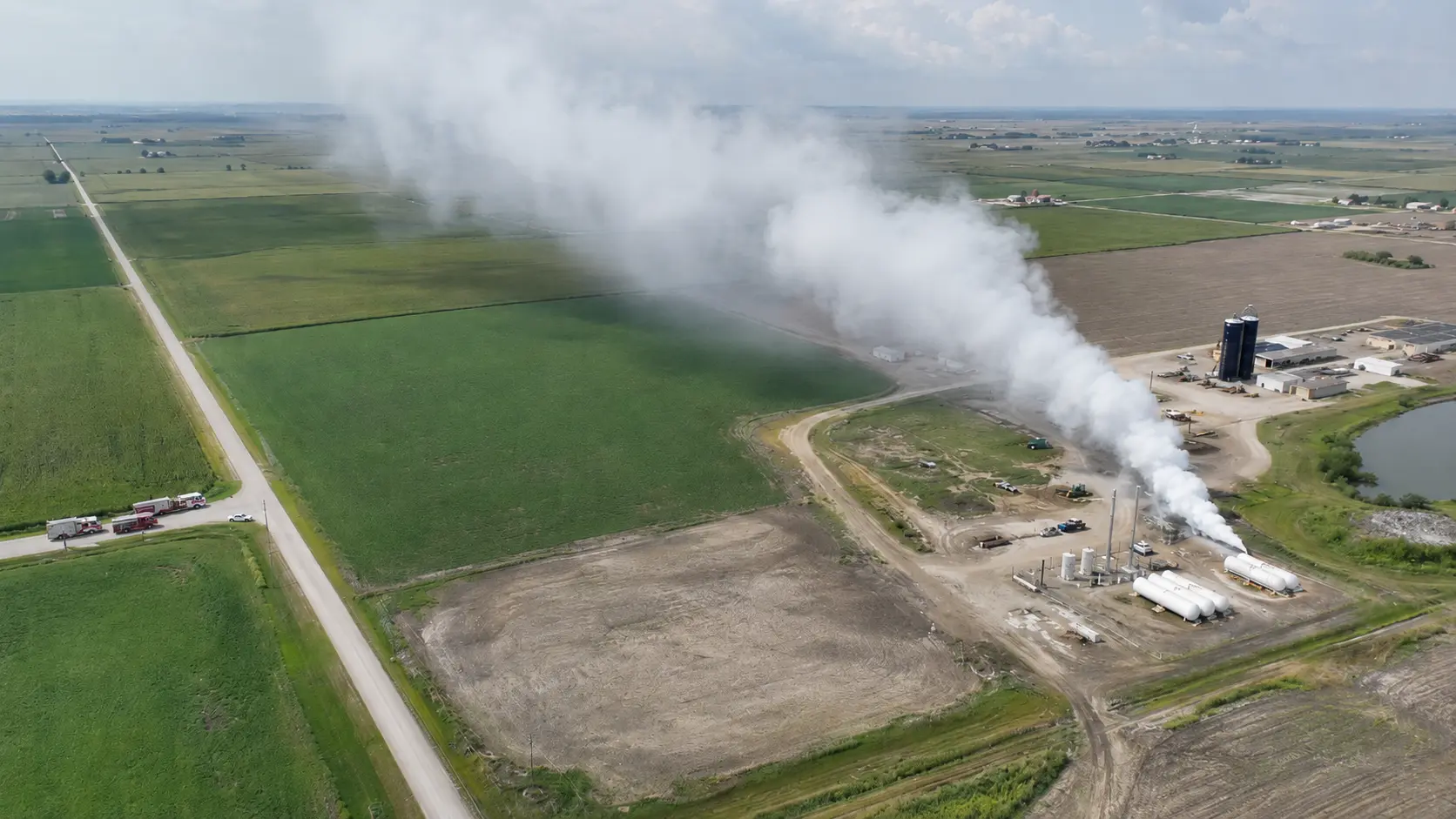
Upwind approach is the primary positioning rule for ammonia, as for any gas release. The downwind area is in the plume — for outdoor releases, this means approaching from the direction the wind is coming from, which places responders outside the gas cloud.
The specific difference from chlorine positioning: responders do not need to be concerned about downhill or sub-grade approach routes for ammonia the way they do for chlorine. Ammonia's lighter-than-air behavior means that a responder approaching upwind but from a low elevation is not at greater risk than one at the same horizontal distance at a higher elevation. Monitoring in enclosed structures should focus on upper floors, attic spaces, and roof areas where ammonia accumulates.
Initial isolation distances from the DOT Emergency Response Guidebook (Guide 125 for ammonia) begin at 100 meters (330 feet) for small releases and increase substantially for large or pressurized tank releases. The downwind protective action distances extend further for large releases under calm wind conditions that limit dispersal.
Water as the Primary Mitigation Tool
Ammonia's extreme water solubility (one volume of water dissolves approximately 700 volumes of ammonia at room temperature) makes water spray the most effective tool for reducing atmospheric concentration from an ongoing release. A water curtain or fog pattern positioned between the release point and the downwind population absorbs ammonia from the air as the gas passes through the water droplets. The effectiveness depends on droplet size (finer droplets provide more surface area), flow rate, and the volume of the water curtain relative to the volume of gas being released.
Water applied to a liquid ammonia spill accelerates evaporation — the liquid ammonia absorbs heat from the water for the evaporation, which may initially increase atmospheric concentrations before the water spray disperses the vapor. For large liquid ammonia spills, directing a water stream at the liquid is counterproductive; it is better to apply water spray above the liquid surface to absorb the vapor as it evaporates naturally.
Runoff from water used for ammonia scrubbing is ammonium hydroxide solution — strongly alkaline and requiring containment from drainage systems. Ammonia scrubbing operations in an enclosed facility require attention to where the contaminated water flows after it has absorbed the ammonia.
Agricultural Release Scenarios
The most common anhydrous ammonia release scenarios in agricultural areas involve nurse tanks — small transport and application tanks (1,000 to 5,000-gallon capacity) used on farms for direct injection of ammonia into soil as fertilizer. These tanks are connected to injection equipment by hoses and fittings that are subject to physical damage from vehicle contact, corrosion, fitting failure, and hose rupture.
Agricultural anhydrous ammonia releases typically occur at the field, where emergency response requires access across unpaved terrain and where the nearest hazmat-trained resources may be 30 to 60 minutes away. The first responders — often volunteer department members — need to implement the basic response: evacuate the immediate area, establish an upwind perimeter, and if victims are present, remove them from the release area and provide fresh air before further assessment. Advanced hazmat operations await team arrival.
Refrigeration System Releases
Anhydrous ammonia is a highly efficient refrigerant used in large cold storage facilities, food processing plants, ice rinks, and industrial refrigeration systems. Ammonia refrigeration systems can contain hundreds to thousands of pounds of refrigerant distributed through an extensive pipe system. A significant pipe failure, fitting leak, or compressor failure can release large quantities quickly in an enclosed mechanical room or refrigerated space.
Refrigeration system releases produce IDLH conditions in the release space within seconds for significant pipe failures. The mechanical room where the compressor equipment is located is typically a confined space — limited egress, no windows, the release point is inside the confined area. First responders arriving at a refrigeration plant with an ammonia alarm should not enter the mechanical room without Level B minimum PPE and atmospheric monitoring. Any first responders who entered the mechanical room before the hazmat team arrived should be treated as potential exposure victims regardless of their subjective assessment of how they feel.
PSM and RMP Regulatory Requirements
Facilities that store anhydrous ammonia above specified threshold quantities are subject to OSHA's Process Safety Management (PSM) standard (29 CFR 1910.119) and EPA's Risk Management Program (RMP) regulation. The PSM threshold for anhydrous ammonia is 10,000 pounds — approximately 1,500 gallons of liquid ammonia. The RMP threshold is also 10,000 pounds.
PSM and RMP requirements include: hazard analysis of the process, written operating procedures, employee training, mechanical integrity program for equipment, management of change procedures, incident investigation, emergency response planning, and coordination with local emergency responders. The emergency response planning requirement specifically requires the facility to coordinate with the local fire department and LEPC (Local Emergency Planning Committee) — providing the department with facility-specific information about the hazard, the storage quantities, and the emergency response procedures before any incident occurs.
Fire departments in areas with PSM/RMP covered facilities should have pre-incident planning visits at those facilities, access to the facility's emergency response plan and Process Hazard Analysis documentation, and familiarity with the specific release scenarios that the facility's emergency plan addresses. A department that receives its first information about a facility's ammonia storage inventory when they respond to a release is starting significantly behind.
Comments 0
No comments yet. Be the first to share your thoughts!
Leave a Comment