
What Is the CPAT and Why Does It Matter?
The Candidate Physical Ability Test (CPAT) is the standardized physical fitness exam used by hundreds of U.S. fire departments to screen entry-level firefighter candidates. Developed jointly by the International Association of Fire Chiefs (IAFC) and the International Association of Fire Fighters (IAFF), the CPAT replaced a patchwork of department-specific fitness tests with a single, legally defensible, job-related standard.
The test is pass/fail — no scores, no partial credit. You complete all 8 events within 10 minutes and 20 seconds wearing a 50-pound vest, or you don't pass. For most departments that use it, passing the CPAT is a mandatory step in the hiring process — you cannot advance to oral interviews, background checks, or conditional offers without it.
The 8 CPAT Events: What You Do, What You Carry, What Fails You
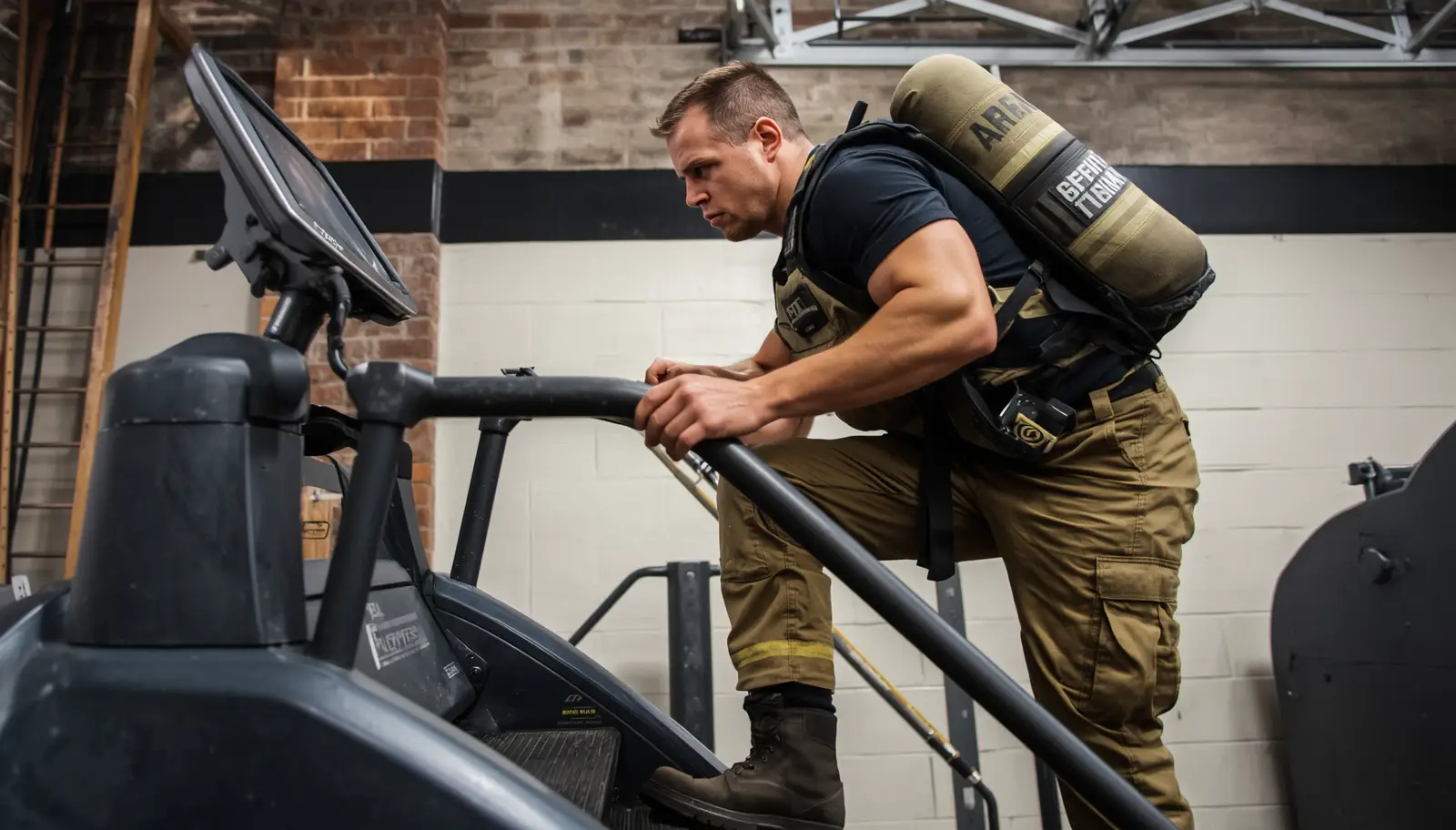
Stair Climb
3 minutes on a StepMill at 60 steps/min wearing 50 lb vest + two 12.5 lb shoulder weights (75 lb total). Simulates climbing stairs while carrying a high-rise hose pack.
Hardest EventHose Drag
Drag an uncharged 1¾" hose line 75 feet, make a 90° turn, drag another 25 feet, then drop to one knee and pull 50 feet of hose. Simulates advancing a hose line.
ModerateEquipment Carry
Remove two saws from a cabinet, carry them 75 feet around a drum, return them. Simulates equipment transport. Key: do not drop equipment or deviate from the path.
ManageableLadder Raise & Extension
Raise a 24-foot aluminum ladder from ground to wall, then extend a 24-foot ladder. Additional 25-lb weights added to vest (75 lb total). Simulates portable ladder operations.
ModerateForcible Entry
Use a 10 lb sledgehammer to strike a measuring device until a buzzer sounds, simulating forcing a door. Core and upper body strength essential. Back to 50 lb vest only.
ModerateSearch
Crawl through a dark, winding tunnel maze approximately 3 feet square. No light; obstacles inside. Simulates primary search in zero visibility. Claustrophobia is a significant factor.
PsychologicalRescue
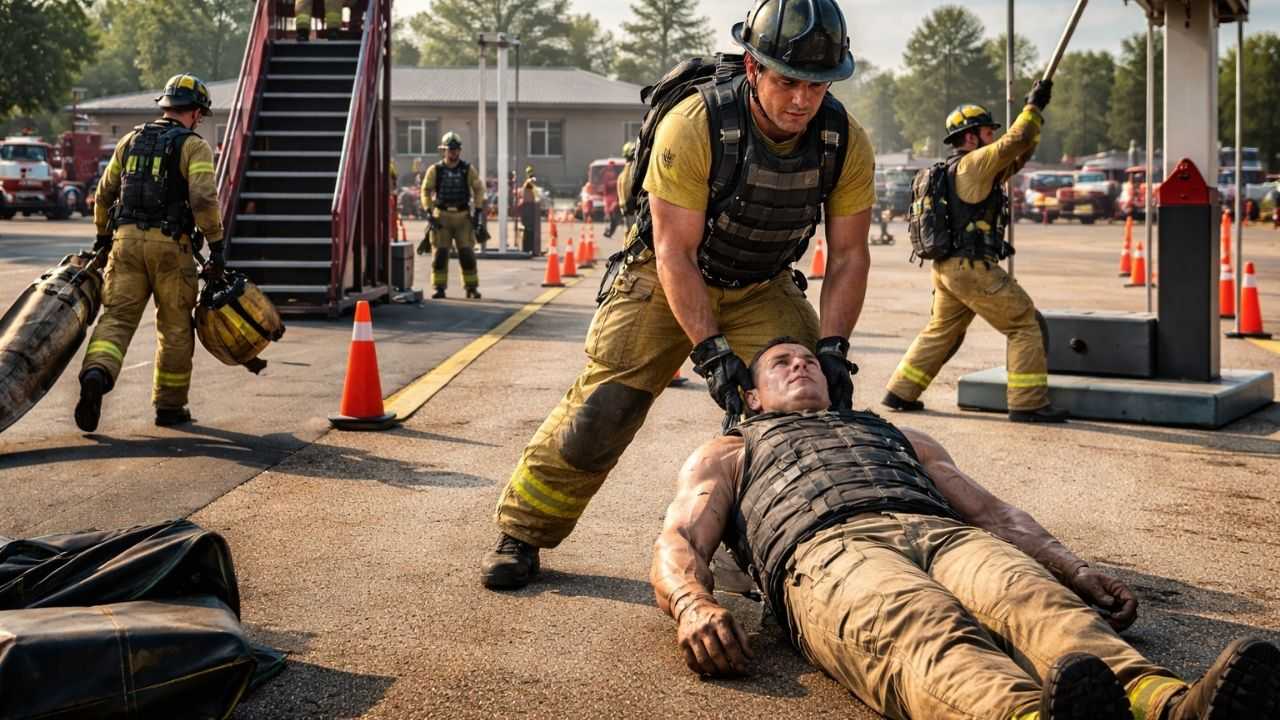
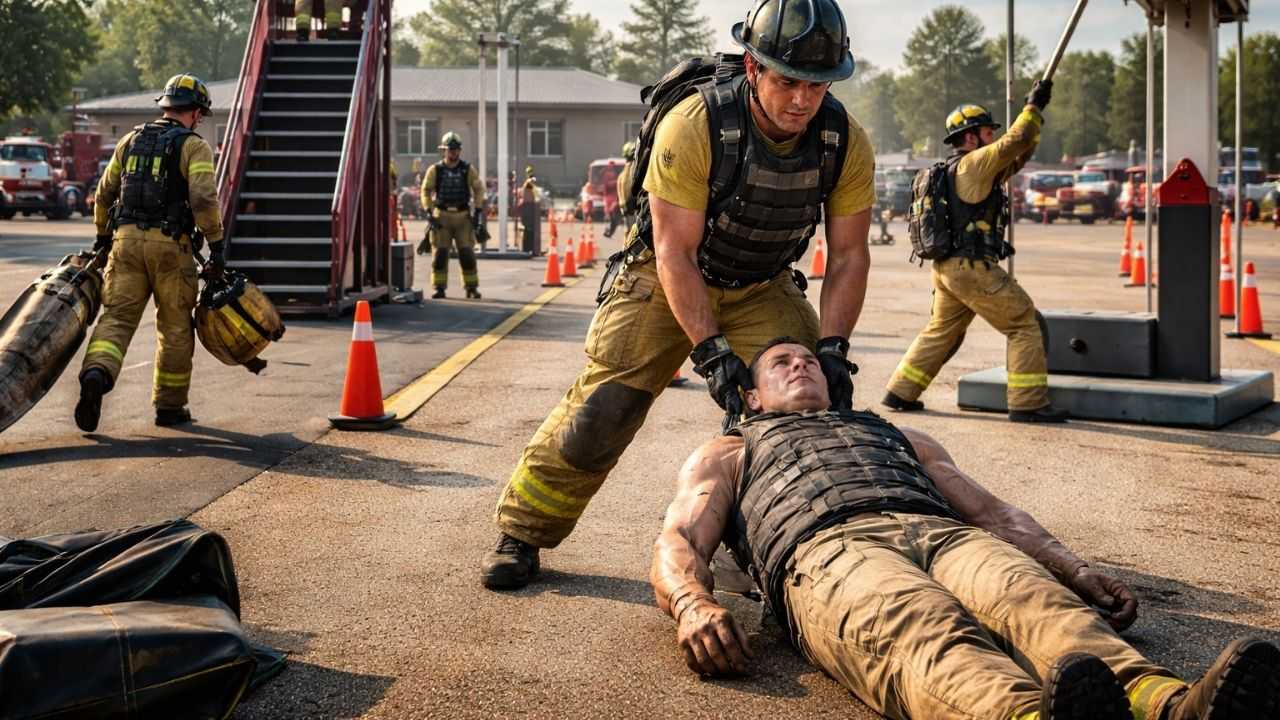
Grasp a 165 lb rescue mannequin by handles and drag it 35 feet, make a 180° turn, drag back 35 feet. Simulates firefighter rescue. Grip strength and leg drive critical.
DemandingCeiling Breach & Pull
Use a pike pole to push a 60-lb hinged door overhead 3 times, then hook and pull a 80-lb overhead mechanism 5 times — repeat for a set number of reps. Simulates opening ceilings for overhaul.
Exhausting FinishAutomatic Disqualifiers: Know These Before Test Day
The CPAT has a strict list of actions that result in immediate test failure — regardless of how well you are performing. Many candidates fail not because they are physically unable to complete the test but because they violate a procedural rule they didn't know about.
| Disqualifying Action | When It Applies |
|---|---|
| Running, jogging, or skipping between or during events | Throughout entire test — walking pace only between events |
| Stopping to rest at any point during an event | All events |
| Failing to complete an event within its designated parameters | Each event has specific completion criteria |
| Exceeding the 10:20 total time limit | Overall test — clock runs from start of stair climb |
| Removing the weighted vest during the test | Throughout test |
| Receiving assistance from anyone during the test | Throughout test |
| Going off the designated course path | Hose drag, equipment carry |
| Falling off the StepMill or holding the rails for support (after first 20 seconds) | Stair climb event |
12-Week CPAT Training Plan
This plan assumes a baseline of moderate fitness — you exercise occasionally but are not currently training specifically for the CPAT. Priority is placed on stair climb conditioning first, then event-specific strength.
Weeks 1–3: Foundation
- StepMill 20 min, 3×/week — no added weight yet
- Weighted stair climbing (backpack 20 lb) 2×/week
- Pull-ups 3 sets to failure daily
- Farmer carries (2×50 lb) — 4 sets × 50 ft
- Hammer strikes on tire — 3 sets × 30 strikes
- Crawl drills in low position — 4 sets × 30 ft
Weeks 4–6: Build Load
- StepMill 30 min with 25 lb vest, 3×/week
- Hose drag simulation — weighted sled drags 75 ft
- Mannequin drag substitution — drag 150 lb sandbag or partner
- Overhead press (simulates ceiling breach) — 4 sets × 12
- Grip training — plate pinches, dead hangs
- 1-mile timed run 2×/week for cardiovascular base
Weeks 7–9: Simulate Test Conditions
- StepMill 3 min at 60 steps/min with 50 lb vest (full event simulation)
- Full gear-weight carries — 50 lb vest for all training
- Event sequence simulation — 3 events back-to-back without rest
- Tunnel crawl practice if available
- Ladder raise practice — find 24-ft ladder if possible
- Recovery runs and mobility work
Weeks 10–12: Peak and Taper
- Full CPAT simulation 2× in weeks 10–11 — all 8 events, timed
- Identify weak events; prioritize those in remaining sessions
- Week 12: reduce volume by 40%; maintain intensity
- No new training stimuli final 5 days before test
- Test-day logistics rehearsal — arrive 30 min early, water, sleep
- Stay off your feet the day before
California applicants: CPAT is widely used through FCTC and many departments, but it is not universal — LAFD moved to BPAT for its 2026 process. See the California firefighter hiring guide before choosing your test.
Event-by-Event Tips From Veteran Firefighters
| Event | Common Mistake | Pro Tip |
|---|---|---|
| Stair Climb | Going out too hard in the first 30 seconds; using rails during warm-up period then cramping | Maintain a controlled, even pace the entire 3 minutes. Practice this exact pace in training — 60 steps/min is surprisingly manageable when trained for, brutal when not |
| Hose Drag | Picking hose up off ground instead of dragging at ankle level; going off course | Keep the hose at ground level; use a low forward lean; watch the cone markers for the 90° turn — missing it wastes time |
| Search Tunnel | Panic in the dark; stopping to orient | Practice crawling in small, dark spaces. Keep one hand on the wall. Steady breathing. This event is almost entirely mental — the physical demand is minimal |
| Rescue Drag | Using back to pull instead of legs; losing grip on handles | Drive with legs; keep back neutral; use underhand grip on handles for more pulling power. Train grip endurance — this event comes when you are already fatigued |
| Ceiling Breach & Pull | Using arm strength only; poor breathing pattern | This is the last event and you are exhausted. Use your body weight on the push phase. Exhale on every exertion. Pace yourself — this event has a rep count, not a time |
What to Do on Test Day
- Arrive 30–45 minutes early — late arrival means no test and no refund
- Bring government-issued photo ID and your CPAT registration confirmation
- Wear the clothes you trained in — do not try new gear or shoes on test day
- Eat a normal meal 2–3 hours before; avoid heavy food; stay hydrated but don't over-drink
- Walk the course visually during orientation — memorize the layout
- During the 20-second stair warm-up, find your pace — do not sprint
- Walk at a controlled pace between events — any faster risks disqualification
- If you feel you are over-heating or losing control, breathe deeply and control your pace — the time limit is generous for a prepared candidate
- After passing, keep your certificate — many departments accept CPAT results for 12 months from the test date
For the full career pathway from CPAT to fire academy — including what to expect at Fire Fighter I and II training, how departments structure their hiring processes, and what the first year on the job looks like — see our complete guide to becoming a firefighter. For physical fitness tools and fitness standards by department, visit the AllFirefighter Tools section.



Comments 0
No comments yet. Be the first to share your thoughts!
Leave a Comment