CPAT Test Prep Guide: Training Plan, Event Breakdown & How to Pass the Candidate Physical Ability Test
The Candidate Physical Ability Test (CPAT) is the standardized physical fitness test required by hundreds of fire departments across the United States and Canada. It is designed to simulate the physical demands of structural firefighting and filter out candidates who cannot safely perform the essential functions of the job. Passing CPAT requires specific preparation — not just general fitness. This guide covers every event in detail, how to train for each, a 12-week preparation plan, and the mistakes that cause candidates to fail.
Jump to:What is CPAT · Required equipment · All 8 events · 1. Stair climb · 2. Hose drag · 3. Equipment carry · 4. Ladder raise and extension · 5. Forcible entry · 6. Search · 7. Rescue · 8. Ceiling breach and pull · 12-week training plan · FAQ
What Is CPAT and Why It Matters
CPAT was developed by the International Association of Fire Chiefs (IAFC) and the International Association of Fire Fighters (IAFF) in the late 1990s as a legally defensible, job-related physical ability test. It replaced the widely varying and often arbitrary physical tests that individual departments used, providing a standardized benchmark that departments and candidates both rely on.
The basics
- Time limit: 10 minutes 20 seconds total to complete all 8 events
- Weight: 50-pound vest worn throughout the test (representing the weight of SCBA and turnout gear). An additional 25-pound simulated hose pack is added for the stair climb event only.
- Pass/fail: Complete all 8 events within the time limit without committing a disqualifying action
- Pacing: Walk between events. Running is permitted during the hose drag portion of Event 2; follow the event-specific rules and proctor instructions.
- Preparation sessions: The CPAT program includes orientation and timed practice opportunities, with written waiver provisions. Confirm arrangements with your licensed test provider and attend the available sessions.
Required Equipment and What to Wear
- Wear securely fitting footwear with a closed heel and toe. Athletic shoes are accepted by many CPAT providers; follow your test site's published footwear rules.
- Long pants (work pants or cargo pants; no shorts or athletic shorts)
- The 50-pound vest and additional 25-pound pack are provided by the test administrator
- The test uses protective equipment including a helmet and gloves. Confirm what your test administrator supplies and the required clothing before attending.
- Bring water — you will need it between practice sessions even if not between events
All 8 CPAT Events: Overview
| # | Event | Simulates | Key demand |
|---|---|---|---|
| 1 | Stair climb | Climbing stairs in a multi-story building with equipment | Cardiovascular, leg endurance, weight-bearing |
| 2 | Hose drag | Advancing an uncharged hoseline | Total body pulling power, hip flexors, lungs |
| 3 | Equipment carry | Removing and carrying saws from apparatus | Grip, forearm, shoulder endurance |
| 4 | Ladder raise and extension | Raising and extending a ground ladder | Shoulder, tricep, controlled upper body force |
| 5 | Forcible entry | Forcing a door with a maul | Explosive hip and shoulder power, stamina |
| 6 | Search | Crawling in a smoke-filled area | Spatial orientation, claustrophobia management, full-body crawl |
| 7 | Rescue | Dragging an unconscious victim | Total body drag strength, hip hinge |
| 8 | Ceiling breach and pull | Opening a ceiling with a hook | Shoulder endurance, overhead push/pull alternating |
Event 1: Stair Climb
Stair Climb
Duration: A 20-second warm-up at 50 steps per minute precedes the timed 3-minute stair climb at 60 steps per minute
Added weight: 50-lb vest + 25-lb shoulder pack (75 lbs total for this event only)
Disqualifiers: After timing begins, falling or dismounting ends the test. Brief contact for balance is allowed; a third infraction for supporting body weight on the rails or wall is a failure. Warm-up restart rules differ; follow the proctor.
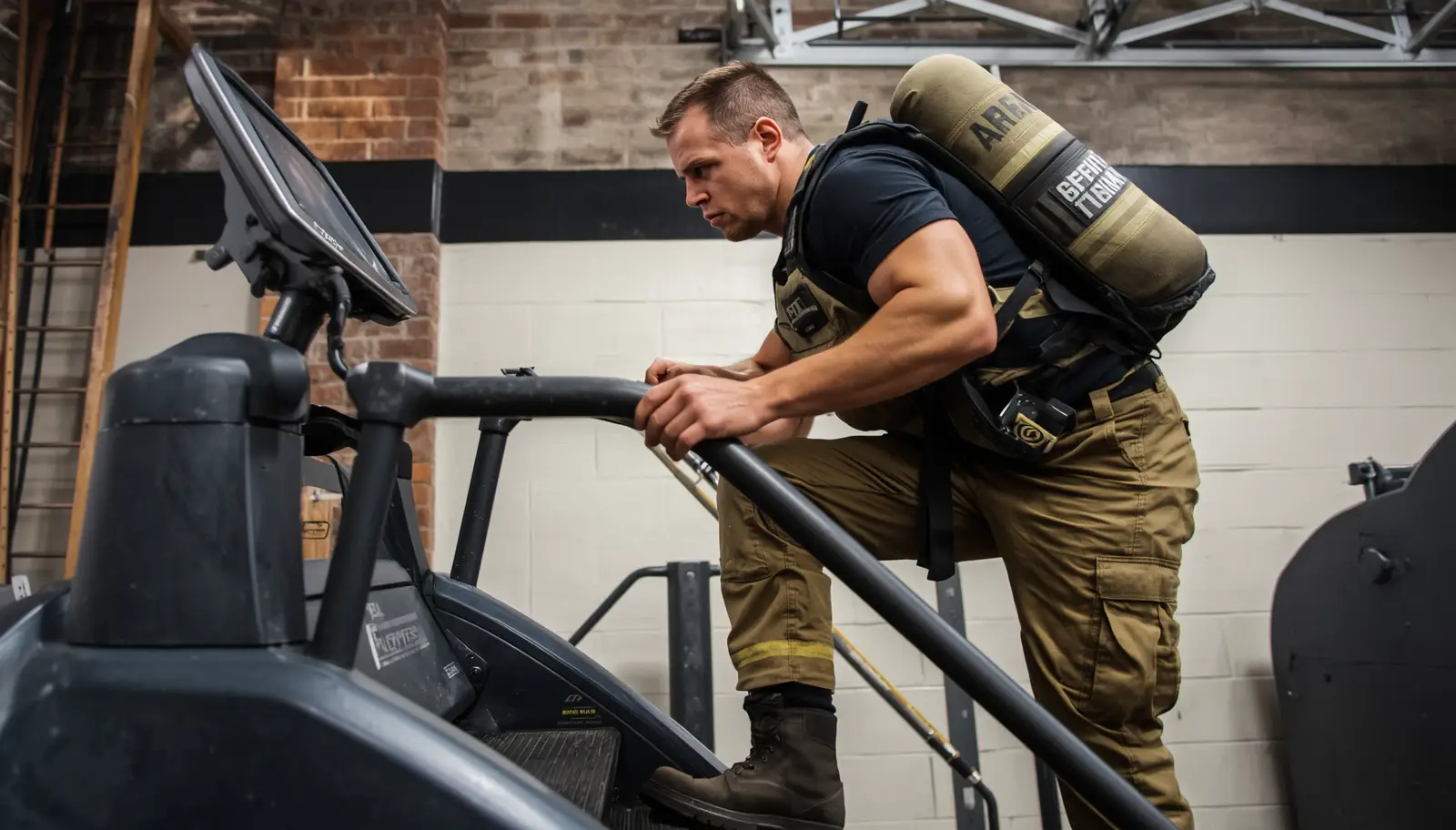
The stair climb is the first event and the cardiovascular gut-check of CPAT. The 75-pound load makes this an event-specific endurance task. Use the scheduled warm-up and orientation to learn the equipment; the standard does not require candidates to start cold.
How to train for it
- Use a StepMill at the gym at 60 steps per minute with a loaded pack or weighted vest. There is no adequate substitute for the actual machine.
- Build to 5–7 minutes without handrail support before the test so that 3 minutes is well within your capacity.
- Progress toward the test load gradually with qualified training guidance. Use official orientation and practice sessions to become familiar with the actual equipment.
- Practice the transition from standing still (check-in) to stepping on the machine — the first 30 seconds are disorienting if you have not practiced the start.
Event 2: Hose Drag
Hose Drag
Task: Drag an uncharged 1¾-inch hose 75 feet to a drum, make a 90° turn, drag another 25 feet, then drop to one knee and pull the hose until a mark crosses the finish line
Key: The hose must be controlled with both hands from the kneeling position; the final pull requires significant sustained pulling force
How to train for it
- Sled drags with a rope are the closest gym equivalent. 45–90 pounds, 100 feet, multiple sets.
- Train the kneeling pull specifically — the kneeling position limits your hip drive and makes the final pull harder than the initial drag. Practice alternating hand-over-hand pulls from a kneeling position.
- Grip strength is the limiting factor for many candidates. Farmer's carries, dead hangs, and towel pull-ups build the grip endurance required.
Event 3: Equipment Carry
Equipment Carry
Task: Remove two saws (approximately 32 lbs each) from a cabinet at shoulder height, carry them 75 feet around a cone, and return them to the cabinet
Key: Carry one saw in each hand while walking. You may place the saws on the ground to adjust your grip; dropping a saw is different and constitutes failure.
How to train for it
- Farmer's carries with dumbbells or kettlebells: 30–35 lbs each hand, 100-foot carries.
- Practice picking up and setting down at the correct height — the awkward overhead removal and replacement of the saws into the cabinet is where many candidates struggle, not the carry itself.
- Forearm and grip endurance: the 32-lb handles cut into unprotected hands. Condition your grip specifically.
Event 4: Ladder Raise and Extension
Ladder Raise and Extension
Task: Walk a 24-foot aluminum ground ladder from horizontal to vertical (hand-over-hand on the rungs), then move to the fly section and extend it to the top using the halyard rope
Key: Controlled movement required; slamming the ladder causes a disqualification; the fly section must be raised and lowered hand-over-hand on the rope
How to train for it
- Practice on an actual 24-foot ladder whenever possible. The technique is counterintuitive until practiced.
- Shoulder press, tricep pushdowns, and wrist curls develop the specific muscle groups used during the ladder raise.
- The halyard pull requires a hand-over-hand rope pulling motion under load. Battle rope pulls and rope climbs are excellent preparation.
Event 5: Forcible Entry
Forcible Entry
Task: Use a 10-lb maul to strike a measurement device until a buzzer sounds, indicating sufficient force has been applied. The buzzer triggers when cumulative force reaches the threshold.
Key: Controlled, powerful swings. Wildly inaccurate swings waste energy. The buzzer requires sustained force accumulation, not a single powerful blow.
How to train for it
- Tire hammer strikes with a sledgehammer are the standard training method. 10–16 lb hammer, 3–5 sets of 30 strikes.
- Power comes from the hips and core, not the arms. Practice hip-driven swing mechanics, not arm-only swings — you will gas out quickly without proper mechanics.
- Rotational core strength: Russian twists, cable rotations, landmine rotations all develop the core rotation driving the swing.
Event 6: Search
Search
Task: Crawl through a darkened tunnel maze (approximately 3 feet square) on hands and knees for the entire course, including a section where you must turn 90° in a confined space and navigate around obstacles
Key: Some sections require lying flat and pulling yourself through. The maze is dark. Disqualification if you cannot complete the course. No time limit separate from the overall CPAT clock.
How to train for it
- Practice crawling long distances on hard surfaces with weight. Your knees, wrists, and shoulders fatigue faster than expected.
- Practice in confined spaces to manage claustrophobia. The search event fails candidates who panic in confined darkness even when they are physically capable.
- 90° turns in a 3-foot tunnel require a specific technique: turn your body into the corner before your legs follow. Practice this movement.
Event 7: Rescue
Rescue
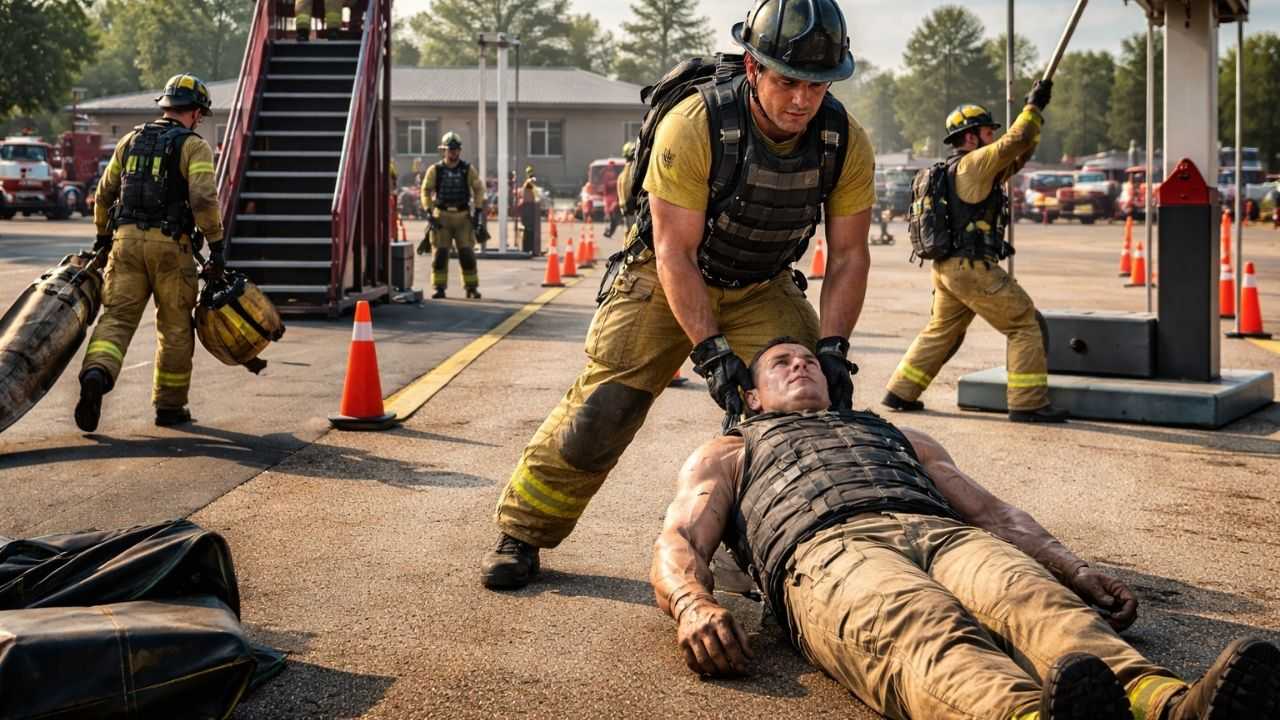
Task: Drag a 165-lb mannequin in a harness approximately 35 feet, make a 180° turn around a drum, and drag it back to the start — approximately 70 feet total
Key: Grasp one or both shoulder handles of the mannequin harness. You may lower the mannequin to adjust your grip; do not grasp or rest on the drum.
How to train for it
- Sled drags with 165+ lbs are the closest equivalent. Build to dragging 200 lbs for 100 feet so 165 lbs for 70 feet feels manageable.
- Practice using the mannequin's shoulder handles as demonstrated by the CPAT proctor. Keep training technique consistent with the actual test rules.
- Lower body strength is the primary driver. Romanian deadlifts, hip thrusts, and reverse lunges develop the posterior chain required.
Event 8: Ceiling Breach and Pull
Ceiling Breach and Pull
Task: Use the pike pole for three complete pushes of the 60-pound hinged door, followed by five complete pulls of the 80-pound device. Complete four sets: 12 pushes and 20 pulls, or 32 repetitions total.
Key: The alternating push-pull overhead motion on a fatigued body at the end of the test is the hardest shoulder endurance challenge in CPAT. You may pause to re-establish your grip while the overall test clock continues. Follow the proctor's count; incomplete repetitions must be repeated.
How to train for it
- Overhead pressing (overhead press, push press) and lat pulldowns develop the specific muscles used.
- Practice the overhead push-pull motion with a resistance band or cable machine to simulate the alternating movement pattern.
- Train this exercise last in your workout to simulate the accumulated fatigue of the preceding 7 events.
- Shoulder endurance is the limiting factor. High-rep overhead work (15–20 reps, multiple sets) builds the endurance needed.
12-Week CPAT Training Plan Overview
| Phase | Weeks | Focus | Key sessions |
|---|---|---|---|
| Base | 1–4 | Build aerobic base and general strength; adapt to weighted vest | 3× cardio (rowing, cycling, stair machine unweighted), 2× full-body strength, 1× long walk with vest |
| Build | 5–8 | Event-specific training; add vest weight to all sessions; increase intensity | 2× stair machine with vest at 60 SPM, 2× event-specific circuits (tire hammer, farmer carry, sled drag), 1× full CPAT simulation |
| Peak | 9–11 | Full CPAT rehearsals; intensity maintenance; recovery management | 2× full CPAT walkthrough at pace, 1× heavy strength, 2× active recovery; reduce volume, maintain intensity |
| Taper | 12 | Recovery; nervous system freshness; mental rehearsal | Light movement only; no heavy lifting after day 3 of test week; sleep priority; attend any final practice session offered |
Track your progress with the Firefighter BMI Calculator. BMI is not a CPAT score or a predictor of passing. Track event-specific preparation through licensed orientation and timed practice; the linked calculator provides general body-size information only.
Frequently Asked Questions
How hard is the CPAT test?
For a fit candidate who has specifically prepared, CPAT is challenging but completable. For a candidate who has done general fitness training without specific CPAT preparation, the stair climb, rescue drag, and ceiling breach and pull are commonly the events where failure occurs. The combination of sustained cardiovascular effort with the 50-pound vest, followed by strength events on a fatigued body, is harder than most candidates expect from general gym fitness.
How long does CPAT take to complete?
The limit is 10 minutes and 20 seconds for all eight events. Walk between events; running is permitted during the hose drag portion of Event 2. The overall clock continues through transitions and permitted pauses.
Can you practice for CPAT at home?
Home exercises can build strength and endurance for CPAT, but they do not reproduce every test device or rule. Use the official preparation guide and attend licensed orientation and practice sessions to learn the stair machine and other event equipment.
What weight do you carry in CPAT?
A 50-pound vest is worn throughout all 8 events. For the stair climb (Event 1), an additional 25-pound shoulder pack is added, bringing the total to 75 pounds. The extra 25-pound pack is removed after the stair climb and the 50-pound vest continues for all remaining events.
Official CPAT sources
This preparation article is independent of the IAFF/IAFC test program. Event rules were checked on October 15, 2026 against the IAFF/IAFC CPAT Manual, 2nd Edition and the IAFF administration guidance. See FCTC's candidate instructions for an example of provider-specific attire rules. Confirm current arrangements with your licensed test site. The training outline above is an editorial example, not an official IAFF/IAFC program.


Comments 0
No comments yet. Be the first to share your thoughts!
Leave a Comment