Ask a hazmat technician what they trained hardest on and the answer will involve Level A suit operations, chemical identification procedures for unknown substances, emergency decon sequences, or industrial chemical release protocols. Ask the same technician what their last ten hazmat calls were and the answer is almost certainly: several natural gas leaks, a few carbon monoxide alarms, a couple of fuel spills, and one or two unknown odor calls. The Level A suit may not have come off the truck at all in the past year.
This is not a criticism of hazmat training — the rare complex incidents require the most rigorous preparation precisely because they are rare and unfamiliar. But the common calls require competence too, and the familiarity that comes from repetition at training does not automatically transfer to competence in the field on calls that are less thoroughly rehearsed. A crew that is excellent at a theoretical chlorine plant response and mediocre at natural gas leak procedures has its training investment misallocated relative to its actual call volume.
In this article:
The Actual Distribution of Hazmat Call Types
National data from NFPA and the PHMSA (Pipeline and Hazardous Materials Safety Administration) shows consistent distribution across fire department hazmat responses:
| Call type | Approximate share of hazmat responses |
|---|---|
| Natural gas and propane leaks | 35–45% |
| Carbon monoxide alarms and exposure | 20–25% |
| Petroleum/fuel spills (vehicle accidents, tank leaks) | 10–15% |
| Unknown odor/substance calls | 8–12% |
| Other flammable liquids and solids | 5–8% |
| Mercury and common lab chemicals | 3–5% |
| Industrial and chlorine/acid incidents | 2–4% |
| All other (radiological, biological, complex industrial) | <3% |
The numbers vary by jurisdiction — an urban department near industrial facilities will have higher industrial incident rates than a suburban department, and a department in a region with extensive natural gas distribution will have higher gas leak rates than one in an area with mostly electric utilities. But the general pattern is consistent: routine hazmat incidents (gas, CO, fuel) dwarf complex industrial incidents by an order of magnitude in most departments' call logs.
Natural Gas Leaks: The Most Common Hazmat Call
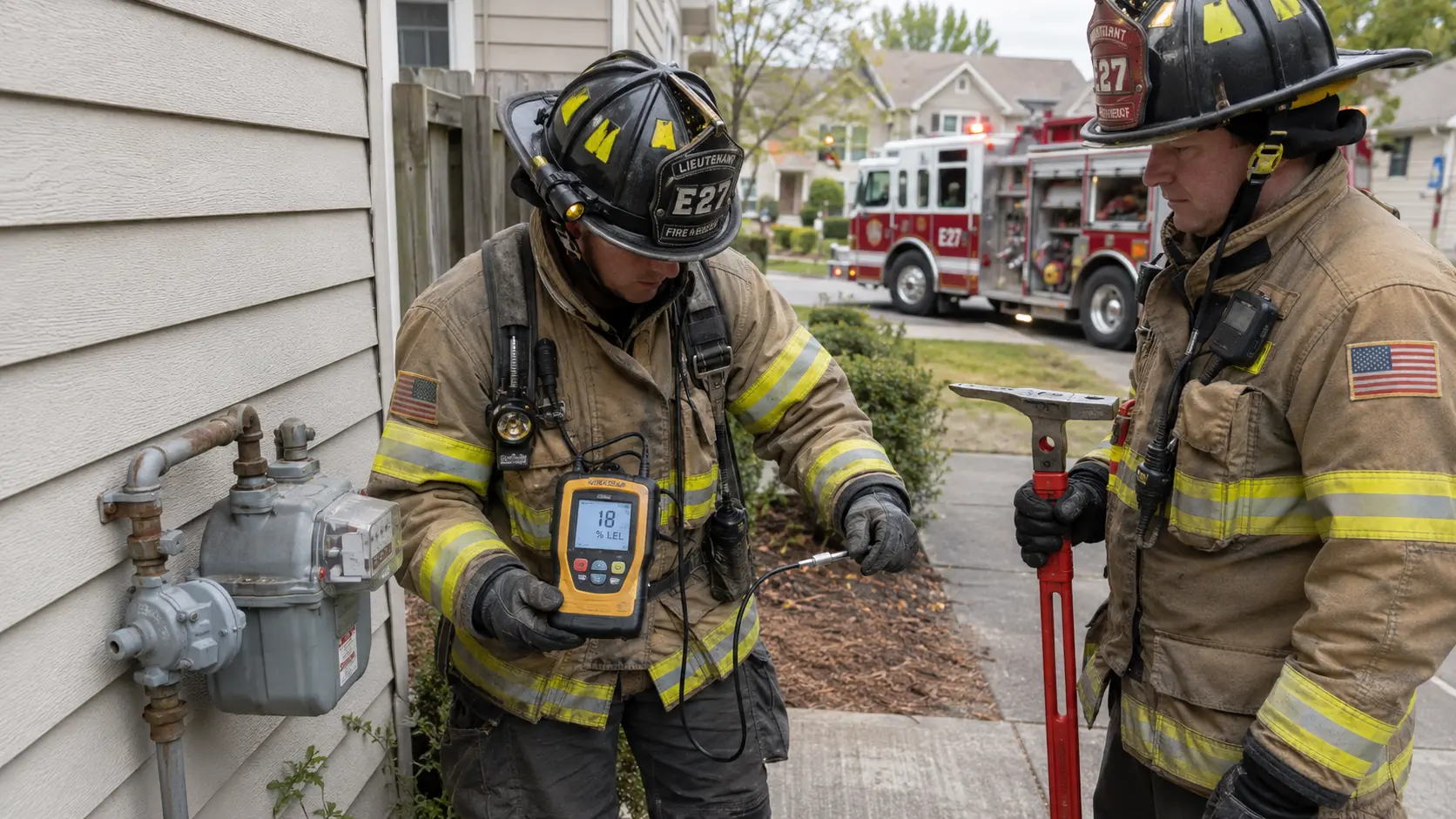
Natural gas is primarily methane (CH₄) — colorless, odorless in its natural state, odorant-added (ethyl mercaptan or similar) at the distribution level to make leaks detectable. Its LEL is 5 percent by volume in air and its UEL is 15 percent. Below 5 percent, the mixture is too lean to ignite. Above 15 percent, it is too rich. Between 5 and 15 percent, it is flammable and will ignite from any ignition source with sufficient energy.
The standard response procedure for a reported gas odor:
- Approach from upwind. Do not park vehicles at the immediate address — vehicle engines are potential ignition sources.
- Assess exterior for visible gas indicators: dead vegetation around buried lines (gas kills roots), frost patterns on the ground in winter (gas escaping from soil freezes surrounding moisture), visible hissing at meter or fittings.
- Evacuate the structure if gas odor is confirmed inside before entering — gas at any concentration above the odor threshold is at concentrations that warrant evacuation and ventilation before entry.
- Enter the structure with combustible gas indicator (CGI) monitoring at multiple points: low (gas may pool if heavier), at the meter, at appliances, and in any enclosed spaces.
- Eliminate ignition sources before monitoring: do not operate light switches, do not allow appliances to cycle, no cell phones in the immediate gas area.
- If CGI reads above 10 percent LEL anywhere in the structure: evacuate all occupants, establish a perimeter, notify the gas utility, do not re-enter until the utility confirms the leak is controlled and the structure is below 10 percent LEL.
Carbon Monoxide: Alarms vs. Actual Exposure
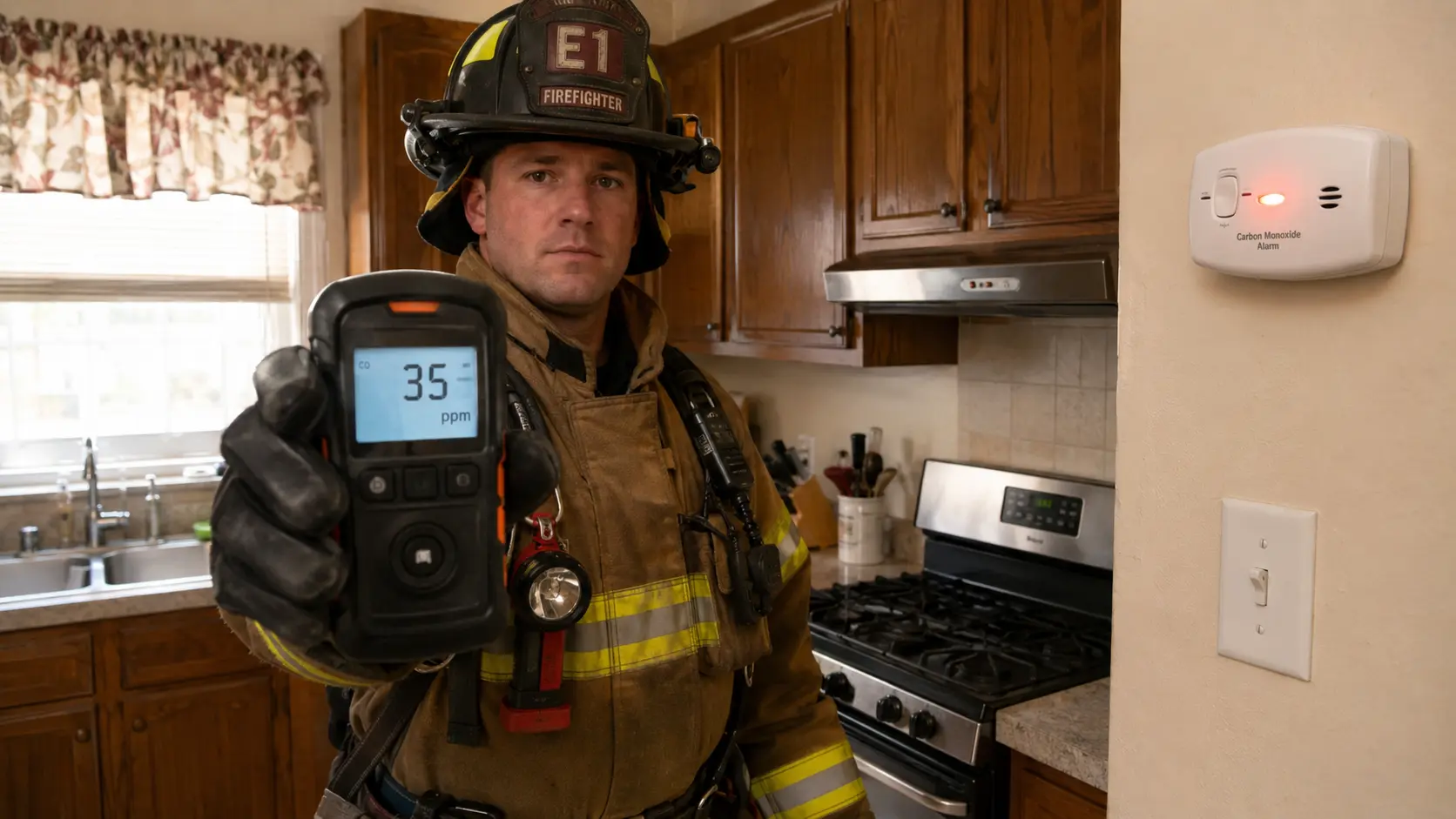
CO alarm activations are among the most frequent hazmat-type calls and present a consistent diagnostic challenge: the alarm may indicate actual elevated CO (a functioning appliance in a partially enclosed space, a vehicle running in an attached garage, a chimney obstruction) or a malfunctioning alarm (end-of-life sensors trigger false alarms, and smoke or other particulates can activate CO alarms). Distinguishing between the two requires monitoring.
The response protocol for a CO alarm activation:
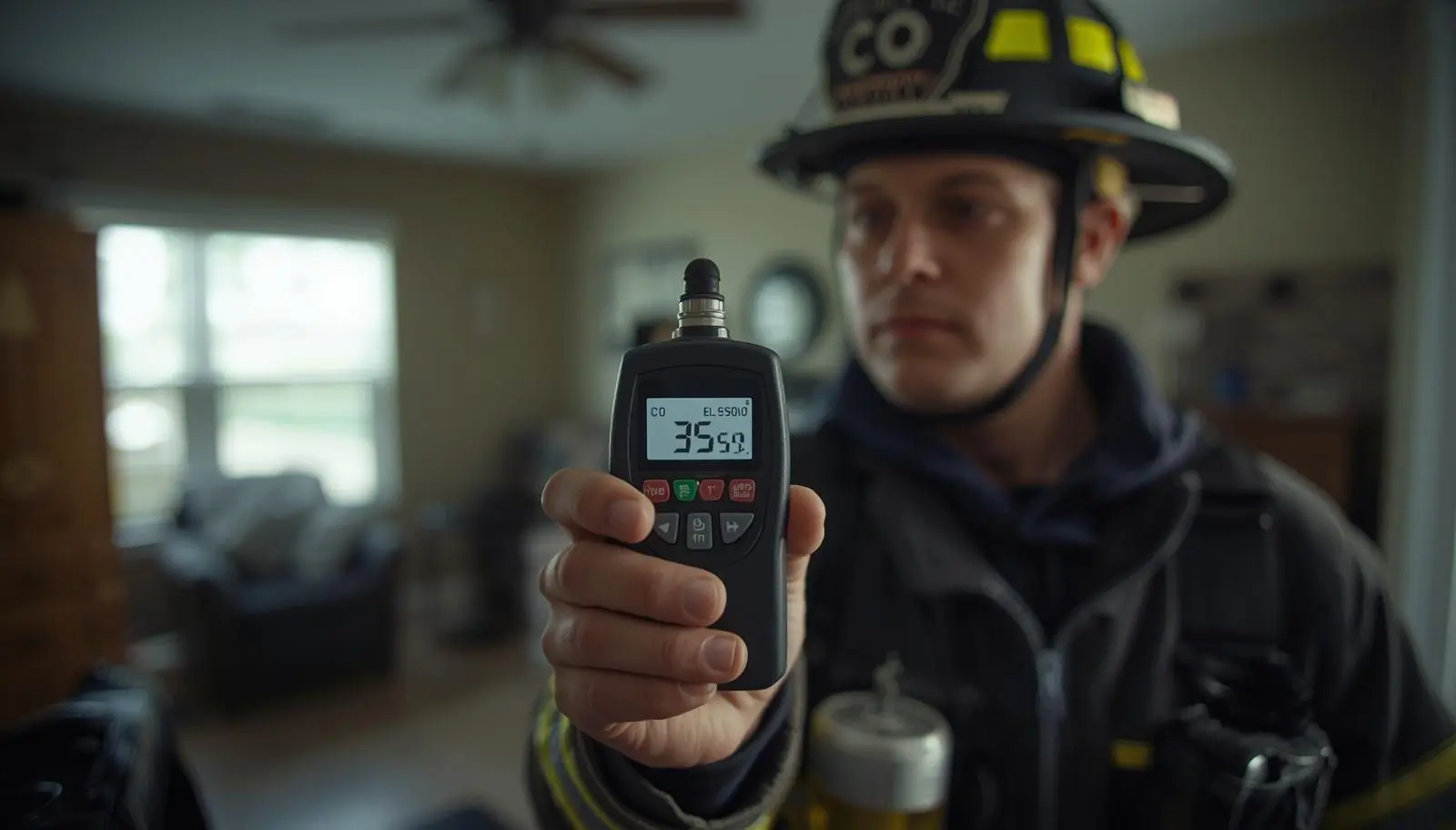
- Enter with CO monitor. Measure CO concentration at multiple points — near the reported alarm, near combustion appliances, and at low levels (CO is slightly lighter than air but is well-mixed in typical indoor environments).
- Assess occupants for CO exposure symptoms: headache, nausea, fatigue, confusion. Anyone with symptoms above mild headache warrants medical evaluation including COHb measurement.
- A reading above 35 ppm (the OSHA 8-hour TWA) requires source identification and correction before reoccupancy.
- A reading above 200 ppm (IDLH is 1,200 ppm but acute symptoms begin at lower concentrations) warrants evacuation and SCBA for further operations.
- A zero reading with a functioning alarm may indicate a sensor end-of-life activation — recommend alarm replacement and document.
Fuel and Petroleum Spills
Vehicle accidents, fuel tank failures, and fuel transfer errors produce petroleum spills that are the third most common hazmat call type in most departments. The hazards from a fuel spill: the flammable vapor above the spill (gasoline's LEL is 1.4 percent, readily reached from a moderate surface spill), the environmental contamination of storm drains and waterways, and the traffic safety hazard of a slippery surface on a roadway.
Fuel spill response priorities: eliminate ignition sources in the immediate area (shut down traffic, prohibit smoking, assess for nearby ignition sources), apply foam or an absorbent material to control vapor from the liquid surface and prevent spread, protect storm drains if the spill is moving toward drainage, and notify environmental authorities if the spill has reached or threatens to reach a waterway or drainage system.
Fuel spills do not typically require hazmat team activation unless the spill volume is large (greater than a few hundred gallons), the material is not readily identifiable as common petroleum product, or the spill has reached sensitive environmental areas. First-responding engine companies handle most fuel spills with the absorbent materials, foam, and monitoring equipment carried on standard apparatus.
Unknown Odor Calls
The unknown odor call — "there's a strange smell coming from somewhere in the building" — is among the most diagnostically ambiguous hazmat call types. It may represent a minor household chemical reaction (bleach and ammonia mixed in a sink drain), an unusual but non-hazardous industrial odor from an adjacent business, sewer gas from a dried trap, or the early detection of a significant leak that has not yet been identified.
Unknown odor response uses the multi-gas monitor as the primary assessment tool: oxygen percentage, LEL, CO, and H₂S provide an initial screening that covers the most common hazardous gas scenarios. A clean reading on all four channels in a space with a distinctive odor is reassuring but not conclusive — some gases and vapors are not detected by the standard four-gas monitor. Photoionization detectors (PIDs) detect a broader range of volatile organic compounds and are useful when the standard multi-gas reading is clean but the odor persists.
Mercury Spills
Mercury spills are a recurring hazmat call type because mercury-containing devices — thermometers, fluorescent light bulbs, barometers, some blood pressure devices, and older thermostats — are still present in homes, schools, and industrial settings, and they break. A broken mercury thermometer releases a small quantity of liquid mercury that, if not cleaned up correctly, volatilizes into mercury vapor — a toxic exposure route that is not visible and not detectable without equipment.
Mercury spill response: evacuate the room, do not attempt vacuum cleanup with a household vacuum (which aerosolizes the mercury and spreads the contamination), do not walk through the spill (which spreads mercury on shoe soles), and contact the hazmat team for appropriate cleanup materials. Specialized mercury spill kits use amalgamating powder or sulfur powder to bind the liquid mercury for safe collection. The cleanup procedure for mercury is specific enough that improvised approaches typically make the contamination problem worse.
Drug Lab Residue
Former drug manufacturing locations — methamphetamine labs in particular — leave chemical residue that constitutes a hazmat exposure risk for subsequent occupants and for fire crews responding to calls at those locations. Meth lab chemicals include precursor solvents, acids, and reactive materials that produce toxic residues on surfaces and in ductwork. A structure that was used as a meth lab may show no visible evidence of its history but test positive for residual chemicals on surface swab testing.
First responders who respond to fire or other emergency calls at former drug lab locations can receive secondary exposure through skin contact with contaminated surfaces. Departments in areas with significant drug activity maintain awareness of known lab locations and apply appropriate precautions — including PPE upgrade and post-incident decon — when responding to addresses with known or suspected lab history.
The Training-to-Call Gap
The gap between training emphasis and call reality in hazmat operations is a known and documented phenomenon. The NFPA and HAZWOPER frameworks require training on complex industrial scenarios because those scenarios exist and must be managed competently when they occur. But training time is finite, and departments that use most of their hazmat training hours on Level A suit operations and industrial release protocols are investing in scenarios that represent under 5 percent of their call volume.
Balanced hazmat training addresses both: the complex scenarios get the depth of preparation they require, and the common scenarios get the repetition they need to be executed smoothly under field conditions. A crew that can explain the theory of a chlorine emergency response but has not practiced natural gas leak procedure in two years may perform the common call less effectively than the rare one — which is the inverse of the risk distribution they actually face.
Comments 0
No comments yet. Be the first to share your thoughts!
Leave a Comment