The average fire department response time in the United States is around seven to eight minutes from the moment a call is received to the moment the first apparatus arrives on scene. That number is an average. It obscures the fact that in a dense urban district with a staffed station two blocks from your house, response might be under three minutes. In a rural area served by a volunteer department, it might be twenty-five. The number that matters is the one for your specific address — and most people have no idea what it is.
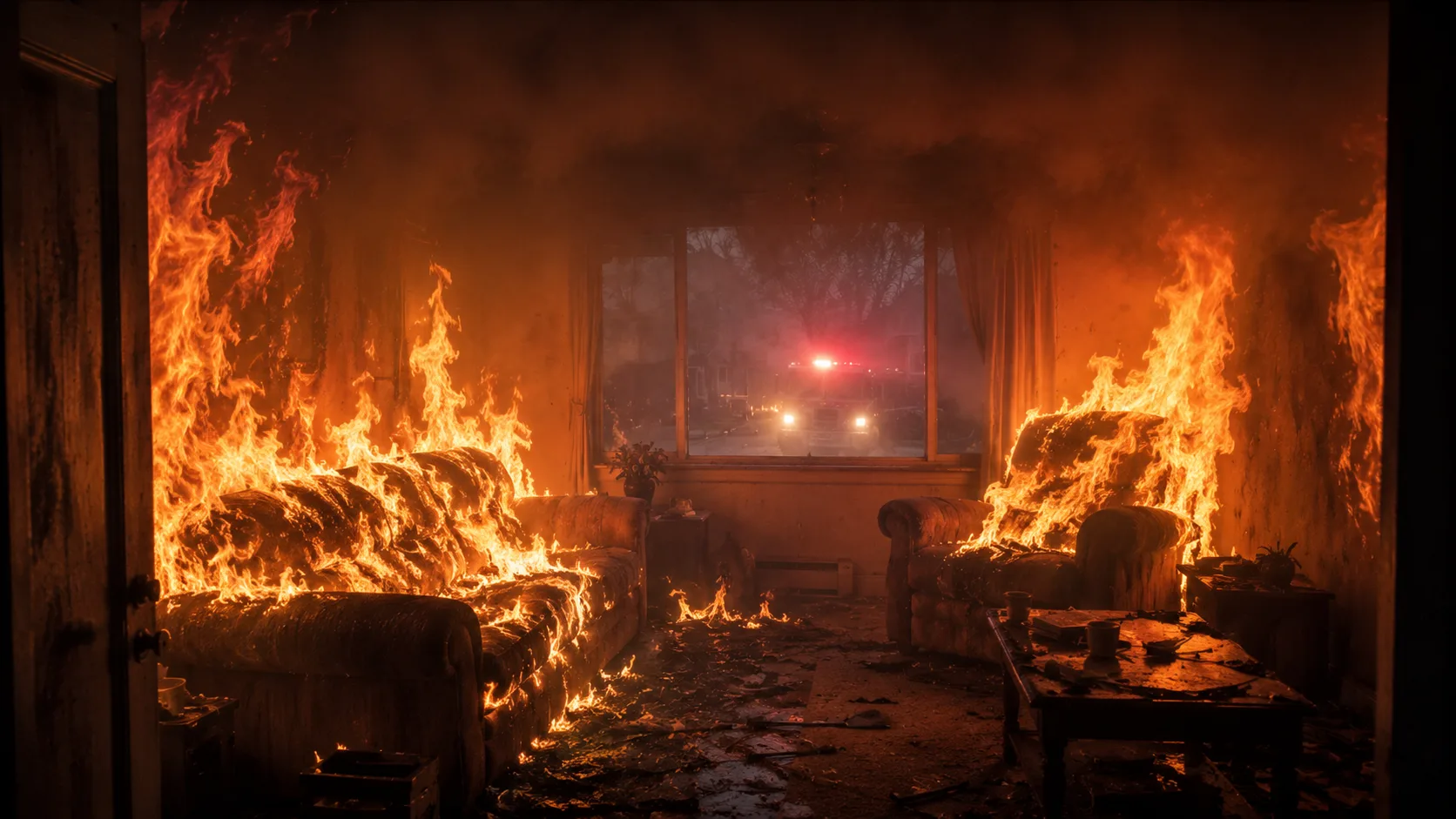
Response time is not just trivia. A house fire in the average modern home reaches flashover — the point at which every combustible surface in a room ignites simultaneously — in three to five minutes after ignition. A fire that is not suppressed before flashover is a fundamentally different incident from one that is caught before it. What happens in those minutes before the truck arrives determines whether the fire department is doing a rescue or a recovery.
In this article:
- The three components of response time
- What NFPA 1710 says — and what it does not
- What flashover means and why the timeline matters
- Urban, suburban, and rural: how location changes everything
- Volunteer departments and why their response works differently
- How staffing levels affect what happens when the truck arrives
- How to find your actual response time
- What to do in those minutes before they arrive
The Three Components of Response Time
Response time is reported as a single number, but it is made up of three separate intervals — each of which varies independently and contributes differently to the outcome.
Dispatch time
The interval between when someone calls 911 and when the call is dispatched to the fire department. In systems where fire and police share a dispatch center, the fire call may be processed by an operator who is also handling police calls — adding seconds or minutes during busy periods. In dedicated fire dispatch centers, this interval is typically under 60 seconds. The national NFPA standard is 60 seconds for dispatching 90 percent of emergency calls, but individual center performance varies considerably.
Turnout time
The interval between when the alarm is received at the station and when the apparatus leaves the station. Firefighters have to get up (if sleeping), don their gear, mount the apparatus, and clear the station. NFPA 1710 sets a standard of 60 seconds for engine companies during daytime hours and 80 seconds at night — the difference accounting for the fact that career firefighters on night shift may be sleeping. Actual turnout times at well-run career departments cluster around 60 to 90 seconds. Volunteer departments, where members may be at home or at work when the alarm sounds, have highly variable turnout times that can range from 2 minutes to 10 or more.
Travel time
The interval between when the apparatus leaves the station and when it arrives on scene. This is the component most directly controlled by station location relative to the incident and by traffic conditions. A station one mile from the incident arrives significantly faster than one three miles away — but traffic, road design, train crossings, and time of day can change that calculation dramatically. NFPA 1710 sets a travel time standard of four minutes or less for the first engine company, 90 percent of the time.
What NFPA 1710 Says — and What It Does Not
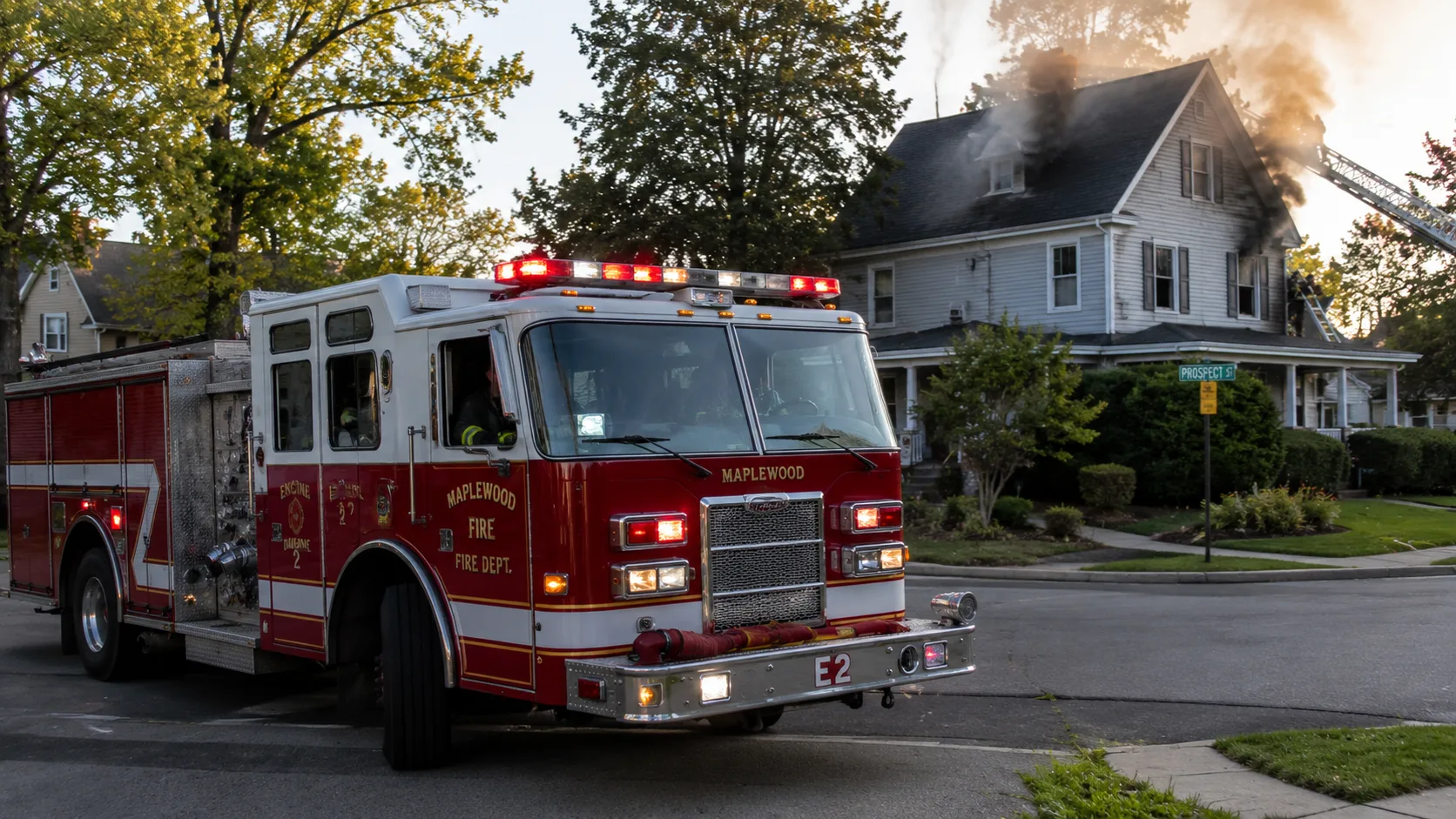
NFPA 1710 is the standard for the organization and deployment of fire suppression operations in career and combination fire departments. It sets specific response time benchmarks: dispatch within 60 seconds, turnout within 60 to 80 seconds, first engine on scene within four minutes of dispatch, and a full effective response force (enough personnel to mount an offensive interior attack) on scene within eight minutes — all for 90 percent of incidents.
Three things about NFPA 1710 that most people do not know:
First, it is a standard, not a regulation. Departments are not legally required to meet it. A department can acknowledge the standard, attempt to meet it, and still fall short on a significant percentage of calls without legal consequence. The 90 percent benchmark means that by design, one in ten calls does not meet the standard — and in departments that are struggling with staffing or geography, that number is higher.
Second, it applies to career and combination departments. NFPA 1720 covers volunteer organizations and sets considerably more flexible standards reflecting the realities of volunteer availability. A volunteer department meeting NFPA 1720 compliance may have response times that look very different from NFPA 1710 benchmarks.
Third, department-level compliance masks address-level variation. A department that meets the four-minute travel standard for 90 percent of its district may have specific neighborhoods — at the edges of the coverage area, across a bridge, past a rail crossing — where travel times routinely exceed eight or ten minutes. Knowing the department's average does not tell you what happens when your address calls.
What Flashover Means and Why the Timeline Matters
Flashover is the transition point in a compartment fire where the fire moves from burning individual items to burning everything simultaneously. As a fire heats a room, the upper air layer accumulates unburned combustion gases and heat radiates downward onto the contents of the room. At approximately 1,100°F in the upper layer — and around 500°F at floor level — the radiated heat becomes sufficient to ignite every combustible surface in the room at once. The fire jumps from burning one couch to burning every surface in that room in a fraction of a second.
Post-flashover, the fire environment is not survivable. Temperature, oxygen depletion, and toxic gas concentration all exceed human physiological limits almost immediately. Pre-flashover, a firefighter with SCBA and proper gear can enter and work. The line between these two conditions is often a matter of two to three minutes — and it is the line that separates a survivable interior rescue from one that is not.
Furniture content is the primary driver of flashover timing. Older homes furnished with wood, cotton, and natural fiber materials took significantly longer to reach flashover — sometimes 30 minutes or more from ignition. Modern homes furnished with synthetic foam upholstery, plastic components, and composite materials reach flashover in three to five minutes. This is a documented, researched difference with direct implications for survivability and for what a fire department can accomplish given its response time.
If your response time is eight minutes and flashover occurs at four minutes, the fire department arrives to a post-flashover fire in most scenarios. This is not a failure — it is physics. What it means practically is that the outcome in most residential fires is determined before the fire department arrives, by whether the occupants were awake, by whether the smoke detector functioned, and by whether they had a plan.
Urban, Suburban, and Rural: How Location Changes Everything
| Location type | Typical first arrival | Typical full response force | Primary variables |
|---|---|---|---|
| Dense urban | 3–5 minutes | 6–10 minutes | Traffic congestion; multiple nearby stations |
| Suburban career | 5–8 minutes | 8–12 minutes | Station spacing; traffic patterns; mutual aid distance |
| Suburban volunteer/combo | 6–15 minutes | 12–25 minutes | Volunteer availability; time of day; member proximity |
| Rural volunteer | 10–25 minutes | 20–45 minutes | Road distance; member location; mutual aid travel |
| Remote rural | 25+ minutes | 45+ minutes | Distance; road conditions; seasonal access; water supply |
The rural response time situation is not a failure of rural fire departments — it is a function of geography and population density that makes the career staffing model economically impossible. A county covering 600 square miles with a population of 15,000 cannot maintain the station density required for four-minute travel times. Rural homeowners live with response times that guarantee a structure fire is a total loss before suppression begins. This is a known condition that shapes how rural fire safety advice should differ from urban: greater emphasis on prevention, early detection, water supply (rural departments may need to draft from a pond or a tank truck rather than a hydrant), and defensible space for wildfire risk.
Volunteer Departments and Why Their Response Works Differently
Roughly 30 percent of U.S. fire departments are primarily volunteer, and they protect a large portion of the country's geographic area — mostly rural and suburban communities where the call volume does not justify a full-time paid department. Understanding how volunteer response works explains why the timeline differs from career departments.
When a call comes in to a volunteer department, the alarm goes out over a pager or app to members who are at home, at their regular jobs, or elsewhere in the community. Members self-respond — they drive to the station, don their gear, and respond in department apparatus. Or some members go directly to the scene in personal vehicles if they are closer. The first apparatus to the scene may have only one or two members aboard if others have not yet arrived at the station.
Time of day matters enormously for volunteer response. At 2pm on a weekday, many members are at work and may not be available. At 7pm on a Saturday, many members are home and respond quickly. A volunteer department may have excellent response times on weekend evenings and challenging response times on weekday afternoons. Seasonal factors affect this too — a department in an agricultural community may have significantly different availability during harvest season.
Some communities use a combination model: a small career staff on duty at all times, supplemented by volunteers. This hybrid approach can meet NFPA 1710 first-arrival standards while using volunteer staffing to build out the response force. The first apparatus arrives quickly; full staffing takes longer.
How Staffing Levels Affect What Happens When the Truck Arrives
Response time is only part of the equation. What happens when the first apparatus arrives depends on how many firefighters it carries, and that number determines whether any interior operations happen immediately or whether the crew must wait for additional resources.
NFPA 1710 requires a minimum of four personnel for safe interior operations in a structural fire — two to enter and one to stand by at the entry point as part of the two-in, two-out requirement, plus a fourth for initial command or pump operation. An engine arriving with two personnel cannot legally or safely initiate interior operations until additional help arrives. They can begin water supply, conduct exterior reconnaissance, and position for attack — but the rescue and suppression that most people picture when they think of "firefighters arriving" requires four.
Many departments, particularly those dealing with budget constraints and staffing shortages, routinely run engines with two or three personnel. An engine arriving with three — one short of the four-person minimum for interior attack — must wait for mutual aid before entering, even if a victim is visible in a window. This is not indifference; it is a policy designed to prevent the additional fatality of a firefighter who enters understaffed and gets in trouble with no one to help them.
How to Find Your Actual Response Time
Most fire departments publish annual reports that include response time data broken down by district or by census tract. These are typically available on the department website or through a public records request. When reading them, look for:
- The 90th percentile response time for your district — not the average. Average response time hides the tail of slow responses. The 90th percentile tells you what happens in the worst 10 percent of cases, which is more informative about worst-case scenarios.
- Whether the data is reported by district or only for the entire department. Department-wide averages mask geographic variation within the coverage area.
- Whether the data includes volunteer call-up time or only career staff response. Combination departments sometimes report only career staff arrival, not the time to a full response force.
If the department does not publish this data, call the fire marshal's office or the department's administrative line and ask. In most states, this is public information and departments are required to provide it on request. Some states publish statewide response time data by department through the state fire marshal's annual report.
What to Do in Those Minutes Before They Arrive
Knowing your response time is useful for one specific purpose: calibrating what you need to do yourself before help arrives. A seven-minute response time means you have seven minutes. A twenty-minute response time means you have twenty minutes to manage your survival and the survival of anyone with you.
- ✓Get everyone out first, call 911 second — if exit is safe, evacuate, then call from outside. Do not call from inside while people are still in the structure unless exit is blocked.
- ✓Meet at a designated location — so you can tell the arriving crew immediately whether everyone is accounted for or whether someone is still inside.
- ✓Tell 911 dispatch if anyone is still inside, their location (floor and room), their mobility status, and whether the fire is growing or contained.
- ✓Stay out — the leading cause of civilian fire deaths in residential fires that also involve a fire department response is people re-entering the structure. Do not go back in for pets, for belongings, or to look for someone you are not sure is inside.
- ✓Guide the arriving crew — wave them down, give them the address clearly, tell them where the fire is and whether anyone is inside. First-arriving crews spend time on scene orientation. You can cut that time significantly.
- ✗Do not attempt interior firefighting with garden hoses or fire extinguishers once the fire has extended beyond the room of origin. This is the phase where civilian deaths from attempted suppression occur.


Comments 0
No comments yet. Be the first to share your thoughts!
Leave a Comment