
Why Wildfire Evacuation Planning Cannot Wait Until Fire Season
Wildfires across the United States have grown larger, faster, and more destructive with each passing decade. Communities in California, Oregon, Washington, Colorado, Texas, and Florida regularly face evacuation orders during fire season — and increasingly, outside of it. The 2018 Camp Fire destroyed the town of Paradise, California, in hours. The 2021 Marshall Fire outside Boulder, Colorado, burned through more than 1,000 homes in a single afternoon in late December.
The core lesson from every major wildfire event is consistent: families who had a plan survived; families who waited to make one often did not escape safely. This guide walks through the complete lifecycle of wildfire evacuation — preparation before any threat exists, action when an order is issued, and recovery after the fire passes.
For a deeper understanding of how wildfires ignite and spread — including how investigators determine origin and cause — see our guide on wildland fire investigations in the U.S.
Step 1: Know Your Zone Before Any Fire Threatens
Every household in a fire-prone area should know their evacuation zone before fire season begins. Most counties in high-risk states have adopted tiered zone systems — often numbered (Zone 1, Zone 2, Zone 3) or color-coded — that allow emergency managers to issue evacuation orders in a sequenced, geographic way as a fire moves.
Look up your zone now using your county Office of Emergency Services (OES) or Sheriff's website. Platforms such as Zonehaven, state-specific portals like California's Ready for Wildfire, and county ArcGIS tools allow address-specific zone lookup. Once you know your zone, sign up for your county's emergency notification system. While Wireless Emergency Alerts (WEA) are sent automatically to cell phones in affected areas, county-level services such as Nixle, Everbridge, or CodeRED provide earlier, more granular neighborhood-level notices.
Also identify at least two evacuation routes from your home — one primary and one alternate. Practice driving both. Routes that seem clear during a normal day may be blocked by fire, downed power lines, or congestion during an actual emergency.
Step 2: Build Your Wildfire Go-Bag
A go-bag (also called a bug-out bag or 72-hour kit) is a pre-packed container holding everything your family needs to survive the first 72 hours of displacement. The goal is that when an evacuation order is issued, you grab the bag and go — no searching, no packing under stress.
For wildfire-specific scenarios, your go-bag should include:
- Water — at least one gallon per person per day for three days; sealed commercial bottles are most practical
- Food — non-perishable, calorie-dense items (nuts, jerky, protein bars, canned goods with pull tabs); rotate every six months
- Medications — a minimum 7-day supply of all prescriptions; include a list of medications, dosages, and prescribing physicians
- Documents — photocopies or digital scans of: government IDs, passports, insurance cards and policy numbers, property deeds, vehicle titles, and financial account information; store in a waterproof pouch
- Respiratory protection — N95 or P100 half-face respirator masks for every family member; standard cloth masks do not filter wildfire smoke particles
- Clothing and footwear — one change of clothing per person including long sleeves and pants (natural fibers like cotton and wool are more fire-resistant than synthetics), and closed-toe, sturdy shoes
- Communication tools — phone chargers, backup power bank, and a battery-powered or hand-crank NOAA weather radio in case cell networks are overloaded
- Cash — card readers may be offline during disasters; have small bills available
- First aid kit — including burn dressings, which are particularly relevant in fire evacuation scenarios
- Flashlight and extra batteries — power outages frequently precede or accompany wildfires, particularly when utility companies implement Public Safety Power Shutoffs (PSPS)
Keep the go-bag in an accessible location — near your main exit, in your vehicle, or in a closet by the garage. Review and restock it every six months, ideally at the start and end of fire season.
Step 3: Create a Family Communication and Reunification Plan
During a fast-moving wildfire evacuation, family members may be separated — at work, school, or different locations when the order is issued. A family communication plan ensures everyone knows what to do without needing to reach each other in real time, when phone networks may be congested.
Your plan should designate:
- A primary meeting point near your home (e.g., a neighbor's driveway or a specific street corner) if family members are evacuating on foot or arrive home to find others gone
- A secondary meeting point outside the immediate evacuation zone — a school parking lot, community center, or relative's address at a safe distance
- An out-of-area contact — a family member or friend in another state who everyone calls or texts to check in, since long-distance calls sometimes connect more reliably during local network congestion
- Your children's school emergency release and reunification protocol — know in advance whether the school shelters in place, buses students to a reunification site, or releases directly to parents
- A plan for elderly or mobility-limited family members who may need assistance evacuating — contact your county's Access and Functional Needs (AFN) registry if applicable
Step 4: Prepare Your Home to Resist Ignition
While no preparation guarantees a home will survive a severe wildfire, reducing ignition risk through defensible space and home hardening can significantly improve survival odds when flame fronts pass.
Defensible Space
Defensible space is the buffer zone between your home and the vegetation surrounding it. California Fire Code and similar regulations in other western states define two primary zones:
- Zone 1 (0–30 feet from the structure): Remove all dead plants, grass, and weeds. Clear gutters of leaves and pine needles. Space plants so fire cannot travel between them. Remove branches within 10 feet of the ground. Keep wood piles away from the house.
- Zone 2 (30–100 feet from the structure): Mow grass to a maximum of four inches during fire season. Create spacing between shrubs and trees. Remove dead plant material from under trees.
Home Hardening
The most common ways wildfires ignite homes are not direct flame contact but embers — burning material lofted ahead of the fire front that land on roofs, in gutters, on decks, and through vents. Key hardening measures include:
- Install ember-resistant vents (Class A fire-rated screens with 1/16-inch mesh or smaller)
- Replace wood shake roofing with Class A fire-rated materials (metal, tile, composite shingles)
- Enclose the underside of eaves and decks
- Install dual-pane or tempered glass windows to resist radiant heat
- Remove combustible patio furniture, doormats, and wood piles from within Zone 1 during high fire danger periods
Step 5: When an Evacuation Order Is Issued — Leave Immediately
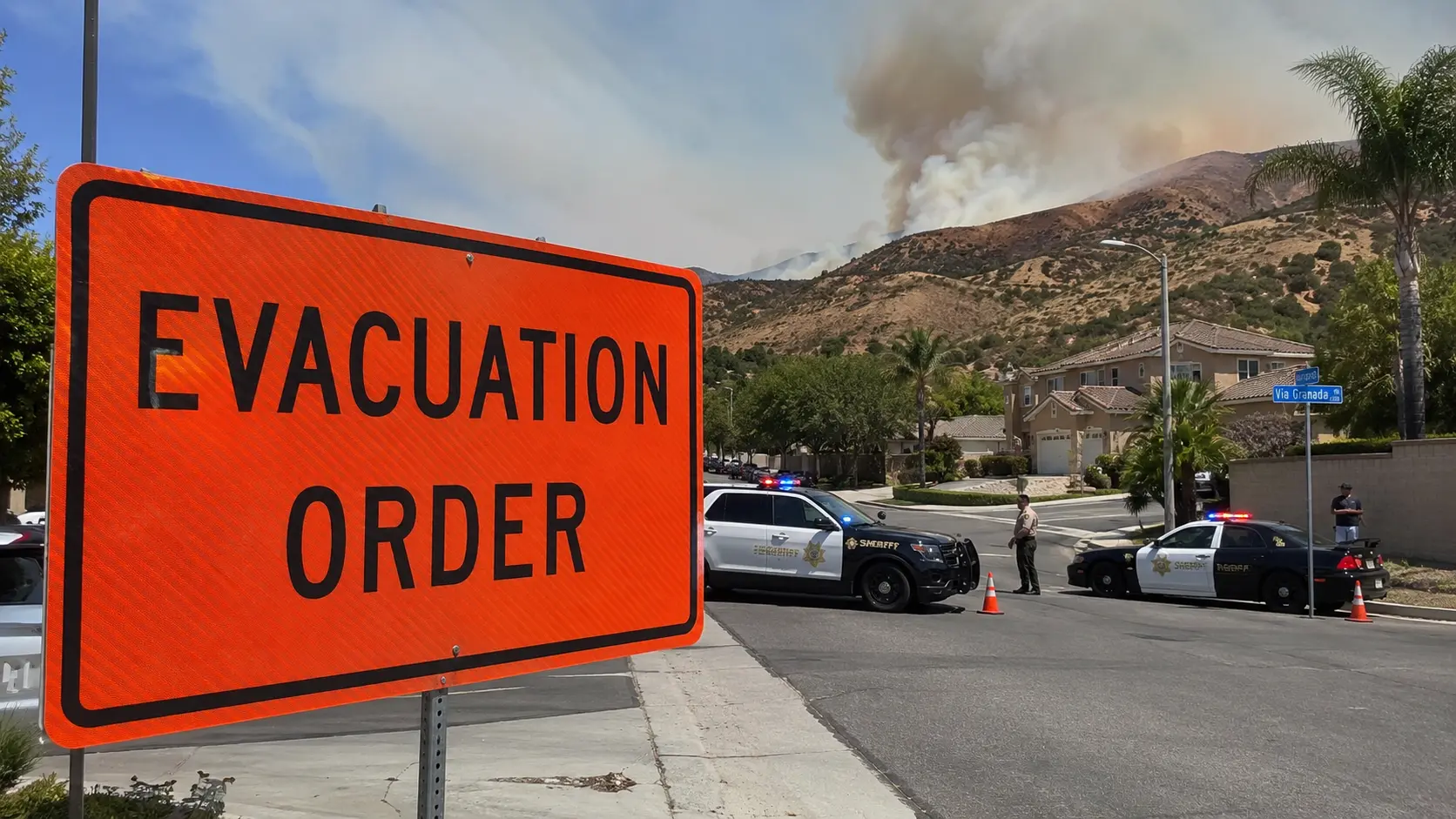
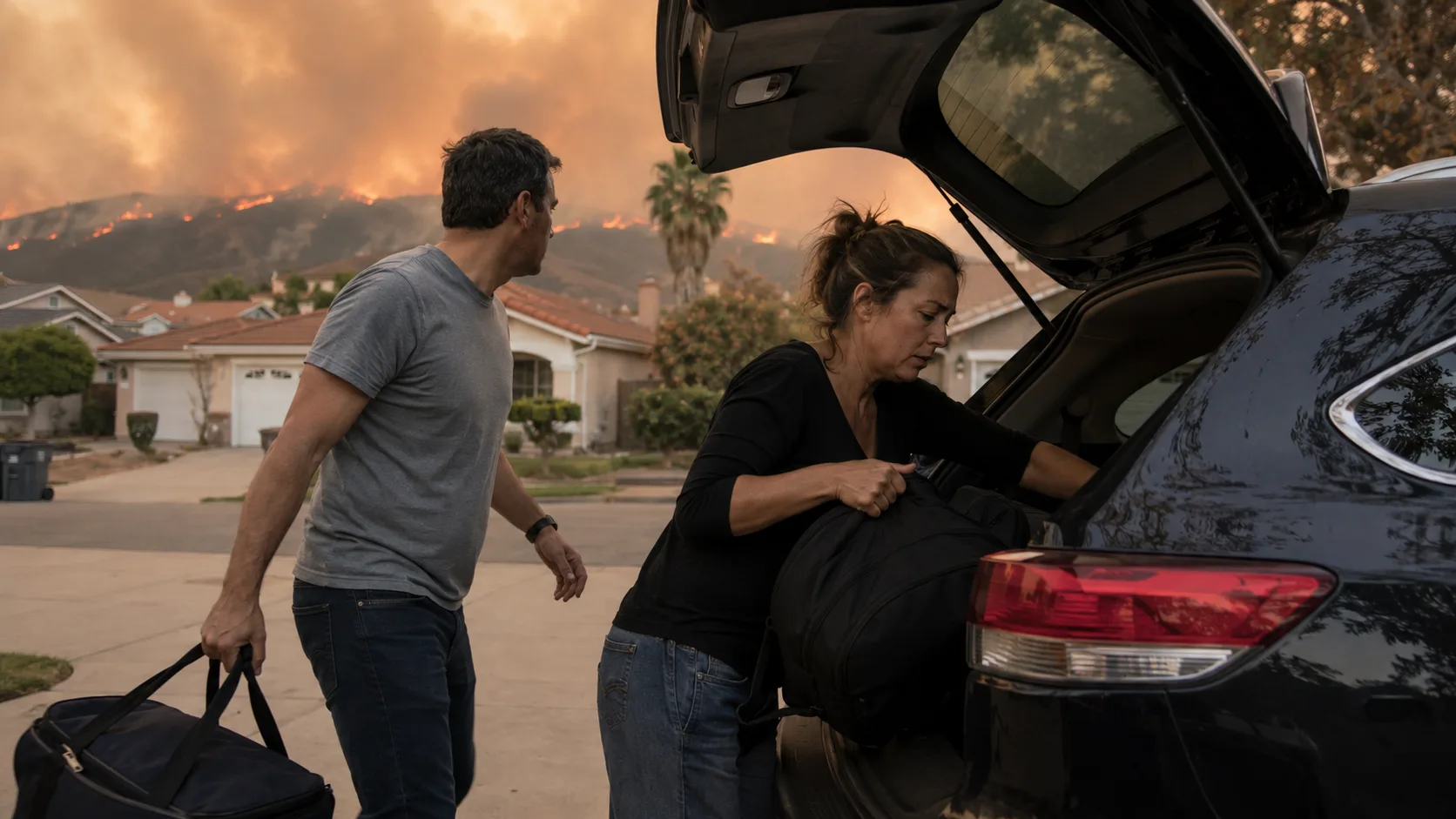
When authorities issue a mandatory evacuation order for your zone, leave without delay. The instinct to wait and watch, gather more items, or defend the home has cost many lives. Fires driven by wind can outrun vehicles on narrow mountain roads. Every minute of delay narrows your margin of safety.
Before leaving — if you have time, measured in minutes, not hours:
- Close all windows and doors (do not lock them — firefighters may need entry). Seal gaps at the bottom of doors with wet towels if available.
- Remove lightweight curtains and flammable window coverings from inside; move them to the center of the room
- Shut off your home's gas at the meter
- Move propane tanks, patio furniture, and wood piles away from the structure or into the garage
- Leave outdoor lights on so the structure is visible in smoke
- Leave a note on your door indicating you have evacuated and how many people and pets were in the home
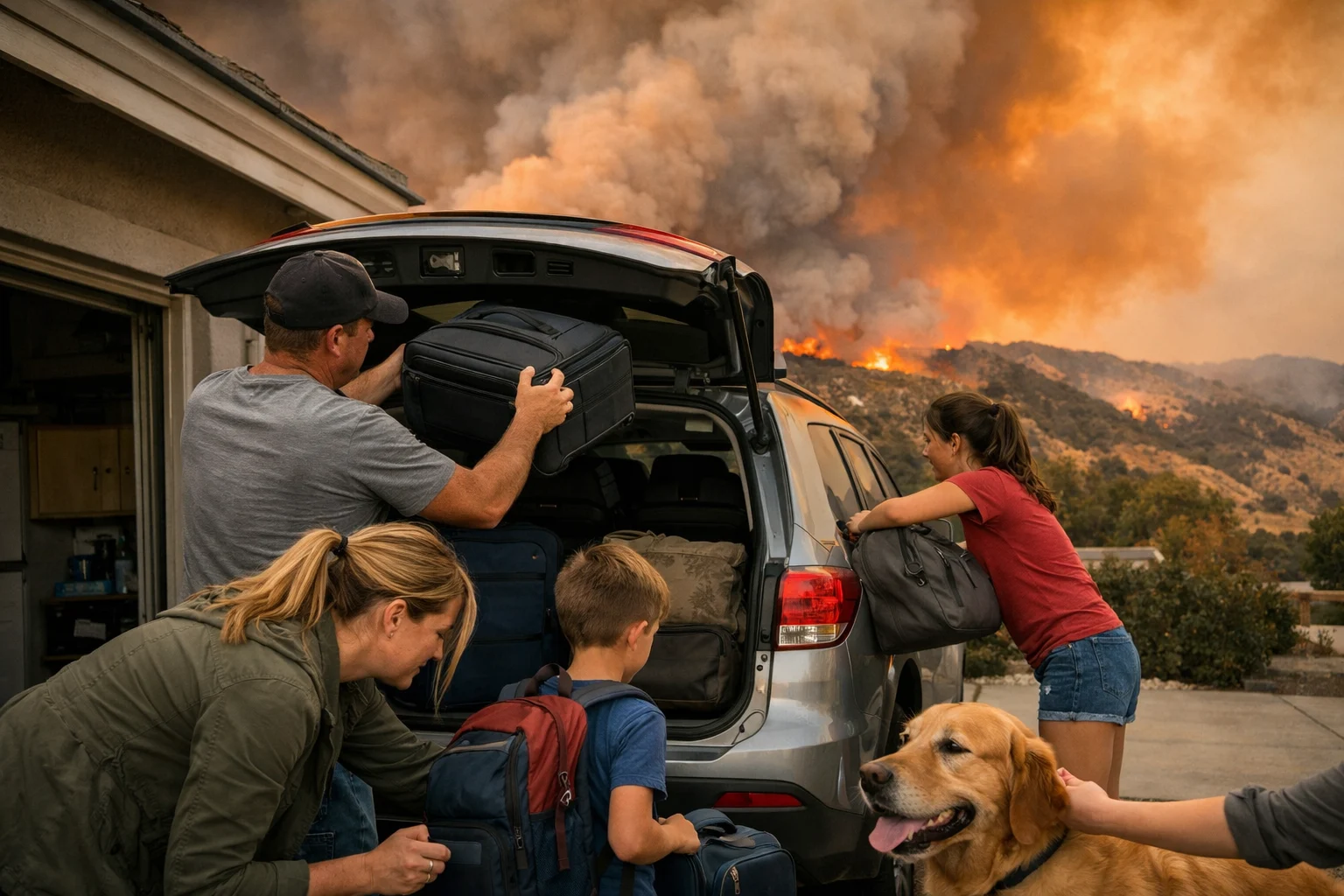
Load family members, pets, the go-bag, and any irreplaceable items (hard drives, heirloom photos) into your vehicle. Do not waste time with heavy furniture, televisions, or non-essentials.
During the Drive Out
Follow designated evacuation routes. Do not take shortcuts through unfamiliar roads — they may dead-end or run into the fire perimeter. Keep headlights on in smoke. If you encounter fire crossing the road ahead, do not drive through it — assess whether turning around is safe, or shelter in the vehicle as a last resort (windows up, vents off, stay below window level).
Monitor your county emergency alert system and Cal Fire, Oregon Department of Forestry, or applicable state agency social media accounts for real-time road closures and route changes.
Step 6: During Displacement — Stay Informed, Stay Safe
Once you have evacuated, the primary task is staying informed about the fire's status and your zone's evacuation order. Resist the urge to return early. Check your county OES or Sheriff's website for zone-by-zone order status — not social media rumors.
Register at your local evacuation shelter or with the American Red Cross Safe and Well registry so family members and emergency managers can confirm your safety. If you have pets, call ahead to identify pet-friendly shelters or animal evacuation facilities in your county — not all public shelters accept animals.
Document any damage to your property from a safe distance or via available drone or aerial imagery if permitted. Contact your homeowner's or renter's insurance company immediately to begin the claims process — policies often have specific notification timing requirements.
Step 7: Returning Home After the Fire
Return only when your specific evacuation zone order has been lifted by official authorities. An all-clear for a neighboring zone does not mean your zone is safe.
When returning, take these precautions seriously:
- Wear an N95 respirator — ash contains toxic combustion byproducts including heavy metals, asbestos from older structures, and benzene compounds
- Do not use tap water until the utility confirms the distribution system is uncontaminated — wildfires can introduce benzene and other volatile compounds into plastic water pipes
- Avoid disturbing ash — use wet methods (gentle spraying with water) rather than dry sweeping or blowing
- Check for structural damage before entering — look for cracks in the foundation, bowed walls, and damage to load-bearing elements; if in doubt, have a licensed contractor assess first
- Watch for hazard trees — fire-killed trees can fall without warning, including well after the fire; do not park or work under trees in the burn area
- Document everything — photograph all damage before beginning any cleanup; this documentation supports insurance claims and potential FEMA disaster assistance applications
Contact your county's local assistance center (often activated for major disaster events) for guidance on debris removal programs, utility reconnection, and rebuilding permits. For fires on or near land involving hazardous materials — including industrial sites, propane storage, or vehicles — refer to our Hazmat Hub for DOT classification reference and first-action guidance.
Special Considerations: Livestock and Large Animals
Evacuating horses, cattle, and other large animals requires advance planning that cannot be improvised under time pressure. Key steps include:
- Identify a destination for large animals — a boarding facility, fairground, or rural property outside the likely fire zone — and confirm capacity in advance
- Ensure your trailer is maintained and accessible; practice loading animals under non-emergency conditions so the process is familiar
- Mark animals with livestock paint or a permanent marker on their hooves with your contact number in case you must release them
- Register with your county's agricultural commissioner or livestock evacuation assistance program where available
Wildfire and Air Quality: Smoke Hazards Beyond the Fire Zone
Wildfire smoke affects areas far beyond the active evacuation zone. Fine particulate matter (PM2.5) from wildfire smoke is a serious respiratory hazard that can reach dangerous levels hundreds of miles from the fire perimeter. Sensitive populations — children, the elderly, and those with asthma, COPD, or heart disease — are at elevated risk.
Monitor air quality through AirNow.gov and the EPA's Air Quality Index (AQI). When AQI exceeds 150 (Unhealthy), limit outdoor activity and seal indoor air by closing windows and running HVAC systems with clean filters. When AQI exceeds 200 (Very Unhealthy), N95 masks are recommended for any outdoor exposure.
Building a Community-Level Preparedness Network
Individual family preparedness is more effective when embedded in a community network. Neighborhood-level preparation initiatives — such as NFPA's Firewise USA program and Ready, Set, Go! promoted by the International Association of Fire Chiefs — help communities coordinate defensible space work, share evacuation resources, and identify vulnerable neighbors who may need assistance.
Talk to your neighbors about your evacuation plans. Know who has mobility limitations, who has livestock, who has a trailer, and who may not receive emergency alerts. This informal network is often the difference between a neighbor being left behind and a neighbor getting out safely.
For firefighters and emergency responders who need structured operational reference during wildfire events, the Tools section on AllFirefighter includes calculators and reference tools for fire flow, shift scheduling, and hazardous material identification.

Comments 0
No comments yet. Be the first to share your thoughts!
Leave a Comment