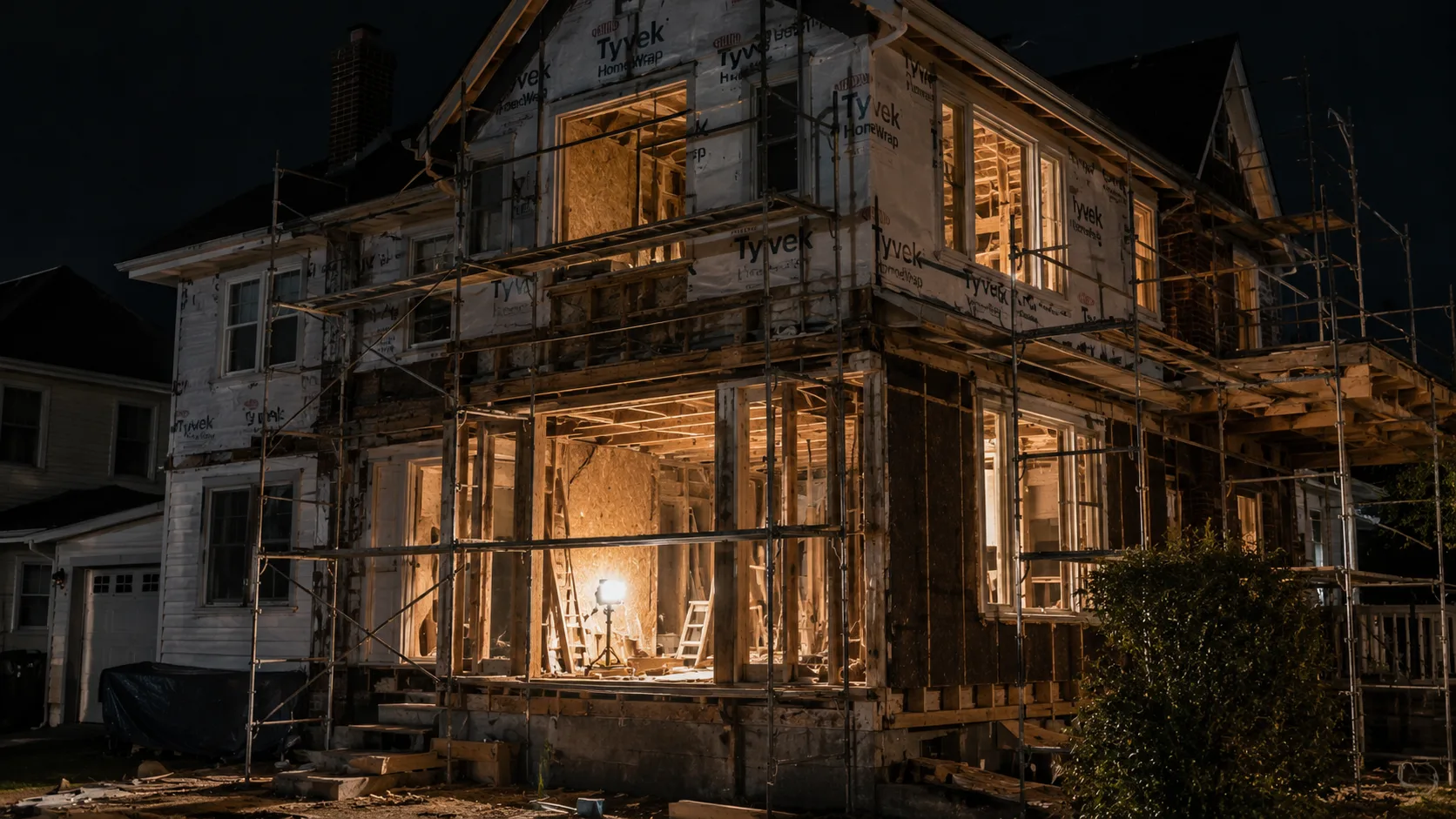

A home under renovation is a home with compromised fire protection. Walls are open. Detection systems may be disconnected. Egress paths are blocked by material. Workers are using tools that produce sparks, heat, and open flames. Flammable materials — adhesives, solvents, paints, fuels — are stored in quantities that would never be present in a finished house. The combination produces a fire risk environment that most homeowners are not thinking about when they are focused on the kitchen remodel or the bathroom addition.
Contractors know the hazards of their own operations. They are less reliably focused on the hazards their operations create for the household living in or adjacent to the work site. The information here is what you should be asking about and what you should be verifying — because the fire that starts at 11pm from improperly stored solvents does not care that the work was professionally done.
In this article:
- Removed drywall and lost compartmentalization
- Hot work: the biggest contractor-created fire hazard
- Detection gaps during renovation
- Temporary wiring and extension cord overloading
- Contractor material storage: what is acceptable
- Sawdust and combustible dust accumulation
- Permits and inspections as fire safety tools
- Requiring a fire watch from your contractor
- Renovation fire safety checklist
Removed Drywall and Lost Compartmentalization
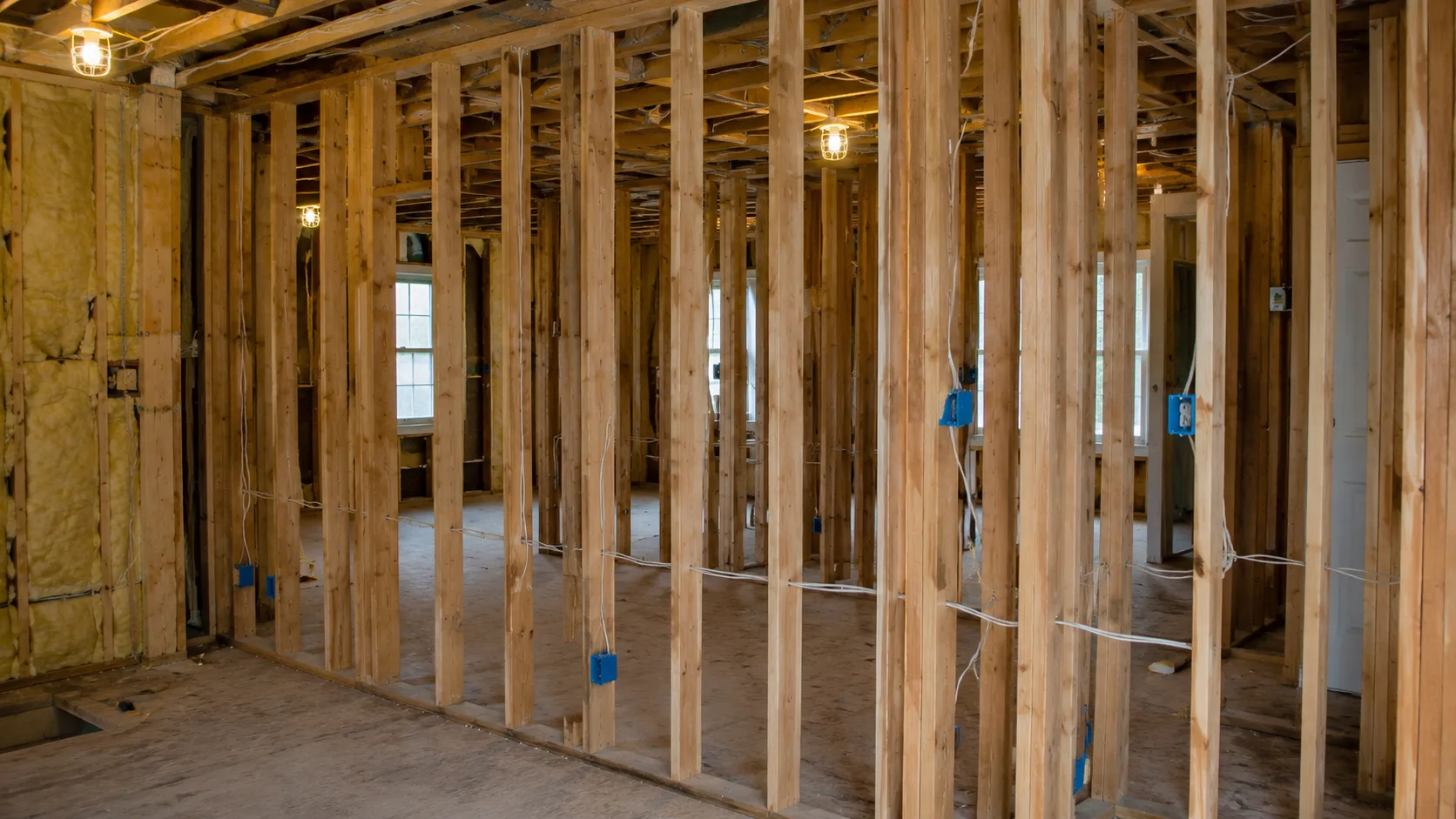
Drywall — gypsum board — is a fire-resistant material that provides compartmentalization: it slows the spread of fire from one space to another, buys time for evacuation, and limits the oxygen supply available to a fire in a given compartment. When walls are opened during renovation, that compartmentalization is gone. Stud bays become open channels from floor to floor, from the basement to the attic, from one room to an adjacent one.
A fire that starts in a room with open wall cavities does not behave like a fire in a finished house. It has pathways to spread vertically and horizontally through the structure that do not exist once the walls are closed. The speed of fire spread through an open-frame structure is significantly higher than through a finished one — which is relevant both to evacuation timing and to the amount of fire department response time that is available before the structure is untenable.
Code requires fire blocking — non-combustible material installed horizontally within stud bays at floor lines and at the tops and bottoms of stud walls — precisely to interrupt these pathways in new construction and during renovation. Your contractor is required to install fire blocking when walls are open. Ask specifically whether fire blocking will be installed and where, and verify it during your own walk-through of the open work area before new drywall goes up.
Hot Work: The Biggest Contractor-Created Fire Hazard
Hot work is any operation that produces open flame, sparks, or heat sufficient to ignite combustible material: welding, cutting with a torch, brazing, soldering, and grinding. These operations are performed routinely by plumbers, HVAC contractors, and structural workers. They are also the leading cause of contractor-originated fires in residential construction.
NFPA 51B — the standard for fire prevention during welding, cutting, and other hot work — requires that all combustible material within 35 feet of hot work operations be cleared or covered with non-combustible shields, that a fire watch be maintained during and for 30 minutes after hot work is complete, and that the area be reinspected 30 minutes after that. The 30-minute fire watch requirement exists because many hot work fires do not ignite immediately — they smolder in insulation, wood framing, or sawdust accumulation for minutes before becoming visible flames.
A contractor who performs a torch soldering operation on your new copper plumbing and immediately moves to the next task — without a fire watch — has left you with a smoldering fire risk in your wall cavity that may not become a visible fire for another 20 minutes. By that point, the contractor's van may be two miles away and the fire may be in the insulation between the bathroom wall and the adjacent bedroom. Ask your contractor specifically about their hot work protocol before any torch or grinding work begins.
Detection Gaps During Renovation
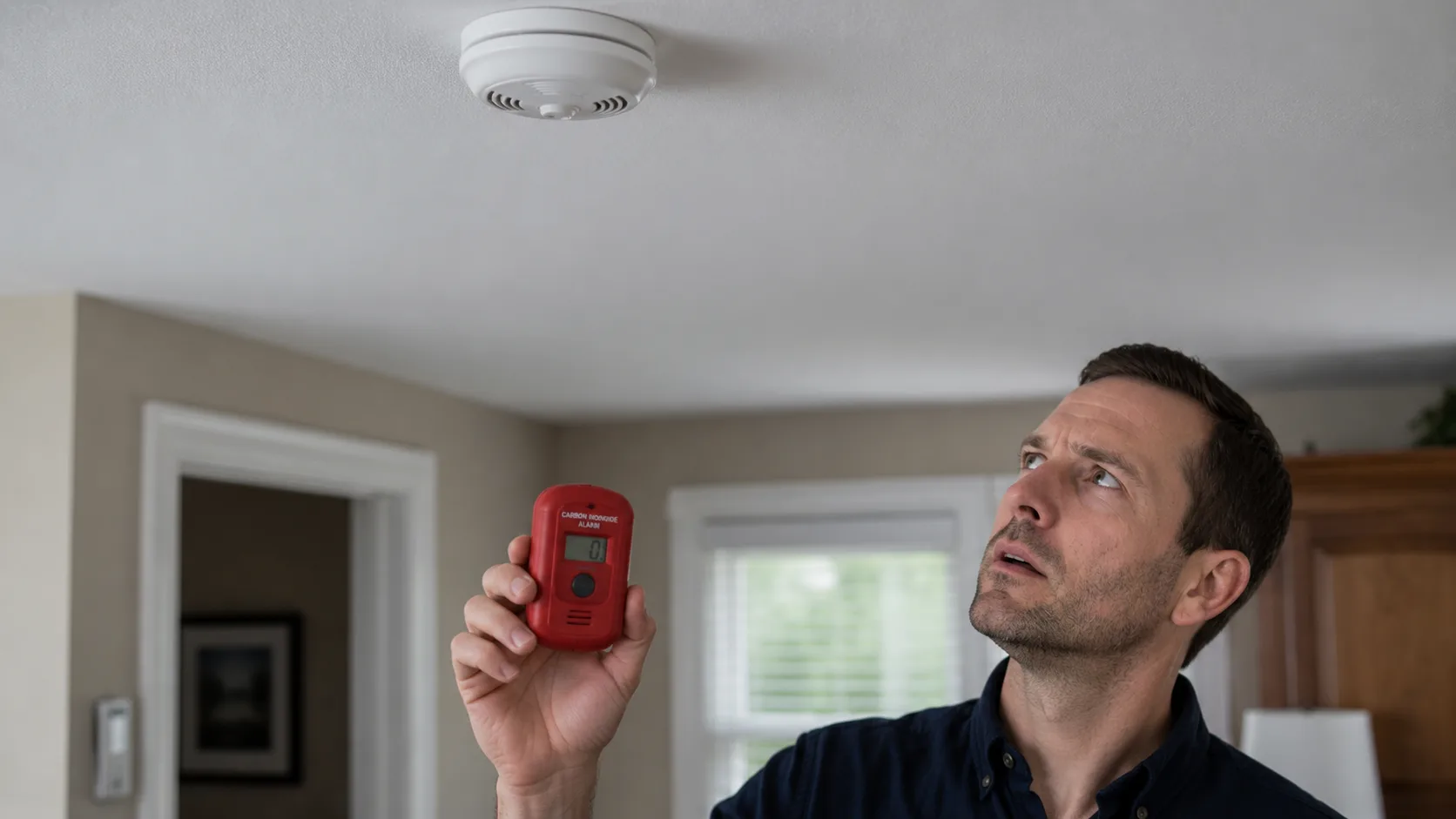
Smoke detectors are sometimes disconnected during renovation — to prevent nuisance alarms from dust, sawdust, and construction fumes that would otherwise trigger them repeatedly during the workday. This is understandable from a workflow standpoint and completely unacceptable from a fire safety standpoint. A disconnected smoke detector during a period when hot work, power tools, and flammable materials are all present is a detector removed from the environment that most needs it.
If detectors must be covered or temporarily moved to prevent nuisance alarms — which is sometimes necessary with dusty demolition work — they should be uncovered and restored to operational condition at the end of each workday. Work should not continue into the evening with detectors offline. At minimum, a battery-operated standalone detector should be placed in each area where detectors have been disabled, providing coverage during work hours.
The renovation may also physically separate detectors from the areas they protect. A detector mounted in a hallway may have its coverage path blocked by temporary walls or work barriers. A coverage gap assessment — walking the renovation area and identifying which spaces are not currently protected by a working detector — should be done at the start of the project and maintained throughout.
Temporary Wiring and Extension Cord Overloading
Construction sites run on extension cords. Multiple power tools, compressors, lights, and chargers all drawing from the same extension cords — which may be running through water, under foot traffic, stapled to surfaces, and bundled together in ways that cause heat buildup. Extension cord fires in residential renovation are a documented category of ignition that receives relatively little attention compared to hot work but occurs at significant rates.
The specific hazards: extension cords not rated for the combined wattage load they are carrying, cords with damaged insulation running through abrasive environments, cords coiled under load (coiling prevents heat dissipation), and cords that are tripped over or pinched under doors or material, creating damage that is not visible on the cord exterior. A 14-gauge extension cord rated for 15 amps running three 15-amp tools simultaneously is overloaded. The insulation heats, eventually fails, and ignites adjacent material.
Require your contractor to use extension cords rated for the load they are carrying, to inspect cords daily for damage, to replace any cord with visible damage immediately, and to not coil cords under load. At the end of each workday, all extension cords should be unplugged from the power source — not left energized overnight in a space with combustible material and no one present.
Contractor Material Storage: What Is Acceptable
Renovation projects involve significant quantities of flammable and combustible materials: paints, stains, lacquers, paint thinners, adhesives, spray foam, and cleaning solvents. These are legitimate materials for the job. Where and how they are stored overnight and over weekends is a fire safety issue that most homeowners never ask about.
The concerns: flammable liquids stored in quantities exceeding what can be safely handled in a residential setting, materials stored near ignition sources (water heaters, furnaces, electrical panels), and containers that are not properly sealed when not in use. A contractor who leaves an open gallon of lacquer thinner next to the gas water heater at the end of Friday afternoon has created a potentially serious ignition scenario for the weekend when no one is present and the water heater cycles on.
Require contractors to store flammable materials in approved containers with tight-sealing lids, away from ignition sources, and to remove excessive quantities from the premises at the end of each workday. What is needed for the next day's work can remain on site; the balance should go back to the supplier or the contractor's vehicle.
Sawdust and Combustible Dust Accumulation
Wood dust — the fine airborne fraction produced by power saws, sanders, and routers — is an explosion hazard at sufficient concentrations in air. This is the industrial hazard addressed by OSHA's combustible dust standards. In a residential renovation context, the risk level is lower because the quantities of dust generated are smaller and spaces are typically ventilated. But sawdust accumulation on surfaces — particularly near electrical panels, near hot work areas, and in spaces with any open flame — creates a fire ignition scenario that is more immediate than dust clouds.
A thick layer of sawdust on the floor near an electrical panel, near a water heater, or in the area where a contractor is about to perform torch work is a hazard. The contractor's responsibility is to keep the work area clear of combustible dust accumulation before performing any hot work and at the end of each workday. Ask whether their cleanup protocol addresses this specifically before work begins.
Permits and Inspections as Fire Safety Tools
Building permits and the inspections that accompany them are widely perceived as bureaucratic overhead. From a fire safety standpoint, they serve a specific function: a building inspector verifying that electrical work has been done correctly, that fire blocking is installed where required, and that HVAC connections are properly made is providing a fire safety check that no homeowner has the expertise to perform independently.
Renovation work performed without required permits — and this includes work done by licensed contractors who skip the permit process to avoid fees or delays — is work that has not been inspected for code compliance. Code compliance in renovation work directly addresses fire spread paths, electrical fire risks, and detection system integrity. A contractor who suggests skipping the permit to save time and money is suggesting skipping the fire safety review that the permit process provides.
Requiring a Fire Watch from Your Contractor
A fire watch is a person assigned specifically to monitor for fire during and after hot work operations — not performing other tasks, not answering the phone, but watching the work area and adjacent areas for smoke, heat, or flame. NFPA 51B specifies what this involves. In commercial construction, fire watches are a standard contractual requirement. In residential renovation, they are rarely discussed.
Include a fire watch requirement in your contract for any renovation that involves torch work, welding, or grinding. The specific language: any hot work requires a designated fire watch for the duration of the work and for 30 minutes after completion, with a final inspection of the work area and all adjacent spaces at 30 minutes after the watch. The fire watch cannot be the same person performing the hot work. If your contractor balks at this requirement, ask why a reasonable fire safety standard is not in their normal protocol.
Renovation Fire Safety Checklist
- ✓Confirm fire blocking will be installed where walls are opened — verify it before new drywall is applied.
- ✓Ask specifically about the hot work protocol — who performs the fire watch, for how long, and what they check.
- ✓Verify smoke detectors are operational at the end of each workday — any disconnected for dust prevention must be restored before the contractor leaves.
- ✓Require all extension cords to be unplugged at day's end — no energized cords overnight in unoccupied work areas.
- ✓Pull required permits for all work — inspections are fire safety checks.
- ✓Require flammable materials to be stored properly — sealed containers, away from ignition sources, excessive quantities removed from site daily.
- ✓Inspect sawdust accumulation areas before hot work — require cleanup before torch or grinding operations.
- ✗Do not allow hot work without a pre-agreed fire watch protocol.
- ✗Do not accept disconnected smoke detectors as an overnight condition.
- ✗Do not skip permits to save time — they provide fire safety inspections you cannot perform yourself.

Comments 0
No comments yet. Be the first to share your thoughts!
Leave a Comment